
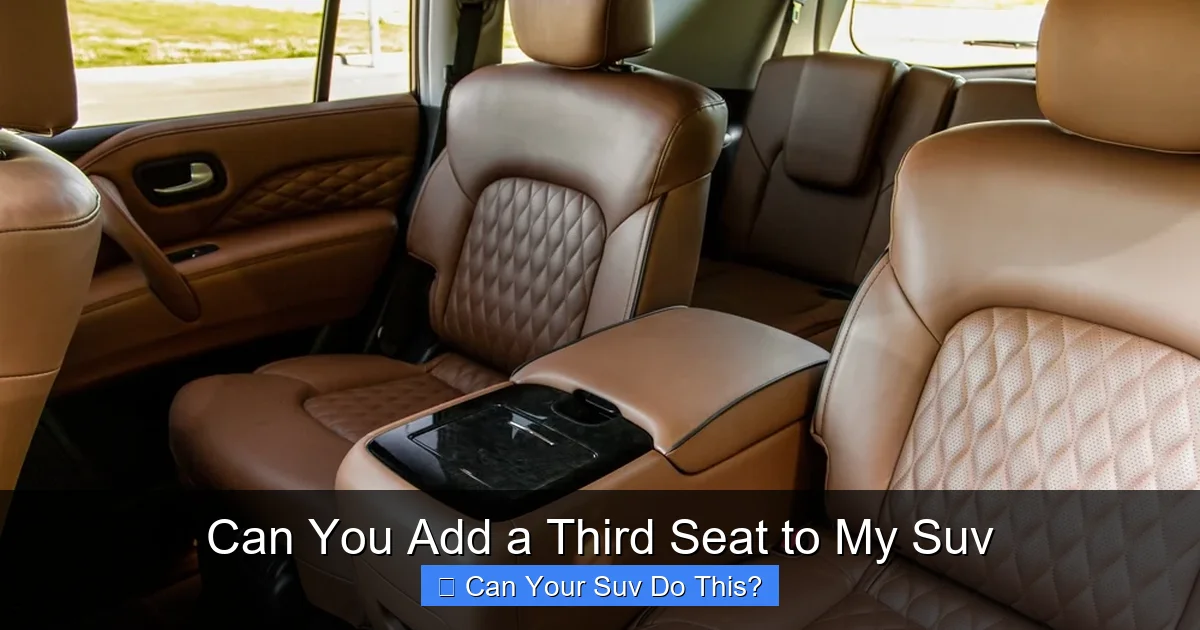
Adding a third seat to your SUV isn’t always as simple as it sounds—but it’s not impossible. Whether you’re hauling kids, gear, or guests, understanding your vehicle’s design, safety standards, and modification options is key. This guide breaks down everything you need to know about expanding your SUV’s seating capacity safely and legally.
Key Takeaways
- Not all SUVs can safely accommodate a third seat: Structural design, floor space, and safety systems determine feasibility.
- Factory-installed third rows are safest and most reliable: If your SUV wasn’t built with one, retrofitting carries risks.
- Aftermarket modifications are limited and often illegal: Most states prohibit unauthorized seat installations due to safety concerns.
- Cargo-to-passenger conversions require professional evaluation: Floor reinforcement, seatbelt integration, and crash testing are essential.
- Consider alternatives like roof racks or trailers: For occasional extra passengers, these may be safer and more practical.
- Check your vehicle’s owner’s manual and VIN specs: These reveal original seating capacity and modification warnings.
- Consult certified mechanics or OEM dealers: They can advise on safe, legal ways to maximize seating without compromising safety.
📑 Table of Contents
- Can You Add a Third Seat to My SUV? The Real Answer
- Why People Want a Third Seat in Their SUV
- Can You Legally and Safely Add a Third Seat?
- Which SUVs Can Actually Support a Third Seat?
- Aftermarket Options: What’s Available and What’s Not
- Safer Alternatives to Adding a Third Seat
- What to Do If You’re Set on Modifying Your SUV
- Final Thoughts: Is It Worth It?
Can You Add a Third Seat to My SUV? The Real Answer
So, you’ve got an SUV—maybe a midsize like a Toyota Highlander or a Ford Explorer—and you’re wondering, “Can you add a third seat to my SUV?” It’s a common question, especially for families on the go, weekend adventurers, or anyone who suddenly finds themselves needing to squeeze in one more passenger. The short answer? Maybe. But it’s not as simple as bolting in a couple of chairs and calling it a day.
SUVs come in all shapes and sizes, and their seating capacity is carefully engineered from the ground up. Manufacturers design vehicles with specific weight limits, structural integrity, and safety systems in mind. Adding a third row—or even a single extra seat—can affect everything from crash performance to braking efficiency. That’s why it’s crucial to understand what your SUV was originally built for before making any changes.
In this guide, we’ll walk you through the possibilities, limitations, and smart alternatives when it comes to expanding your SUV’s seating. Whether you’re driving a compact crossover or a full-size hauler, we’ll help you figure out if adding that third seat is a safe, legal, and practical move—or if you’re better off exploring other options.
Why People Want a Third Seat in Their SUV
Visual guide about Can You Add a Third Seat to My Suv
Image source: static.carsdn.co
Let’s be honest—nobody buys an SUV just for the looks. We want space. We want versatility. And when life throws us curveballs—like carpooling three kids instead of two, or inviting a friend on a road trip—we suddenly wish we had that extra row of seats.
The demand for third-row seating has skyrocketed over the past decade. According to industry reports, over 60% of new SUV buyers now consider third-row availability a top priority. Families with multiple children, multigenerational households, and even pet owners (yes, some people want to bring the dog along too) are driving this trend.
But here’s the catch: not every SUV is built to handle seven or eight passengers. Compact and midsize models like the Honda CR-V, Mazda CX-5, or Subaru Forester typically max out at five seats. Even some larger SUVs, like the Nissan Murano or Hyundai Santa Fe, only offer five seats unless you opt for a specific trim with an optional third row.
So why not just add one yourself? After all, you can buy aftermarket seats online, right? Well, it’s not that simple. Safety regulations, vehicle warranties, and structural limitations make DIY seat additions risky—and often illegal.
The Emotional Pull of Extra Seating
There’s something deeply satisfying about being the “go-to” driver for group outings. Whether it’s school pickup, soccer practice, or a weekend camping trip, having that extra seat means you’re the one everyone counts on. It’s not just about convenience—it’s about connection.
But that emotional desire can sometimes cloud judgment. We’ve all seen those viral videos of people cramming six kids into a five-seater SUV with blankets and hope. It might work for a quick trip around the block, but it’s a dangerous gamble when highways and sudden stops are involved.
That’s why it’s important to balance your needs with reality. Yes, you want to help your friends or family. But you also want everyone to get home safely.
Practical Scenarios That Call for a Third Seat
Let’s look at some real-life situations where a third seat would be a game-changer:
– **Carpooling with three kids instead of two:** One week, it’s just your two and a friend. The next, a cousin joins in. Suddenly, you’re one seat short.
– **Grandparents visiting:** Your parents come to town for the holidays, and now you’ve got five people to shuttle around—plus luggage.
– **Pet transportation:** You’re taking the dog to the vet, but your partner needs the car. Now you’ve got a person, a dog, and two kids to fit.
– **Work or volunteer groups:** You’re coordinating a community cleanup or a team-building event, and you’re the only one with a vehicle big enough to help.
In each of these cases, a third seat would solve the problem. But before you start shopping for aftermarket parts, let’s dig into what’s actually possible.
Can You Legally and Safely Add a Third Seat?
This is the million-dollar question: Can you add a third seat to my SUV without breaking the law or risking lives? The answer depends on several factors, including your vehicle’s make and model, its original design, and local regulations.
Factory vs. Aftermarket: The Safety Divide
The safest and most reliable way to have a third row is if your SUV came with one from the factory. Vehicles like the Chevrolet Tahoe, Ford Expedition, or Kia Telluride are built with reinforced floors, additional airbags, and seatbelt systems designed for seven or eight passengers.
When a third row is factory-installed, every component—from the seat frames to the seatbelt anchors—is crash-tested and certified to meet federal safety standards. That means in the event of a collision, the seats are designed to protect occupants and not become dangerous projectiles.
But if your SUV wasn’t built with a third row, adding one later is a completely different story. Aftermarket seat installations are rarely approved by the National Highway Traffic Safety Administration (NHTSA) or the vehicle manufacturer. In fact, most automakers explicitly warn against modifying seating configurations.
Structural and Safety Concerns
SUVs are engineered as complete systems. The floor pan, roof supports, suspension, and braking system are all designed to handle a specific weight distribution and passenger load. Adding a third seat—especially in the cargo area—can throw this balance off in dangerous ways.
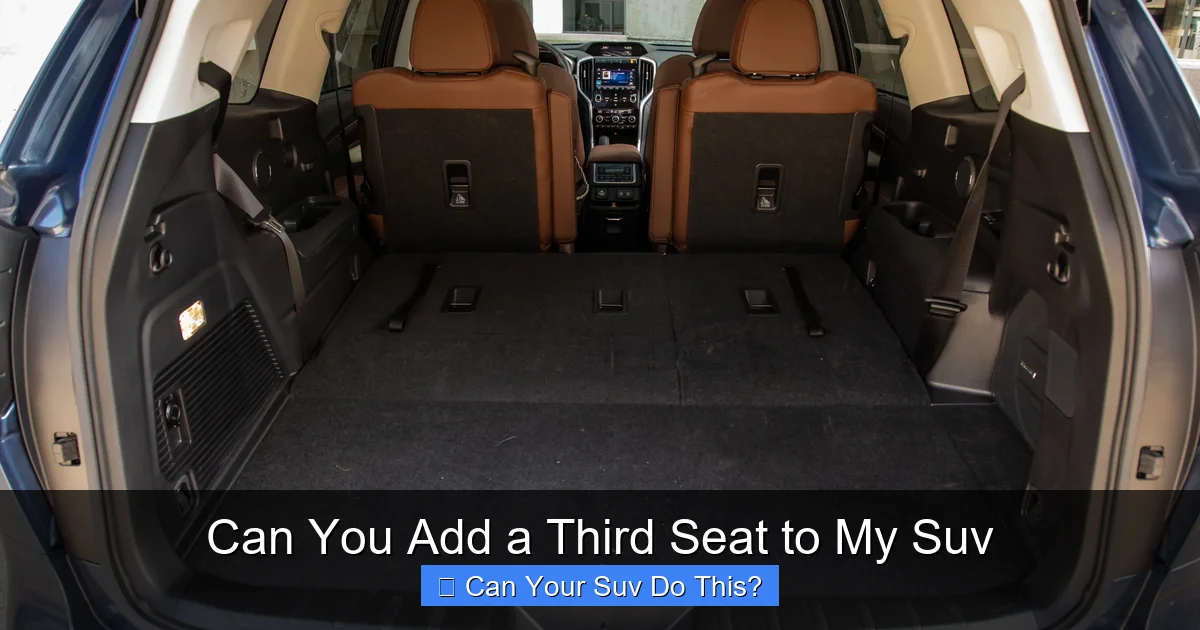
For example, placing seats in the rear cargo area often means mounting them on a flat surface not designed to handle the forces of a crash. In a rear-end collision, an improperly anchored seat can collapse, injuring passengers or blocking exits.
Additionally, seatbelts must be properly anchored to the vehicle’s frame. Most cargo areas lack the reinforced anchor points needed for safe seatbelt installation. Using makeshift anchors or bolting into weak spots can lead to catastrophic failure during an accident.
Legal and Warranty Implications
Even if you manage to install a third seat safely, you could be breaking the law. Most states require that all passenger seats meet federal motor vehicle safety standards (FMVSS). Unapproved modifications can result in fines, failed inspections, or even liability in the event of an accident.
Moreover, altering your vehicle’s seating can void your warranty. Manufacturers often include clauses that void coverage if unauthorized modifications are made. So if your transmission fails a year later, and they discover you added a third row, you might be stuck with the bill.
Which SUVs Can Actually Support a Third Seat?
Not all SUVs are created equal when it comes to seating capacity. Some are built from the ground up to handle seven or eight passengers, while others simply don’t have the space or structure to support a third row.
SUVs That Come with Optional Third Rows
Many midsize and full-size SUVs offer third-row seating as an option or standard feature. These vehicles are designed with the necessary space, structural support, and safety systems in place. Examples include:
– **Toyota Highlander:** Available with a third row that seats up to eight passengers.
– **Honda Pilot:** Offers a spacious third row with easy access via a sliding second row.
– **Ford Explorer:** Comes with a third row in most trims, though it’s best for smaller passengers.
– **Kia Sorento:** A midsize SUV with an optional third row that’s great for kids or short trips.
– **Chevrolet Traverse:** One of the roomiest third rows in its class, comfortably seating adults.
If you’re shopping for an SUV and third-row seating is a priority, these models are excellent choices. But what if you already own an SUV that doesn’t have a third row?
SUVs That Can’t Safely Add a Third Seat
Compact and subcompact SUVs like the Nissan Rogue, Hyundai Tucson, or Jeep Cherokee are not designed for third-row seating. Their shorter wheelbases, smaller cargo areas, and lighter frames make retrofitting nearly impossible without major structural changes.
Even some larger SUVs, like the Ford Edge or Volkswagen Atlas Cross Sport, are built as five-seaters with no third-row option. Attempting to add seats in these vehicles would require cutting into the floor, reinforcing the chassis, and installing new safety systems—all of which are cost-prohibitive and potentially unsafe.
Gray Area: Vehicles with Modification Potential
There are a few exceptions. Some older SUVs or commercial-style vehicles, like the Ford Excursion or Chevrolet Suburban, have been modified by specialty shops to add extra seating. These conversions are typically done by certified upfitters and involve extensive engineering.
For example, a company might convert a five-seat SUV into a seven-seater by extending the wheelbase, reinforcing the frame, and installing certified seats and seatbelts. However, these modifications can cost $10,000 or more and may still not meet modern safety standards.
Aftermarket Options: What’s Available and What’s Not
So, what if you’re determined to add a third seat? Are there any aftermarket solutions that are safe and legal?
Aftermarket Seat Kits: Rare and Risky
A quick search online might turn up “third-row seat kits” for popular SUVs. These kits often include seat frames, cushions, and mounting hardware. But buyer beware: most of these products are not approved by the NHTSA or the vehicle manufacturer.
In fact, the NHTSA has issued warnings about aftermarket seat installations, stating that they “may not provide adequate protection in a crash” and “could increase the risk of injury.”
Even if a kit claims to be “bolt-in” or “easy to install,” it likely doesn’t account for critical factors like seatbelt anchoring, airbag deployment zones, or crash energy absorption.
Professional Upfitters: A Limited Solution
Some specialty shops offer custom seating conversions for SUVs. These companies often work with fleet operators, emergency services, or luxury vehicle owners who need extra seating.
For example, a company might convert a Ford Explorer into a seven-seater by installing a fold-flat third row in the cargo area. These conversions are typically done with certified parts and include professional installation.
However, these services are expensive—often costing $5,000 to $15,000—and may still not be legal for everyday passenger use. Additionally, insurance companies may refuse to cover vehicles with unapproved modifications.
DIY Modifications: A Dangerous Gamble
We’ve all seen the YouTube videos: someone bolts a couple of lawn chairs into their SUV’s cargo area and calls it a day. While it might look like a quick fix, it’s one of the most dangerous things you can do.
Lawn chairs aren’t designed for vehicle use. They lack proper seatbelts, side supports, and crash protection. In a sudden stop or collision, passengers could be thrown forward, crushed, or ejected from the vehicle.
Even if you use actual car seats, mounting them improperly can lead to failure. Seatbelts must be anchored to the vehicle’s frame, not the floor or seat rails. Without proper reinforcement, the entire seat can detach during an accident.
Safer Alternatives to Adding a Third Seat
If adding a third seat isn’t safe or legal, what are your options? Fortunately, there are several practical alternatives that can help you transport more people or gear without compromising safety.
Upgrade to a Larger SUV
The most straightforward solution is to trade in your current SUV for one that already has a third row. If you’re due for a vehicle upgrade anyway, this might be the perfect time.
Look for models like the Toyota Sequoia, Ford Expedition MAX, or GMC Yukon XL, which offer spacious third rows and ample cargo space. Many of these vehicles also come with advanced safety features, towing capacity, and modern infotainment systems.
While this option involves a financial investment, it’s the safest and most reliable way to get the seating you need.
Use a Trailer or Cargo Carrier
If you only need extra space occasionally, consider using a trailer or roof-mounted cargo carrier. These accessories allow you to transport gear, pets, or even small passengers (in approved child trailers) without modifying your vehicle.
For example, a lightweight utility trailer can carry camping gear, coolers, or luggage, freeing up interior space for passengers. Roof racks can hold bikes, kayaks, or storage boxes, keeping the cabin clear.
Just make sure your SUV is rated for towing and that you follow all safety guidelines when attaching and loading trailers.
Rent a Larger Vehicle
For one-time events like family reunions, weddings, or road trips, renting a larger SUV or minivan might be the best choice. Companies like Enterprise, Hertz, and Turo offer seven- and eight-passenger vehicles at reasonable rates.
This option gives you the flexibility to use a third-row vehicle when needed, without the long-term commitment of ownership. Plus, you won’t have to worry about modifications, insurance, or depreciation.
Coordinate Carpooling or Rideshares
Sometimes, the simplest solution is to share the load. If you’re regularly transporting a group, consider rotating drivers or using rideshare apps like Uber or Lyft for extra passengers.
This approach reduces wear and tear on your vehicle, saves fuel, and ensures everyone travels safely in a properly equipped car.
What to Do If You’re Set on Modifying Your SUV
If you’re still determined to add a third seat, proceed with extreme caution. Here’s a step-by-step guide to doing it as safely as possible.
Step 1: Consult Your Owner’s Manual
Start by checking your vehicle’s owner’s manual. Look for sections on seating capacity, modification warnings, and cargo area usage. Most manuals explicitly state that adding seats is not recommended.
You can also use your VIN (Vehicle Identification Number) to look up your SUV’s original specifications online. This will tell you how many seats it was designed for and whether any factory third-row options were available.
Step 2: Talk to a Certified Mechanic or Dealer
Visit a dealership or certified mechanic who specializes in your vehicle’s make and model. Ask them directly: “Can you add a third seat to my SUV?” Be honest about your intentions.
A professional can assess your vehicle’s structure, recommend safe modifications (if any), and warn you about potential risks. They may also be able to connect you with authorized upfitters or suggest alternative solutions.
Step 3: Research Local Laws and Regulations
Contact your state’s Department of Motor Vehicles (DMV) or transportation agency to learn about laws regarding vehicle modifications. Some states require inspections for any changes to seating or safety systems.
You may also need to notify your insurance company. Failure to disclose modifications could result in denied claims or policy cancellation.
Step 4: Consider Professional Conversion Services
If a safe, legal modification is possible, work with a certified upfitter who has experience with your vehicle type. Ask for references, certifications, and proof of compliance with safety standards.
Be prepared for a high cost and a long wait time. These services are not quick fixes—they require careful planning and execution.
Step 5: Test and Inspect Regularly
If you proceed with a modification, inspect the seats, seatbelts, and mounting points regularly. Look for signs of wear, loosening bolts, or structural damage.
Never exceed the vehicle’s gross vehicle weight rating (GVWR). Overloading can damage the suspension, brakes, and tires, and increase the risk of accidents.
Final Thoughts: Is It Worth It?
So, can you add a third seat to my SUV? The honest answer is: it depends. For most drivers, the risks outweigh the benefits. Factory-installed third rows are the safest and most reliable option, and aftermarket modifications are often unsafe, illegal, or prohibitively expensive.
Instead of trying to force your current SUV to do something it wasn’t designed for, consider upgrading to a larger model, using a trailer, or renting when needed. These alternatives are safer, more practical, and better for your peace of mind.
Remember, your SUV is more than just a vehicle—it’s a lifeline for your family, your adventures, and your daily routine. Don’t compromise its integrity for the sake of an extra seat. Make smart choices, prioritize safety, and enjoy the ride.
Frequently Asked Questions
Can I legally add a third seat to my SUV?
In most cases, no. Adding a third seat without factory approval violates federal safety standards and state laws. Unauthorized modifications can result in fines, failed inspections, or liability in accidents.
Are aftermarket third-row seat kits safe?
Generally, no. Most aftermarket kits are not crash-tested or approved by the NHTSA. They may lack proper seatbelt anchors and structural support, increasing injury risk in a collision.
What SUVs can be modified to add a third seat?
Very few. Only certain full-size or commercial-style SUVs with reinforced frames may be candidates for professional conversion. Even then, modifications are expensive and may not meet safety standards.
Will adding a third seat void my warranty?
Yes, in most cases. Vehicle manufacturers typically void warranties if unauthorized modifications are made. Check your warranty terms before making any changes.
Can I put seats in the cargo area of my SUV?
It’s not recommended. Cargo areas aren’t designed for passenger seating and lack proper seatbelt anchors, airbag coverage, and crash protection.
What’s the safest way to transport more than five people?
The safest option is to use a vehicle factory-equipped with a third row. Alternatively, rent a larger SUV or minivan, or coordinate carpooling with other drivers.