
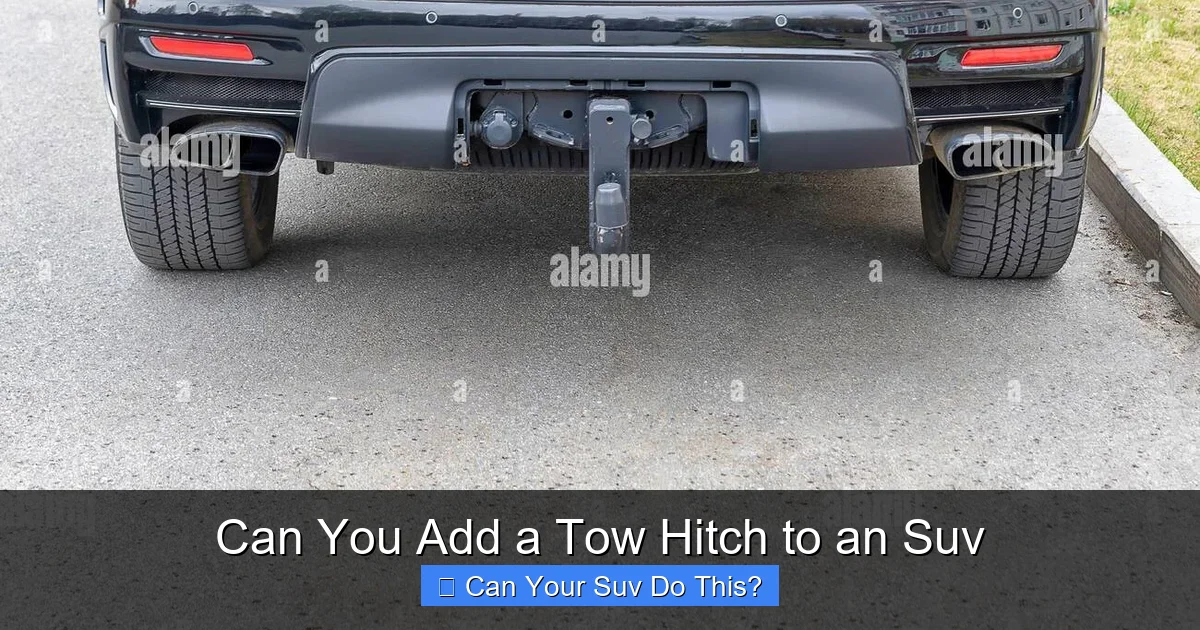
Yes, you can add a tow hitch to most SUVs, but success depends on your vehicle’s make, model, and factory specs. Proper installation and matching the hitch to your SUV’s towing capacity ensures safe and effective towing for trailers, campers, or gear.
So, you’ve got an SUV—maybe it’s a rugged Ford Explorer, a sleek Toyota Highlander, or a compact Honda CR-V—and you’re eyeing that shiny new camper, a utility trailer full of landscaping gear, or even a small boat. You’re wondering: *Can you add a tow hitch to an SUV?* The short answer? **Absolutely.** But like most things in life, it’s not quite that simple. The real answer depends on your vehicle, your towing goals, and how much you’re willing to invest in the setup.
SUVs are built for versatility. They’re the Swiss Army knives of the automotive world—great for school runs, weekend adventures, and yes, towing. But not all SUVs are created equal when it comes to hauling power. Some come from the factory ready to tow, complete with integrated hitches and cooling systems. Others need a little help. That’s where the tow hitch comes in. Adding a tow hitch to your SUV opens up a world of possibilities, from weekend camping trips to moving furniture or hauling ATVs. But before you rush out and buy the first hitch you see, it’s important to understand what’s involved—and what could go wrong if you skip the basics.
In this guide, we’ll walk you through everything you need to know about adding a tow hitch to your SUV. We’ll cover compatibility, types of hitches, installation options, safety tips, and even how to maintain your setup for years of reliable use. Whether you’re a first-time tower or a seasoned hauler, this article will help you make smart, safe decisions. So grab a notebook, and let’s get towing.
Key Takeaways
- Most SUVs can be fitted with a tow hitch: Whether compact or full-size, nearly all SUVs have aftermarket or OEM hitch options available.
- Check your SUV’s towing capacity first: Never exceed the manufacturer’s recommended towing limit—this is critical for safety and warranty compliance.
- Choose the right hitch class: Hitches range from Class I (light-duty) to Class V (heavy-duty); match the class to your towing needs.
- Professional installation is recommended: While DIY is possible, improper installation can damage your SUV or create safety hazards.
- Consider wiring and brake controllers: For trailers with lights or brakes, you’ll need a wiring harness and possibly a brake controller.
- Factory vs. aftermarket hitches: OEM hitches often integrate better, but aftermarket options can be more affordable and versatile.
- Regular maintenance matters: Inspect your hitch, bolts, and connections before every tow to prevent accidents.
📑 Table of Contents
Understanding Tow Hitches and SUV Compatibility
Before you even think about bolting a hitch to your SUV, you need to understand what a tow hitch actually does—and whether your vehicle can handle it. A tow hitch is a device attached to the frame of your vehicle that allows you to connect and tow another object, like a trailer, camper, or boat. It’s not just a piece of metal; it’s a critical safety component that transfers the weight and force of the load to your SUV’s chassis.
Not every SUV is designed to tow heavy loads. Some are built more for city driving and light cargo, while others are engineered for serious hauling. That’s why the first step in adding a tow hitch is checking your SUV’s **towing capacity**. This number, provided by the manufacturer, tells you the maximum weight your vehicle can safely tow. It’s usually found in the owner’s manual or on the manufacturer’s website. For example, a 2023 Subaru Outback has a towing capacity of 2,700 to 3,500 pounds depending on the engine, while a Ford Expedition can tow up to 9,300 pounds.
But here’s the catch: **just because you can add a hitch doesn’t mean you should tow to the max.** Your SUV’s suspension, brakes, transmission, and cooling system all play a role in safe towing. Overloading your vehicle can lead to overheating, brake failure, or even structural damage. So even if your SUV technically supports a hitch, you need to match your towing needs to its capabilities.
Another factor is **factory preparation**. Some SUVs come with pre-wiring for trailer lights, reinforced frames, or even integrated trailer sway control. These features make adding a hitch easier and safer. For instance, the Jeep Grand Cherokee often includes a trailer tow package that simplifies installation. If your SUV wasn’t built with towing in mind, you might need additional components like a transmission cooler or upgraded brakes.
Do All SUVs Support Tow Hitches?
The good news? **Yes, the vast majority of SUVs can be fitted with a tow hitch.** Whether you drive a compact crossover like the Mazda CX-5 or a full-size beast like the Chevrolet Tahoe, there’s likely a hitch solution available. Aftermarket manufacturers like Curt, Draw-Tite, and Reese design hitches for hundreds of SUV models, often with bolt-on installations that don’t require welding.
However, there are exceptions. Some ultra-compact SUVs or electric models may have limited frame space or structural designs that make hitch installation difficult or unsafe. For example, certain electric SUVs like the Tesla Model Y have unique underbody layouts that can complicate hitch mounting. In these cases, you’ll need to consult with a professional installer or the manufacturer to ensure compatibility.
Also, keep in mind that adding a hitch to a vehicle not designed for towing—even if technically possible—can void your warranty or create liability issues in the event of an accident. Always check your owner’s manual and, if in doubt, talk to a certified mechanic or dealer.
Types of Tow Hitches for SUVs
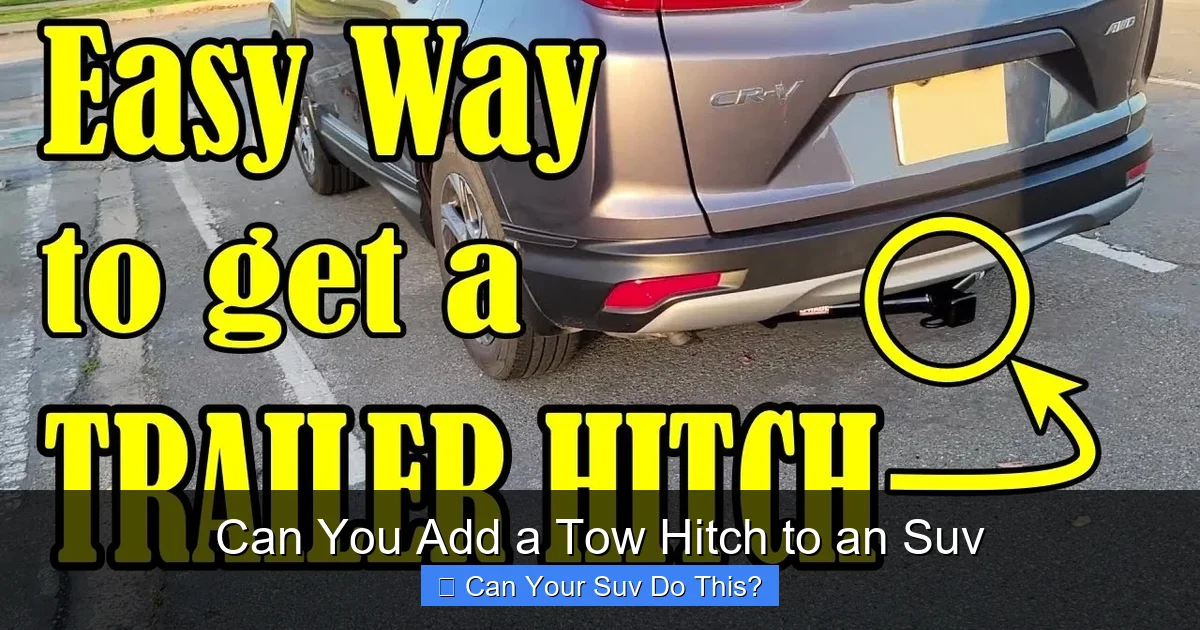
Visual guide about Can You Add a Tow Hitch to an Suv
Image source: i.ytimg.com
Not all tow hitches are the same. In fact, there are several types, each designed for different towing needs and vehicle setups. Choosing the right one is crucial for safety, performance, and ease of use. Let’s break down the most common types you’ll encounter when adding a tow hitch to your SUV.
The first thing to understand is **hitch classes**. These are standardized ratings that indicate how much weight a hitch can handle. They range from Class I to Class V, with higher numbers supporting heavier loads.
– **Class I:** Up to 2,000 pounds towing capacity, 200 pounds tongue weight. Ideal for small trailers, bike racks, or lightweight cargo carriers. Common on compact SUVs like the Honda HR-V.
– **Class II:** Up to 3,500 pounds towing, 350 pounds tongue weight. Good for small campers, utility trailers, or jet skis. Found on midsize SUVs like the Toyota RAV4.
– **Class III:** Up to 6,000 pounds towing, 600 pounds tongue weight. The most popular class for SUVs. Handles larger trailers, small boats, and pop-up campers. Used on vehicles like the Ford Edge or Nissan Pathfinder.
– **Class IV:** Up to 10,000 pounds towing, 1,000 pounds tongue weight. For heavy-duty towing—think large travel trailers or horse trailers. Common on full-size SUVs like the GMC Yukon.
– **Class V:** Over 10,000 pounds towing capacity. Rare for SUVs but available on heavy-duty models like the Ford Expedition Max.
Beyond class, there are different **hitch styles**:
– **Receiver Hitches:** The most common type. Features a square tube (usually 1.25” or 2”) that accepts various accessories like ball mounts, bike racks, or cargo carriers. Easy to remove when not in use.
– **Fixed Ball Mount Hitches:** Permanently attached with a ball already in place. Less versatile but simpler and often cheaper.
– **Gooseneck and Fifth Wheel Hitches:** Designed for heavy trailers, typically used with pickup trucks. Rarely used on SUVs due to space and structural limitations.
– **Weight Distribution Hitches:** Not a hitch type per se, but an add-on system that redistributes tongue weight across all axles for better stability. Essential for towing heavy loads with an SUV.
For most SUV owners, a **Class III receiver hitch** is the sweet spot—offering flexibility, strong capacity, and compatibility with a wide range of towing accessories.
Choosing the Right Hitch for Your SUV
So how do you pick the right hitch? Start with your **towing needs**. Are you hauling a 1,500-pound pop-up camper? A 5,000-pound travel trailer? Or just a bike rack for weekend rides? Your answer will determine the class and style you need.
Next, consider **ease of installation and use**. Receiver hitches are great because you can swap out accessories quickly. If you only tow occasionally, this versatility is a big plus. But if you’re always towing the same trailer, a fixed ball mount might save you time.
Also, think about **aesthetics and ground clearance**. Some hitches sit lower on the vehicle, which can affect off-road performance or make it harder to drive over steep driveways. Look for a hitch with a recessed receiver or a design that tucks up close to the bumper.
Finally, check **compatibility with your SUV’s features**. If your SUV has a rear parking sensor or backup camera, make sure the hitch doesn’t block it. Some hitches come with sensor cutouts or camera mounts to preserve functionality.
For example, if you drive a 2022 Hyundai Santa Fe and plan to tow a small camper, a Class III receiver hitch from Curt (like the Curt 13450) is a popular choice. It’s bolt-on, doesn’t require drilling, and includes a 2” receiver for maximum accessory compatibility.
Installation Options: DIY vs. Professional
Once you’ve chosen the right hitch, the next big decision is **how to install it**. You’ve got two main options: do it yourself or hire a professional. Both have pros and cons, and the best choice depends on your skills, tools, and confidence level.
DIY Installation: Is It Worth It?
Many SUV owners are tempted to install their own hitch to save money. And yes, it’s possible—especially with bolt-on receiver hitches designed for easy installation. Brands like Draw-Tite and Curt often include detailed instructions, all necessary hardware, and even video tutorials.
The process typically involves:
– Lifting the SUV (using a jack and stands)
– Removing the rear bumper or exhaust components (if needed)
– Bolting the hitch to the frame using provided brackets and bolts
– Reassembling any removed parts
– Testing the fit and torque
For someone with basic mechanical skills and the right tools (socket wrench, torque wrench, jack stands), this can take 1–3 hours. It’s a satisfying project, and you’ll learn a lot about your vehicle in the process.
But here’s the catch: **DIY installation comes with risks**. If the hitch isn’t aligned properly, bolts aren’t torqued to spec, or the frame is damaged during installation, you could compromise safety. A loose or misaligned hitch can fail under load, leading to catastrophic accidents. Also, if you drill into the wrong spot or damage wiring, you might face costly repairs.
Professional Installation: The Safe Bet
For most people, **professional installation is the smarter choice**. Certified mechanics or hitch specialists have the experience, tools, and knowledge to install your hitch correctly the first time. They’ll also check for clearance, ensure proper torque, and verify that all vehicle systems (like sensors and cameras) still work.
Professional installers often offer warranties on their work, giving you peace of mind. And while it costs more—typically $200–$500 depending on the hitch and labor rates—it’s a small price to pay for safety and reliability.
Many auto parts stores (like AutoZone or O’Reilly) and specialty shops (like U-Haul or hitch installers) offer installation services. Some even price-match online hitch purchases, so you can buy the hitch online and have it installed locally.
Hybrid Approach: Buy Online, Install Locally
A popular middle ground is buying your hitch online (where prices are often lower) and having it professionally installed. This gives you the best of both worlds: cost savings and expert installation. Just make sure the installer confirms compatibility before you buy.
Wiring, Brakes, and Accessories
Adding a hitch is just the first step. To tow safely, you’ll likely need additional components—especially if your trailer has lights, brakes, or other electrical systems.
Trailer Wiring Harness
Most trailers have brake lights, turn signals, and running lights that need to connect to your SUV’s electrical system. That’s where a **trailer wiring harness** comes in. It plugs into your SUV’s taillight wiring and provides a connector for the trailer.
There are two main types:
– **T-Connectors:** Plug into existing wiring without cutting or splicing. Easy to install and reversible.
– **Splicing Harnesses:** Require cutting into the vehicle’s wiring. More permanent but sometimes necessary for certain models.
Many SUVs have factory-installed trailer wiring ports, making installation a breeze. If not, aftermarket harnesses are widely available. For example, the Tekonsha T-One Connector is a popular choice for many Toyota and Ford SUVs.
Brake Controllers
If you’re towing a trailer with electric brakes (common on trailers over 1,500 pounds), you’ll need a **brake controller**. This device mounts inside your SUV and allows you to control the trailer’s brakes from the driver’s seat.
There are two types:
– **Time-Delayed:** Applies trailer brakes after a set delay. Simpler and cheaper.
– **Proportional:** Matches trailer brake force to your SUV’s deceleration. Smoother and safer, especially on hills.
Most brake controllers install under the dashboard and connect to the wiring harness. Professional installation is recommended, as improper setup can lead to brake failure.
Other Useful Accessories
– **Ball Mount and Hitch Ball:** Choose the right size (usually 2” for SUVs) and rise/drop to match your trailer’s coupler height.
– **Safety Chains:** Always use them—they’re a legal requirement and a critical backup if the hitch fails.
– **Trailer Sway Control:** Helps prevent fishtailing, especially in windy conditions or with tall trailers.
– **Weight Distribution System:** For heavy loads, this redistributes weight to improve handling and reduce strain on your SUV.
Safety Tips and Maintenance
Once your hitch is installed and you’re ready to tow, safety should be your top priority. Towing adds stress to your SUV and changes how it handles, so it’s important to follow best practices.
Pre-Tow Checklist
Before every trip, do a quick inspection:
– Check hitch bolts for tightness (use a torque wrench if possible)
– Inspect the ball mount and hitch receiver for cracks or wear
– Ensure the trailer coupler is securely locked
– Test all lights (brake, turn, running)
– Verify safety chains are crossed and attached
– Confirm the trailer is level and loaded properly (60% of weight in front of the axle)
Driving Tips
Towing changes your SUV’s dynamics:
– Allow extra stopping distance—your SUV is heavier now.
– Take turns wider to avoid clipping curbs.
– Use lower gears on hills to reduce brake strain.
– Avoid sudden maneuvers; sway can be dangerous.
Regular Maintenance
Even when not towing, inspect your hitch periodically:
– Clean off dirt, salt, and debris
– Lubricate the ball mount and receiver
– Check for rust or corrosion, especially in winter climates
– Replace worn parts immediately
A little maintenance goes a long way in preventing failures on the road.
Factory vs. Aftermarket Hitches
When shopping for a hitch, you’ll notice two main options: **factory (OEM)** and **aftermarket**. Which is better?
Factory Hitches
Pros:
– Designed specifically for your SUV
– Often integrate with vehicle systems (sensors, cameras)
– May be covered under warranty
– Clean, OEM look
Cons:
– More expensive
– Limited availability for older models
– Fewer accessory options
Aftermarket Hitches
Pros:
– More affordable
– Wider variety of styles and classes
– Often easier to install
– Better for custom setups
Cons:
– May not integrate perfectly with sensors
– Quality varies by brand
– Could affect warranty (check with dealer)
For most SUV owners, a high-quality aftermarket hitch from a reputable brand is the best value. But if you want seamless integration and don’t mind the cost, OEM is worth considering.
Real-World Examples and Case Studies
Let’s look at a few real scenarios to see how adding a tow hitch plays out.
Case 1: Weekend Camper with a Honda CR-V
Sarah owns a 2021 Honda CR-V and wants to tow a 2,500-pound pop-up camper. Her CR-V has a towing capacity of 1,500 pounds—too low. She upgrades to a 2023 model with the turbo engine, which increases capacity to 3,500 pounds. She installs a Class II receiver hitch and wiring harness. Now she can safely tow her camper for weekend trips.
Case 2: Family Road Trip with a Ford Explorer
The Johnson family has a 2022 Ford Explorer and plans a cross-country trip with a 5,000-pound travel trailer. They install a Class III receiver hitch, brake controller, and weight distribution system. With proper setup, they enjoy a smooth, safe journey.
Case 3: DIY Gone Wrong
Mike tries to install a hitch on his 2018 Nissan Rogue but skips torque specs and doesn’t align it properly. On his first tow, the hitch shifts, damaging the bumper and causing a near-accident. He learns the hard way that professional installation is worth the cost.
Conclusion
So, can you add a tow hitch to an SUV? **Yes—almost always.** Whether you drive a compact crossover or a full-size SUV, there’s a hitch solution that can expand your vehicle’s capabilities. But success depends on doing your homework: checking towing capacity, choosing the right hitch class, and ensuring proper installation.
Adding a tow hitch isn’t just about bolting on a piece of metal. It’s about safety, compatibility, and smart planning. With the right setup, your SUV can become a towing powerhouse, ready for adventures big and small. Just remember: when it comes to towing, it’s not just about what your SUV *can* do—it’s about what it *should* do. Respect the limits, maintain your equipment, and always prioritize safety.
Whether you’re hauling a trailer for work or play, a properly installed tow hitch can open up a world of possibilities. So go ahead—get that hitch, hit the road, and make the most of your SUV’s potential.
Frequently Asked Questions
Can any SUV be fitted with a tow hitch?
Most SUVs can be fitted with a tow hitch, but compatibility depends on the make, model, and frame design. Always check your owner’s manual and consult a professional if unsure.
Will adding a tow hitch void my SUV’s warranty?
Generally, no—adding a hitch doesn’t void your warranty unless it causes damage. However, modifications that lead to repairs may not be covered, so check with your dealer.
Do I need a brake controller for my SUV?
Only if you’re towing a trailer with electric brakes (usually over 1,500 pounds). For lightweight trailers without brakes, a controller isn’t necessary.
Can I install a tow hitch myself?
Yes, if you have mechanical skills and the right tools. However, professional installation is recommended for safety and proper torque specifications.
What’s the difference between a Class III and Class IV hitch?
Class III hitches handle up to 6,000 pounds, while Class IV supports up to 10,000 pounds. Choose based on your SUV’s towing capacity and your typical load.
Do I need to upgrade my SUV’s suspension for towing?
Not always, but heavy towing can strain stock suspension. Consider air helper springs or a weight distribution system for better handling and safety.