
Yes, you can often add a tow package to an SUV—but it depends on your vehicle’s make, model, and factory capabilities. While some SUVs are ready for easy upgrades, others may need significant modifications. Always consult your owner’s manual and a certified mechanic before making changes.
So, you’ve got an SUV—maybe it’s a midsize crossover like a Honda CR-V or a rugged full-size like a Toyota 4Runner—and you’re wondering, “Can I add a tow package to my SUV?” Maybe you want to pull a small trailer for camping gear, haul a jet ski to the lake, or even tow a lightweight camper for weekend getaways. The good news? In many cases, the answer is yes. But it’s not always as simple as bolting on a hitch and hitting the road.
Adding a tow package to your SUV isn’t just about slapping on a receiver hitch. It’s about ensuring your vehicle can handle the extra stress, weight, and demands of towing safely and reliably. Some SUVs come from the factory with towing capabilities built in, while others need significant upgrades to be road-ready. And even if your SUV wasn’t originally equipped with a tow package, that doesn’t necessarily mean it can’t be added later—just that you’ll need to do your homework.
In this guide, we’ll walk you through everything you need to know about adding a tow package to your SUV. We’ll cover what a tow package actually includes, how to determine if your SUV is a good candidate, the differences between factory and aftermarket options, installation tips, cost expectations, and safety considerations. By the end, you’ll have a clear picture of whether your SUV can become a towing machine—and how to do it the right way.
Key Takeaways
- Not all SUVs can be retrofitted: Only SUVs with the right frame, cooling, and electrical systems can safely support a tow package.
- Factory vs. aftermarket matters: Factory-installed tow packages are optimized for your SUV; aftermarket kits vary in quality and compatibility.
- Weight ratings are critical: Never exceed your SUV’s Gross Vehicle Weight Rating (GVWR) or tongue weight limits.
- Professional installation is recommended: Improper installation can void warranties, damage your SUV, or create safety hazards.
- Legal and insurance considerations: Some states require registration updates or special licensing for towing above certain weights.
- Costs vary widely: Basic tow packages start around $500, while full upgrades can exceed $3,000.
- Check your warranty: Modifying your SUV may affect coverage—always verify with your dealer first.
📑 Table of Contents
What Is a Tow Package, Anyway?
Before we dive into whether you can add one, let’s clarify what a “tow package” actually means. A tow package is a collection of components and upgrades designed to help your SUV safely and efficiently pull a trailer or other load. It’s not just one part—it’s a system.
At its core, a tow package typically includes:
– A trailer hitch (usually a Class III or IV receiver)
– Wiring harness for trailer lights
– Transmission cooler (for automatic transmissions)
– Upgraded suspension components
– Heavy-duty cooling system (engine and transmission)
– Possibly a brake controller (for trailers with electric brakes)
– Reinforced frame or mounting points
Some factory tow packages also include software tuning, enhanced alternators, or even special gear ratios in the differential to improve towing performance.
For example, a 2023 Ford Explorer with the optional Class III Tow Package comes with a 5,600-pound towing capacity, a trailer brake controller, and a dedicated wiring harness. But if you buy the same model without the package, it may only be rated for 1,500 to 2,000 pounds—and adding the full package later could be complicated.
So, when people ask, “Can you add a tow package to an SUV?” they’re really asking whether these components can be retrofitted to a vehicle that didn’t come with them. And the answer depends on several factors, which we’ll explore next.
Can Your SUV Handle a Tow Package?
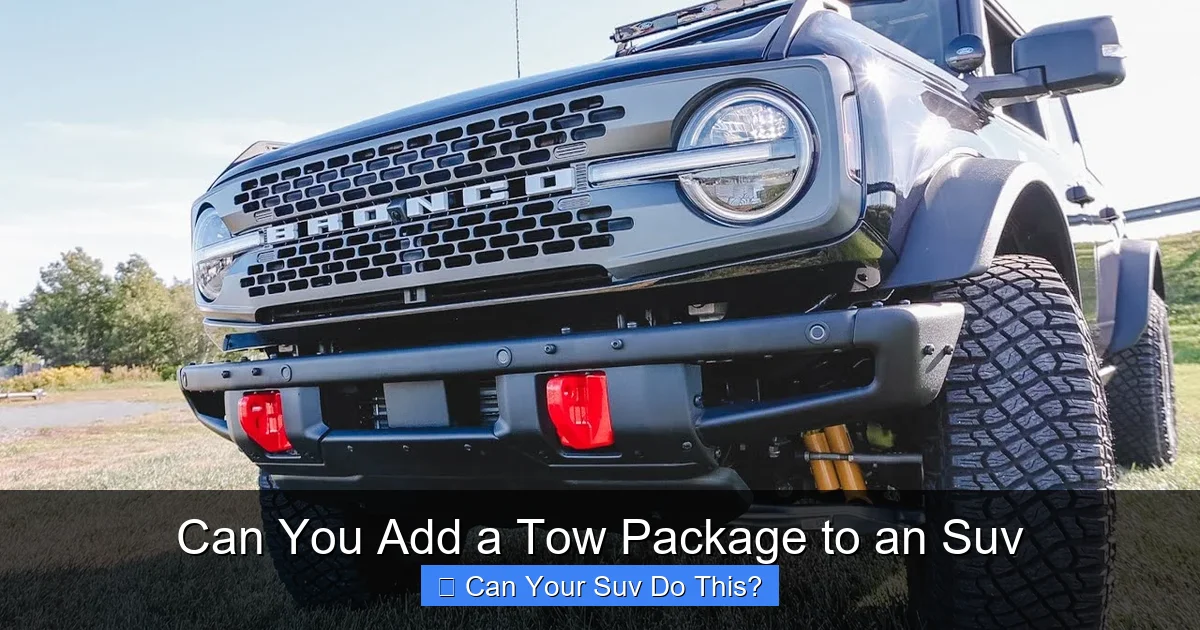
Visual guide about Can You Add a Tow Package to an Suv
Image source: i.ytimg.com
Not every SUV is built to tow—and not every SUV can be upgraded to do so. The first step in determining whether you can add a tow package is understanding your vehicle’s towing potential.
Check Your Owner’s Manual
Your SUV’s owner’s manual is your best friend here. It will list the maximum towing capacity for your specific model, trim, and engine configuration. This number is set by the manufacturer based on extensive testing and engineering. Exceeding it can lead to mechanical failure, unsafe handling, and even accidents.
For instance, a 2022 Subaru Outback with the standard 2.5L engine has a towing capacity of 2,700 pounds. But if you upgrade to the turbocharged 2.4L engine, that jumps to 3,500 pounds—and the factory tow package is often included or recommended with that engine. So, if you have the base model, adding a tow package might not increase your legal towing limit unless other components are upgraded.
Assess Your SUV’s Structural Integrity
Towing puts stress on your SUV’s frame, suspension, and drivetrain. SUVs with body-on-frame construction—like the Jeep Wrangler, Toyota 4Runner, or Ford Bronco—are generally better suited for towing because they’re built like trucks. They have stronger frames and better weight distribution.
On the other hand, unibody SUVs—like the Honda CR-V, Toyota RAV4, or Nissan Rogue—are built more like cars. They’re lighter and more fuel-efficient, but they’re not designed for heavy towing. While some unibody SUVs can handle light trailers (under 3,500 pounds), pushing them beyond their limits can cause frame flex, suspension sag, or even structural damage.
So, if you drive a compact crossover, adding a tow package might only be practical for very light loads—like a small utility trailer or a single ATV. But if you have a midsize or full-size SUV with a robust build, you may have more flexibility.
Engine and Transmission Matter
Towing is hard work—especially on hills or in hot weather. Your engine needs to generate enough power, and your transmission needs to stay cool under load.
SUVs with smaller engines (under 2.0L) or continuously variable transmissions (CVTs) may struggle with towing, even with a hitch installed. For example, a base-model Hyundai Tucson with a 1.6L turbo engine is rated to tow 1,500 pounds—but that’s only if it has the optional tow package. Without it, towing may not be recommended at all.
Larger engines (3.5L V6 or higher) and traditional automatic transmissions with torque converters are better suited for towing. They generate more torque and handle heat better. If your SUV has a small engine, adding a tow package might not be worth it unless you’re only towing very light loads.
Cooling System Capacity
When you tow, your engine and transmission work harder, which generates more heat. Without proper cooling, you risk overheating—especially in stop-and-go traffic or on long climbs.
A proper tow package includes an upgraded radiator, transmission cooler, and sometimes an auxiliary oil cooler. If your SUV doesn’t have these, adding them can be expensive and complex. Some vehicles have space in the engine bay for aftermarket coolers, while others don’t.
For example, the 2021 Chevrolet Traverse can be equipped with a trailering package that includes a heavy-duty cooling system. But if you buy one without it, retrofitting the cooler may require custom brackets, routing new lines, and modifying the radiator support—work that’s best left to professionals.
Factory vs. Aftermarket Tow Packages
Once you’ve determined your SUV can handle towing, the next question is: Should you go with a factory-installed package or an aftermarket solution?
Factory Tow Packages: The Gold Standard
Factory tow packages are designed specifically for your SUV. They’re tested by the manufacturer, integrated into the vehicle’s systems, and often covered by warranty. If your SUV was available with a tow package as an option, it’s usually the safest and most reliable choice.
For example, the 2023 Toyota Highlander offers a Tow Package that includes a 5,000-pound capacity, a transmission cooler, a trailer brake controller, and a wiring harness. If you order the Highlander with this package, everything is installed at the factory and works seamlessly.
But what if you already own a Highlander without the package? Can you add it later? In some cases, yes—but it’s not always straightforward. Toyota may offer a “retrofit” kit for certain models, but it often requires dealership installation and can cost nearly as much as ordering it new.
Aftermarket Tow Packages: Flexibility and Cost
Aftermarket tow packages are built by third-party companies like Curt, Draw-Tite, Reese, or Westin. They’re often more affordable and widely available. You can buy a hitch, wiring harness, and even a brake controller separately and install them yourself—or have a shop do it.
For example, a Curt Class III hitch for a 2020 Ford Escape costs around $200–$300 and can be installed in a few hours. Add a wiring harness ($50–$100) and a brake controller ($100–$200), and you’ve got a basic tow setup for under $600.
But here’s the catch: Aftermarket parts may not be as robust as factory components. They might not integrate with your SUV’s electronics, and they could void parts of your warranty. Also, not all aftermarket hitches are rated for the same weight as factory ones.
For instance, a factory tow package on a 2022 Jeep Grand Cherokee might allow 6,200 pounds of towing, but an aftermarket hitch for the same model might only be rated for 3,500–5,000 pounds. Always check the hitch’s Gross Trailer Weight (GTW) and Tongue Weight (TW) ratings before buying.
Hybrid Approach: Mixing Factory and Aftermarket
Some owners choose a hybrid approach—using factory-style parts where possible and aftermarket for the rest. For example, you might install a factory-style hitch (sold by the dealer) but use an aftermarket brake controller.
This can save money while maintaining reliability. Just make sure all components are compatible and properly rated for your SUV’s towing capacity.
How to Add a Tow Package to Your SUV
If you’ve decided your SUV can handle a tow package, here’s how to go about adding one—step by step.
Step 1: Research Your SUV’s Towing Capacity
Start by checking your owner’s manual or the manufacturer’s website. Look for the maximum towing capacity for your exact model, year, engine, and drivetrain. This is your hard limit—don’t exceed it.
For example, a 2021 Nissan Pathfinder with the 3.5L V6 can tow up to 6,000 pounds with the proper equipment. But without the tow package, it’s only rated for 1,500 pounds. So, if you want to tow a 5,000-pound trailer, you’ll need the full package.
Step 2: Choose the Right Hitch Class
Trailer hitches are classified by weight capacity:
– Class I: Up to 2,000 lbs GTW, 200 lbs TW
– Class II: Up to 3,500 lbs GTW, 350 lbs TW
– Class III: Up to 6,000–8,000 lbs GTW, 600–800 lbs TW
– Class IV: Up to 10,000–12,000 lbs GTW, 1,000–1,200 lbs TW
– Class V: Over 12,000 lbs GTW
Most SUVs use Class III or IV hitches. Choose one that matches or exceeds your SUV’s towing capacity—but don’t go overkill. A Class V hitch on a small SUV is unnecessary and could cause handling issues.
Step 3: Install the Hitch and Wiring
Hitch installation is usually straightforward. Most aftermarket hitches bolt directly to the frame using existing holes. You’ll need basic tools, a torque wrench, and about 2–4 hours.
Wiring is trickier. You’ll need a wiring harness that connects to your SUV’s taillights and powers the trailer’s brake lights, turn signals, and running lights. Some harnesses plug into the factory connector; others require splicing.
If your trailer has electric brakes, you’ll also need a brake controller. This device mounts inside the cabin (usually under the dash) and lets you adjust brake force. It must be wired into the vehicle’s electrical system and calibrated properly.
Step 4: Upgrade Cooling and Suspension (If Needed)
If your SUV doesn’t have a transmission cooler, consider adding one—especially if you plan to tow frequently or in hot climates. A cooler helps prevent overheating and extends transmission life.
You can buy aftermarket coolers that install in-line with the transmission fluid lines. Installation requires draining the fluid, routing new lines, and refilling—best done by a mechanic.
Suspension upgrades like helper springs, airbags, or sway bars can improve stability when towing. These aren’t always necessary, but they help if your SUV sags or sways under load.
Step 5: Test and Inspect
After installation, take your SUV for a test drive with a light load. Check for unusual noises, vibrations, or warning lights. Make sure all trailer lights work and the brake controller responds correctly.
Have a professional inspect the setup if you’re unsure. Many auto shops offer towing safety checks for around $50–$100.
Cost of Adding a Tow Package
So, how much does it cost to add a tow package to an SUV? It depends on what you need and whether you DIY or hire a pro.
Basic Tow Setup (Under 3,500 lbs)
– Class II or III hitch: $150–$400
– Wiring harness: $50–$150
– Installation (DIY): $0
– Installation (professional): $100–$300
– **Total: $200–$850**
This is suitable for small trailers, jet skis, or utility loads.
Mid-Range Tow Setup (3,500–6,000 lbs)
– Class III hitch: $200–$500
– Wiring harness: $100–$200
– Brake controller: $100–$300
– Transmission cooler: $150–$400
– Installation: $200–$500
– **Total: $750–$1,900**
This is common for midsize SUVs towing campers or boats.
Full Tow Package (6,000+ lbs)
– Class IV hitch: $300–$700
– Heavy-duty wiring and brake controller: $200–$500
– Transmission and engine coolers: $300–$800
– Suspension upgrades: $200–$600
– Professional installation: $500–$1,000
– **Total: $1,500–$3,600+**
This is for full-size SUVs towing large trailers, RVs, or multiple vehicles.
Keep in mind: If your SUV requires frame modifications or custom fabrication, costs can skyrocket. Always get multiple quotes from reputable shops.
Safety and Legal Considerations
Towing isn’t just about capability—it’s about safety. Here’s what you need to know.
Never Exceed Weight Limits
Your SUV has three key weight ratings:
– **Gross Vehicle Weight Rating (GVWR):** The maximum your SUV can weigh, including passengers, cargo, and fuel.
– **Gross Trailer Weight (GTW):** The total weight of the trailer and its contents.
– **Tongue Weight (TW):** The downward force the trailer exerts on the hitch (usually 10–15% of GTW).
Exceeding any of these can cause loss of control, brake failure, or structural damage.
Check State Laws
Towing laws vary by state. Some require:
– Trailer registration
– Special licenses for heavy trailers
– Safety chains and breakaway brakes
– Speed limits for towing
For example, in California, trailers over 1,500 pounds must have brakes. In Texas, you need a special license to tow over 10,000 pounds.
Insurance and Warranty
Adding a tow package may affect your insurance. Some insurers require notification if you’re towing heavy loads. Also, modifications can void parts of your warranty—especially if they cause damage.
Always check with your dealer and insurer before making changes.
Conclusion
So, can you add a tow package to an SUV? The short answer is: often, yes—but it’s not always simple or safe. Your SUV’s make, model, engine, and factory specs all play a role. While many SUVs can be upgraded with aftermarket hitches and accessories, others may need significant modifications—or simply aren’t built for towing.
The key is to do your research, respect your vehicle’s limits, and prioritize safety. Whether you’re towing a small trailer or a full-sized camper, a properly installed tow package can open up new adventures. But cutting corners can lead to costly repairs—or worse.
If you’re unsure, consult a certified mechanic or your dealership. They can help you determine what’s possible and recommend the best path forward. With the right setup, your SUV can become a reliable towing partner for years to come.
Frequently Asked Questions
Can I add a tow package to any SUV?
Not all SUVs can safely support a tow package. It depends on the vehicle’s frame, engine, cooling system, and factory towing capacity. Always check your owner’s manual and consult a professional before making modifications.
Is it cheaper to add a tow package after purchase?
Sometimes, but not always. Factory tow packages are often more cost-effective when ordered new. Aftermarket kits can be cheaper upfront but may require additional upgrades and professional installation, increasing total cost.
Will adding a tow package void my warranty?
It depends. Modifications that cause damage may void parts of your warranty. However, installing a hitch or wiring harness typically doesn’t affect coverage unless it leads to a problem. Always check with your dealer first.
Do I need a brake controller for towing?
Yes, if your trailer has electric brakes. A brake controller is required to activate the trailer’s brakes from inside your SUV. It’s essential for safe stopping, especially with heavier loads.
Can I install a tow package myself?
Basic hitches and wiring can be DIY projects if you’re handy with tools. However, brake controllers, coolers, and suspension upgrades are best left to professionals to ensure safety and proper function.
What’s the difference between a Class III and Class IV hitch?
Class III hitches handle up to 6,000–8,000 pounds, while Class IV hitches support up to 10,000–12,000 pounds. Choose based on your SUV’s towing capacity and the weight of what you plan to tow.