
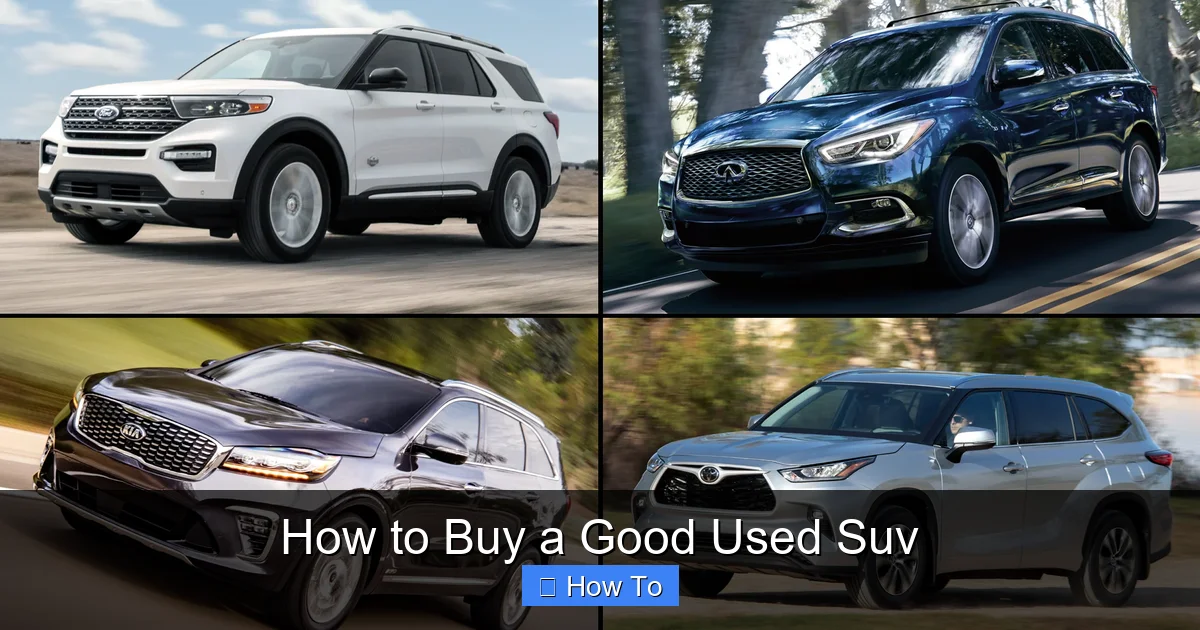
Buying a used SUV doesn’t have to be stressful. This guide walks you through every step, from setting a budget to finalizing the purchase, so you can drive away with a vehicle that’s safe, reliable, and right for your needs. Save money and avoid scams with expert tips and practical advice.
Key Takeaways
- Set a realistic budget: Include not just the purchase price but also insurance, taxes, registration, and potential repairs.
- Research models and reliability: Focus on SUVs with strong safety ratings, good fuel economy, and low maintenance costs.
- Check the vehicle history report: Use services like Carfax or AutoCheck to uncover accidents, title issues, or odometer fraud.
- Inspect the SUV thoroughly: Look for signs of wear, rust, leaks, and test all features during a hands-on inspection.
- Take a test drive: Pay attention to engine performance, braking, steering, and noise levels.
- Get a pre-purchase inspection: Hire a trusted mechanic to evaluate the SUV before you buy.
- Negotiate the price: Use market data and any issues found to get the best deal possible.
How to Buy a Good Used SUV: A Complete Step-by-Step Guide
Buying a used SUV can be one of the smartest decisions you make—if you do it right. SUVs offer space, safety, and versatility, making them ideal for families, outdoor enthusiasts, and daily commuters alike. But the used car market can be tricky. Without the right knowledge, you might end up with a lemon, overpay, or miss out on a great deal.
This guide will walk you through the entire process of buying a good used SUV, from start to finish. Whether you’re a first-time buyer or upgrading from an older model, you’ll learn how to find a reliable, affordable, and safe vehicle. We’ll cover budgeting, research, inspections, negotiations, and more—so you can drive off with confidence.
Let’s get started.
Step 1: Determine Your Needs and Budget
Before you even look at a single SUV, you need to know what you’re looking for—and how much you can afford.
Ask Yourself the Right Questions
Start by thinking about how you’ll use the SUV. Do you need it for city driving, off-roading, or long road trips? How many passengers do you regularly carry? Do you need cargo space for gear, pets, or kids’ sports equipment?
Also consider fuel efficiency, towing capacity, and available features like all-wheel drive, Apple CarPlay, or advanced safety systems. For example, if you live in a snowy area, an SUV with all-wheel drive might be essential.
Set a Realistic Budget
Your budget should include more than just the purchase price. Experts recommend the “total cost of ownership” approach. This means factoring in:
- Sales tax and registration fees
- Insurance premiums (SUVs can be more expensive to insure)
- Fuel costs
- Routine maintenance (oil changes, tire rotations)
- Potential repairs
A good rule of thumb is to keep your total car expenses under 15% of your monthly take-home pay. For example, if you earn $4,000 a month after taxes, aim to spend no more than $600 on all car-related costs.
Use online tools like Kelley Blue Book (KBB) or Edmunds to estimate the fair market value of the SUVs you’re considering. These sites also provide “True Cost to Own” calculators that factor in depreciation, fuel, maintenance, and more.
Step 2: Research the Best Used SUVs
Not all used SUVs are created equal. Some models are known for their reliability, while others have a history of mechanical issues.
Focus on Reliability and Safety
Start by narrowing your list to SUVs with strong reputations. Look for models that consistently rank high in reliability surveys from sources like J.D. Power, Consumer Reports, and U.S. News & World Report.
Some of the most reliable used SUVs in recent years include:
- Toyota RAV4 (2016–2020)
- Honda CR-V (2015–2020)
- Mazda CX-5 (2016–2020)
- Subaru Forester (2017–2020)
- Ford Escape (2017–2020, especially with the 1.5L EcoBoost engine)
These models are known for their durability, good fuel economy, and strong resale value.
Check Safety Ratings
Safety should be a top priority. Visit the National Highway Traffic Safety Administration (NHTSA) and the Insurance Institute for Highway Safety (IIHS) websites to check crash test ratings.
Look for SUVs with high scores in frontal, side, and rollover tests. Also, check for available safety features like:
- Automatic emergency braking
- Blind-spot monitoring
- Lane departure warning
- Adaptive cruise control
- Rearview camera (mandatory on all new cars since 2018)
Even if a used SUV doesn’t have all the latest tech, basic safety features like airbags, ABS, and stability control are must-haves.
Consider Fuel Economy and Ownership Costs
Larger SUVs tend to guzzle gas, so if you’re driving a lot, fuel efficiency matters. Compact and midsize SUVs like the RAV4 or CR-V often get 28–35 mpg on the highway.
Also, check average repair costs. Some brands, like Toyota and Honda, are cheaper to maintain than luxury brands like BMW or Mercedes-Benz.
Step 3: Find Used SUVs for Sale
Now that you know what you want, it’s time to start shopping.
Use Trusted Sources
Avoid sketchy classified ads or “too good to be true” deals. Stick to reputable platforms like:
- Autotrader.com
- Cars.com
- CarGurus.com
- Carfax.com
- Local dealership websites
You can also check certified pre-owned (CPO) programs from manufacturers. CPO SUVs are typically newer, come with extended warranties, and have passed rigorous inspections.
Set Up Alerts
Most car shopping sites let you save searches and set up email alerts. For example, you can get notified when a 2018 Honda CR-V under $22,000 appears within 50 miles of your ZIP code.
This helps you act quickly when a good deal pops up.
Compare Prices
Don’t fall in love with the first SUV you see. Compare at least three similar models to understand the market rate.
Use KBB’s “Fair Purchase Price” or Edmunds’ “True Market Value” as benchmarks. If a listing is significantly below market, ask why. It could be a private seller in a hurry—or it could have hidden problems.
Step 4: Check the Vehicle History Report
Never buy a used SUV without checking its history. This step can save you from buying a car with a dangerous past.
Get the VIN and Run a Report
Every vehicle has a unique 17-digit Vehicle Identification Number (VIN). You can find it on the dashboard (visible through the windshield), the driver’s side door jamb, or the registration paperwork.
Use the VIN to pull a history report from:
- Carfax (most detailed, but paid)
- AutoCheck (often cheaper, good alternative)
- National Insurance Crime Bureau (free, checks for theft or salvage titles)
What to Look For
A clean history report should show:
- No major accidents or structural damage
- Consistent ownership (not too many owners in a short time)
- Regular maintenance records
- No odometer rollback
- Clean title (not salvage, rebuilt, or flood-damaged)
Red flags include:
- “Salvage” or “rebuilt” title
- Flood damage (common in hurricane-prone areas)
- Multiple accidents
- Long periods with no service records
- Odometer discrepancies
If the report shows any of these, walk away—or at least get a professional inspection before proceeding.
Step 5: Inspect the SUV in Person
Even with a clean history, you need to see the SUV in person. A visual inspection can reveal hidden problems.
Schedule a Meeting
If buying from a private seller, meet in a public place during daylight hours. Bring a friend for safety. If buying from a dealer, visit the lot and ask to see the vehicle.
Exterior Inspection
Walk around the SUV and look for:
- Rust or corrosion, especially under the doors, wheel wells, and rocker panels
- Dents, scratches, or mismatched paint (signs of past repairs)
- Uneven gaps between body panels (could indicate frame damage)
- Cracked or cloudy headlights
- Tire wear—check for uneven patterns, which may signal alignment issues
Also, check the windshield for cracks or chips. Large cracks can be expensive to replace.
Interior Inspection
Sit inside and check:
- Seat condition—look for excessive wear, stains, or tears
- Odors—musty smells may indicate water leaks or mold
- Dashboard warning lights—start the engine and see if any stay on
- Functionality of buttons, switches, and infotainment system
- Air conditioning and heating—test both on high and low
- Power windows, locks, and mirrors
- Sunroof operation (if equipped)
Open the glove box and center console to check for moisture or debris.
Under the Hood
Pop the hood and look for:
- Leaks (oil, coolant, or transmission fluid)
- Corroded battery terminals
- Worn belts or hoses
- Excessive dirt or sludge in the engine bay
- Check engine oil—it should be clean and at the right level
If you’re not comfortable doing this yourself, bring a mechanic or a knowledgeable friend.
Step 6: Take a Test Drive
The test drive is your chance to see how the SUV performs on the road.
Drive in Different Conditions
Try to drive on:
- City streets (to test braking and maneuverability)
- Highways (to check acceleration and wind noise)
- Bumpy or uneven roads (to test suspension)
Listen and Feel
Pay attention to:
- Engine noise—should be smooth and quiet
- Transmission shifts—should be seamless, not jerky
- Brake feel—should be firm, not spongy
- Suspension—should absorb bumps without excessive bouncing
- Steering—should be responsive and not pull to one side
- Wind or road noise—excessive noise may indicate poor insulation
Also, test the backup camera, parking sensors, and blind-spot monitoring if equipped.
Check for Warning Lights
After the drive, check the dashboard again. If any warning lights come on, ask the seller about them.
Step 7: Get a Pre-Purchase Inspection
This is one of the most important steps—and it’s worth the cost.
Hire a Trusted Mechanic
Even if the SUV seems perfect, have a qualified mechanic inspect it. Most charge $100–$150 for a thorough inspection.
They’ll check:
- Engine and transmission
- Brake system
- Suspension and steering
- Exhaust system
- Electrical components
- Frame and undercarriage
Ask for a Written Report
The mechanic should provide a detailed report with photos and recommendations. If they find major issues, you can:
- Walk away
- Ask the seller to fix the problems
- Negotiate a lower price
Never skip this step—especially with private sales.
Step 8: Negotiate the Price
Now that you’ve done your homework, it’s time to talk money.
Use Your Research
Refer to KBB, Edmunds, or local listings to justify your offer. For example: “Similar 2017 RAV4s in this area are listed for $21,000, but this one has high mileage and needs new tires.”
Point Out Issues
If the inspection revealed problems, use them as leverage. Say: “The brakes are worn, and the AC isn’t cooling well. I’d like to adjust the price to cover those repairs.”
Be Polite but Firm
Negotiation is a conversation, not a battle. Start with a reasonable offer and be prepared to meet in the middle.
Private sellers may be more flexible than dealers. On average, you can expect to negotiate 5–10% off the asking price.
Consider the Total Cost
Don’t just focus on the purchase price. If a dealer offers a lower price but high financing rates or add-ons (like extended warranties or paint protection), the total cost might be higher.
Step 9: Finalize the Purchase
Once you’ve agreed on a price, it’s time to close the deal.
Review the Paperwork
Make sure all documents are in order:
- Vehicle title (signed by the seller)
- Bill of sale
- Odometer disclosure statement
- Warranty information (if applicable)
- Maintenance records
If buying from a dealer, they’ll handle most of this. With a private seller, you may need to file the paperwork yourself.
Transfer Ownership
Visit your local DMV to register the SUV and get new plates. You’ll need:
- Proof of insurance
- Signed title
- Bill of sale
- Emissions test (if required in your state)
Get Insurance
Before driving off, make sure the SUV is insured. Call your provider or shop around for quotes. Full coverage is recommended for used SUVs, especially if you’re financing.
Troubleshooting Common Issues
Even with careful research, problems can arise. Here’s how to handle common issues:
“The Seller Won’t Let Me Get an Inspection”
This is a major red flag. A trustworthy seller should welcome an inspection. If they refuse, walk away.
“The SUV Has a Salvage Title”
Salvage titles mean the car was declared a total loss by an insurance company. While some are safe, they’re harder to insure and resell. Proceed with extreme caution—or avoid altogether.
“The Price Seems Too Good to Be True”
It probably is. Scammers often post fake listings with low prices to lure buyers. Always verify the seller and meet in person.
“I Found a Problem After Buying”
If you bought from a dealer, check if the SUV is under warranty or covered by state lemon laws (which vary). With private sales, “buyer beware” usually applies—so inspections are crucial.
Conclusion
Buying a good used SUV doesn’t have to be overwhelming. By following these steps—setting a budget, researching models, checking history, inspecting the vehicle, and negotiating wisely—you can find a reliable, safe, and affordable SUV that fits your lifestyle.
Remember, patience pays off. Don’t rush into a purchase just because you’re excited. Take your time, do your homework, and trust your instincts. With the right approach, your next SUV could be a smart investment that serves you well for years to come.
Drive safe and happy shopping!