
Yes, you can add nitrous to an SUV, but it’s not as simple as just bolting on a kit. While nitrous oxide systems can dramatically boost horsepower, they come with serious mechanical, legal, and safety considerations that every SUV owner should understand before making the leap.
So, you’ve got an SUV—maybe a rugged Ford Explorer, a turbocharged BMW X5, or even a lifted Jeep Grand Cherokee—and you’re wondering, “Can I add nitrous to this thing?” You’ve seen it in movies, heard about it at car meets, and watched YouTube videos of muscle cars screaming down the drag strip with a plume of white vapor shooting from the exhaust. Nitrous oxide—commonly called “nitrous” or “NOS”—is legendary for its ability to deliver instant, jaw-dropping power. But does that magic work on your family hauler or off-road warrior?
The short answer? Yes, you *can* add nitrous to an SUV. But the real question isn’t whether it’s possible—it’s whether it’s smart, safe, and worth it. Adding nitrous isn’t like slapping on a new set of tires or upgrading your stereo. It’s a serious modification that can transform your SUV’s performance… or turn it into a smoking heap in seconds if done wrong. In this guide, we’ll break down everything you need to know about installing nitrous in an SUV—from how it works, to what it costs, to whether your specific vehicle can handle it. Whether you’re a weekend warrior or a full-time gearhead, this is your no-BS roadmap to nitrous for SUVs.
Let’s be real: most SUVs aren’t built for drag racing. They’re designed for comfort, cargo space, and all-terrain capability. But that doesn’t mean they can’t benefit from a little extra muscle. With the right setup, nitrous can turn a sluggish V6 into a tire-smoking beast or give a turbocharged engine an extra kick when you need it most. But before you start shopping for nitrous bottles and solenoids, you need to understand the fundamentals—and the risks.
Key Takeaways
- Nitrous oxide can be installed on most SUVs: With the right engine setup and supporting modifications, nitrous systems are compatible with many SUV models, especially performance-oriented ones.
- It delivers instant power boosts: Nitrous provides a significant horsepower and torque increase—often 50 to 250+ HP—within seconds of activation.
- Engine durability is a major concern: Stock engines, especially in non-performance SUVs, may not handle the stress of nitrous without internal upgrades.
- Fuel system upgrades are often required: To prevent lean conditions and engine damage, a properly tuned fuel system with larger injectors or a supplemental pump may be necessary.
- Legal and insurance implications exist: Nitrous systems may violate emissions laws in some regions and could affect your vehicle’s insurance coverage or resale value.
- Professional installation is strongly recommended: Due to the complexity and risk involved, DIY installations can lead to catastrophic engine failure if not done correctly.
- Not ideal for daily driving: Nitrous is best used for short bursts during racing or performance events, not for regular commuting.
📑 Table of Contents
- How Nitrous Oxide Works in Vehicles
- Can Your SUV Handle Nitrous?
- Required Upgrades and Supporting Modifications
- Installation Process: What to Expect
- Cost Breakdown: What You’ll Spend
- Legal, Safety, and Practical Considerations
- Real-World Examples and Success Stories
- Conclusion: Is Nitrous Right for Your SUV?
How Nitrous Oxide Works in Vehicles
At its core, nitrous oxide (N₂O) is a chemical compound that, when injected into an engine’s intake system, dramatically increases power output. But how does it actually work? And why does it make engines go from mild to wild in a heartbeat?
When nitrous is released from its pressurized bottle, it enters the engine as a liquid. As it vaporizes, it cools the intake charge significantly—sometimes by over 100 degrees Fahrenheit. Cooler air is denser, which means more oxygen molecules are packed into each cylinder during the intake stroke. More oxygen allows for more fuel to be burned, resulting in a much more powerful combustion event. This is why nitrous is often described as “free horsepower”—it doesn’t require engine internals to be physically changed, just the addition of a gas and a fuel system tweak.
But here’s the catch: nitrous doesn’t create power on its own. It enables the engine to burn more fuel efficiently. That’s why every nitrous system must be paired with a corresponding increase in fuel delivery. Without it, the engine runs lean—meaning too much air and not enough fuel—which can cause detonation, melted pistons, and catastrophic engine failure in seconds.
There are two main types of nitrous systems: dry and wet.
Dry Nitrous Systems
A dry system injects only nitrous into the intake manifold. The extra oxygen from the nitrous forces the engine’s computer (ECU) to add more fuel through the existing fuel injectors. This works well on fuel-injected engines with robust ECUs that can adapt to sudden changes in airflow. However, it requires precise tuning to avoid lean conditions. Dry systems are simpler and often cheaper, but they’re less common on modern SUVs due to the complexity of factory engine management systems.
Wet Nitrous Systems
A wet system injects both nitrous and additional fuel directly into the intake. This gives you full control over the air-fuel ratio, making it safer and more reliable—especially for higher horsepower shots. Wet systems are the go-to choice for most performance applications, including SUVs, because they reduce the risk of engine damage. They do require more components (extra fuel lines, solenoids, and sometimes a supplemental fuel pump), but the added safety is worth it.
Another key factor is the “shot” size—the amount of nitrous being injected. Small shots (like 50–75 HP) are relatively safe for stock engines, especially if the vehicle has some performance modifications. Larger shots (150+ HP) demand forged internals, upgraded fuel systems, and professional tuning. For most SUVs, a moderate shot is the sweet spot between performance and reliability.
Can Your SUV Handle Nitrous?
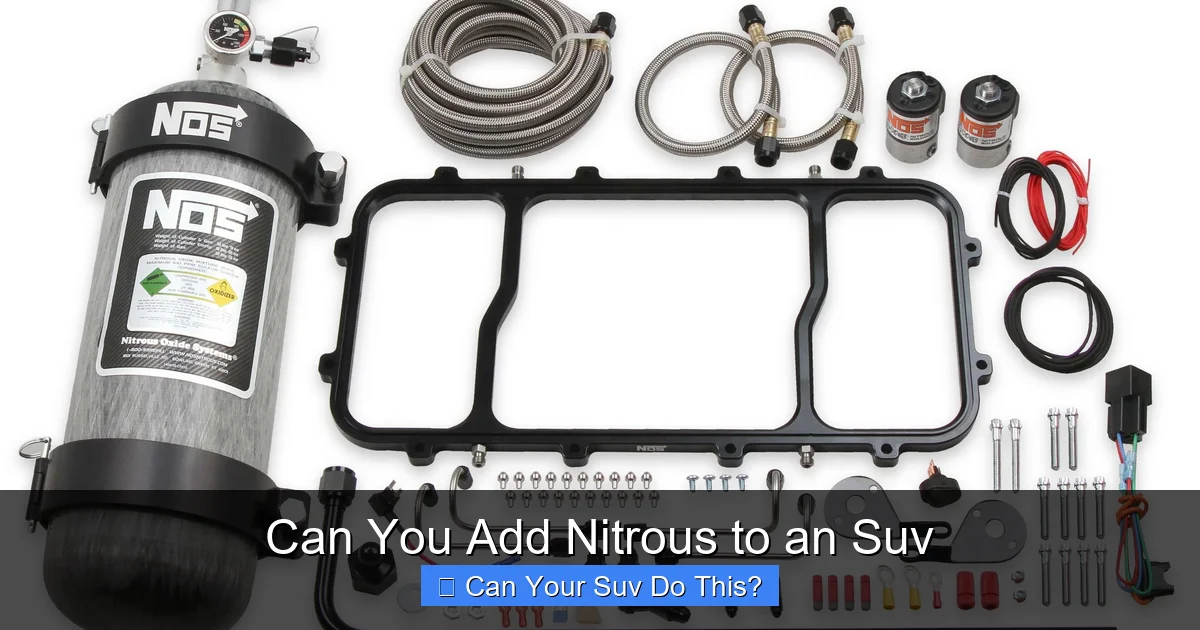
Visual guide about Can You Add Nitrous to an Suv
Image source: images.holley.com
Not all SUVs are created equal when it comes to nitrous compatibility. While the technology itself can be adapted to almost any gasoline-powered engine, your SUV’s design, age, and current condition play a huge role in whether nitrous is a smart upgrade.
Let’s break it down by vehicle type.
Performance SUVs (e.g., BMW X5 M, Mercedes-AMG GLE, Ford Explorer ST)
These vehicles are the best candidates for nitrous. They come with high-output engines, reinforced internals, and advanced engine management systems. Adding nitrous to a twin-turbo V8 in an X5 M, for example, can push it from 600 HP to over 800 HP with the right setup. These SUVs often have the cooling capacity, fuel delivery, and structural integrity to handle the extra stress.
Turbocharged or Supercharged SUVs (e.g., Audi Q7, Volvo XC90 T8, Jeep Grand Cherokee SRT)
Turbocharged engines already operate under high boost, so adding nitrous can be tricky. The combination of forced induction and nitrous can lead to excessive cylinder pressures and heat. However, with proper tuning and supporting mods (like upgraded intercoolers and fuel systems), it’s possible. Many tuners use nitrous to “top off” turbo engines during drag runs, giving them a final burst of power when the turbo starts to lag.
Stock or Older SUVs (e.g., base-model Honda Pilot, Toyota Highlander, 2000s-era Ford Expedition)
These vehicles are the riskiest for nitrous. Their engines are built for longevity and fuel efficiency, not high-stress performance. Stock pistons, rods, and head gaskets may not survive even a small nitrous shot under load. If you’re driving a naturally aspirated V6 with 150,000 miles on the odometer, adding nitrous is like putting racing tires on a minivan—it might look cool, but it’s not built for it.
Diesel SUVs
Nitrous can be used on diesel engines, but it’s less common and requires specialized systems. Diesel engines rely on compression ignition, not spark plugs, so the nitrous must be carefully timed and controlled. Some diesel performance enthusiasts use nitrous to reduce turbo lag or increase towing power, but it’s a niche application with limited support.
Before you even think about installing nitrous, ask yourself: What’s the condition of my engine? Do I have any performance mods already? Am I willing to invest in supporting upgrades? If your SUV is bone-stock and used for daily driving, nitrous is probably overkill—and potentially dangerous.
Required Upgrades and Supporting Modifications
Installing nitrous isn’t a “bolt-on and go” modification. To do it safely and effectively, you’ll likely need several supporting upgrades. Skipping these is the fastest way to turn your SUV into a roadside memorial.
Fuel System Upgrades
As mentioned earlier, nitrous requires more fuel. Most stock fuel systems can’t keep up with the demand, especially on larger shots. You may need:
– Larger fuel injectors
– A high-flow fuel pump
– A rising-rate fuel pressure regulator
– A dedicated nitrous fuel solenoid
For example, a 100 HP nitrous shot might require 20–30% more fuel flow. If your SUV’s fuel pump is already working hard, it could fail under the added load. Upgrading to a Walbro 255 LPH pump or equivalent is a common first step.
Engine Internals
If you’re planning a shot over 75 HP, consider upgrading internal components:
– Forged pistons (to handle higher cylinder pressures)
– Stronger connecting rods
– Upgraded head gaskets (like copper or multi-layer steel)
These parts are expensive, but they’re essential for reliability. A stock piston can shatter under nitrous-induced detonation, sending metal shrapnel through your engine block.
Cooling System Enhancements
Nitrous generates a lot of heat. Your SUV’s cooling system must be up to the task. Consider:
– A larger radiator
– High-performance coolant
– Electric fan upgrades
– Oil cooler (especially for turbocharged engines)
Overheating can warp heads, blow gaskets, and ruin your day—literally.
Ignition System
Nitrous can cause spark blowout—where the spark plug can’t ignite the dense air-fuel mixture. Upgraded ignition components help:
– High-output coils
– Performance spark plugs (like NGK or Denso Iridium)
– Stronger spark plug wires (if applicable)
Some tuners also retard ignition timing slightly when nitrous is active to reduce the risk of detonation.
Transmission and Drivetrain
More power means more stress on your transmission, driveshaft, and differential. If your SUV has an automatic transmission, it may need a shift kit or cooler. Manual transmissions might require a stronger clutch. Rear-wheel-drive and all-wheel-drive SUVs with open differentials could experience wheel spin or axle failure under sudden power surges.
Tuning and Engine Management
This is non-negotiable. You cannot safely run nitrous without proper tuning. A professional tuner will:
– Adjust fuel maps for nitrous activation
– Set safe timing curves
– Monitor air-fuel ratios with a wideband O2 sensor
– Program the nitrous controller (if using a digital system)
Many modern nitrous kits come with progressive controllers that gradually ramp up nitrous flow, reducing shock to the engine. This is especially important for SUVs with sensitive electronics.
Installation Process: What to Expect
So, you’ve decided to move forward. What does the installation process actually look like?
Step 1: Choose the Right Kit
Start by selecting a nitrous kit designed for your engine type and desired power level. Popular brands include ZEX, NOS, and Nitrous Express. Look for a wet kit with a progressive controller and safety features like a bottle heater and purge valve.
Step 2: Mount the Nitrous Bottle
The bottle must be securely mounted in the trunk or cargo area, preferably in a vertical position. Use a certified bottle bracket and ensure it’s protected from impact. Never mount it near heat sources or electrical components.
Step 3: Run Lines and Install Solenoids
Nitrous and fuel lines must be routed from the bottle to the intake manifold. Use high-pressure nylon or steel braided lines. Install solenoids near the intake to control flow. Make sure all connections are tight and leak-free.
Step 4: Install Nozzles and Fuel System Components
Nozzles are placed in the intake manifold or throttle body. Fuel solenoids and injectors are installed in-line with the fuel system. This step often requires drilling and tapping, so precision is key.
Step 5: Wire the System
Connect the solenoids to a switch inside the cabin (usually on the dashboard or center console). Use a relay and fuse for safety. Some systems integrate with the ECU for automatic activation based on throttle position or RPM.
Step 6: Tune and Test
This is where a professional tuner comes in. They’ll connect a laptop to your SUV’s OBD2 port, load a custom tune, and perform a series of test runs. They’ll monitor air-fuel ratios, timing, and engine temps to ensure everything is safe.
Never skip tuning. Even a small mistake can destroy your engine.
Cost Breakdown: What You’ll Spend
Adding nitrous to an SUV isn’t cheap. Here’s a rough estimate of what you might pay:
– Basic wet nitrous kit (50–75 HP): $500–$800
– High-performance kit (100–150 HP): $1,000–$1,500
– Fuel system upgrades: $300–$800
– Engine internals (if needed): $1,500–$3,000+
– Tuning and installation: $500–$1,200
– Bottle refills (every 10–20 uses): $30–$50
Total cost for a safe, reliable setup: $2,500–$6,000+, depending on your SUV and goals.
Remember, this isn’t a one-time expense. Nitrous bottles need refilling, and the system requires maintenance. If you’re not prepared for ongoing costs, it might not be worth it.
Legal, Safety, and Practical Considerations
Before you hit the bottle, consider the broader implications.
Legality
In many states and countries, nitrous systems are legal for off-road or track use only. On public roads, they may violate emissions laws or vehicle modification regulations. Some states require nitrous systems to be disabled or removed during inspections. Check your local laws before installing.
Insurance
Most insurance companies don’t cover nitrous-related damage. If your engine blows up from a nitrous backfire, you’re likely on your own. Some specialty insurers offer performance vehicle coverage, but it’s expensive.
Safety
Nitrous bottles are pressurized to over 1,000 PSI. If they rupture, they can cause serious injury. Always use a certified bottle, secure it properly, and install a safety blow-down tube. Never overfill the bottle—heat can cause pressure to spike.
Practicality
Nitrous is not for daily driving. It’s designed for short bursts—10 to 30 seconds max. Running it continuously can overheat the engine and drain the bottle quickly. Most users activate it only during drag races, dyno pulls, or highway overtakes.
Also, nitrous doesn’t improve fuel economy. In fact, it makes it worse. Every time you hit the button, you’re burning extra fuel. If you’re looking to save gas, look elsewhere.
Real-World Examples and Success Stories
Still not convinced? Let’s look at some real-world examples.
Case Study: 2018 Ford Explorer ST with 100 HP Nitrous Shot
A modified Explorer ST owner installed a ZEX wet kit with a 100 HP shot. He upgraded the fuel pump, installed colder spark plugs, and had the car tuned by a local shop. The result? 0–60 mph dropped from 5.8 seconds to 4.6 seconds. He uses it only at the track and reports no issues after 18 months.
Case Study: 2020 Jeep Grand Cherokee SRT with Progressive Nitrous
This owner added a Nitrous Express system with a progressive controller to complement his supercharger. The nitrous kicks in at 4,000 RPM and ramps up to 150 HP by 6,000 RPM. He uses it for mountain passes and drag racing. With forged internals and a custom tune, the engine has held up well.
Case Study: 2005 Toyota 4Runner with 50 HP Shot
A budget build with a small nitrous shot. The owner kept it mild, upgraded the fuel pump, and used it only for towing heavy trailers up steep grades. It worked well for occasional use, but he avoided prolonged activation to protect the stock engine.
These examples show that nitrous *can* work on SUVs—when done responsibly.
Conclusion: Is Nitrous Right for Your SUV?
So, can you add nitrous to an SUV? Absolutely. Should you? That depends.
If you drive a performance SUV, enjoy track days, and are willing to invest in supporting mods and professional tuning, nitrous can be a thrilling upgrade. It delivers instant power, turns heads, and gives your SUV a whole new personality.
But if you’re driving a stock family hauler, use your SUV for daily commuting, or aren’t prepared for the costs and risks, it’s probably not worth it. The potential for engine damage, legal issues, and high maintenance outweighs the benefits for most people.
Nitrous isn’t a magic bullet—it’s a tool. And like any tool, it’s only as good as the person using it. Do your research, consult with experts, and never cut corners. When done right, nitrous can make your SUV faster, louder, and more exciting than ever. But when done wrong, it can leave you stranded—and out thousands of dollars.
So go ahead, dream big. But drive smart.
Frequently Asked Questions
Can I install nitrous in a hybrid or electric SUV?
No, nitrous systems are designed for internal combustion engines. Hybrid SUVs with gasoline engines may be compatible, but electric SUVs cannot use nitrous at all, as they lack traditional engine components.
How often do I need to refill the nitrous bottle?
It depends on usage. A typical 10-pound bottle can provide 20–30 full-power activations. For occasional use, it may last months. For frequent racing, you might refill every few weeks.
Will nitrous void my vehicle’s warranty?
Yes, in most cases. Manufacturers typically void warranties if aftermarket performance modifications like nitrous are detected, especially if they cause engine damage.
Can I use nitrous with a supercharger or turbocharger?
Yes, but it requires careful tuning. Combining forced induction with nitrous increases power significantly but also raises the risk of detonation and engine failure without proper support.
Is nitrous safe for towing?
It can be, in small doses. Some use nitrous to assist with heavy towing on steep grades, but prolonged use under load can overheat the engine. Use cautiously and monitor temperatures closely.
Do I need a special license to drive an SUV with nitrous?
No, but you must comply with local laws. In many areas, nitrous is illegal for street use, so you’d need to disable or remove it for daily driving to avoid fines or penalties.