

This guide teaches you how to calculate GVWR of your SUV using manufacturer data, vehicle labels, and simple math. You’ll learn why GVWR matters for safety, towing, and legal compliance—and how to avoid common mistakes.
Key Takeaways
- GVWR stands for Gross Vehicle Weight Rating: It’s the maximum safe weight your SUV can carry, including passengers, cargo, fuel, and accessories.
- You can find GVWR on the door jamb sticker: Check the driver’s side door frame for a label with this critical number.
- Never exceed GVWR: Overloading risks brake failure, tire blowouts, and loss of control.
- Calculate actual weight to stay safe: Weigh your loaded SUV at a certified scale to compare against GVWR.
- Towing capacity is different from GVWR: Don’t confuse the two—GVWR includes the trailer tongue weight.
- Aftermarket parts can affect GVWR: Adding heavy accessories may require a re-rated suspension or updated GVWR.
- Check state laws: Some states enforce GVWR limits with fines or inspections.
What Is GVWR and Why Does It Matter?
If you’ve ever wondered, “How do I calculate GVWR of my SUV?” you’re not alone. GVWR—or Gross Vehicle Weight Rating—is one of the most important numbers for any vehicle owner, especially SUV drivers who often carry heavy loads or tow trailers. But what exactly is it?
GVWR is the maximum total weight your SUV is designed to safely carry, as determined by the manufacturer. This includes the weight of the vehicle itself (curb weight), plus passengers, cargo, fuel, fluids, and any aftermarket additions like roof racks or bumpers. Think of it as your SUV’s “weight limit”—just like a bridge has a posted limit, your vehicle does too.
Why does this matter? Because exceeding GVWR can lead to serious consequences. Overloading your SUV strains the suspension, brakes, and tires. It increases stopping distance, reduces handling, and raises the risk of tire blowouts or brake failure. In extreme cases, it can cause accidents or damage your vehicle beyond repair. Plus, driving over GVWR may void your insurance or lead to fines in some states.
Understanding how to calculate GVWR of your SUV isn’t just about safety—it’s also about legal compliance and smart vehicle management. Whether you’re planning a family road trip, hauling gear for a weekend project, or towing a camper, knowing your GVWR helps you stay within safe limits.
In this guide, we’ll walk you through every step to find, verify, and use your SUV’s GVWR. You’ll learn where to look for the number, how to calculate your current weight, and what to do if you’re close to the limit. By the end, you’ll have the confidence to load your SUV safely and responsibly.
Step 1: Locate Your SUV’s GVWR
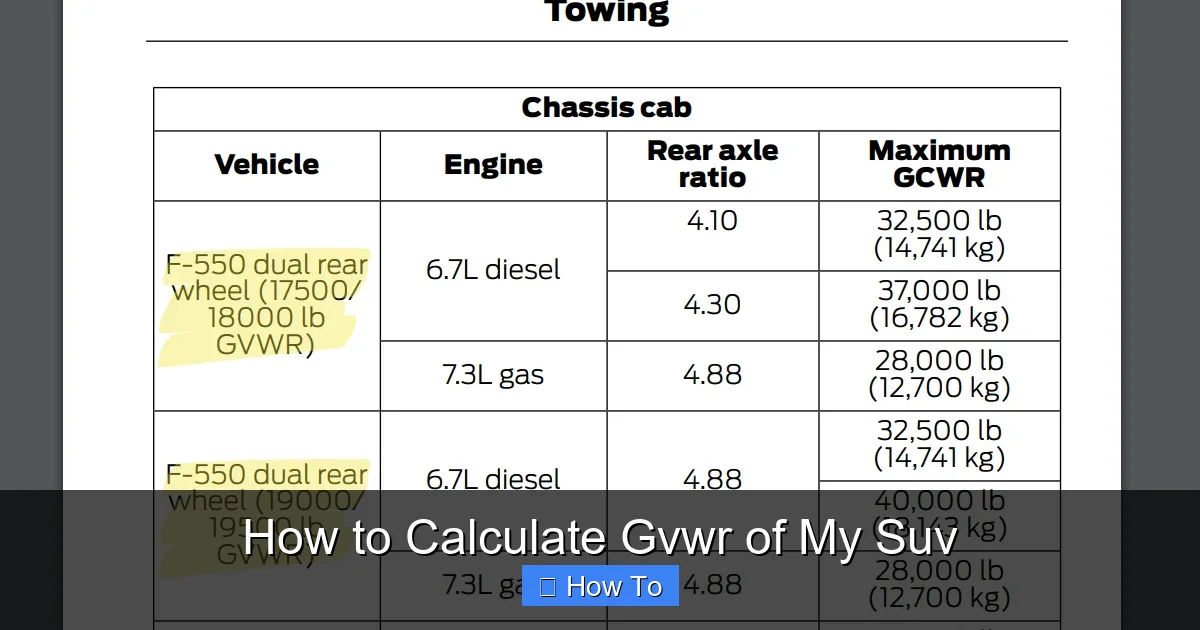
Visual guide about How to Calculate Gvwr of My Suv
Image source: camperfaqs.com
The first step in calculating GVWR of your SUV is finding the official number. Fortunately, manufacturers make this easy by providing GVWR in several standard locations. Here’s where to look:
Check the Driver’s Side Door Jamb
Open the driver’s side door and look at the frame where the door latches. You’ll usually find a sticker or metal plate with vehicle information. This label includes the GVWR, often labeled as “Gross Vehicle Weight Rating” or “GVWR.” It may also show the front and rear GAWR (Gross Axle Weight Ratings), which are important for weight distribution.
For example, a 2023 Toyota Highlander might have a GVWR of 6,000 pounds. This number is set by the factory and doesn’t change unless modified by a certified technician.
Review the Owner’s Manual
If you can’t find the door jamb sticker or it’s damaged, check your owner’s manual. Most manufacturers include a section on vehicle specifications, including GVWR, curb weight, and payload capacity. Look for chapters titled “Vehicle Specifications,” “Capacities,” or “Weight Ratings.”
Tip: If you’ve lost your manual, visit the manufacturer’s website and search by your SUV’s make, model, and year. Many automakers offer free PDF downloads.
Use the VIN Decoder
Your Vehicle Identification Number (VIN) contains encoded information about your SUV, including its GVWR. You can use free online VIN decoders (like those from NHTSA or Edmunds) to extract this data. Simply enter your 17-digit VIN, and the tool will display key specs.
Note: Not all VIN decoders show GVWR, so cross-check with the door jamb or manual if possible.
Contact the Manufacturer or Dealer
If all else fails, call the automaker’s customer service or visit a local dealership. Provide your VIN, and they can look up your SUV’s exact GVWR. This is especially helpful for older models or vehicles with custom builds.
Step 2: Understand the Components of GVWR
Visual guide about How to Calculate Gvwr of My Suv
Image source: parkedinparadise.com
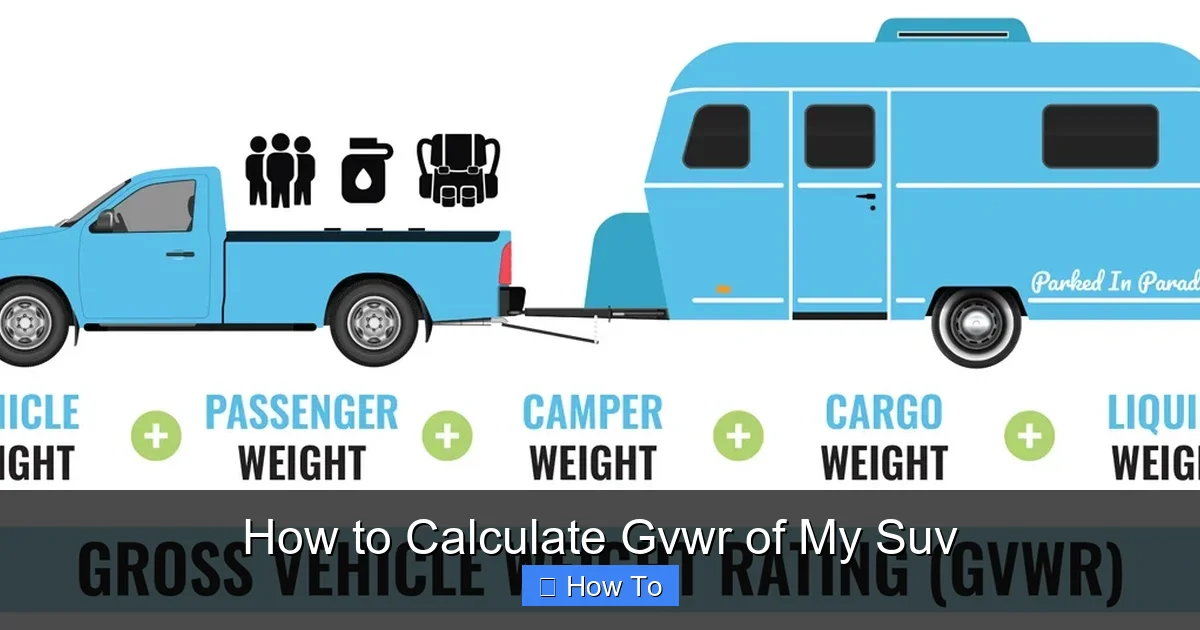
Now that you’ve found your GVWR, it’s important to understand what it includes. GVWR isn’t just the weight of your SUV—it’s the total allowable weight under normal operating conditions. Here’s a breakdown:
Curb Weight
This is the weight of your SUV when it’s empty but fully equipped—fuel tank full, all fluids topped off, and standard equipment installed. Curb weight does not include passengers or cargo.
For example, a Ford Explorer might have a curb weight of 4,500 pounds.
Payload Capacity
Payload is the weight your SUV can carry in addition to its curb weight. It includes passengers, luggage, tools, and any accessories. You can calculate payload using this formula:
Payload = GVWR – Curb Weight
So if your SUV has a GVWR of 6,000 pounds and a curb weight of 4,500 pounds, your payload capacity is 1,500 pounds. That means you can safely carry up to 1,500 pounds of people and gear.
Passenger and Cargo Weight
Every person and item inside your SUV counts toward the payload. On average, assume 150 pounds per passenger (including clothing and personal items). Cargo includes suitcases, coolers, pet carriers, and anything else in the cabin or cargo area.
Tip: Use a bathroom scale to weigh heavy items like coolers or toolboxes before loading.
Fuel and Fluids
Gasoline weighs about 6 pounds per gallon. A full 20-gallon tank adds 120 pounds. Don’t forget engine oil, coolant, and other fluids—they add up over time.
Aftermarket Additions
Roof racks, bull bars, winches, and towing hitches add weight. Even if they’re installed at the factory, they’re included in the curb weight. But if you add them later, they count toward your payload.
Example: A heavy-duty roof rack might weigh 50 pounds. That’s 50 pounds less available for passengers or cargo.
Step 3: Calculate Your SUV’s Actual Weight
Knowing your GVWR is only half the battle. To stay safe, you need to know how much your SUV actually weighs when loaded. Here’s how to do it:
Weigh Your SUV at a Certified Scale
The most accurate way to calculate GVWR of your SUV is to weigh it when fully loaded. Visit a truck stop, landfill, or public weighing station that offers scale services. Many charge $5–$15 for a weigh-in.
When you arrive:
– Load your SUV exactly as you would for a trip (passengers, cargo, full fuel tank).
– Drive onto the scale and record the total weight.
– If possible, get a separate reading for the front and rear axles to check weight distribution.
Compare this number to your GVWR. If the actual weight is close to or over the limit, you need to remove items or redistribute weight.
Estimate Weight Using a Calculator
If you can’t access a scale, estimate your SUV’s weight using this method:
1. Start with the curb weight (from the manual or door jamb).
2. Add the weight of all passengers (150 lbs each is a safe average).
3. Add the weight of cargo (use a scale for heavy items).
4. Add fuel weight (6 lbs per gallon × number of gallons).
5. Add any aftermarket parts.
Example:
– Curb weight: 4,500 lbs
– 4 passengers: 600 lbs
– Cargo: 300 lbs
– Fuel (15 gallons): 90 lbs
– Roof rack: 50 lbs
Total estimated weight: 5,540 lbs
If your GVWR is 6,000 lbs, you’re safely under the limit. But if it’s 5,500 lbs, you’re over—and need to lighten the load.
Use a Portable Wheel Scale (Optional)
For frequent towing or hauling, consider investing in a portable wheel scale. These devices measure the weight on each tire and can help you balance your load. They’re especially useful for RVers and contractors.
Step 4: Account for Towing and Trailer Tongue Weight
Many SUV owners tow trailers, boats, or campers. But towing affects your GVWR because the trailer’s tongue weight (the downward force on the hitch) counts as cargo.
Understand Tongue Weight
Tongue weight is typically 10–15% of the trailer’s total weight. For a 3,000-pound trailer, that’s 300–450 pounds pressing down on your SUV’s rear axle.
This weight is part of your payload—so it reduces how much you can carry inside the vehicle.
Calculate Total Load with a Trailer
To calculate GVWR of your SUV when towing:
1. Weigh your loaded SUV (as described above).
2. Add the tongue weight of the trailer.
3. Compare the total to your GVWR.
Example:
– Loaded SUV weight: 5,200 lbs
– Trailer tongue weight: 400 lbs
Total: 5,600 lbs
If your GVWR is 6,000 lbs, you’re still safe. But if it’s 5,500 lbs, you’re over the limit—even if the trailer itself is within towing capacity.
Don’t Confuse Towing Capacity with GVWR
Towing capacity is the maximum weight your SUV can pull. GVWR is the maximum weight your SUV can carry. They’re related but not the same.
For instance, an SUV might have a towing capacity of 5,000 pounds but a GVWR of 6,000 pounds. If the trailer tongue weight is 500 pounds, and your SUV already weighs 5,600 pounds, you’re over GVWR—even though the trailer is within towing limits.
Always check both numbers before towing.
Step 5: Adjust for Aftermarket Modifications
Adding accessories can change your SUV’s weight and handling. Here’s how to account for them:
Heavy Accessories Reduce Payload
Items like steel bumpers, lift kits, or auxiliary fuel tanks add weight. A 100-pound bumper means 100 pounds less available for passengers or cargo.
Some Mods Require GVWR Recalculation
If you install a lift kit or heavy-duty suspension, the manufacturer may provide a new GVWR. Check with the installer or parts supplier.
In some cases, you may need to have your vehicle re-certified by a licensed engineer, especially for commercial use.
Check Warranty and Insurance
Modifications can affect your warranty or insurance coverage. Inform your insurer if you’ve made significant changes.
Troubleshooting Common GVWR Issues
Even with careful planning, you might run into problems. Here’s how to handle common issues:
“I Can’t Find the GVWR on the Door Jamb”
The sticker may be faded, damaged, or missing. Try the owner’s manual, VIN decoder, or contact the manufacturer.
“My Loaded Weight Is Close to GVWR”
Redistribute weight to the front axle if possible. Move heavy items forward and avoid overloading the rear. Consider removing non-essential items.
“I’m Over GVWR—What Now?”
Immediately reduce weight. Remove cargo, transfer items to another vehicle, or make multiple trips. Never drive over GVWR.
“My SUV Feels Unstable When Loaded”
This could indicate uneven weight distribution or worn suspension. Have your vehicle inspected by a mechanic.
Final Tips for Safe SUV Loading
– Always weigh your SUV when fully loaded at least once a year.
– Use cargo nets or straps to secure items and prevent shifting.
– Keep heavy items low and centered to improve stability.
– Check tire pressure regularly—underinflated tires increase the risk of blowouts.
– Educate all passengers about weight limits and safe loading practices.
Conclusion
Learning how to calculate GVWR of your SUV is a vital skill for any driver. It ensures your vehicle operates safely, legally, and efficiently. By following these steps—locating your GVWR, understanding its components, weighing your loaded SUV, and accounting for towing and modifications—you can avoid overloading and protect yourself, your passengers, and others on the road.
Remember, GVWR isn’t just a number—it’s a safety boundary. Respect it, and your SUV will serve you well for years to come.