
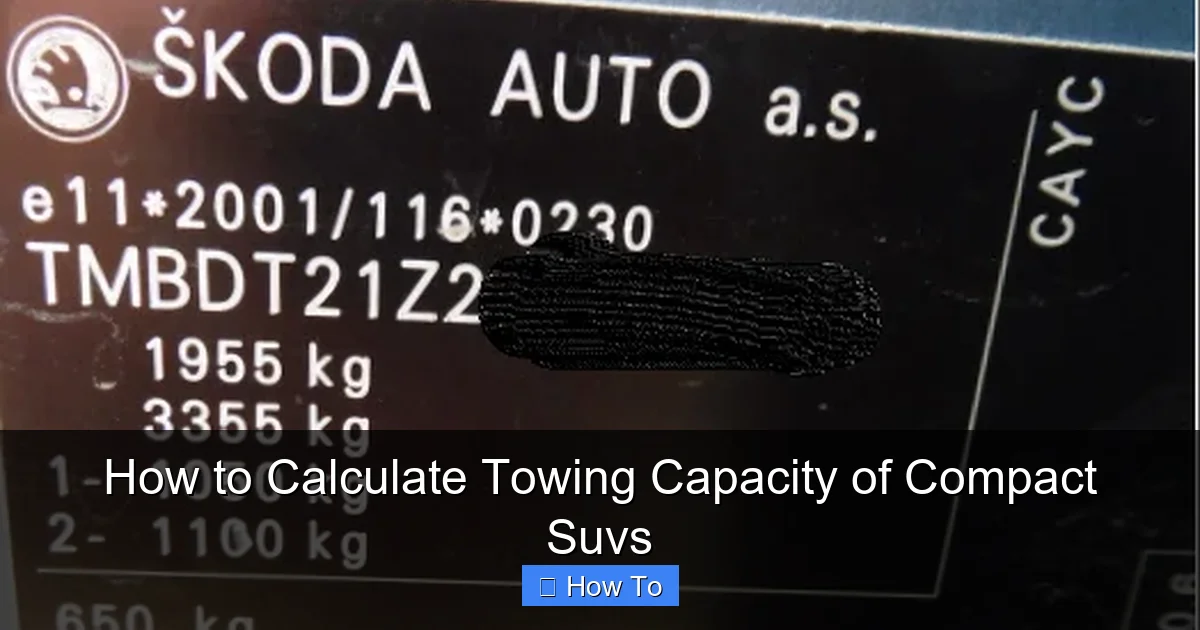
This guide walks you through how to calculate towing capacity of compact SUVs using your vehicle’s specs, owner’s manual, and online tools. You’ll learn to match your SUV’s limits with real-world towing needs, ensuring safety and performance.
Key Takeaways
- Check your owner’s manual first: The manufacturer lists the official towing capacity based on your SUV’s model, engine, and drivetrain.
- Understand the difference between curb weight and GVWR: GVWR (Gross Vehicle Weight Rating) helps determine how much your SUV can safely carry, including passengers, cargo, and tongue weight.
- Use the trailer weight formula: Subtract your SUV’s curb weight and payload from its GVWR to estimate safe towing limits.
- Consider drivetrain and engine type: All-wheel drive (AWD) and turbocharged engines often increase towing capacity compared to front-wheel drive (FWD) or base engines.
- Factor in trailer type: Travel trailers, boat trailers, and utility trailers have different weight distributions and affect towing differently.
- Never exceed the lowest rating: Always follow the most restrictive limit among your SUV, hitch, and trailer.
- Use online calculators and dealer tools: Many automakers offer online towing guides to help you find accurate numbers quickly.
How to Calculate Towing Capacity of Compact SUVs
If you’re thinking about towing a small trailer, pop-up camper, or even a lightweight boat with your compact SUV, knowing how to calculate towing capacity is essential. Unlike full-size trucks, compact SUVs have lower towing limits—but that doesn’t mean they can’t handle light to moderate loads safely. The key is understanding your vehicle’s capabilities and using the right tools to make smart decisions.
In this guide, you’ll learn a clear, step-by-step method to determine your compact SUV’s towing capacity. We’ll cover everything from reading your owner’s manual to using online calculators, factoring in real-world conditions, and avoiding common mistakes. Whether you’re hauling a jet ski to the lake or towing a small camper for a weekend getaway, this guide will help you do it safely and confidently.
Step 1: Find Your SUV’s Official Towing Capacity
Visual guide about How to Calculate Towing Capacity of Compact Suvs
Image source: gomyreview.com
The first and most reliable way to determine your compact SUV’s towing capacity is to check the manufacturer’s specifications. This number is set by the automaker and reflects the maximum weight your vehicle can safely tow under ideal conditions.
Check the Owner’s Manual
Your owner’s manual is the best place to start. Look for a section titled “Towing,” “Trailer Towing,” or “Payload and Towing.” Most manuals include a table that lists towing capacities based on:
- Engine type (e.g., 2.0L turbo vs. 1.5L)
- Drivetrain (FWD, AWD, 4WD)
- Transmission (automatic vs. manual)
- Trim level
For example, a 2023 Honda CR-V with a 1.5L turbo engine and AWD might have a towing capacity of 1,500 pounds, while the same model with a towing package could reach 2,000 pounds.
Look for the Towing Package
Some compact SUVs come with an optional towing package that increases capacity. This package often includes:
- Upgraded cooling system
- Heavy-duty alternator
- Trailer hitch receiver
- Wiring harness for trailer lights
- Stabilizer bars or reinforced suspension
If your SUV has this package, the towing capacity will be higher. Always confirm whether your vehicle includes it—this info is usually in the manual or on the window sticker (Monroney label) from when you bought the car.
Visit the Manufacturer’s Website
If you no longer have your manual, go to the automaker’s official website. Most brands have a “Build & Price” or “Specifications” section where you can enter your SUV’s year, make, model, and trim to find towing details.
For instance, Toyota’s website lets you compare the 2024 RAV4 LE (1,500 lbs) with the RAV4 Hybrid AWD (3,500 lbs). That’s a big difference—showing how powertrain choices affect towing.
Step 2: Understand Key Weight Terms
Visual guide about How to Calculate Towing Capacity of Compact Suvs
Image source: cstatic-images.com
To calculate towing capacity accurately, you need to understand a few important weight terms. These aren’t just numbers—they’re safety limits that protect your vehicle and everyone on the road.
Gross Vehicle Weight Rating (GVWR)
GVWR is the maximum total weight your SUV can safely carry, including:
- The vehicle itself (curb weight)
- Passengers
- Cargo
- Fuel
- Tongue weight (the downward force from the trailer on the hitch)
You can find GVWR on the driver’s side door jamb sticker (usually near the latch). It’s listed in pounds or kilograms.
For example, a 2022 Subaru Forester might have a GVWR of 4,715 lbs.
Curb Weight
Curb weight is the weight of the vehicle when it’s empty—no passengers, no cargo, but with a full tank of gas and all standard fluids. This number is often listed in the manual or on manufacturer websites.
Using the same Forester example, the curb weight might be 3,500 lbs.
Payload Capacity
Payload is the total weight your SUV can carry in people and gear. It’s calculated as:
Payload = GVWR – Curb Weight
So, if your GVWR is 4,715 lbs and curb weight is 3,500 lbs, your payload is 1,215 lbs.
This includes everything you put in the car—so if you have four passengers (600 lbs), luggage (200 lbs), and a dog (50 lbs), that’s 850 lbs used. That leaves 365 lbs for tongue weight and other cargo.
Tongue Weight
Tongue weight is the downward force the trailer exerts on the hitch. It should be 10% to 15% of the total trailer weight.
For example, if you’re towing a 1,500-pound trailer, the tongue weight should be 150 to 225 pounds.
This weight counts toward your payload—so if your payload is 1,215 lbs and you’re using 850 lbs for people and gear, you only have 365 lbs left. That means you can safely tow a trailer with up to about 2,400 lbs total weight (since 15% of 2,400 is 360 lbs). But wait—your SUV’s official towing capacity might be lower. Always follow the lowest limit.
Step 3: Use the Towing Capacity Formula
Now that you know the key terms, you can use a simple formula to estimate your safe towing limit.
Safe Towing Capacity = GVWR – Curb Weight – Payload Used – Tongue Weight Reserve
But here’s the catch: this formula gives you a theoretical number. The real limit is the manufacturer’s stated towing capacity. So always use the lower of the two.
Let’s walk through an example.
Example Calculation
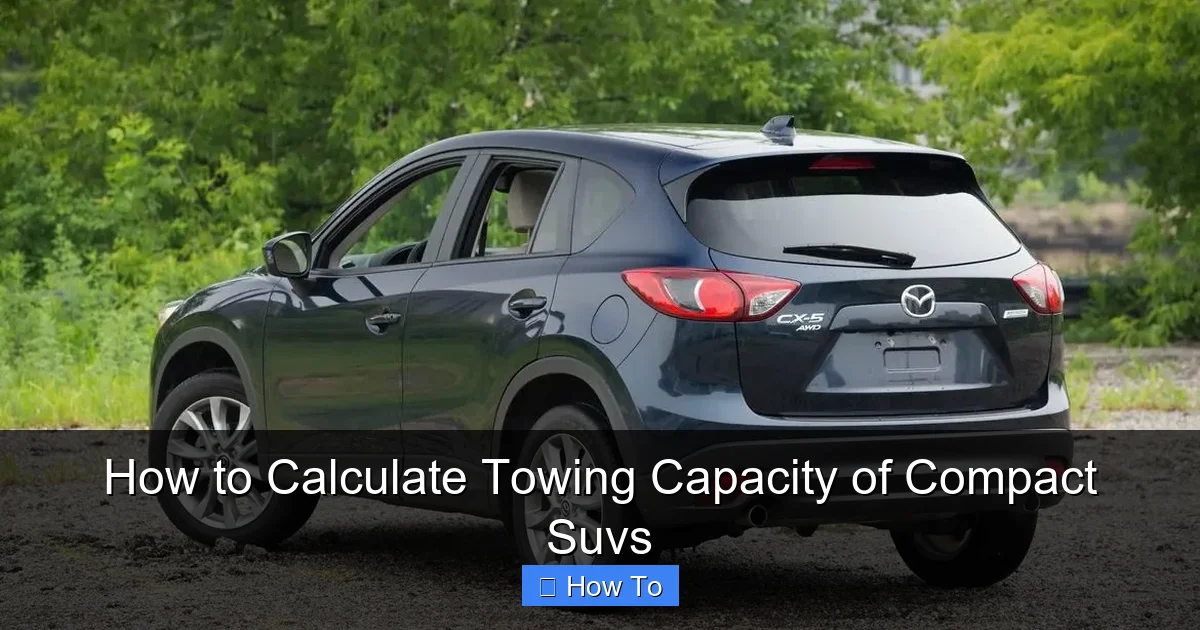
Say you drive a 2023 Mazda CX-5 with these specs:
- GVWR: 4,620 lbs
- Curb weight: 3,550 lbs
- Payload capacity: 1,070 lbs
- Official towing capacity: 2,000 lbs (with towing package)
You’re planning a trip with:
- Two passengers: 300 lbs
- Luggage and gear: 200 lbs
- Dog: 50 lbs
- Total payload used: 550 lbs
You want to tow a small travel trailer weighing 1,800 lbs. Tongue weight at 10% = 180 lbs.
Now calculate:
Available for tongue weight = Payload – Used payload = 1,070 – 550 = 520 lbs
Since 180 lbs is less than 520 lbs, you’re within payload limits.
But your official towing capacity is 2,000 lbs, and your trailer is 1,800 lbs—so you’re under that too.
✅ This setup is safe.
Now imagine you add another passenger and more gear, bringing used payload to 700 lbs.
Available for tongue weight = 1,070 – 700 = 370 lbs
Still enough for 180 lbs tongue weight.
But what if your trailer weighs 2,200 lbs? Tongue weight = 220 lbs.
You’re still under payload, but now you’re over the 2,000-lb towing limit.
❌ Not safe—don’t tow it.
Step 4: Consider Your SUV’s Drivetrain and Engine
Not all compact SUVs are created equal. Two models with the same name can have very different towing capacities based on their powertrain.
Engine Type Matters
Larger or turbocharged engines generally provide more torque, which is essential for towing. For example:
- A 2.5L naturally aspirated engine might tow 1,500 lbs
- A 2.5L turbocharged engine in the same SUV might tow 3,500 lbs
Check your engine size and type in the manual or on the hood badge.
Drivetrain Impact
All-wheel drive (AWD) or four-wheel drive (4WD) improves traction, especially when starting from a stop or driving on wet or gravel roads. Many compact SUVs offer higher towing capacities with AWD.
For instance:
- Nissan Rogue FWD: 1,000–1,500 lbs
- Nissan Rogue AWD: 1,500 lbs (with towing package)
While the difference isn’t huge, AWD can make towing feel more stable and confident.
Transmission and Cooling
Towing puts extra strain on your transmission and engine. Some SUVs with towing packages include:
- Transmission cooler
- Engine oil cooler
- Upgraded radiator
These help prevent overheating during long climbs or hot weather. If your SUV doesn’t have these, avoid towing near its maximum capacity for extended periods.
Step 5: Match Your Trailer Type to Your SUV
Different trailers behave differently on the road. The type of trailer you’re towing affects how your SUV handles and how much weight it can safely pull.
Utility Trailers
These are open, flatbed trailers used for hauling ATVs, lawn equipment, or furniture. They’re usually lightweight (500–1,500 lbs) and have low wind resistance.
✅ Great for compact SUVs.
Boat Trailers
Boat trailers can be tricky because the weight distribution changes when you load or unload the boat. A 1,500-pound boat might require a 2,000-pound trailer.
Also, launching and retrieving from a ramp puts extra stress on your SUV’s transmission and brakes.
💡 Tip: Use a trailer with brakes if the total weight exceeds 1,000 lbs.
Travel Trailers and Pop-Up Campers
These are popular with compact SUV owners. Pop-up camper: lightweight (1,000–2,000 lbs), aerodynamic.
Hard-sided travel trailers: heavier (2,000–4,000 lbs), more wind drag.
Even if your SUV can tow 3,500 lbs, a 3,000-pound travel trailer with high sides can feel unstable in crosswinds.
💡 Tip: Choose a trailer with a low center of gravity and consider a weight distribution hitch if needed.
Tongue Weight and Weight Distribution
Improperly loaded trailers can cause fishtailing or make your SUV hard to steer. Always:
- Load 60% of the weight in the front half of the trailer
- Use a brake controller if your trailer has electric brakes
- Check that the trailer sits level when hitched
Step 6: Use Online Tools and Dealer Resources
Don’t rely on guesswork. Use digital tools to double-check your calculations.
Manufacturer Towing Guides
Most automakers offer online towing guides. For example:
These tools let you enter your exact model and options to get precise towing numbers.
Third-Party Calculators
Websites like:
- TowingCapacities.com
- TrailerLife.com’s Towing Guide
- Edmunds Towing Calculator
Allow you to compare multiple SUVs and see real-world towing data.
Visit a Dealership
If you’re unsure, talk to a service advisor at your local dealership. They can look up your VIN and confirm your SUV’s towing specs, including whether it has a towing package.
Step 7: Perform a Real-World Safety Check
Even with perfect calculations, always test your setup before a long trip.
Do a Test Drive
Hitch up your trailer (even empty) and drive around your neighborhood. Check:
- How the SUV handles turns
- Brake response (allow extra stopping distance)
- Engine temperature (watch for overheating)
- Wind stability (especially on highways)
If the SUV feels sluggish or unstable, you may be overloaded.
Check Your Hitch and Wiring
Make sure:
- The hitch is rated for your trailer’s weight
- The ball size matches the trailer coupler (usually 2” or 1-7/8”)
- Trailer lights work (brake, turn, and running lights)
- Safety chains are crossed under the coupler
Weigh Your Load
The only way to know for sure is to weigh your fully loaded SUV and trailer at a public scale (found at truck stops or recycling centers).
Weigh:
- Your SUV with passengers, cargo, and fuel
- The trailer (loaded)
- The combined rig (if possible)
Compare these weights to your GVWR, trailer rating, and towing capacity.
Troubleshooting Common Towing Issues
Even with careful planning, problems can arise. Here’s how to handle them.
Problem: SUV Feels Sluggish or Overheats
Cause: Overloading or lack of cooling.
Solution:
- Reduce cargo or trailer weight
- Install a transmission cooler
- Avoid towing in extreme heat or uphill terrain
Problem: Trailer Sways or Fishtails
Cause: Improper weight distribution or high speed.
Solution:
- Load more weight toward the front of the trailer
- Use a sway control device
- Reduce speed, especially in wind
Problem: Brakes Feel Weak
Cause: SUV brakes aren’t designed to stop a trailer.
Solution:
- Install a brake controller
- Use a trailer with electric brakes
- Allow extra stopping distance
Problem: Hitch Sags or Rides Low
Cause: Too much tongue weight or weak suspension.
Solution:
- Use a weight distribution hitch
- Check rear suspension for wear
- Reduce tongue weight by moving cargo forward
Conclusion
Calculating the towing capacity of your compact SUV doesn’t have to be complicated. By following these steps—checking your manual, understanding weight terms, using the right formula, and testing your setup—you can tow safely and confidently.
Remember: never exceed the manufacturer’s stated towing capacity, even if your math says you can. Compact SUVs are capable, but they’re not trucks. Respect their limits, and they’ll serve you well for years.
Whether you’re towing a small camper, a boat, or a utility trailer, take the time to do it right. Your safety, your vehicle, and everyone on the road will thank you.