
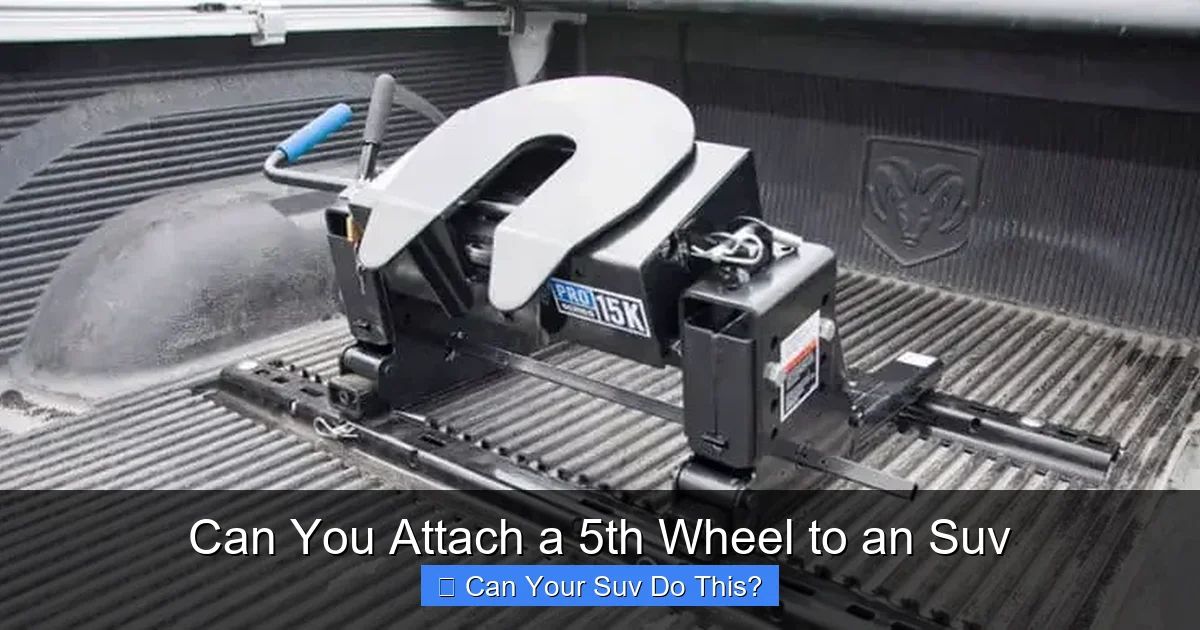
Yes, you can attach a 5th wheel to an SUV—but only if it’s a heavy-duty model with proper towing capacity and a reinforced frame. Most standard SUVs aren’t built for this, so understanding your vehicle’s limits is crucial before attempting any setup.
So, you’ve got an SUV—maybe a big one like a Chevy Tahoe or a Ford Expedition—and you’re dreaming of hitting the open road with a cozy 5th wheel camper in tow. It sounds awesome, right? You imagine pulling up to a scenic campsite, unhitching, and stepping into your home away from home. But here’s the real question: Can you actually attach a 5th wheel to an SUV?
The short answer? Yes—but with major caveats. Unlike pickup trucks, which are naturally built to handle the unique demands of 5th wheel towing, most SUVs aren’t designed for this kind of setup. That doesn’t mean it’s impossible, but it does mean you’ll need to do your homework, make some serious modifications, and possibly rethink your towing strategy altogether.
In this guide, we’ll walk you through everything you need to know about attaching a 5th wheel to an SUV. We’ll cover the technical requirements, the risks involved, the best SUV models for the job, and whether it’s even worth the effort. Whether you’re a weekend warrior or a full-time RVer, this article will help you make an informed decision—so you don’t end up stranded (or worse) on the side of the highway.
Let’s dive in.
Key Takeaways
- Not all SUVs can tow a 5th wheel: Only heavy-duty SUVs like the Ford Expedition, Chevrolet Tahoe, or GMC Yukon with high towing ratings are viable candidates.
- Frame reinforcement is essential: Standard SUV frames aren’t designed for the concentrated stress of a 5th wheel hitch; modifications are often required.
- Proper hitch installation matters: A professionally installed, weight-rated 5th wheel hitch is non-negotiable for safety and performance.
- Payload capacity is more critical than towing capacity: The SUV must handle the hitch weight (typically 15–25% of the trailer’s total weight) without exceeding its payload limit.
- Legal and insurance considerations apply: Some states have specific regulations for 5th wheel towing with SUVs, and your insurance may require updates.
- Alternative options exist: If your SUV isn’t suitable, consider a travel trailer or upgrading to a pickup truck for safer, easier towing.
- Professional consultation is recommended: Always consult a certified mechanic or towing specialist before modifying your SUV for 5th wheel use.
📑 Table of Contents
What Is a 5th Wheel Trailer?
Before we get into whether your SUV can handle one, let’s make sure we’re on the same page about what a 5th wheel actually is.
A 5th wheel trailer is a type of recreational vehicle (RV) that’s designed to be towed by a pickup truck using a special hitch mounted in the truck bed. The name comes from the old-fashioned term for a type of trailer coupling used in horse-drawn wagons—hence “5th wheel.” These trailers are typically larger and more luxurious than standard travel trailers, often featuring multiple slide-outs, full kitchens, master bedrooms, and even residential-style appliances.
Because of their size and weight, 5th wheels require a robust towing vehicle. They connect via a kingpin that locks into a hitch mounted in the bed of a truck. This setup allows for better weight distribution and improved stability compared to bumper-pull trailers. But here’s the catch: the hitch must be mounted directly over or just behind the rear axle, which is why pickup trucks are the go-to choice.
SUVs, on the other hand, usually have enclosed cargo areas and no truck bed. That means you can’t simply bolt a 5th wheel hitch into the back like you would with a Ford F-150 or Ram 2500. So, how do people even attempt this? And is it safe?
Can Your SUV Actually Tow a 5th Wheel?

Visual guide about Can You Attach a 5th Wheel to an Suv
Image source: metalfixes.com
Now for the million-dollar question: Can your SUV tow a 5th wheel? The answer depends on several factors—most importantly, the make, model, and year of your SUV, as well as its towing and payload capacities.
Let’s break it down.
Towing Capacity vs. Payload Capacity
When evaluating whether your SUV can handle a 5th wheel, you need to look at two key numbers: towing capacity and payload capacity.
– Towing capacity refers to the maximum weight your SUV can pull behind it. This is usually listed in the owner’s manual or on the manufacturer’s website. For example, a 2023 Ford Expedition Max can tow up to 9,300 pounds when properly equipped.
– Payload capacity, however, is often the limiting factor. This is the total weight your SUV can carry inside the vehicle—including passengers, cargo, fuel, and the tongue weight of the trailer. For 5th wheels, the hitch weight (also called pin weight) typically ranges from 15% to 25% of the trailer’s total weight. So, a 10,000-pound 5th wheel could exert 1,500 to 2,500 pounds of downward force on your SUV’s rear axle.
Most SUVs have a payload capacity between 1,000 and 2,000 pounds. Once you subtract the weight of passengers, gear, and fuel, you might only have 800–1,200 pounds left for the hitch weight. That’s not enough for most 5th wheels.
SUV Frame Strength and Design
Another critical issue is the structural integrity of your SUV’s frame. Pickup trucks are built with reinforced frames designed to handle the concentrated stress of a 5th wheel hitch. SUVs, especially unibody models (like the Honda Pilot or Toyota Highlander), are not.
Even body-on-frame SUVs (like the Chevrolet Tahoe or Ford Expedition) aren’t typically engineered to support a 5th wheel hitch in the cargo area. The rear suspension and frame rails aren’t reinforced for the kind of point loading that occurs when a 5th wheel is attached. Without proper reinforcement—such as welding in additional crossmembers or using a custom hitch system—you risk damaging your vehicle or causing a catastrophic failure while driving.
Which SUVs Are Best Suited for 5th Wheel Towing?
That said, not all hope is lost. Some heavy-duty SUVs come close to meeting the requirements—especially if they’re based on truck platforms.
Here are a few examples:
– Ford Expedition (2018–present): Built on the same platform as the Ford F-150, the Expedition has a strong frame and high towing capacity (up to 9,300 lbs). With aftermarket modifications, some owners have successfully installed 5th wheel hitches—but only with professional reinforcement.
– Chevrolet Tahoe / GMC Yukon (2021–present): These full-size SUVs share architecture with the Silverado/Sierra trucks. They offer up to 8,400 lbs of towing capacity and decent payload (around 1,700–1,900 lbs). Again, modifications are required.
– Lincoln Navigator: Similar to the Expedition, the Navigator has the power and frame strength to potentially handle a 5th wheel—but again, only with significant upgrades.
Even with these models, you’re pushing the limits. Most manufacturers explicitly state that their SUVs are not designed for 5th wheel towing. Attempting it voids warranties and increases liability.
How to Attach a 5th Wheel to an SUV (If You Must)
If you’ve weighed the risks and still want to proceed, here’s how it’s typically done—and what you’ll need.
Step 1: Confirm Your SUV’s Capabilities
Before spending a dime, consult your owner’s manual and contact the manufacturer. Ask specifically: “Is this vehicle approved for 5th wheel towing?” If the answer is no—or if it’s unclear—proceed with extreme caution.
Use online towing calculators (like those from RV.net or the manufacturer) to estimate your actual towing and payload limits based on your configuration (engine, drivetrain, axle ratio, etc.).
Step 2: Choose the Right Hitch System
You’ll need a specialized 5th wheel hitch designed for SUVs. These aren’t common, but a few companies offer custom solutions:
– REESE Specialty SUV 5th Wheel Hitches: Designed for select Ford and GM SUVs, these hitches mount in the cargo area and include reinforcement brackets.
– Curt SUV 5th Wheel Hitches: Offer models compatible with certain Expedition and Yukon models, often requiring frame modifications.
These hitches are expensive—typically $2,000–$4,000—and must be installed by a certified professional.
Step 3: Reinforce the Frame and Suspension
This is non-negotiable. A standard SUV frame will not handle the stress. You’ll likely need:
– Welded steel reinforcement plates along the frame rails
– Additional crossmembers to distribute the load
– Upgraded rear suspension (airbags or heavy-duty shocks)
Some owners also install a gooseneck adapter in the cargo area, which can be safer than a traditional 5th wheel setup—but still requires frame work.
Step 4: Install Weight Distribution and Braking Systems
Even with a reinforced frame, you’ll need:
– A brake controller (for electric or hydraulic trailer brakes)
– A weight distribution hitch (though less common with 5th wheels, it can help with sway)
– A sway control system
Also, ensure your SUV has trailer brake provisions. Many newer models do, but older ones may require an aftermarket controller.
Step 5: Test and Inspect Regularly
After installation, take your rig to a certified RV inspector. They’ll check the hitch, frame, wiring, and brakes. Then, take short test drives before committing to a long trip.
Inspect the hitch, frame, and suspension every few thousand miles. Look for cracks, rust, or loose bolts.
Risks and Downsides of Towing a 5th Wheel with an SUV
Let’s be honest: this isn’t a decision to take lightly. There are real risks involved.
Safety Concerns
The biggest risk is structural failure. If your SUV’s frame isn’t properly reinforced, the constant stress from the 5th wheel can cause cracks, bends, or even breakage—especially on rough roads or during sudden stops.
Additionally, SUVs have a higher center of gravity than trucks. Adding a heavy load behind and above the rear axle can make the vehicle unstable, increasing the risk of rollover or loss of control.
Warranty and Insurance Issues
Most manufacturers will void your powertrain or frame warranty if you modify your SUV for 5th wheel towing. Insurance companies may also deny claims if they determine the modification contributed to an accident.
Always notify your insurer before making changes. You may need a specialized RV policy.
Reduced Maneuverability and Fuel Economy
Even if your SUV can technically tow the weight, you’ll notice:
– Slower acceleration
– Reduced braking performance
– Poorer handling, especially in wind or on hills
– Significantly lower fuel economy (expect 10–15 mpg or less)
Parking and turning will also be more difficult due to the extended length.
Limited Availability of Compatible Trailers
Many 5th wheel manufacturers design their trailers for truck towing. Some may not recommend or warranty their products when towed by an SUV—even with modifications.
Alternatives to 5th Wheel Towing with an SUV
Given all these challenges, you might be wondering: Is there a better way? Absolutely.
Option 1: Use a Travel Trailer
A bumper-pull travel trailer is the most common and practical option for SUV owners. These trailers connect to a standard hitch receiver at the rear of the vehicle and distribute weight more evenly.
Pros:
– No frame modifications needed
– Compatible with most SUVs (if within towing limits)
– Easier to maneuver and park
– Lower cost
Cons:
– Less living space than a 5th wheel
– Can cause sway if not properly loaded
Many SUVs can comfortably tow a 7,000–8,000 lb travel trailer. For example, a Toyota Highlander can handle a small to mid-size trailer, while a Ford Expedition can tow a larger model with slide-outs.
Option 2: Upgrade to a Pickup Truck
If you’re serious about 5th wheel living, consider trading your SUV for a heavy-duty pickup. Trucks like the Ford F-250, Ram 2500, or Chevrolet Silverado 2500 are built for this purpose.
Pros:
– Designed for 5th wheel towing
– Stronger frame and suspension
– Easier hitch installation
– Better stability and safety
Cons:
– Higher upfront cost
– Less passenger/cargo space inside
Many RVers find that the trade-off is worth it for the peace of mind and performance.
Option 3: Use a Tow Dolly or Trailer Converter
Some owners use a tow dolly to convert a 5th wheel into a bumper-pull setup—but this is rare, complex, and not recommended for long-term use. It also doesn’t solve the payload issue.
Real-World Examples: Who’s Doing It?
Despite the challenges, some adventurous RVers have successfully attached 5th wheels to SUVs. Here are a few real-world examples:
– The “Expedition Camper” Build: A YouTube creator modified a 2020 Ford Expedition with a custom hitch, frame reinforcements, and air suspension. He tows a 32-foot 5th wheel across the country—but admits it’s a “high-maintenance” setup requiring constant checks.
– Yukon XL Conversion: A family in Colorado installed a Curt SUV 5th wheel hitch on their GMC Yukon XL. They use it for weekend trips but avoid highways and steep grades due to handling concerns.
– The Cautionary Tale: A forum user reported cracking his Tahoe’s frame after just 5,000 miles of 5th wheel towing. He now uses a travel trailer instead.
These stories show that while it’s possible, it’s not for everyone—and definitely not for the faint of heart.
Final Verdict: Should You Do It?
So, can you attach a 5th wheel to an SUV? Technically, yes—but should you?
Only if:
– You drive a heavy-duty, body-on-frame SUV with high towing and payload ratings
– You’re willing to invest $5,000–$10,000 in modifications and professional installation
– You accept the risks to safety, warranty, and insurance
– You plan to use it infrequently and on easy terrain
For most people, the answer is no. The complexity, cost, and risk simply aren’t worth it when safer, simpler alternatives exist.
If you’re set on 5th wheel living, your best bet is to upgrade to a capable pickup truck. If you love your SUV and want to travel, a well-matched travel trailer is a far more practical and enjoyable option.
At the end of the day, the goal is to enjoy the journey—not stress over whether your vehicle will hold up. Choose wisely, tow safely, and happy camping!
Frequently Asked Questions
Can any SUV tow a 5th wheel?
No, not all SUVs can tow a 5th wheel. Only heavy-duty, body-on-frame models like the Ford Expedition or Chevrolet Tahoe have the potential—and even then, modifications are required.
What’s the main challenge of attaching a 5th wheel to an SUV?
The biggest challenge is payload capacity. Most SUVs can’t handle the hitch weight (15–25% of the trailer’s total weight) without exceeding their limits, even if their towing capacity seems sufficient.
Do I need to modify my SUV’s frame?
Yes, frame reinforcement is essential. Standard SUV frames aren’t designed for the concentrated stress of a 5th wheel hitch, so welding in additional supports is typically required.
Is it legal to tow a 5th wheel with an SUV?
It may be legal in some states, but regulations vary. Always check local laws and ensure your setup meets safety standards. Some states require specific lighting, braking, or hitch certifications.
Will my insurance cover a modified SUV towing a 5th wheel?
Possibly—but only if you inform your insurer and update your policy. Many standard auto policies exclude modified vehicles or commercial/RV use, so a specialized RV policy may be needed.
What’s a safer alternative to 5th wheel towing with an SUV?
A bumper-pull travel trailer is the safest and most practical alternative. It works with most SUVs, requires no frame modifications, and offers a good balance of space and maneuverability.