
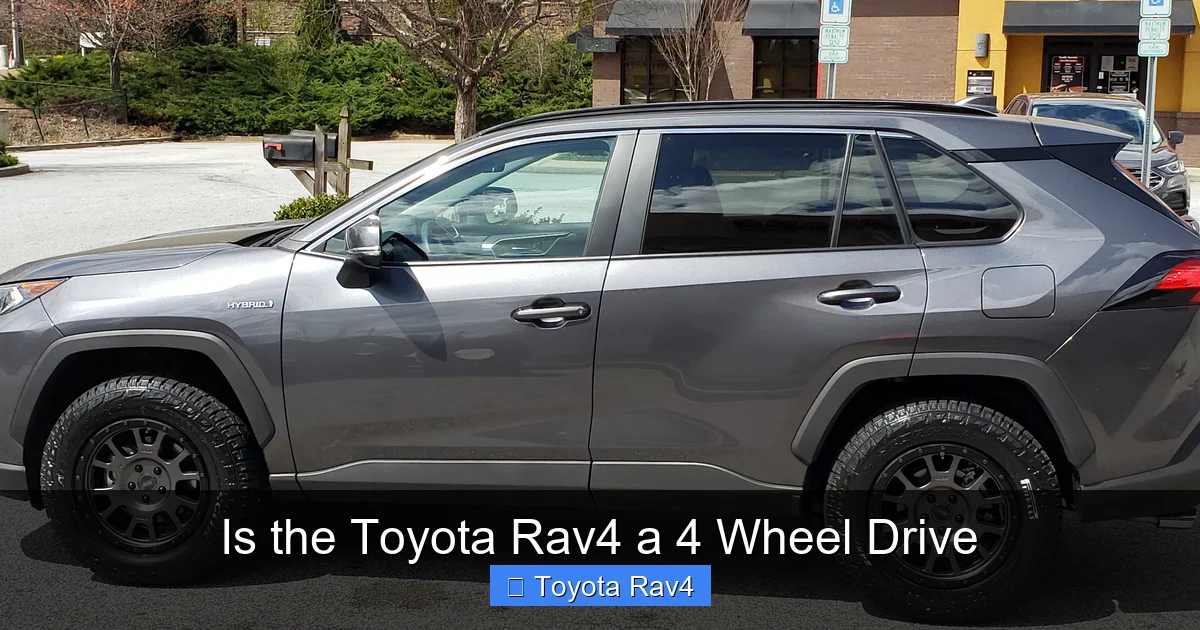
The Toyota RAV4 is not a traditional 4 wheel drive (4WD) vehicle but comes with an advanced all-wheel drive (AWD) system in most trims. This intelligent AWD setup provides excellent traction in rain, snow, and light off-road conditions, making it ideal for everyday drivers who want confidence without the complexity of 4WD.
Key Takeaways
- RAV4 uses AWD, not 4WD: The Toyota RAV4 features an all-wheel drive system, not a traditional four-wheel drive setup, which is better suited for on-road and light off-road use.
- Multiple AWD options available: Depending on the model year and trim, the RAV4 offers Dynamic Torque Vectoring AWD, AWD with rear driveline disconnect, and hybrid-specific E-Four AWD.
- Excellent for bad weather: The AWD system automatically sends power to the wheels with the most grip, improving safety in rain, snow, and icy conditions.
- Not built for serious off-roading: While capable on gravel, dirt, and snow-covered roads, the RAV4 isn’t designed for extreme off-road terrain like rock crawling or deep mud.
- Fuel efficiency remains strong: Thanks to smart AWD technology that disengages when not needed, the RAV4 maintains impressive fuel economy even with AWD.
- Hybrid models include AWD: Even the RAV4 Hybrid comes with an electric AWD system (E-Four), giving all trims access to enhanced traction.
- Easy to use with no driver input: Unlike 4WD systems that require manual engagement, the RAV4’s AWD works automatically—no buttons or levers needed.
📑 Table of Contents
- Is the Toyota RAV4 a 4 Wheel Drive?
- Understanding AWD vs. 4WD: What’s the Difference?
- Toyota RAV4 AWD Systems Explained
- Real-World Performance: How the RAV4 Handles in Tough Conditions
- Fuel Efficiency and AWD: Can You Have Both?
- Who Should Choose the RAV4 with AWD?
- Conclusion: Is the RAV4 Right for You?
Is the Toyota RAV4 a 4 Wheel Drive?
If you’re shopping for a compact SUV that can handle rain-slicked highways, snowy mountain passes, or the occasional gravel road trip, you’ve probably asked: *Is the Toyota RAV4 a 4 wheel drive?* It’s a smart question—especially if you live in an area with unpredictable weather or enjoy weekend adventures beyond the pavement.
The short answer? No, the Toyota RAV4 is not a traditional 4 wheel drive (4WD) vehicle. But that doesn’t mean it can’t handle tough conditions. In fact, the RAV4 comes equipped with a highly capable all-wheel drive (AWD) system that offers many of the same benefits as 4WD—without the complexity or fuel penalty. This AWD technology has evolved significantly over the years, making the RAV4 one of the most versatile and dependable compact SUVs on the market.
So what’s the difference between AWD and 4WD? And why does it matter for your driving experience? Let’s break it down in simple terms. 4WD systems are typically found in trucks and serious off-road vehicles. They send equal power to all four wheels and are often manually engaged—great for rock crawling or deep mud, but overkill for daily commuting. AWD, on the other hand, is designed for on-road performance and automatic traction management. It constantly monitors wheel slip and redirects power where it’s needed most, all without driver input.
The RAV4’s AWD system strikes a perfect balance between capability and convenience. Whether you’re driving through a thunderstorm, navigating a snowy driveway, or taking a scenic backroad detour, the RAV4 gives you confidence behind the wheel. And with multiple AWD configurations across different trims and powertrains—including hybrid models—there’s a RAV4 to match nearly every lifestyle.
Understanding AWD vs. 4WD: What’s the Difference?

Visual guide about Is the Toyota Rav4 a 4 Wheel Drive
Image source: cdn.dealeraccelerate.com
Before diving deeper into the RAV4’s capabilities, it’s important to understand the key differences between all-wheel drive (AWD) and four-wheel drive (4WD). While the terms are often used interchangeably, they serve different purposes and are built for different driving environments.
How AWD Works
All-wheel drive systems are designed to improve traction and stability in a variety of on-road conditions. Unlike 4WD, AWD operates automatically—there’s no need to flip a switch or pull a lever. Sensors monitor wheel speed, throttle input, and steering angle to detect slippage. When one or more wheels lose grip, the system instantly sends more power to the wheels with traction.
Most modern AWD systems, including those in the RAV4, are “on-demand,” meaning they primarily power the front wheels during normal driving to save fuel. Only when slippage is detected does power get sent to the rear wheels. This makes AWD ideal for daily driving in rain, snow, or light off-road conditions.
How 4WD Works
Four-wheel drive systems, commonly found in trucks and off-road SUVs like the Toyota 4Runner, are built for extreme conditions. They typically split power evenly between the front and rear axles and often include low-range gearing for crawling over rocks or climbing steep inclines. Many 4WD systems require the driver to manually engage them using a dial or lever.
Because 4WD sends power to all four wheels at all times (or in a locked state), it can reduce fuel efficiency and make steering feel heavier on pavement. It’s excellent for serious off-roading but unnecessary—and sometimes counterproductive—for city driving or highway commutes.
Why the RAV4 Uses AWD
Toyota chose AWD for the RAV4 because it aligns with the vehicle’s purpose: a practical, fuel-efficient SUV for everyday drivers who occasionally venture off the beaten path. The RAV4 isn’t meant to replace a Jeep Wrangler or Ford Bronco—it’s designed to be a reliable family hauler that can handle whatever the weather throws at it.
By using AWD instead of 4WD, Toyota keeps the RAV4 lightweight, efficient, and easy to drive. There’s no learning curve—just get in, start the engine, and go. The system works seamlessly in the background, giving you peace of mind without requiring any special knowledge or effort.
Toyota RAV4 AWD Systems Explained
Not all AWD systems are created equal, and Toyota has developed several advanced versions for the RAV4 over the years. Depending on the model year, trim level, and powertrain, you’ll find different AWD technologies designed to maximize performance, efficiency, and control.
Dynamic Torque Vectoring AWD
One of the most advanced systems available on the RAV4 is Dynamic Torque Vectoring AWD. Found on higher trims like the Limited and TRD Off-Road, this system does more than just send power to the rear wheels—it can also distribute torque left and right across the rear axle.
Using a pair of electronically controlled clutches, the system can send up to 50% of the rear torque to either the left or right rear wheel. This improves cornering stability and helps the RAV4 rotate more effectively through turns, especially on slippery surfaces. It’s particularly useful when driving on winding mountain roads or during sudden maneuvers.
For example, if you’re driving through a snowy curve and the inside rear wheel starts to slip, the system can redirect power to the outside rear wheel, helping the vehicle maintain its intended path. This level of control is rare in compact SUVs and gives the RAV4 a sportier, more confident feel.
AWD with Rear Driveline Disconnect
To improve fuel efficiency, many RAV4 models feature an AWD system with a rear driveline disconnect. Under normal driving conditions—like cruising on the highway—the system operates in front-wheel drive mode to save fuel. Only when sensors detect wheel slip does it engage the rear wheels.
This smart design means you get the benefits of AWD when you need it, without the constant fuel drain of a full-time system. Toyota claims this technology can improve fuel economy by up to 1 mpg compared to older AWD setups. For drivers who prioritize efficiency but still want all-weather capability, this is a game-changer.
E-Four AWD (Hybrid Models)
The RAV4 Hybrid takes AWD a step further with its E-Four system. Instead of using a mechanical driveshaft to power the rear wheels, E-Four uses a separate electric motor mounted on the rear axle. This allows for instant torque delivery and even more precise control.
Because the rear motor operates independently, the E-Four system can respond faster to slippage than traditional mechanical AWD. It also enables features like Trail Mode, which optimizes torque distribution for low-traction surfaces like mud or gravel.
One of the biggest advantages of E-Four is its efficiency. Since the rear motor is powered by the hybrid battery, it doesn’t rely on engine power, reducing mechanical drag and improving overall fuel economy. The RAV4 Hybrid with E-Four can achieve up to 40 mpg in the city, making it one of the most fuel-efficient AWD SUVs in its class.
TRD Off-Road and Adventure Trims
For buyers who want a bit more off-road capability, Toyota offers the TRD Off-Road and Adventure trims. These models come with enhanced AWD systems, including Multi-Terrain Select and Crawl Control.
Multi-Terrain Select allows you to choose from different driving modes—Mud & Sand, Rock, or Snow—each optimizing the AWD system, throttle response, and traction control for specific conditions. Crawl Control acts like an off-road cruise control, automatically managing speed and braking over rough terrain so you can focus on steering.
While these features don’t make the RAV4 a true off-roader, they do expand its versatility. You won’t be crossing the Rubicon Trail, but you can confidently tackle forest service roads, snowy trails, or muddy campgrounds.
Real-World Performance: How the RAV4 Handles in Tough Conditions
So how does the RAV4 actually perform when the going gets tough? Let’s look at real-world scenarios where AWD makes a difference.
Driving in Snow and Ice
If you live in a snowy climate, you’ll appreciate the RAV4’s AWD system. On a snowy morning, the system detects when the front wheels begin to slip and instantly sends power to the rear. This helps prevent fishtailing and improves acceleration from a stop.
One driver in Minnesota shared that their RAV4 handled a sudden snowstorm with ease. “I was able to pull out of my icy driveway without spinning,” they said. “The AWD kicked in smoothly, and I felt in control the whole time.”
The RAV4 also comes with features like Snow Mode, which adjusts throttle response and shift points for smoother acceleration on low-traction surfaces. Combined with winter tires, the RAV4 is a reliable winter warrior.
Rain and Wet Roads
Heavy rain can turn highways into skating rinks, especially during sudden downpours. The RAV4’s AWD system helps maintain grip by redistributing power when hydroplaning begins. Even at highway speeds, drivers report feeling stable and secure.
A commuter in Seattle noted, “I drive over mountain passes regularly, and the RAV4 handles rain-slicked curves like a champ. I never feel like I’m losing control.”
Gravel and Dirt Roads
For weekend adventurers, the RAV4’s AWD system shines on gravel and dirt roads. Whether you’re heading to a campsite, hiking trail, or rural property, the system provides the traction needed to navigate loose surfaces.
With the TRD Off-Road trim, drivers can engage Trail Mode, which fine-tunes the AWD and stability control for off-pavement driving. One owner in Colorado used their RAV4 to access a remote cabin during spring runoff. “The roads were muddy and uneven, but the RAV4 never hesitated,” they said. “It’s not a rock crawler, but it got me where I needed to go.”
City and Highway Driving
Even in everyday driving, the RAV4’s AWD system adds a layer of safety. Sudden lane changes, wet intersections, or debris on the road can cause loss of traction. The AWD system responds in milliseconds, helping you maintain control.
And because the system disengages when not needed, you won’t notice any difference in handling or fuel economy during normal driving. It’s like having a safety net that’s always there—but only when you need it.
Fuel Efficiency and AWD: Can You Have Both?
One common concern about AWD vehicles is fuel economy. After all, sending power to four wheels instead of two typically increases fuel consumption. But Toyota has worked hard to minimize this penalty in the RAV4.
How AWD Affects MPG
On average, AWD reduces fuel economy by about 1–2 mpg compared to front-wheel drive. But thanks to technologies like rear driveline disconnect and hybrid integration, the RAV4 narrows that gap.
For example, the 2024 RAV4 AWD gets an EPA-estimated 27 mpg city / 35 mpg highway. The RAV4 Hybrid with E-Four AWD achieves an impressive 41 mpg city / 38 mpg highway. That’s better than many front-wheel drive SUVs.
Tips to Maximize Fuel Efficiency
Even with AWD, you can take steps to improve your RAV4’s fuel economy:
- Keep tires properly inflated: Underinflated tires increase rolling resistance and reduce MPG.
- Use Eco Mode: This adjusts throttle response and climate control to save fuel.
- Avoid aggressive driving: Rapid acceleration and hard braking waste fuel, especially with AWD engaged.
- Remove roof racks when not in use: They create drag and reduce aerodynamics.
- Maintain regular service: Clean air filters and fresh oil help the engine run efficiently.
By driving smart and maintaining your vehicle, you can enjoy the benefits of AWD without sacrificing fuel economy.
Who Should Choose the RAV4 with AWD?
The RAV4 with AWD isn’t for everyone—but it’s a great fit for a wide range of drivers.
Families in All-Weather Climates
If you live in an area with snow, rain, or seasonal storms, AWD adds an extra layer of safety for your family. Parents can drive with confidence, knowing the RAV4 can handle slippery roads.
Outdoor Enthusiasts
Hikers, campers, and weekend explorers will appreciate the RAV4’s ability to reach remote trailheads and campsites. While it’s not a full off-roader, it’s capable enough for most recreational adventures.
City Drivers Who Want Peace of Mind
Even if you mostly drive in the city, AWD can be valuable during sudden storms or flooded streets. It’s like having insurance for your tires.
Hybrid Buyers
If you’re considering the RAV4 Hybrid, you’ll get E-Four AWD standard on most trims. It’s a win-win: excellent fuel economy and all-weather capability.
Who Might Skip AWD?
If you live in a warm, dry climate and never drive on unpaved roads, front-wheel drive may be sufficient. You’ll save a few hundred dollars upfront and gain slightly better fuel economy. But for most buyers, the added safety and versatility of AWD are worth the investment.
Conclusion: Is the RAV4 Right for You?
So, is the Toyota RAV4 a 4 wheel drive? No—but it’s better. With its advanced all-wheel drive systems, the RAV4 offers the traction, safety, and confidence of 4WD without the complexity, weight, or fuel penalty. Whether you’re commuting through a snowstorm, exploring a gravel backroad, or just want peace of mind on rainy days, the RAV4 delivers.
From the intelligent Dynamic Torque Vectoring AWD to the efficient E-Four system in hybrid models, Toyota has engineered the RAV4 to handle real-world challenges with ease. It’s not built for extreme off-roading, but it’s more than capable for everyday adventures and all-weather driving.
If you’re looking for a reliable, fuel-efficient, and versatile compact SUV, the RAV4 with AWD is a top contender. It’s no surprise that it’s one of the best-selling vehicles in America—year after year.
Frequently Asked Questions
Is the Toyota RAV4 a 4 wheel drive vehicle?
No, the Toyota RAV4 is not a 4 wheel drive (4WD) vehicle. Instead, it comes with an advanced all-wheel drive (AWD) system that automatically distributes power to the wheels with the most traction.
Does every RAV4 come with AWD?
No, not every RAV4 comes with AWD. Front-wheel drive is standard on most trims, but AWD is available as an option on gasoline models and standard on most hybrid trims.
Can the RAV4 go off-road?
The RAV4 can handle light off-road conditions like gravel roads, snow, and dirt trails, especially with the TRD Off-Road or Adventure trims. However, it’s not designed for extreme off-roading like rock crawling.
How does the RAV4 AWD system work?
The AWD system uses sensors to detect wheel slip and automatically sends power to the rear wheels when needed. Some models can even distribute torque between the left and right rear wheels for better control.
Does AWD reduce fuel economy in the RAV4?
AWD slightly reduces fuel economy—typically by 1–2 mpg—but Toyota’s smart systems like rear driveline disconnect and hybrid integration help minimize the impact.
Is the RAV4 Hybrid AWD better than gas AWD?
The RAV4 Hybrid with E-Four AWD offers faster response, better efficiency, and instant torque. It’s ideal for drivers who want maximum fuel economy and all-weather capability.