
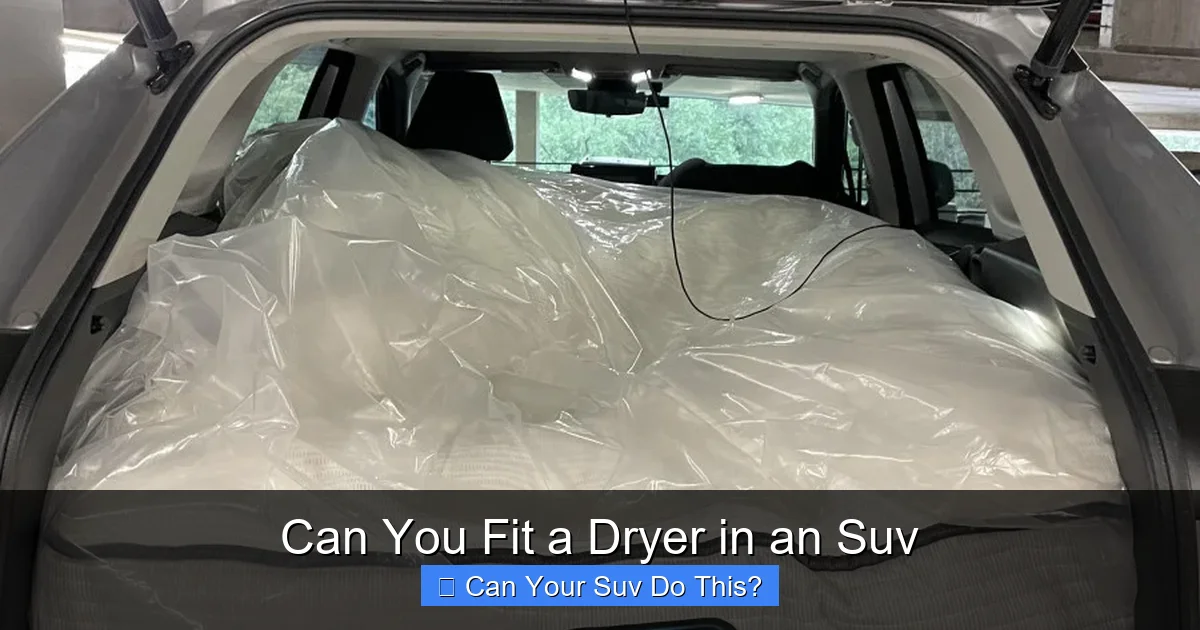
Yes, you can fit a dryer in an SUV—but it depends on the dryer type, SUV size, and how you prepare the cargo space. With the right planning, tools, and techniques, even compact SUVs can handle smaller dryers, while larger models like full-size trucks or extended SUVs make the job much easier.
So, you’ve just bought a new dryer—or maybe you’re helping a friend move theirs—and you’re wondering: *Can you fit a dryer in an SUV?* It’s a surprisingly common question, especially for people who don’t have access to a truck or van but still need to transport large appliances. The short answer? **Yes, it’s often possible—but not always easy, and definitely not guaranteed.**
The truth is, whether or not you can fit a dryer in your SUV depends on several factors: the size and type of your dryer, the make and model of your SUV, how much you’re willing to rearrange (or remove) interior components, and how prepared you are with the right tools and techniques. While some SUVs can handle a standard dryer with room to spare, others will struggle even with a compact unit. And let’s be honest—nobody wants to damage their vehicle, hurt themselves, or end up with a dryer wedged in the backseat like a stubborn suitcase.
In this guide, we’ll walk you through everything you need to know about fitting a dryer in an SUV. From measuring your space and choosing the right dryer to loading it safely and exploring alternatives if your SUV just isn’t up to the task, we’ve got you covered. Whether you’re driving a nimble Honda CR-V or a hulking Chevrolet Suburban, this article will help you make an informed decision—and maybe even save you a trip to the rental truck depot.
Key Takeaways
- SUV size matters: Larger SUVs like the Ford Expedition or Chevrolet Tahoe offer more cargo space and are better suited for transporting full-size dryers.
- Dryer type is crucial: Compact or portable dryers are far easier to load into most SUVs than standard electric or gas models.
- Measure before you move: Always check both your dryer’s dimensions and your SUV’s cargo area, including door openings and interior height.
- Use proper equipment: A dolly, moving straps, and non-slip mats can make loading safer and prevent damage to your vehicle or appliance.
- Secure the load: Never drive with an unsecured dryer—use ratchet straps or bungee cords to keep it stable during transit.
- Consider professional help: For heavy or bulky dryers, hiring movers or renting a truck may be smarter and safer than risking injury or vehicle damage.
- Alternative solutions exist: If your SUV isn’t up to the task, explore delivery services, portable dryers, or temporary laundry solutions.
📑 Table of Contents
Understanding Dryer Sizes and Types
Before you even think about opening your SUV’s rear hatch, it’s essential to understand what kind of dryer you’re dealing with. Not all dryers are created equal—and their size, weight, and design can make a huge difference in whether they’ll fit in your vehicle.
Standard Full-Size Dryers
These are the typical electric or gas dryers you’ll find in most homes. They usually measure around **27 inches wide, 30–33 inches deep, and 36–42 inches tall**, depending on the brand and model. Weight-wise, they range from **120 to 200 pounds**, with gas models often being slightly heavier due to the burner assembly. Because of their bulk and weight, full-size dryers are the most challenging to transport in an SUV—especially if you’re working alone or don’t have the right equipment.
One thing to note: many full-size dryers are designed to sit side-by-side with a matching washer, which means they’re built to fit through standard doorways (typically 30 inches wide). But that doesn’t mean they’ll easily slide into your SUV’s cargo area, especially if the rear opening is narrower or the interior height is limited.
Compact and Portable Dryers
If you’re working with a smaller space or a lighter load, compact dryers are your best friend. These units are typically **18–24 inches wide, 18–24 inches deep, and 24–30 inches tall**, and they weigh between **40 and 80 pounds**. They’re ideal for apartments, RVs, or small homes, and they’re much more manageable when it comes to transport.
Portable dryers, in particular, often come with wheels and a collapsible design, making them easy to roll into a vehicle. Some even vent through a window or use condensation systems that don’t require external ducting. Because of their smaller footprint, these dryers can usually fit in the cargo area of even compact SUVs like the Toyota RAV4 or Nissan Rogue—especially if you fold down the rear seats.
Stackable and All-in-One Units
Stackable dryers are designed to be installed on top of a matching washer, saving floor space in tight laundry areas. While they’re similar in size to standard dryers, their vertical orientation can sometimes make them easier to load into a vehicle—especially if you can tilt them upright during transport.
All-in-one washer-dryer combos are another option. These units combine washing and drying functions in a single appliance, and they’re often more compact than buying two separate machines. However, they’re still relatively heavy (usually 150–200 pounds) and may not offer the same drying capacity as a standalone dryer. Still, their smaller size can make them a viable option for SUV transport, particularly in larger vehicles.
SUV Cargo Space: What You Need to Know

Visual guide about Can You Fit a Dryer in an Suv
Image source: suvpedia.com
Now that you understand the different types of dryers, let’s talk about your SUV. Not all SUVs are built the same when it comes to cargo capacity. Some are designed for families and weekend adventures, while others are built for serious hauling. Knowing your vehicle’s limits is key to answering the question: *Can you fit a dryer in an SUV?*
Measuring Your SUV’s Cargo Area
The first step is to get out your tape measure and take accurate dimensions of your SUV’s cargo space. You’ll want to measure:
– **Interior length** (from the back of the front seats to the tailgate)
– **Interior width** (at the narrowest point, usually between the wheel wells)
– **Interior height** (from the floor to the ceiling, with seats up or down)
– **Tailgate opening width and height** (this is often the limiting factor)
For example, a Honda CR-V has a cargo area that’s about **39 inches long, 40 inches wide, and 30 inches high** with the rear seats up. Fold the seats down, and you gain more length—but the height and width remain the same. In contrast, a Ford Expedition offers over **46 inches of height, 50 inches of width, and more than 80 inches of length** with the third row folded—plenty of room for a full-size dryer.
Rear Door and Entry Clearance
Even if your cargo area is large enough, the opening might not be. Many SUVs have rear doors that are narrower than the interior, especially models with liftgates that open upward. A dryer that’s 27 inches wide might not fit through a 26-inch opening—no matter how much space you have inside.
Also consider the angle of entry. If your SUV has a low step-in height but a high tailgate, you might need to tilt the dryer at a steep angle to get it in, which can be risky without help. Some vehicles, like the Jeep Grand Cherokee or Toyota Highlander, have wider rear openings that make loading easier.
Weight Limits and Suspension
Don’t forget about weight. Most SUVs have a cargo capacity of **500 to 1,500 pounds**, but that includes passengers, luggage, and everything else in the vehicle. A full-size dryer can easily weigh 150–200 pounds, and if you’re adding passengers and other gear, you could be pushing your vehicle’s limits.
Overloading your SUV can damage the suspension, reduce braking efficiency, and increase wear on tires and shocks. Always check your owner’s manual for the maximum payload capacity and distribute weight evenly to avoid tipping or instability.
Step-by-Step Guide to Loading a Dryer into an SUV
So, you’ve measured your dryer and your SUV, and you’re confident it’ll fit. Now comes the tricky part: actually getting it in the vehicle. This isn’t a job for the faint of heart—especially if you’re working alone. But with the right approach, it’s totally doable.
Prepare the Vehicle and Dryer
Start by clearing out your SUV’s cargo area. Remove any bags, boxes, or gear that could get in the way. If your dryer has a cord or vent hose, wrap it neatly and secure it with a zip tie or tape to prevent snagging.
Next, fold down the rear seats if possible. Most SUVs allow you to fold the 60/40 or 40/20/40 split seats flat, creating a longer, more level surface. This gives you more room to slide the dryer in and reduces the risk of damaging the seats or the appliance.
If your dryer is on a pallet or in a box, consider removing the packaging before loading. Cardboard can tear and create a mess, and pallets are often too wide to fit through the door. Just make sure the dryer is clean and dry before bringing it inside your vehicle.
Use a Dolly or Appliance Cart
A heavy-duty dolly is your best friend when moving a dryer. Look for one with **rubber wheels and a strap or belt** to secure the load. Appliance dollies are specifically designed for this purpose and often have a pivoting front wheel that makes turning easier.
Position the dolly next to the dryer, tilt the appliance back slightly, and slide the dolly underneath. Secure the dryer to the dolly with straps, then tilt it back onto the wheels. Now you can roll it toward your SUV.
Loading Techniques
There are a few ways to get the dryer into your SUV, depending on the vehicle and your strength:
– **Two-Person Lift:** The safest and most common method. One person stands at the rear of the SUV, the other at the front of the dolly. Lift the dryer onto the cargo floor, then slide it in while guiding it through the door.
– **Ramp Method:** If you have a portable ramp (like those used for motorcycles or wheelchairs), you can roll the dryer up into the vehicle. This works best with flat cargo floors and low step-in heights.
– **Tilt and Slide:** For lighter dryers or smaller SUVs, you might be able to tilt the dryer upright, angle it through the door, and then lay it down inside. This requires careful coordination and a non-slip surface to prevent sliding.
Always lift with your legs, not your back, and avoid twisting your body while carrying heavy loads. If the dryer feels too heavy or unstable, stop and get help.
Securing the Load
Once the dryer is inside, don’t just close the door and drive. An unsecured dryer can shift during transit, damaging your vehicle or causing an accident. Use **ratchet straps or heavy-duty bungee cords** to anchor the dryer to the SUV’s cargo hooks or seat anchors.
Place the straps over the top of the dryer and tighten them until the unit doesn’t move. If possible, position the dryer so it’s centered and doesn’t block your rearview mirror. For extra safety, place a non-slip mat or moving blanket underneath to prevent scratches.
SUV Models That Can Handle a Dryer
Not all SUVs are created equal when it comes to hauling large appliances. Some are clearly better suited for the job than others. Here’s a quick look at SUVs that are more likely to fit a dryer—especially a full-size one.
Full-Size and Extended SUVs
These are your best bet if you’re transporting a standard dryer. Models like the **Chevrolet Suburban, Ford Expedition, GMC Yukon XL, and Toyota Sequoia** offer massive cargo areas with high ceilings, wide openings, and strong suspension systems.
For example, the Ford Expedition Max has over **108 cubic feet of cargo space** with all rear seats folded—enough to fit a dryer, a washer, and still have room for groceries. The Suburban offers similar space, with a low load floor and power-folding seats that make loading even easier.
Mid-Size SUVs with Flexible Interiors
Some mid-size SUVs can handle a dryer—especially if it’s compact or you’re willing to get creative. The **Honda Pilot, Toyota Highlander, and Hyundai Palisade** all have three rows of seats that fold flat, creating a long, continuous cargo area.
The Highlander, for instance, has a cargo length of over **70 inches** with the second and third rows down. While the height might be tight for a full-size dryer, a compact or portable model should fit with room to spare.
Compact SUVs: Possible, But Challenging
Can you fit a dryer in a compact SUV like a **Honda CR-V, Toyota RAV4, or Mazda CX-5**? Technically, yes—but only if it’s a small, lightweight dryer and you’re willing to remove seats or make multiple trips.
The CR-V, for example, has a cargo area that’s about **39 inches long and 40 inches wide** with the seats up. Fold the seats down, and you gain length, but the height is still limited to around 30 inches. That’s enough for a portable dryer, but not a standard 36-inch-tall model.
If you’re determined, you could remove the rear seats entirely (check your owner’s manual for instructions), but this is a last resort and may void your warranty or affect resale value.
When an SUV Isn’t Enough: Alternatives and Solutions
Let’s be real—sometimes, your SUV just isn’t the right tool for the job. Maybe your dryer is too big, your vehicle is too small, or you simply don’t want to risk damaging your car. In those cases, it’s worth considering alternatives.
Rent a Truck or Van
One of the easiest solutions is to rent a pickup truck or cargo van for the day. Companies like **U-Haul, Home Depot, and Penske** offer affordable rentals with low decks and wide openings—perfect for loading appliances.
A standard pickup truck bed is usually **6–8 feet long, 4–5 feet wide, and 2–3 feet high**, giving you plenty of space for a dryer, washer, and even a mattress. Many rentals also come with a dolly and ramp, so you don’t need to bring your own.
Use a Delivery Service
Many appliance stores offer delivery and installation services for a fee. While this might cost $50–$150, it’s often worth it for the peace of mind. The delivery team will bring the dryer to your door, carry it inside, and even hook it up for you.
Some retailers, like **Best Buy, Lowe’s, and Home Depot**, also offer free delivery on large purchases, so it’s worth checking the fine print.
Consider a Portable or Compact Dryer
If you’re buying a new dryer and know you’ll need to transport it yourself, consider a portable or compact model. These take up less space, are easier to move, and can often be installed in tight spaces like closets or balconies.
Brands like **Panda, Magic Chef, and LG** offer compact dryers that are perfect for small homes or apartments. Some even vent through a window, eliminating the need for external ducting.
Temporary Laundry Solutions
If you’re in a pinch and can’t get a dryer home right away, consider temporary alternatives. Many apartment complexes have shared laundry rooms, and some laundromats offer drop-off services where they wash and dry your clothes for you.
You could also use a **clothesline, drying rack, or space heater** to air-dry your clothes at home until you can get a proper dryer set up.
Safety Tips and Best Practices
Transporting a dryer isn’t just about fitting it in your SUV—it’s about doing it safely. Heavy appliances can cause serious injury if not handled properly, and improper loading can damage your vehicle or lead to accidents on the road.
Lift with Care
Always use proper lifting techniques: bend your knees, keep your back straight, and lift with your legs. If the dryer feels too heavy, don’t try to be a hero—get help. Two people can usually manage a full-size dryer, but three or four may be needed for larger models.
Protect Your Vehicle
Use moving blankets or cardboard to protect your SUV’s interior from scratches and dents. Place a rubber mat or non-slip pad on the cargo floor to prevent the dryer from sliding.
Drive Cautiously
Once the dryer is loaded and secured, drive slowly and avoid sudden stops or sharp turns. The added weight can affect your vehicle’s handling, especially on hills or in windy conditions.
Check Local Laws
Some states have regulations about transporting large items on public roads. Make sure your load is fully covered or secured, and avoid blocking your lights or license plate.
Conclusion
So, can you fit a dryer in an SUV? The answer is a cautious **yes**—but only if you plan carefully, measure accurately, and use the right tools and techniques. While larger SUVs like the Ford Expedition or Chevrolet Suburban can handle full-size dryers with ease, compact models may struggle even with smaller units.
The key is to assess your specific situation: What kind of dryer do you have? What kind of SUV are you driving? Are you willing to fold seats, use a dolly, or get help from a friend? If the answer to all these is yes, then you’re probably good to go.
But if you’re unsure, or if the risk seems too high, don’t hesitate to explore alternatives like renting a truck, using a delivery service, or opting for a portable dryer. Your back—and your SUV—will thank you.
At the end of the day, transporting a dryer doesn’t have to be a nightmare. With the right preparation and a little creativity, even the most challenging moves can be done safely and successfully. So go ahead—load up that dryer, secure it tight, and hit the road with confidence.
Frequently Asked Questions
Can I fit a standard dryer in a Honda CR-V?
It’s unlikely. The CR-V’s cargo area is too small for a full-size dryer, especially in height and length. You might fit a compact or portable dryer, but not a standard 27-inch model.
Do I need to remove the rear seats to fit a dryer?
Not always, but it can help. Removing seats creates more space, but it’s often unnecessary if you fold them down and use a dolly. Only remove seats as a last resort.
Can I transport a dryer lying on its side?
It’s not recommended. Most dryers are designed to operate upright, and laying them on their side can damage internal components, especially in gas models.
How much does a typical dryer weigh?
A standard electric dryer weighs 120–180 pounds, while gas models can be 150–200 pounds. Compact dryers are much lighter, usually 40–80 pounds.
Is it safe to drive with a dryer in the back of my SUV?
Yes, as long as it’s properly secured with straps and doesn’t block your view. Always check that the load is stable before driving.
What’s the easiest way to move a dryer by myself?
Use a heavy-duty dolly with straps, and consider renting a truck or van. If you must use your SUV, get help from a friend—even one extra person makes a big difference.