

Yes, you can fit a fridge in an SUV—but it depends on the fridge size, SUV model, and how you prepare the vehicle. With proper planning, folding seats, and secure tie-downs, many mid-size and full-size SUVs can handle a standard mini or even a full-size refrigerator for moving or camping trips.
So, you’ve got a new fridge—or maybe you’re helping a friend move theirs—and you’re wondering: *Can you fit a fridge in an SUV?* It’s a surprisingly common question, especially among renters, DIY movers, and outdoor enthusiasts who rely on their sport utility vehicles for more than just grocery runs. The short answer? **Yes, it’s often possible—but not always easy.**
The real answer depends on a handful of factors: the size and type of your SUV, the dimensions and weight of the fridge, how you configure your interior space, and how safely you secure everything. While a compact crossover like a Honda CR-V might struggle with a full-sized refrigerator, a three-row SUV like a Toyota Highlander or a GMC Yukon could handle it with room to spare. And if you’re willing to get creative—folding seats, removing headrests, or even temporarily taking out the center console—you might be surprised what fits.
But before you start wrestling appliances into your vehicle, it’s important to understand the logistics. Fridges aren’t just bulky—they’re heavy, fragile, and require careful handling to avoid damaging both the appliance and your SUV. Plus, improper loading can create serious safety hazards while driving. This guide will walk you through everything you need to know to determine whether your SUV can handle a fridge, how to do it safely, and what alternatives exist if it’s just not feasible.
Key Takeaways
- SUV size matters: Larger SUVs like the Chevrolet Suburban or Ford Expedition offer enough cargo space to fit a full-size fridge, while compact SUVs may only handle mini fridges.
- Fridge dimensions are critical: Measure your fridge’s height, width, and depth before attempting to load it—don’t forget door swing and ventilation space.
- Seat configuration is key: Folding or removing rear seats can dramatically increase cargo room and make loading easier.
- Secure the load properly: Use ratchet straps, moving blankets, and non-slip mats to prevent shifting and damage during transit.
- Weight distribution affects safety: Place the heaviest part of the fridge (usually the compressor at the bottom) toward the vehicle’s center for better balance.
- Alternative solutions exist: If your SUV can’t fit a full fridge, consider portable coolers, 12V camping fridges, or professional delivery services.
- Check local laws: Some states have regulations about unsecured cargo or protruding items, so verify legal requirements before hitting the road.
📑 Table of Contents
Understanding SUV Cargo Capacity
Not all SUVs are created equal when it comes to hauling power. While they’re generally more spacious than sedans or hatchbacks, there’s a wide range in cargo volume depending on the make, model, and year. To figure out if your SUV can fit a fridge, start by checking its official cargo capacity—usually listed in cubic feet by the manufacturer.
For example, the 2023 Honda CR-V offers about 39 cubic feet behind the rear seats and up to 75 cubic feet with the seats folded. That’s plenty for luggage, camping gear, or a mini fridge—but likely not enough for a standard 18–25 cubic foot refrigerator lying flat. On the other hand, the Ford Expedition Max boasts a staggering 121 cubic feet of maximum cargo space, making it one of the best SUVs for large-item transport.
But cubic footage alone doesn’t tell the whole story. You also need to consider the shape of the cargo area. Some SUVs have wide, flat floors ideal for sliding in large boxes, while others have wheel wells, uneven surfaces, or narrow openings that complicate loading. The height of the cargo opening—measured from the ground to the roof of the trunk—is especially important for tall items like upright fridges.
Another factor is whether the rear seats fold flat. Many modern SUVs have 60/40 or 40/20/40 split-folding rear seats that allow you to create a long, continuous surface. Some even offer a “flat-load” feature where the front passenger seat can recline or fold forward to extend the cargo area even further. If your SUV has these features, you’re in a much better position to accommodate a fridge.
Measuring Your SUV’s Interior
Before you even think about loading a fridge, grab a tape measure and assess your SUV’s interior dimensions. Focus on three key measurements:
– **Cargo length:** From the back of the front seats (or folded rear seats) to the tailgate.
– **Cargo width:** At the narrowest point, usually between the wheel wells.
– **Cargo height:** From the floor to the roof, especially near the opening.
Compare these numbers to your fridge’s external dimensions. Don’t forget to account for packaging—cardboard boxes add a few inches on each side. Also, consider how you’ll angle the fridge during loading. Most people load fridges on their side (with the door facing up) to reduce height, but this requires extra length.
Pro tip: Take photos of your empty cargo area from multiple angles. This helps visualize how the fridge might fit and makes it easier to plan your loading strategy.
Fridge Size and Type Considerations
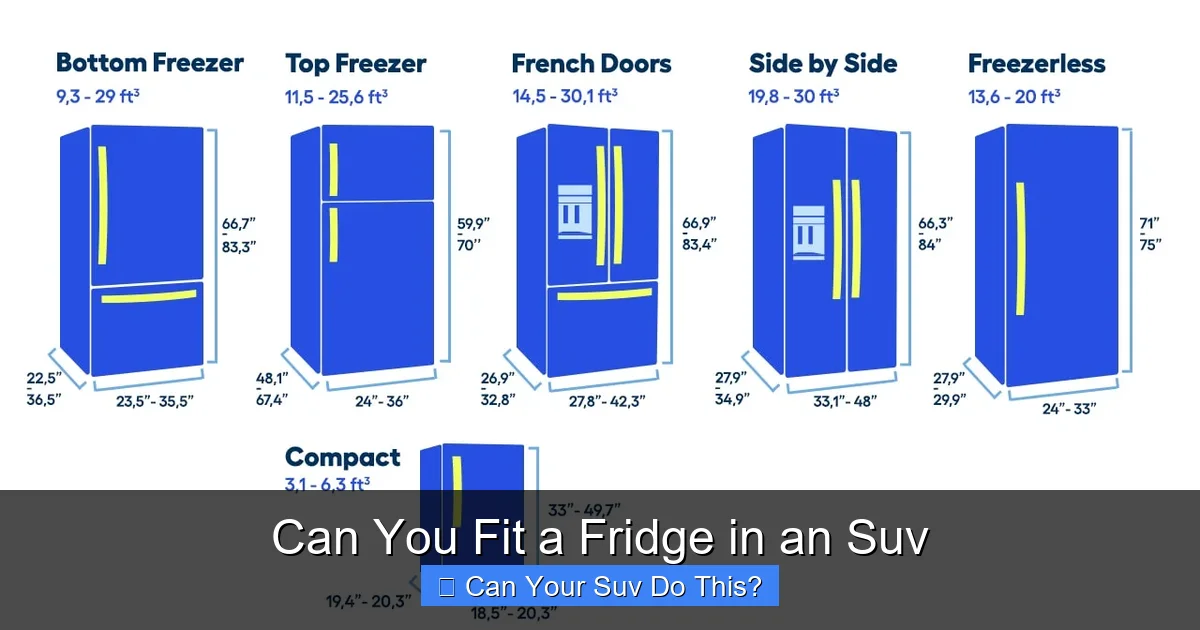
Visual guide about Can You Fit a Fridge in an Suv
Image source: rona.ca
Not all refrigerators are built the same—and that makes a huge difference in whether they’ll fit in your SUV. Refrigerators come in several common types, each with different size ranges and handling requirements.
Mini fridges (also called compact or dorm fridges) are the easiest to transport. Typically ranging from 1.7 to 4.5 cubic feet, these units stand about 20–30 inches tall and weigh 30–60 pounds. They’re perfect for small SUVs and can often fit upright in the back seat or cargo area without folding any seats. Many even come with built-in handles or wheels for easier maneuvering.
Standard top-freezer or bottom-freezer refrigerators are the most common in homes. These usually range from 18 to 25 cubic feet and stand 65–70 inches tall. They’re heavy—often 200–300 pounds—and require careful handling. Because of their height, they almost always need to be loaded on their side, which increases the required cargo length.
French door and side-by-side models are wider and deeper, making them harder to fit. They also tend to have more delicate hinges and seals, so extra care is needed to avoid damage.
Portable 12V camping fridges are another option—especially if you’re using your SUV for overlanding or road trips. These plug into your car’s cigarette lighter and run on battery power. While they don’t replace a full kitchen fridge, they’re excellent for keeping food and drinks cold without needing ice. Best of all, they’re lightweight (usually under 50 pounds) and compact, fitting easily in even the smallest SUVs.
Weight and Structural Concerns
Fridges are heavy—and that weight can affect your SUV’s performance and safety. Most SUVs have a payload capacity (the total weight they can carry including passengers, cargo, and fuel) between 1,000 and 1,800 pounds. A full-size fridge can take up 200–300 pounds of that, leaving less room for other items.
More importantly, how you distribute that weight matters. Placing a heavy fridge too far back can shift the vehicle’s center of gravity, affecting handling, braking, and stability—especially during sudden stops or sharp turns. Always position the fridge as close to the front seats as possible, ideally centered over the rear axle.
Also, be mindful of your SUV’s suspension. Overloading one side or placing excessive weight in the trunk can cause sagging, uneven tire wear, or even damage to shocks and springs over time.
Loading Strategies and Safety Tips
Successfully fitting a fridge in your SUV isn’t just about size—it’s about technique. With the right approach, you can maximize space and minimize risk.
Start by clearing out the cargo area completely. Remove floor mats, spare tire covers, and any loose items. If your SUV has removable rear seats (some models allow this), consider taking them out for extra space—but only if you’re comfortable doing so and have a safe place to store them.
Next, protect both your SUV and the fridge. Lay down moving blankets or thick towels on the floor and walls to prevent scratches. Use non-slip rubber mats or cardboard to keep the fridge from sliding. Wrap the fridge in blankets or bubble wrap, especially around the door and corners.
When it comes to loading, teamwork is essential. Fridges are awkward and heavy—never try to lift one alone. Use a dolly or appliance cart with straps to wheel it up a ramp into the SUV. If you don’t have a ramp, enlist two strong helpers to lift it carefully. Always lift with your legs, not your back, and communicate clearly during the process.
Once inside, position the fridge with the compressor (usually at the bottom rear) facing the front of the vehicle. This keeps the heaviest part near the center and reduces tipping risk. If loading on its side, ensure the door is secured shut with tape or straps—never let it swing open during transit.
Securing the Load
An unsecured fridge is a dangerous fridge. Even at low speeds, sudden braking can send a 250-pound appliance flying forward, potentially injuring passengers or damaging the interior.
Use high-quality ratchet straps anchored to your SUV’s built-in tie-down points (usually located in the cargo floor). Loop the straps over the top and sides of the fridge, pulling tightly to eliminate movement. Avoid using bungee cords—they stretch and can fail under stress.
For extra security, place foam blocks or wooden braces between the fridge and the tailgate to prevent backward shifting. If space allows, fill gaps with soft items like pillows or duffel bags to cushion the load.
Never cover the fridge with tarps or plastic unless absolutely necessary—condensation can build up and damage internal components. And always double-check that nothing blocks your rearview mirror or obstructs your view.
Real-World Examples: Which SUVs Can Handle a Fridge?
Let’s look at some popular SUV models and how they stack up when it comes to fridge transport.
The **Toyota Highlander** (2023) offers 16 cubic feet behind the third row, 48.4 cubic feet with the third row folded, and 84.3 cubic feet with both rear rows down. With a cargo floor length of about 75 inches when fully extended, it can likely fit a standard fridge on its side—especially if you remove the center headrest or fold the front passenger seat.
The **Honda Pilot** is similar in size, with up to 83.9 cubic feet of cargo space. Its wide-opening tailgate and low load floor make it a solid choice for appliance hauling.
For larger needs, the **Chevrolet Tahoe** and **GMC Yukon** (both over 90 cubic feet max) are excellent options. Their three-row seating and massive trunks can easily accommodate a full-size fridge, even with passengers in the front seats.
On the smaller end, the **Mazda CX-5** maxes out at around 59 cubic feet—enough for a mini fridge or a very narrow standard model, but likely not a typical household unit.
If you drive a **Tesla Model Y**, note that its cargo area is well-designed but has a high load floor and limited vertical space. While it might fit a mini fridge upright, a full-size unit would be a tight squeeze.
When It’s Not Feasible
Sometimes, despite your best efforts, your SUV just isn’t up to the task. Maybe it’s too small, the fridge is too big, or you need to carry passengers at the same time. In those cases, consider alternatives:
– **Rent a truck or van:** U-Haul, Home Depot, and other rental services offer affordable cargo vehicles designed for moving appliances.
– **Use a trailer:** If your SUV has a tow hitch, a small utility trailer can carry the fridge safely and legally.
– **Hire professional movers:** For valuable or oversized appliances, it may be worth the cost to avoid damage or injury.
– **Opt for delivery:** Many retailers offer white-glove delivery service, including haul-away of your old fridge.
Alternative Cooling Solutions for SUV Owners
If you’re trying to transport a fridge because you need cold storage on the go—say, for a camping trip or long road trip—there are better-suited options than hauling a full kitchen appliance.
Portable 12V electric coolers are a game-changer. Brands like Dometic, ARB, and Engel make high-quality units that plug directly into your SUV’s power outlet. They’re energy-efficient, quiet, and can maintain temperatures as low as 0°F. Most weigh under 50 pounds and fit easily in the trunk or back seat.
For shorter trips, high-end insulated coolers like Yeti or RTIC can keep ice for days without electricity. Pair them with reusable ice packs or frozen water bottles to extend cooling time.
And if you’re renovating or moving and need temporary refrigeration, consider renting a compact fridge from a local appliance store or using a friend’s vehicle for the initial transport.
Legal and Safety Considerations
Transporting a fridge in your SUV isn’t just a matter of physics—it’s also a legal issue. In many states, unsecured cargo that could become a projectile in a crash is considered a traffic violation. Some jurisdictions even have specific rules about items protruding from vehicles or blocking visibility.
Always ensure your load is fully contained within the vehicle or properly flagged if extending beyond the tailgate. Use reflective tape or warning flags if the fridge sticks out more than a few inches.
Also, be aware of height restrictions in parking garages, drive-thrus, or low-clearance areas. A fridge loaded on its side can add significant height to your vehicle’s profile.
Finally, never transport a fridge that’s still plugged in or contains food. Residual moisture can cause mold, and spoiled food creates odors and attracts pests. Always clean and dry the interior thoroughly before transport.
Final Thoughts: Is It Worth It?
So, can you fit a fridge in an SUV? In many cases, yes—but it’s not always the smartest or safest choice. If you’re moving across town and have a large SUV with flexible seating, go for it. Just measure twice, secure everything properly, and drive cautiously.
But if you’re dealing with a compact SUV, a fragile vintage fridge, or a long-distance move, it might be better to explore alternatives. Your back, your vehicle, and your passengers will thank you.
At the end of the day, SUVs are incredibly versatile—but they’re not magic boxes. Knowing their limits—and working within them—is the key to safe, successful transport.
Frequently Asked Questions
Can a mini fridge fit in a small SUV?
Yes, most mini fridges (under 30 inches tall and 60 pounds) can fit easily in small SUVs like the Honda CR-V or Toyota RAV4, often without folding any seats. Just make sure to secure it properly to prevent shifting.
Do I need to remove the fridge doors to fit it in my SUV?
Usually not, but if space is extremely tight, removing the doors (if possible) can reduce width and make loading easier. Always check the manufacturer’s instructions first, as some seals and hinges are delicate.
Can I drive with a fridge sticking out of the tailgate?
It’s not recommended and may be illegal in your area. If the fridge extends beyond the vehicle, use warning flags and ensure it’s securely strapped. Better yet, choose a larger vehicle or trailer.
Will transporting a fridge damage my SUV’s interior?
It can if you’re not careful. Always use moving blankets, floor protectors, and non-slip mats. Avoid dragging the fridge, and never let it rest directly on plastic trim or carpet without padding.
Can I transport a fridge in an electric SUV like a Tesla?
Yes, but be mindful of weight distribution and cargo space. Electric SUVs often have heavy batteries, so adding a 250-pound fridge affects range and handling. Ensure the load is balanced and secured.
What’s the safest way to load a fridge into an SUV?
Use a dolly and ramp, enlist at least one helper, lift with your legs, and always secure the fridge with ratchet straps anchored to the vehicle’s tie-down points. Never rush the process.