

Yes, you can fit a king mattress in many SUVs—but it depends on the vehicle, mattress type, and how you load it. With the right preparation, folding seats, and strategic placement, even compact SUVs can sometimes manage the job. This guide breaks down everything you need to know.
So, you’ve just bought a brand-new king mattress—congrats! It’s plush, supportive, and promises nights of deep, restful sleep. But now comes the real challenge: getting it home. You’ve got an SUV, not a pickup truck or cargo van, and you’re wondering, Can you fit a king mattress in an SUV? The short answer? Yes—most of the time. But it’s not always straightforward.
SUVs come in all shapes and sizes, from tiny crossovers to full-size beasts with three rows of seating. And while a king mattress is undeniably large—typically 76 inches wide and 80 inches long—it’s not impossible to transport in many SUVs, especially if you’re willing to get creative. Whether you’re moving, upgrading your bedroom, or helping a friend relocate, knowing how to safely and efficiently fit a king mattress into your SUV can save you time, money, and stress.
In this guide, we’ll walk you through everything you need to know: from measuring your vehicle and choosing the right mattress type, to loading techniques, safety tips, and even alternatives if your SUV just isn’t cutting it. We’ll cover real-world examples, practical advice, and insider tricks used by movers and DIYers alike. By the end, you’ll know exactly whether your SUV can handle the job—and how to do it right.
Key Takeaways
- Most midsize and large SUVs can fit a king mattress with rear seats folded down. Vehicles like the Ford Explorer, Toyota Highlander, and Chevrolet Tahoe offer enough cargo space when configured properly.
- Compact SUVs may struggle but aren’t impossible. Models like the Honda CR-V or Subaru Forester can work if the mattress is rolled, folded, or loaded at an angle—though it’s tight.
- Mattress type matters: memory foam rolls easier than innerspring. A compressed, rolled king mattress in a box is far more SUV-friendly than a traditional spring mattress.
- Roof racks and trailer hitches expand your options. If the mattress doesn’t fit inside, secure it to a roof rack or rent a small trailer for safe transport.
- Always measure before you load. Know your SUV’s cargo dimensions and the mattress size—king mattresses are typically 76” x 80”—and plan your loading strategy accordingly.
- Safety first: secure the load properly. Use ratchet straps, bungee cords, and padding to prevent shifting, damage, or hazards while driving.
- Practice makes perfect—do a dry run. Test loading with cardboard or blankets first to avoid surprises on moving day.
📑 Table of Contents
- Understanding King Mattress Dimensions
- SUV Size Matters: Which Models Can Handle a King Mattress?
- Loading Techniques: How to Fit a King Mattress in Your SUV
- Safety and Security: Don’t Forget the Straps
- Alternatives If Your SUV Can’t Handle It
- Real-World Examples: Success Stories
- Final Tips for a Smooth Experience
Understanding King Mattress Dimensions
Before you even think about loading, you need to know what you’re working with. A standard king mattress measures 76 inches in width and 80 inches in length. That’s over six feet wide and nearly seven feet long—bigger than many people realize. The height can vary depending on the mattress type, but most fall between 10 and 14 inches tall.
Now, compare that to your SUV’s cargo space. Most midsize SUVs, like the Toyota Highlander or Ford Explorer, offer around 40 to 50 cubic feet of cargo volume with the rear seats folded down. But volume isn’t the only factor—dimensions matter more. You need enough length, width, and height to accommodate the mattress without forcing it.
For example, the cargo area of a Honda CR-V (compact SUV) is about 39.2 inches high, 40.5 inches wide (between wheel wells), and 68.7 inches long with the rear seats down. That’s tight for a king mattress, which is 76” wide and 80” long. You’d need to angle it or roll it to fit. In contrast, a full-size SUV like the Chevrolet Tahoe offers over 90 cubic feet of space and a cargo floor length of nearly 80 inches—making it much more feasible.
Mattress Types and Their Impact on Fit
Not all king mattresses are created equal when it comes to transport. The type of mattress you have—or plan to buy—can make a huge difference in whether it fits in your SUV.
Memory foam and hybrid mattresses are often compressed and rolled for shipping. These “mattress-in-a-box” options can be squeezed into tighter spaces, especially if you’re willing to unroll them at home. They’re flexible, lightweight, and easier to maneuver through doors and around corners.
Innerspring mattresses, on the other hand, are rigid and bulky. They don’t compress well and are harder to angle or fold. If you’re transporting a traditional spring mattress, you’ll need more space and careful planning.
Hybrid mattresses combine foam and springs, offering a middle ground. They’re more flexible than pure innerspring but stiffer than all-foam models. Still, many hybrids come rolled and can be unpacked after transport.
If you’re buying new and plan to transport it yourself, consider a mattress designed for easy shipping. Brands like Casper, Purple, and Saatva offer king sizes that arrive compressed in a box—perfect for SUV transport.
SUV Size Matters: Which Models Can Handle a King Mattress?
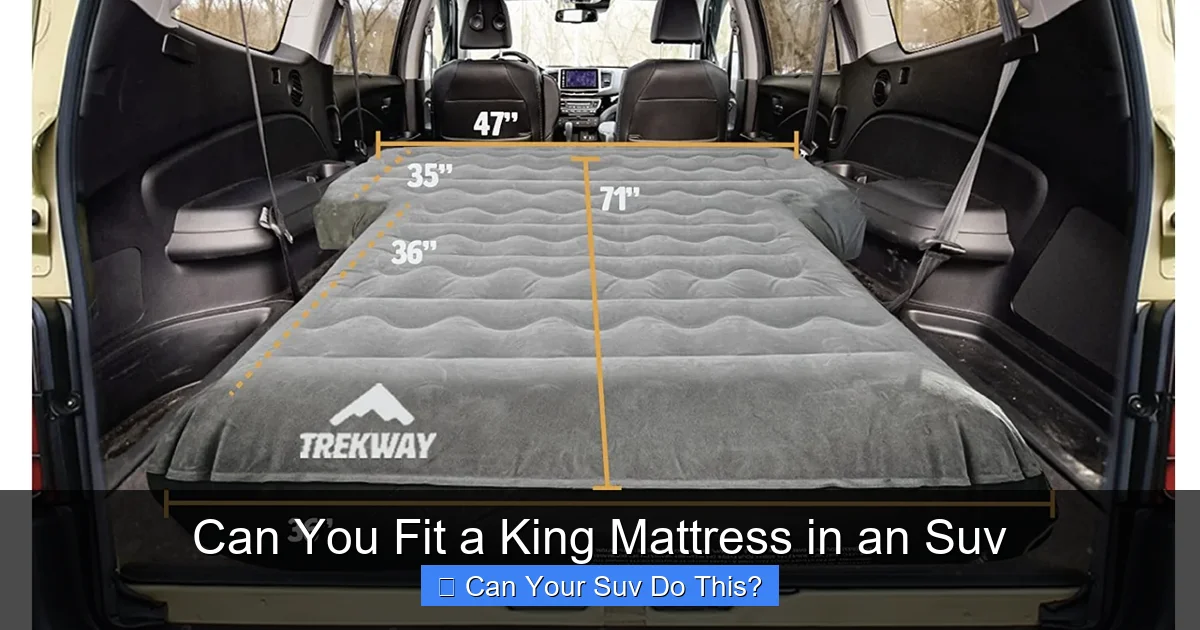
Visual guide about Can You Fit a King Mattress in an Suv
Image source: offroading.com
Not all SUVs are built the same, and their cargo capacity varies widely. Let’s break it down by category to help you determine if your vehicle is up to the task.
Compact SUVs: Tight but Possible
Compact SUVs like the Honda CR-V, Toyota RAV4, Subaru Forester, and Mazda CX-5 are popular for their fuel efficiency and city-friendly size. But can they fit a king mattress?
The short answer: maybe—with effort.
Most compact SUVs have cargo lengths under 70 inches with the rear seats folded. That’s shorter than a king mattress’s 80-inch length. However, you can often angle the mattress diagonally across the cargo area, using the full width and height of the vehicle. For example, the Forester’s cargo area is 76.3 inches long diagonally—just enough for a king mattress if loaded carefully.
You’ll also need to fold down both rear seats and possibly remove headrests to maximize space. Some owners even tilt the front passenger seat forward to extend the loading area.
Pro tip: Use a rolled or compressed mattress. If you’re buying new, opt for a mattress-in-a-box that arrives rolled. Unroll it at home, and you’re golden.
Midsize SUVs: The Sweet Spot
Midsize SUVs like the Ford Explorer, Toyota Highlander, Hyundai Santa Fe, and Nissan Pathfinder offer a great balance of space and drivability. These vehicles typically have cargo lengths between 70 and 80 inches with the rear seats down—making them ideal candidates for king mattress transport.
For example, the Ford Explorer offers up to 87.8 cubic feet of cargo space with both rear rows folded. The cargo floor is about 78 inches long, which is just shy of a king mattress’s 80-inch length. But with a slight angle and the front passenger seat tilted forward, it usually fits.
The Toyota Highlander is another strong contender. With the third row folded, you get about 84.3 cubic feet of space and a cargo length of around 77 inches. Again, angling the mattress diagonally often does the trick.
These SUVs also have wider cargo openings and lower load floors, making it easier to slide the mattress in without scratching your vehicle or the mattress.
Full-Size SUVs: No Problem Here
If you drive a full-size SUV like the Chevrolet Tahoe, Ford Expedition, GMC Yukon, or Lincoln Navigator, you’re in luck. These vehicles are built for big loads—whether it’s luggage, furniture, or a king mattress.
The Tahoe, for instance, offers up to 122.8 cubic feet of cargo space with all rear seats folded. The cargo floor is nearly 80 inches long, matching the mattress length exactly. You can lay the mattress flat, centered, with room to spare.
The Ford Expedition is even more spacious, with up to 104.6 cubic feet behind the first row and a cargo length of over 80 inches. Some models even have a powered fold-flat third row, making loading a breeze.
These SUVs often come with roof rails, tow hitches, and built-in tie-down points—perfect for securing large items. If you’re moving frequently or helping friends with big items, a full-size SUV is a worthwhile investment.
Loading Techniques: How to Fit a King Mattress in Your SUV
Knowing your SUV can fit the mattress is one thing—actually getting it in is another. Here are proven techniques to make the process smooth and safe.
Fold and Tilt the Seats
Start by folding down the rear seats. Most SUVs have 60/40 or 40/60 split-folding rear seats, allowing you to fold one side while keeping the other upright for passengers or smaller items.
Next, check if your front passenger seat can tilt forward. Many SUVs allow the seatback to recline or tilt, creating a longer, flatter loading surface. This can add several inches of usable length.
Some vehicles even have a “cargo mode” that automatically folds and locks the seats into place. Check your owner’s manual for this feature.
Load at an Angle
If the mattress is too long to fit straight in, try loading it diagonally. Position one corner of the mattress in the far rear corner of the cargo area and angle it toward the opposite front corner.
This technique uses the full diagonal space of the vehicle, which is often longer than the straight length. For example, a cargo area that’s 70” long straight might measure 85” diagonally—plenty for a king mattress.
Just be careful not to scratch the interior or damage the mattress. Use moving blankets or cardboard to protect surfaces.
Roll or Compress the Mattress
If you’re transporting a memory foam or hybrid mattress, it likely arrived rolled in a box. Keep it that way until you reach your destination.
Rolled mattresses are much easier to maneuver through doors, around tight corners, and into SUVs with smaller cargo openings. Once inside, you can unroll it and let it expand.
Some people even use vacuum bags to compress the mattress further, though this is more common for moving long distances.
Use the Roof Rack (When Necessary)
If the mattress simply won’t fit inside—even with seats folded and angled—consider using a roof rack.
Many SUVs come with factory-installed roof rails or crossbars. You can secure the mattress to the roof using ratchet straps, bungee cords, and a protective tarp.
This method works best for shorter trips and fair weather. Avoid driving in rain, snow, or high winds, as the mattress can shift or get damaged.
Always cover the mattress with a waterproof tarp and secure it tightly. Check local laws—some states require permits for oversized loads.
Safety and Security: Don’t Forget the Straps
Once the mattress is in, your job isn’t done. An unsecured mattress can become a dangerous projectile in a sudden stop or accident.
Use Ratchet Straps or Bungee Cords
Secure the mattress to the SUV’s built-in tie-down points. Most vehicles have anchor points in the cargo area, often near the floor or seat mounts.
Use ratchet straps for the best hold—they provide strong, adjustable tension. Bungee cords are quicker but less secure, so use them only for light loads or short trips.
Avoid tying the mattress to door handles or seat frames, as these aren’t designed to handle heavy loads.
Protect the Mattress and Interior
Use moving blankets, foam padding, or old comforters to protect both the mattress and your SUV’s interior. Sliding a mattress over carpet or plastic can cause tears or scuffs.
If you’re loading at an angle, place cardboard or plywood under the corners to prevent punctures.
Drive Carefully
With a large load, your SUV’s handling will change. The center of gravity shifts, and wind resistance increases—especially if the mattress is on the roof.
Drive slower than usual, avoid sharp turns, and leave extra space between you and other vehicles.
Check the load periodically during long trips. Vibration can loosen straps over time.
Alternatives If Your SUV Can’t Handle It
Sometimes, despite your best efforts, the mattress just won’t fit. Don’t panic—there are alternatives.
Rent a Trailer
Many auto parts stores, home improvement centers, and rental companies offer small utility trailers for daily rent. These are affordable (often $20–$50 per day) and perfect for one-time moves.
A small flatbed trailer can easily carry a king mattress, and most SUVs can tow one with a standard hitch.
Use a Rideshare or Delivery Service
If you bought the mattress new, ask the retailer about delivery options. Many offer same-day or next-day delivery for a fee.
Alternatively, use a rideshare service like Uber or Lyft with a large vehicle option. Some drivers offer cargo services for furniture and mattresses.
Borrow a Truck or Van
Ask a friend or family member with a pickup truck or cargo van for help. Even a short-term loan can save you the hassle of renting.
Real-World Examples: Success Stories
Let’s look at a few real scenarios where people successfully transported king mattresses in their SUVs.
Case 1: The Honda CR-V Owner
Sarah, a CR-V driver, needed to move a king memory foam mattress. She folded the rear seats, tilted the front passenger seat, and loaded the rolled mattress diagonally. It fit snugly, and she used straps to secure it. Total time: 20 minutes.
Case 2: The Ford Explorer Family
The Johnsons used their Explorer to move a hybrid king mattress. They folded both rear rows, laid the mattress flat, and secured it with ratchet straps. They even had room for luggage and a small dresser.
Case 3: The Roof Rack Solution
Mike’s compact SUV couldn’t fit the mattress inside. He used his roof rack, covered the mattress with a tarp, and drove carefully to his new apartment. It took longer, but it worked.
Final Tips for a Smooth Experience
– Measure twice, load once. Know your SUV’s cargo dimensions and the mattress size before you go.
– Choose the right mattress. Opt for a compressed, rolled model if you’re transporting it yourself.
– Practice loading. Do a dry run with cardboard or blankets to test the fit.
– Protect everything. Use padding and covers to avoid damage.
– Secure the load. Never drive with an unstrapped mattress.
– Consider alternatives. If it doesn’t fit, rent a trailer or use delivery.
Transporting a king mattress in an SUV is totally doable—with the right preparation. Whether you’re driving a compact crossover or a full-size beast, a little planning goes a long way. So go ahead, upgrade that sleep setup, and rest easy knowing your SUV can handle the job.
Frequently Asked Questions
Can you fit a king mattress in a Honda CR-V?
Yes, but it’s tight. With the rear seats folded and the mattress loaded diagonally or rolled, it can fit. A compressed mattress-in-a-box works best.
Will a king mattress fit in a Toyota RAV4?
It’s possible if you angle the mattress or use a rolled foam mattress. The cargo length is shorter than the mattress, so diagonal loading is key.
Do I need a roof rack to transport a king mattress?
Not always. Most midsize and large SUVs can fit it inside. Use a roof rack only if the mattress won’t fit internally and you’re prepared for weather and safety challenges.
Can I drive with a mattress on my SUV roof?
Yes, but only with proper securing. Use ratchet straps, a waterproof tarp, and drive slowly. Avoid bad weather and check local regulations.
What’s the best type of mattress to transport in an SUV?
Memory foam or hybrid mattresses that arrive rolled in a box are ideal. They’re flexible, lightweight, and expand after unboxing.
How do I secure a mattress in my SUV?
Use ratchet straps attached to the vehicle’s tie-down points. Avoid bungee cords for long trips. Cover the mattress to prevent shifting and damage.