
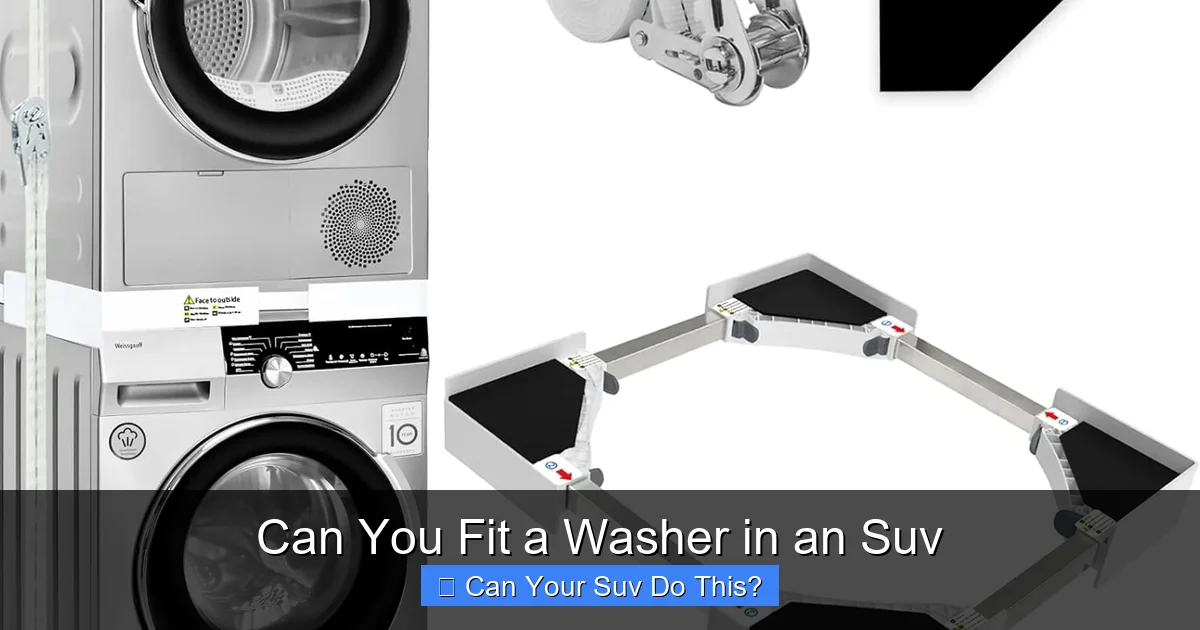
Yes, you can fit a washer in an SUV—but it depends on the model, washer size, and how you prepare the space. With smart packing and the right vehicle, even compact SUVs can handle a standard top-load washer with some effort.
Key Takeaways
- SUV size matters: Larger SUVs like the Ford Expedition or Chevrolet Tahoe offer more cargo space, making washer transport easier.
- Washer type impacts fit: Top-load washers are generally shorter and easier to load than front-load models, which are taller and heavier.
- Remove doors and seats when possible: Folding down rear seats or removing third-row seats can create a flat, open cargo area.
- Use moving straps and blankets: Protect both your SUV’s interior and the washer during transport with padding and secure tie-downs.
- Check weight limits: Most SUVs can handle a washer’s weight (80–150 lbs), but verify your vehicle’s payload capacity to avoid damage.
- Rent a trailer if needed: For smaller SUVs or heavy-duty washers, a small utility trailer may be the safest and easiest option.
- Plan the route and loading: Measure doorways, hallways, and your SUV’s cargo opening to avoid last-minute surprises.
📑 Table of Contents
- Can You Really Fit a Washer in an SUV?
- Understanding Washer Sizes and Types
- SUV Cargo Space: What You Need to Know
- Preparing Your SUV for Washer Transport
- Loading the Washer: Step-by-Step
- Alternative Solutions: When Your SUV Isn’t Enough
- Safety Tips and Common Mistakes to Avoid
- Real-World Examples: SUVs That Can Handle a Washer
- Conclusion: Yes, You Can Fit a Washer in an SUV
Can You Really Fit a Washer in an SUV?
So, you’ve just bought a new washer—or maybe you’re helping a friend move theirs—and the big question hits: can you fit a washer in an SUV? It’s not as crazy as it sounds. In fact, many people do it regularly, whether they’re moving, upgrading appliances, or helping out a neighbor. But just because it’s possible doesn’t mean it’s always easy.
The short answer? Yes, you can fit a washer in an SUV. But the real answer depends on several factors: the size and type of your SUV, the dimensions of the washer, how you prepare the cargo space, and a little bit of creativity. Some SUVs are built for this kind of heavy lifting. Others? Not so much. But with the right planning, even a compact SUV can pull it off—sometimes with a little help from a friend (or two).
This guide will walk you through everything you need to know to safely and successfully transport a washer in your SUV. From measuring your vehicle to choosing the right washer type, we’ll cover the practical steps, common mistakes, and pro tips that make all the difference. Whether you’re driving a Honda CR-V or a full-size GMC Yukon, you’ll learn how to make it work.
Understanding Washer Sizes and Types
Visual guide about Can You Fit a Washer in an Suv
Image source: abeautifulmess.com
Before you even think about loading a washer into your SUV, you need to know what you’re dealing with. Washers come in different sizes, shapes, and weights—and these details can make or break your transport plan.
Standard Top-Load vs. Front-Load Washers
The two most common types of washers are top-load and front-load models. Each has its own advantages—and challenges—when it comes to fitting into an SUV.
Top-load washers are typically shorter in height, usually ranging from 38 to 42 inches tall. They’re also often narrower, around 27 to 29 inches wide. This makes them easier to maneuver through doors and into vehicles. Plus, since you load them from the top, there’s no need to worry about a heavy door swinging open during transport.
Front-load washers, on the other hand, are taller—often 39 to 44 inches—and can be heavier due to their high-efficiency design and larger drum capacity. They’re also wider, sometimes up to 30 inches or more. The front door is a major concern: if it’s not secured properly, it can swing open and damage your SUV’s interior or the washer itself.
In terms of weight, most residential washers range from 80 to 150 pounds. High-capacity or commercial models can weigh even more. So while your SUV might have the space, you still need to consider whether it can safely carry the load.
Compact and Portable Washers
If you’re working with a smaller SUV—like a Toyota RAV4 or Subaru Forester—you might want to consider a compact or portable washer. These units are designed for small spaces and are much easier to transport.
Compact washers are usually around 33 to 36 inches tall and 24 inches wide. They’re ideal for apartments, RVs, or tiny homes. Portable washers are even smaller, often on wheels, and can be as light as 50 pounds. Some models even hook up to a kitchen sink.
While these won’t replace a full-sized washer for large families, they’re perfect for singles, couples, or as a backup unit. And because they’re smaller and lighter, they’re a breeze to load into almost any SUV—even with the seats up.
Measuring Your Washer
Before you head to the store or start loading, grab a tape measure. You’ll want to record three key dimensions: height, width, and depth. Don’t forget to include any protruding parts like control panels, hoses, or the door.
Also, measure the door opening of the washer. If it’s a front-loader, you’ll need to ensure the door can stay closed during transport. Some people use bungee cords or straps to secure it, but be careful not to damage the seal or hinges.
Pro tip: Take a photo of your washer with the tape measure next to it. This gives you a visual reference and makes it easier to compare with your SUV’s cargo space.
SUV Cargo Space: What You Need to Know
Now that you know your washer’s size, it’s time to look at your SUV. Not all SUVs are created equal when it comes to cargo capacity. Some are built for adventure and heavy loads, while others prioritize fuel efficiency and passenger comfort.
Compact and Midsize SUVs
Compact SUVs like the Honda CR-V, Toyota RAV4, and Mazda CX-5 are popular for their fuel efficiency and city-friendly size. But when it comes to hauling a washer, they can be a tight squeeze.
Most compact SUVs have around 35 to 40 cubic feet of cargo space behind the rear seats. With the seats folded down, that number jumps to 60 to 70 cubic feet. That sounds like a lot—but remember, you’re dealing with a bulky, rectangular object.
A standard top-load washer (about 27” wide x 38” tall x 30” deep) might fit diagonally in a CR-V with the seats down, but it’s going to be a tight fit. You’ll likely need to remove the headrests and angle the washer carefully. Front-loaders? Even tighter.
Midsize SUVs like the Ford Explorer, Hyundai Santa Fe, and Nissan Murano offer more room. With rear seats folded, they typically provide 70 to 80 cubic feet of space. That’s enough for most standard washers, especially if you remove the third-row seats (if equipped).
Full-Size SUVs: The Heavy Lifters
If you’re driving a full-size SUV like the Chevrolet Tahoe, Ford Expedition, or GMC Yukon, you’re in luck. These vehicles are designed for serious cargo hauling.
The Ford Expedition, for example, offers up to 108 cubic feet of cargo space with all rear seats folded. That’s more than enough room for a washer—and still leaves space for boxes, tools, or other gear. The large rear hatch and low load floor make loading even easier.
Full-size SUVs also have higher payload capacities, often exceeding 1,500 pounds. That means they can easily handle the weight of a washer plus passengers and other cargo.
Measuring Your SUV’s Cargo Area
Don’t rely on manufacturer specs alone. Every SUV is a little different, and real-world space can vary based on seat design, spare tire placement, and interior trim.
To get accurate measurements:
– Open the rear hatch and measure the width at the narrowest point (usually at the wheel wells).
– Measure the height from the cargo floor to the ceiling.
– Measure the depth from the back of the front seats (or folded rear seats) to the hatch.
Compare these numbers to your washer’s dimensions. If the washer is wider than the cargo opening, you’re out of luck unless you remove doors or use a ramp.
Preparing Your SUV for Washer Transport
Once you’ve confirmed your SUV can handle the washer, it’s time to get it ready. A little prep work can prevent scratches, dents, and frustration.
Clear the Cargo Area
Start by removing everything from the back of your SUV. That means bags, tools, spare tires (if accessible), and any loose items. You want a clean, open space to work with.
If your SUV has a third row of seats, fold them down or remove them if possible. Some models allow you to completely remove the third-row seats for extra space. Check your owner’s manual for instructions.
Protect the Interior
Washers are heavy and can scratch or dent your SUV’s interior. To protect your vehicle:
– Lay down moving blankets or thick towels on the cargo floor and walls.
– Use cardboard or plywood under the washer to prevent sliding.
– Cover seatbacks and headrests with plastic or fabric to avoid scuffs.
If you’re transporting a front-load washer, make sure the door is securely closed. Use moving straps or bungee cords to keep it shut—but avoid over-tightening, which can damage the door seal.
Secure the Washer
Never transport a washer without securing it. A shifting load can damage your SUV or cause an accident.
Use ratchet straps or heavy-duty bungee cords to tie the washer to the cargo anchors in your SUV. Most vehicles have tie-down hooks in the cargo floor. Loop the straps around the washer’s frame (not the control panel or hoses) and tighten them firmly.
If your washer has wheels, lock them or place blocks in front and behind to prevent rolling.
Loading the Washer: Step-by-Step
Now for the moment of truth: loading the washer into your SUV. This part requires teamwork, patience, and the right technique.
Gather Your Tools
Before you start, make sure you have:
– A dolly or appliance cart (highly recommended)
– Moving straps or ropes
– Gloves (to protect your hands)
– A friend or two (seriously, don’t do this alone)
A dolly with straps can make the job much easier. Look for one with a tilt feature or large wheels for smooth movement.
Position the Washer
Back your SUV up to a flat, level surface. If possible, park on a slight incline with the rear facing downhill—this makes loading easier.
Place the dolly behind the washer and tilt it back slightly. Secure the washer to the dolly with straps.
Lift and Load
With one person at the front and one at the back, slowly roll the washer up to the SUV’s cargo opening. If the ground is uneven, use a ramp or plywood plank to create a smooth transition.
Lift the front of the dolly and guide it into the cargo area. Once the washer is partially inside, tilt it upright and slide it the rest of the way.
If you don’t have a dolly, you’ll need at least two people to lift and carry the washer. Bend your knees, keep your back straight, and lift with your legs. Communicate clearly—“ready?” “lift!” “slide!”
Angle and Adjust
If the washer doesn’t fit straight in, try angling it diagonally. Sometimes a few inches of extra space can make all the difference.
Once inside, position the washer so it’s centered and stable. Use foam blocks or towels to fill any gaps and prevent movement.
Alternative Solutions: When Your SUV Isn’t Enough
Even with the best planning, some SUVs just aren’t up to the task. If your vehicle is too small or the washer too large, don’t force it. There are other options.
Rent a Trailer
Many home improvement stores and rental companies offer small utility trailers for daily or weekend use. A 5×8-foot trailer can easily hold a washer, dryer, and other appliances.
Trailers are especially useful for compact SUVs or when you’re transporting multiple items. Just make sure your SUV is rated for towing and you have the proper hitch and lights.
Use a Moving Service
If you’re not comfortable loading or transporting a washer yourself, consider hiring a local moving service. Many offer same-day delivery for appliances and can handle the heavy lifting.
This is a great option if you’re buying a new washer and want it delivered and installed in one trip.
Borrow a Truck or Van
Do you have a friend with a pickup truck or cargo van? A full-size pickup with a bed cover can easily fit a washer—and often with room to spare.
Cargo vans like the Ford Transit or Mercedes Sprinter are also excellent for appliance transport. If you’re part of a community group or neighborhood app, you might be able to borrow one for a few hours.
Safety Tips and Common Mistakes to Avoid
Transporting a washer isn’t just about space—it’s about safety. A few simple precautions can prevent injuries and damage.
Don’t Overload Your SUV
Check your SUV’s payload capacity in the owner’s manual. This is the maximum weight it can carry, including passengers, cargo, and fuel.
A typical SUV can handle 1,000 to 1,500 pounds. A washer weighs 80–150 pounds, so you’re usually safe—but add passengers, groceries, and other gear, and you could exceed the limit.
Avoid Sudden Stops
Even with straps, a heavy washer can shift during hard braking. Drive slowly, avoid sharp turns, and give yourself extra stopping distance.
If possible, place the washer behind the rear seats—not in the footwells—to reduce the risk of injury in a collision.
Don’t Skip the Padding
It’s tempting to skip the blankets and just “be careful.” But a single bump can scratch your SUV’s interior or dent the washer’s finish.
Invest in a few moving blankets or use old comforters. It’s cheap insurance.
Measure Twice, Load Once
It’s easy to assume your SUV will fit the washer based on online specs. But real-world measurements matter.
Always measure both the washer and your SUV’s cargo opening before you leave the store or start loading.
Real-World Examples: SUVs That Can Handle a Washer
Still not sure if your SUV can do it? Here are a few real-world examples.
Honda CR-V with a Compact Washer
A friend of mine recently bought a compact top-load washer for her apartment. Her 2020 Honda CR-V had just enough space with the rear seats folded. She used a dolly and two people to load it, and it fit diagonally with a few inches to spare.
Ford Expedition with a Front-Load Washer
A family in Texas used their Ford Expedition to transport a new front-load washer from the store to their home. With the third-row seats removed, they had over 80 cubic feet of space. They secured the door with straps and used moving blankets to protect the interior. The whole process took about 20 minutes.
Toyota Highlander with a Portable Washer
A college student used his Toyota Highlander to move a portable washer into his dorm. The small unit fit easily in the cargo area with the seats up. He even had room for a mini-fridge and some boxes.
Conclusion: Yes, You Can Fit a Washer in an SUV
So, can you fit a washer in an SUV? The answer is a resounding yes—with the right preparation and vehicle.
Larger SUVs like the Ford Expedition or Chevrolet Tahoe make it easy, while compact models may require more effort or creative solutions. The key is knowing your washer’s dimensions, measuring your SUV’s cargo space, and using the right tools and techniques.
Whether you’re moving, upgrading, or helping a friend, transporting a washer in an SUV is totally doable. Just remember to protect your vehicle, secure the load, and don’t be afraid to ask for help.
With a little planning and teamwork, your SUV can handle more than you think. And who knows? You might just discover it’s the perfect weekend project.
Frequently Asked Questions
Can a small SUV like a Honda CR-V fit a standard washer?
It’s possible, but tight. A standard top-load washer may fit diagonally with the rear seats folded, but front-load models are usually too tall. A compact or portable washer is a better option for small SUVs.
Do I need a dolly to load a washer into an SUV?
Highly recommended. A dolly with straps makes it much easier to move and load a heavy washer, especially on uneven ground or up a ramp.
Can I transport a washer with passengers in the SUV?
Yes, as long as the washer is secured in the cargo area and doesn’t exceed the vehicle’s payload capacity. Avoid placing heavy items in footwells where they could cause injury.
What if my washer is too wide for the SUV’s cargo opening?
You may need to remove the rear doors (if removable) or use a trailer. Some people also angle the washer diagonally to squeeze it through.
Is it safe to transport a washer without securing it?
No. An unsecured washer can shift during driving, damage your SUV, or cause an accident. Always use ratchet straps or bungee cords tied to cargo anchors.
Can I fit both a washer and dryer in an SUV?
Only in large SUVs with all rear seats folded. A full-size SUV like a GMC Yukon or Ford Expedition might handle both, but it’s a tight fit. A trailer or moving service is often a better choice.