
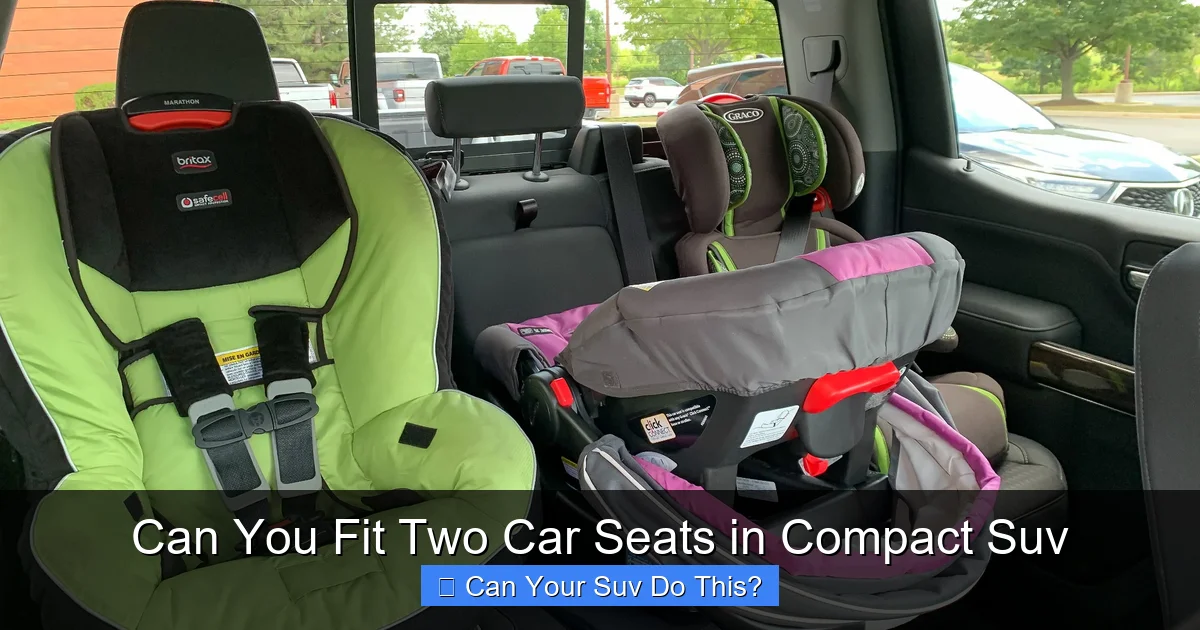
Yes, you can fit two car seats in most compact SUVs—but it depends on the vehicle, seat types, and installation method. With smart planning and the right gear, families can enjoy both safety and space without upgrading to a larger vehicle.
Key Takeaways
- Most compact SUVs can accommodate two car seats: Many models like the Honda CR-V, Toyota RAV4, and Subaru Forester offer enough rear seat width and legroom for two seats, especially when using slim-profile designs.
- Car seat type matters: Rear-facing infant seats take up more space than forward-facing or booster seats, so consider your child’s age and seat size when planning.
- Installation technique is crucial: Proper LATCH system use, seat angle adjustment, and seatback positioning can make or break a successful fit.
- Slim-profile car seats help: Brands like Clek, Diono, and Chicco offer narrow designs that maximize space without sacrificing safety.
- Test before you buy: Always test-fit car seats in your vehicle before purchasing, either at a retailer or through a certified technician.
- Third-row access may be limited: In compact SUVs with optional third rows, installing two seats in the second row might block access or reduce cargo space.
- Safety should never be compromised: Never force a fit—if seats overlap, block airbags, or prevent proper harness tension, it’s not safe, even if it “fits.”
📑 Table of Contents
- Can You Fit Two Car Seats in a Compact SUV? The Real Answer
- Why Compact SUVs Are Popular (and Challenging) for Families
- Top Compact SUVs That Fit Two Car Seats (With Room to Spare)
- Choosing the Right Car Seats for a Tight Fit
- Installation Tips to Maximize Space and Safety
- Real-Life Scenarios: Parents Who Made It Work
- When It Doesn’t Work: Signs You Need a Bigger Vehicle
- Final Thoughts: Yes, You Can Make It Work
Can You Fit Two Car Seats in a Compact SUV? The Real Answer
So, you’ve just welcomed a second little one—or maybe you’re planning ahead—and suddenly your once-spacious compact SUV feels a lot smaller. You’re staring at the back seat, wondering: *Can I really fit two car seats in here?* You’re not alone. Thousands of parents face this exact dilemma every year, especially as compact SUVs remain the most popular vehicle type in the U.S.
The good news? Yes, you can fit two car seats in most compact SUVs. But—and this is a big but—it’s not always easy, and it definitely requires some strategy. Unlike minivans or full-size SUVs, compact SUVs are designed for efficiency and agility, not maximum passenger space. That means every inch counts when you’re installing not one, but two bulky car seats.
But don’t panic. With the right vehicle, the right seats, and a little know-how, many families make it work beautifully. From urban commuters to weekend adventurers, compact SUVs are proving they can handle the chaos of family life—even with two little passengers in tow. In this guide, we’ll walk you through everything you need to know to make two car seats fit safely and comfortably in your compact SUV, from choosing the right model to mastering installation tricks.
Why Compact SUVs Are Popular (and Challenging) for Families

Visual guide about Can You Fit Two Car Seats in Compact Suv
Image source: cdn.bestcarseathub.com
Compact SUVs have exploded in popularity over the past decade, and for good reason. They offer the higher driving position and cargo space of an SUV with better fuel economy and easier parking than larger models. Brands like Honda, Toyota, Subaru, Mazda, and Hyundai dominate the market with models that balance style, safety, and practicality.
But when it comes to car seat fit, compact SUVs present a unique challenge. While they’re bigger than sedans, they’re still smaller than midsize or full-size SUVs. The rear seat width typically ranges from 52 to 56 inches—enough for two average-sized adults, but tight when you add the bulk of car seats.
The Space Dilemma: Width, Depth, and Legroom
Let’s break it down. Car seats aren’t just wide—they also stick out into the footwell, especially rear-facing infant seats. A typical infant seat can extend 12 to 18 inches from the back of the vehicle seat. That means if your compact SUV has limited rear legroom (say, 37 inches or less), installing two rear-facing seats might push the front seats so far forward that the driver or front passenger is uncomfortable—or worse, the seat is unsafe to use.
Width is another factor. Most compact SUVs have rear seat widths between 52 and 56 inches. A standard car seat is about 17 to 19 inches wide. Two seats side by side need at least 34 to 38 inches of clear space. That leaves only 14 to 18 inches for a third passenger or cargo—if you’re lucky.
And don’t forget about seat contours. Many compact SUVs have sculpted rear seats with center humps or bolsters that can interfere with car seat bases. Some seats are also sloped or reclined at an angle that makes installation tricky.
Safety Ratings and LATCH System Availability
Another consideration is safety infrastructure. Most modern compact SUVs come equipped with the LATCH (Lower Anchors and Tethers for Children) system, which makes installing car seats easier and more secure. However, the placement and strength of these anchors vary by model.
Some compact SUVs have LATCH anchors only in the outboard positions (left and right), meaning you can’t install a middle seat using LATCH—even if there’s space. Others have anchors in all three rear positions, giving you more flexibility.
Always check your vehicle’s owner’s manual and the car seat manufacturer’s guidelines. The National Highway Traffic Safety Administration (NHTSA) also provides a free car seat inspection locator tool to help you find certified technicians who can check your installation.
Top Compact SUVs That Fit Two Car Seats (With Room to Spare)
Not all compact SUVs are created equal when it comes to car seat fit. Some models are surprisingly spacious in the back, while others feel cramped even with one seat. Based on real-world testing and parent feedback, here are some of the best compact SUVs for fitting two car seats.
Honda CR-V
The Honda CR-V consistently ranks as one of the most family-friendly compact SUVs. With up to 55.9 inches of rear shoulder room and 40.4 inches of legroom, it offers some of the most generous rear seat dimensions in its class. The flat floor and wide opening make it easy to install two car seats side by side.
Parents report success with two rear-facing infant seats, especially when using slim models like the Clek Liing or Chicco KeyFit 30. The CR-V also has LATCH anchors in all three rear positions, allowing for flexible installation.
Toyota RAV4
The RAV4 is another top contender. It offers 54.3 inches of rear shoulder room and 37.8 inches of legroom. While slightly tighter than the CR-V, it still accommodates two car seats comfortably in most cases.
One advantage of the RAV4 is its flat rear seatback, which helps with rear-facing installations. The LATCH system is well-placed, and the seat cushions are firm, providing a stable base for car seats. Many parents use the Diono Radian 3RXT or Graco 4Ever for a snug fit.
Subaru Forester
Subaru has long been a favorite among families, and the Forester is no exception. With 55.3 inches of rear shoulder room and 39.3 inches of legroom, it’s one of the roomiest compact SUVs available.
The Forester’s wide doors and high roofline make it easy to load and secure car seats. The rear seat is also relatively flat, which helps with installation. Subaru’s standard all-wheel drive is a bonus for families in snowy or rural areas.
Mazda CX-5
The Mazda CX-5 is known for its stylish design and sporty handling, but it’s also surprisingly capable with car seats. It offers 54.3 inches of rear shoulder room and 37.4 inches of legroom.
While slightly tighter than the CR-V or Forester, the CX-5 can still fit two car seats, especially if you use narrow models. The LATCH anchors are easy to access, and the rear seat is well-contoured for stability.
Hyundai Tucson
The latest Hyundai Tucson offers a modern interior and generous rear space. With 55.5 inches of shoulder room and 38.7 inches of legroom, it’s one of the most spacious compact SUVs in its class.
The flat floor and wide rear doors make it easy to install two seats. Hyundai also includes LATCH in all rear positions, giving you flexibility. Parents have successfully installed two rear-facing seats using the Nuna PIPA or Britax B-Safe.
Choosing the Right Car Seats for a Tight Fit
Even the roomiest compact SUV can feel cramped if you choose the wrong car seats. The key is selecting models that are narrow, lightweight, and designed for tight spaces.
Slim-Profile Car Seats: Your Best Friends
Slim-profile car seats are engineered to take up less space without compromising safety. These seats are typically 16 to 17 inches wide, compared to the standard 18 to 19 inches.
Top slim models include:
– Clek Liing: At just 16.9 inches wide, this rear-facing infant seat is one of the narrowest on the market. It’s also lightweight and easy to install with the LATCH system.
– Diono Radian 3RXT: This convertible seat is 17 inches wide and can be used rear-facing, forward-facing, or as a booster. Its steel frame adds durability, and it folds flat for storage.
– Chicco NextFit Zip: At 19 inches wide, it’s not the slimmest, but its compact base and easy installation make it a favorite for tight spaces.
– Graco 4Ever DLX: This all-in-one seat is 18.5 inches wide and grows with your child from infancy to booster age. Its slim design fits well in most compact SUVs.
Rear-Facing vs. Forward-Facing: Space Considerations
Rear-facing seats take up the most space, especially infant carriers. They extend deep into the footwell and require a reclined angle, which can push the front seats forward.
Forward-facing seats are more compact, as they sit upright and attach to the vehicle’s top tether. Booster seats take up the least space, as they’re essentially just seat cushions.
If you’re planning for two children, consider transitioning the older child to a forward-facing seat as soon as they meet the height and weight requirements (usually around 2 years old). This frees up valuable space for a rear-facing infant seat.
Infant Car Seat Carriers: Pros and Cons
Infant car seat carriers are convenient—you can snap the seat in and out of the car without waking the baby. But they’re also bulky and often wider than convertible seats.
If space is tight, consider skipping the carrier and using a convertible seat from day one. Many modern convertibles, like the Clek Fllo or Nuna RAVA, are designed for newborns and can be used from birth.
Alternatively, choose a narrow infant seat like the Clek Liing or UPPAbaby Mesa, which are designed to fit in smaller vehicles.
Installation Tips to Maximize Space and Safety
Even with the right vehicle and seats, proper installation is critical. A poorly installed car seat can be dangerous, no matter how much space you have.
Use the LATCH System Correctly
The LATCH system uses lower anchors and top tethers to secure the car seat without a seat belt. It’s easier to use and often provides a tighter installation.
However, LATCH has weight limits—typically 65 pounds combined for the child and seat. Once you exceed that, you must switch to a seat belt installation.
Always check your vehicle and seat manuals for LATCH limits. Some compact SUVs allow LATCH use in the center seat, while others don’t.
Angle Matters for Rear-Facing Seats
Rear-facing seats must be installed at the correct angle—usually between 30 and 45 degrees—to protect the baby’s airway. Most seats have built-in angle indicators or adjusters.
In compact SUVs with sloped rear seats, you may need a pool noodle or rolled towel under the seat base to achieve the right angle. Never use aftermarket products not approved by the manufacturer.
Push the Front Seats Forward (Safely)
If two rear-facing seats are pushing the front seats too far forward, you may need to adjust the driver or passenger seat. But never compromise your driving position.
Your knees should be slightly bent when pressing the pedals, and you should be able to reach the steering wheel comfortably. If the seat is too close, it can interfere with airbag deployment or reduce control.
Some parents install one rear-facing and one forward-facing seat to balance space. Others use a “seat shuffle” method—installing the seats, then adjusting the front seats to find the best compromise.
Check for Interference
Make sure the car seats don’t interfere with each other or the vehicle. Seats should not touch, and harness straps should not be twisted or pinched.
Also, ensure the seats don’t block air vents, cup holders, or door handles. And never install a rear-facing seat in front of an active airbag.
Real-Life Scenarios: Parents Who Made It Work
Let’s hear from real parents who’ve successfully fit two car seats in compact SUVs.
Case Study: The Urban Family in a Honda CR-V
Sarah and Mike live in Chicago and drive a 2021 Honda CR-V. They have a 3-year-old and a 6-month-old. Sarah uses a Clek Liing for the baby and a Graco Tranzitions booster for their toddler.
“We were worried about space, but the CR-V surprised us,” Sarah says. “The rear seat is wide, and the doors open wide too. We installed the Liing on the driver’s side and the booster on the passenger side. There’s still room for a small backpack or stroller in the back.”
Case Study: The Outdoor Enthusiasts in a Subaru Forester
Jake and Emily live in Colorado and love hiking and camping. They drive a 2020 Subaru Forester with two kids—ages 1 and 4.
“We use a Diono Radian for the toddler and a Chicco KeyFit for the baby,” Emily says. “The Forester’s flat floor and high roof make it easy to get the seats in. We’ve even taken it on mountain roads with both seats installed. It’s tight, but it works.”
Case Study: The City Commuter in a Mazda CX-5
Lisa drives a 2022 Mazda CX-5 and has twins, both 18 months old. She uses two Clek Liing seats.
“It was a challenge at first,” Lisa admits. “The CX-5 is stylish but not the roomiest. We had to move the front seats up a bit, but now it’s fine. We use the LATCH system and check the installation every few weeks. It’s not perfect, but it’s safe and it works for our daily commute.”
When It Doesn’t Work: Signs You Need a Bigger Vehicle
Despite your best efforts, there are times when two car seats just won’t fit safely in a compact SUV.
Red Flags to Watch For
– The car seats overlap or touch each other.
– The front seats are pushed so far forward that the driver or passenger is uncomfortable or unsafe.
– The car seats block airbags or emergency exits.
– You can’t achieve the correct rear-facing angle.
– The harness straps are twisted or can’t be tightened properly.
– You’re forcing the installation or using unauthorized modifications.
If any of these apply, it’s time to consider a larger vehicle. A midsize SUV like the Honda Pilot, Toyota Highlander, or Kia Sorento offers more rear seat space and often a third row.
Alternatively, consider a minivan like the Honda Odyssey or Chrysler Pacifica, which are designed specifically for families with multiple car seats.
Transitioning to a Larger Vehicle
If you decide to upgrade, don’t rush. Test-drive several models with your car seats installed. Many dealerships allow you to bring your seats for a trial run.
Also, consider timing. If your older child is close to outgrowing their car seat, you might only need a larger vehicle for a year or two. In that case, a used midsize SUV or a short-term lease could be a cost-effective solution.
Final Thoughts: Yes, You Can Make It Work
Fitting two car seats in a compact SUV isn’t just possible—it’s practical for many families. With the right vehicle, the right seats, and careful installation, you can keep your family safe and comfortable without sacrificing the efficiency and style of a compact SUV.
Remember, every family’s situation is different. What works for one may not work for another. The key is to prioritize safety, test your setup, and be willing to adapt.
Whether you’re navigating city streets or heading out on a road trip, your compact SUV can be a reliable partner in parenthood. Just remember: it’s not about having the biggest vehicle—it’s about making the smartest choices for your family.
So go ahead—load up those car seats, buckle up, and hit the road. Your adventure is just beginning.
Frequently Asked Questions
Can you fit two rear-facing car seats in a compact SUV?
Yes, many compact SUVs can fit two rear-facing car seats, especially models like the Honda CR-V, Subaru Forester, and Toyota RAV4. Using slim-profile seats and proper installation techniques can make it work safely.
What is the narrowest car seat for a compact SUV?
The Clek Liing is one of the narrowest car seats at just 16.9 inches wide, making it ideal for tight spaces. Other slim options include the Diono Radian 3RXT and Chicco KeyFit 30.
Do I need to use the LATCH system to fit two car seats?
No, you can use the seat belt to install car seats, but the LATCH system often provides a tighter, more secure fit. Just be aware of weight limits—most LATCH systems max out at 65 pounds combined.
Can I install two car seats in the middle of a compact SUV?
It depends on the vehicle. Some compact SUVs have LATCH anchors in the center seat, while others don’t. Even if anchors are present, space and seat contours may make it difficult. Always check your owner’s manual.
What if my car seats don’t fit side by side?
If the seats don’t fit safely side by side, consider installing one rear-facing and one forward-facing seat, or look into a midsize SUV or minivan with more rear seat space.
How do I know if my car seat installation is safe?
A safe installation means the seat doesn’t move more than one inch side to side or front to back, the harness is snug, and the seat is at the correct angle. Visit a certified car seat technician for a free inspection.