
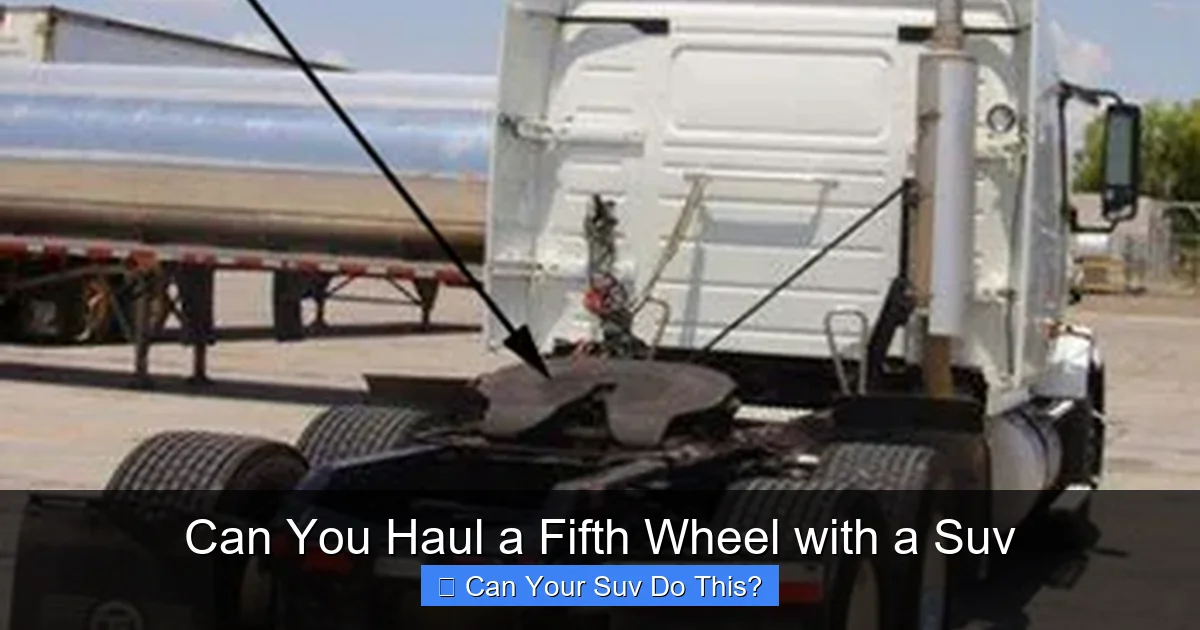
Hauling a fifth wheel with an SUV is possible—but only with the right vehicle and setup. Most standard SUVs lack the towing power and hitch compatibility, but heavy-duty models like the Ford Expedition or Chevrolet Tahoe can handle smaller fifth wheels when properly equipped.
So, you’ve got an SUV—maybe a sleek crossover or a rugged full-size beast—and you’re dreaming of hitting the open road with a cozy fifth-wheel trailer in tow. It sounds like the perfect combo: comfort, space, and adventure. But before you start shopping for that dream RV, let’s answer the big question: *Can you haul a fifth wheel with an SUV?*
The short answer? It’s complicated. While it’s technically possible under very specific conditions, most SUVs simply aren’t built to handle the unique demands of fifth-wheel towing. Unlike travel trailers that attach to a hitch on the back of your vehicle, fifth wheels require a special kingpin hitch mounted directly into the bed of a pickup truck. That means your SUV would need a truck bed—which, by definition, it doesn’t have. So right off the bat, there’s a major hurdle.
But don’t lose hope just yet. Some larger, truck-based SUVs blur the line between SUV and pickup, offering impressive towing capabilities and, in rare cases, modified setups that allow fifth-wheel towing. In this guide, we’ll break down exactly what it takes to haul a fifth wheel with an SUV, which models might work, the risks involved, and smarter alternatives if your ride isn’t up to the task.
Whether you’re a weekend warrior or a full-time RVer, understanding your vehicle’s limits is key to safe, stress-free travel. Let’s dive in.
Key Takeaways
- Most SUVs cannot tow fifth wheels: Standard SUVs typically lack the towing capacity and frame strength needed for fifth-wheel trailers.
- Heavy-duty SUVs are the exception: Full-size, truck-based SUVs like the Ford Expedition, Chevrolet Suburban, or GMC Yukon XL may be capable with proper equipment.
- Towing capacity matters most: Check your SUV’s manufacturer-rated towing capacity—fifth wheels usually require 10,000+ pounds.
- Fifth-wheel hitches require a truck bed: Unlike travel trailers, fifth wheels need a special hitch mounted in a pickup truck bed, not an SUV’s rear bumper.
- Weight distribution is critical: The pin weight (15–25% of trailer weight) must be supported by the SUV’s rear axle without overloading it.
- Always consult your owner’s manual: Never exceed your SUV’s gross combined weight rating (GCWR) or rear axle weight limits.
- Consider alternatives: If your SUV can’t handle a fifth wheel, a travel trailer or pop-up camper may be a safer, more practical option.
📑 Table of Contents
Understanding Fifth-Wheel Trailers and How They Work
Before we talk about SUVs, let’s make sure we’re on the same page about what a fifth-wheel trailer actually is. Unlike traditional travel trailers that hitch to the rear bumper or frame of a vehicle, fifth wheels are designed to be towed by pickup trucks using a special hitch system.
What Makes a Fifth Wheel Different?
A fifth-wheel trailer gets its name from the large, horseshoe-shaped hitch plate that extends over the bed of a pickup truck. This “fifth wheel” connects to a kingpin on the trailer, allowing for a more stable and balanced towing experience. Because the trailer’s weight rests partially on the truck’s bed—typically 15% to 25% of the total trailer weight—it creates a pivot point that improves maneuverability and reduces sway.
This design offers several advantages:
– Better weight distribution
– Tighter turning radius
– More interior space (since the front of the trailer extends over the truck bed)
– Improved stability at high speeds
But here’s the catch: that hitch system requires a truck bed. There’s no standard way to mount a fifth-wheel hitch on an SUV’s rear bumper or frame. SUVs are built for passenger comfort and cargo space, not for bearing the concentrated weight of a trailer’s pin.
Why Most SUVs Aren’t Built for Fifth-Wheel Towing
SUVs—especially crossovers and unibody models—are engineered differently than pickup trucks. They prioritize ride comfort, fuel efficiency, and interior space over raw towing power and structural strength. Their frames aren’t designed to handle the downward force of a fifth-wheel hitch, and their rear axles often can’t support the heavy pin weight.
Even if you could somehow mount a fifth-wheel hitch to an SUV (more on that later), you’d likely exceed the vehicle’s rear axle weight rating long before reaching the trailer’s full capacity. This could lead to dangerous handling, suspension failure, or even accidents.
So while the idea of towing a fifth wheel with an SUV might sound appealing—imagine rolling up to the campground in your luxury SUV with a spacious trailer in tow—the reality is that most SUVs just aren’t up to the job.
Can Any SUV Actually Tow a Fifth Wheel?
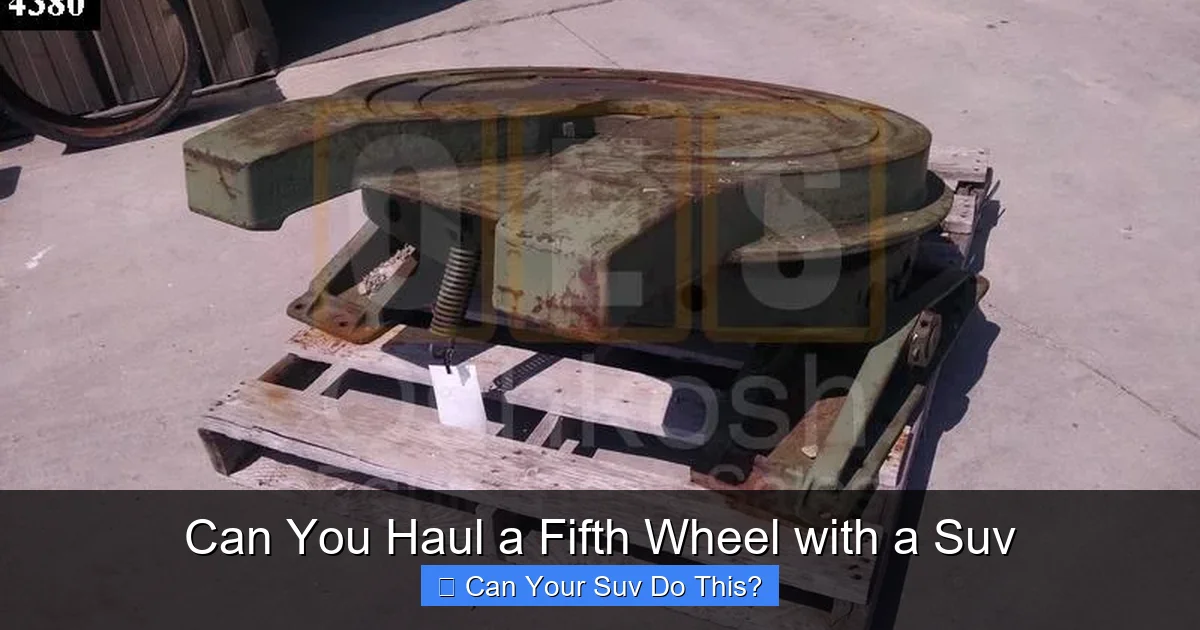
Visual guide about Can You Haul a Fifth Wheel with a Suv
Image source: oshkoshequipment.com
Now for the million-dollar question: is there *any* SUV that can safely and legally tow a fifth wheel? The answer is a cautious “maybe”—but only under very specific conditions.
The Role of Truck-Based SUVs
Not all SUVs are created equal. While crossovers like the Honda CR-V or Toyota RAV4 are built on car platforms, full-size SUVs like the Ford Expedition, Chevrolet Tahoe, GMC Yukon, and Lincoln Navigator are built on truck platforms. These vehicles share chassis, suspension, and towing systems with their pickup truck cousins—the Ford F-150, Chevrolet Silverado, and GMC Sierra.
Because of this shared DNA, heavy-duty SUVs often have impressive towing capacities. For example:
– The 2024 Ford Expedition Max can tow up to 9,300 pounds.
– The Chevrolet Tahoe with the Max Trailering Package can handle 8,400 pounds.
– The GMC Yukon XL can tow up to 8,400 pounds.
But here’s the thing: even with these numbers, most fifth-wheel trailers weigh *well* over 10,000 pounds when fully loaded. A typical 30-foot fifth wheel might have a dry weight of 8,000–9,000 pounds, but add water, gear, propane, and passengers, and you’re easily pushing 11,000–13,000 pounds. That’s beyond the capacity of even the strongest SUV.
The Hitch Problem: No Truck Bed, No Fifth Wheel
Even if your SUV has the towing capacity, there’s still the issue of the hitch. Fifth-wheel hitches must be mounted in a truck bed. There’s no standard or safe way to install one on an SUV’s rear frame or bumper. Some companies have attempted to create adapter systems or custom mounts, but these are rare, expensive, and often not approved by manufacturers or safety organizations.
One example is the “fifth-wheel-to-gooseneck” adapter, which converts a fifth-wheel trailer to use a gooseneck hitch. Gooseneck hitches can sometimes be installed on SUVs with reinforced frames, but this still requires a truck-style setup and isn’t common. Even then, the weight distribution and handling may not be ideal.
Real-World Examples: When It Might Work
There are a few edge cases where an SUV *might* be able to tow a fifth wheel—but they’re exceptions, not the rule.
One scenario involves modifying a full-size SUV to include a truck bed. Some custom builders have converted SUVs like the Suburban or Expedition into “SUV-truck hybrids” by cutting out the rear section and welding in a pickup bed. This allows for a proper fifth-wheel hitch installation. However, these conversions are:
– Extremely expensive ($15,000–$30,000+)
– Not covered by manufacturer warranties
– Potentially unsafe if not done by a certified professional
– Rare and hard to insure
Another possibility is using a very small, lightweight fifth-wheel trailer—sometimes called a “mini fifth wheel.” These compact models, like the Scamp 5th Wheel or the Escape 5.0, can weigh as little as 2,500–4,000 pounds. With a pin weight under 800 pounds, they might be within the rear axle capacity of a heavy-duty SUV.
For example, a modified Ford Expedition with a reinforced rear suspension and a custom gooseneck adapter *might* be able to tow a 3,500-pound mini fifth wheel. But again, this requires expert modification, careful weight monitoring, and acceptance of significant risk.
Critical Factors to Consider Before Attempting Fifth-Wheel Towing
If you’re still considering towing a fifth wheel with your SUV, don’t rush into it. There are several critical factors you must evaluate to ensure safety, legality, and practicality.
1. Towing Capacity vs. Trailer Weight
Your SUV’s towing capacity is the maximum weight it can safely pull, as determined by the manufacturer. This number is found in your owner’s manual or on the manufacturer’s website. It’s not just about the trailer’s dry weight—you must account for:
– Freshwater tanks (8.3 lbs per gallon)
– Propane tanks (about 4 lbs per gallon)
– Batteries, generators, and appliances
– Clothing, food, and personal items
– Passengers and pets
A good rule of thumb: never tow more than 80% of your vehicle’s maximum towing capacity. This leaves a safety buffer for hills, wind, and unexpected loads.
2. Pin Weight and Rear Axle Limits
Pin weight—the downward force exerted by the trailer on the hitch—is arguably more important than total towing capacity. Most fifth wheels exert 15% to 25% of their total weight as pin weight. For a 10,000-pound trailer, that’s 1,500 to 2,500 pounds pressing down on your SUV’s rear axle.
Your SUV’s rear axle weight rating (RAWR) is usually listed in the manual. If the pin weight exceeds this, you risk:
– Rear suspension collapse
– Loss of steering control
– Tire blowouts
– Brake failure
Even if your SUV can *pull* the weight, it may not be able to *support* it.
3. Gross Combined Weight Rating (GCWR)
The GCWR is the maximum allowable weight of your fully loaded SUV plus the fully loaded trailer. Exceeding this limit can void your warranty, increase wear on your vehicle, and make it unsafe to drive.
For example, if your SUV has a GCWR of 16,000 pounds and weighs 6,500 pounds when loaded, you can only tow up to 9,500 pounds—even if the towing capacity is higher.
4. Hitch Compatibility and Installation
As mentioned, fifth-wheel hitches require a truck bed. There are no OEM-approved fifth-wheel hitches for SUVs. Any custom installation must be done by a certified technician and may not be street-legal in all states.
Additionally, the hitch must be rated for the trailer’s weight. A 10,000-pound trailer needs a Class V or higher hitch—something most SUVs aren’t equipped to handle.
5. Handling and Safety Concerns
Towing a fifth wheel changes how your vehicle handles. The added weight affects:
– Braking distance (longer stops)
– Acceleration (slower response)
– Cornering (increased sway risk)
– Visibility (reduced rear view)
SUVs have a higher center of gravity than trucks, making them more prone to rollover when towing heavy loads. Without proper weight distribution and sway control, a fifth-wheel setup could become dangerously unstable.
Safer Alternatives to Fifth-Wheel Towing with an SUV
If your SUV can’t safely tow a fifth wheel, don’t despair. There are several excellent alternatives that offer similar comfort and space without the risk.
Travel Trailers: The SUV-Friendly Option
Travel trailers are the most common type of RV and are designed to be towed by a wide range of vehicles, including SUVs. They hitch to a standard ball mount on the rear bumper or frame, making them much easier to set up.
Many travel trailers offer floor plans similar to fifth wheels, with separate bedrooms, full kitchens, and spacious living areas. Lightweight models like the Jayco Jay Feather or the Airstream Bambi can be towed by midsize SUVs, while larger models may require a full-size SUV or truck.
Advantages of travel trailers:
– Compatible with most SUVs
– Easier to hitch and unhitch
– Lower cost than fifth wheels
– Wide variety of sizes and styles
Pop-Up Campers: Lightweight and Affordable
If you’re looking for something even lighter, pop-up campers (or tent trailers) are a great option. These fold-down trailers weigh as little as 1,500–2,500 pounds and can be towed by compact SUVs like the Subaru Outback or Honda Passport.
While they don’t offer the same level of comfort as a fifth wheel, modern pop-ups come with amenities like queen beds, kitchenettes, and air conditioning. They’re perfect for weekend trips and casual campers.
Teardrop Trailers: Compact and Stylish
Teardrop trailers are small, aerodynamic campers that weigh under 2,000 pounds. They’re ideal for solo travelers or couples and can be towed by almost any SUV. Many feature outdoor kitchens, sleeping areas, and even composting toilets.
Their small size makes them easy to maneuver and park, and they’re often more fuel-efficient than larger RVs.
Consider a Truck + SUV Combo
If you’re set on a fifth wheel, the safest and most practical solution is to use a pickup truck for towing and keep your SUV for daily driving. Many RVers tow their fifth wheel with a truck and drive a separate SUV or sedan when they reach their destination.
This setup gives you the best of both worlds: the power and stability of a truck for towing, and the comfort and efficiency of an SUV for exploring.
Final Thoughts: Should You Even Try?
So, can you haul a fifth wheel with an SUV? Technically, yes—but only in very rare, highly modified cases. For the vast majority of SUV owners, the answer is no.
The risks far outweigh the benefits. Even if you manage to install a hitch and stay within weight limits, you’re pushing your vehicle beyond its design limits. One wrong turn, one strong gust of wind, or one overloaded tank could lead to disaster.
Instead, choose an RV that matches your vehicle’s capabilities. A well-matched travel trailer or pop-up camper can offer just as much adventure—without the danger.
Remember: safe towing isn’t just about power. It’s about balance, preparation, and respect for your vehicle’s limits. When in doubt, consult a professional RV dealer or towing specialist. Your safety—and your peace of mind—are worth it.
Frequently Asked Questions
Can a Ford Expedition tow a fifth wheel?
The Ford Expedition has strong towing capacity (up to 9,300 lbs), but it lacks a truck bed, which is required for a fifth-wheel hitch. While custom modifications are possible, they’re not recommended or widely supported.
What’s the lightest fifth-wheel trailer available?
Mini fifth wheels like the Scamp 5th Wheel or Escape 5.0 can weigh as little as 2,500–4,000 pounds. These may be towable by heavy-duty SUVs with modifications, but pin weight and hitch compatibility remain challenges.
Can I install a fifth-wheel hitch on my SUV?
No standard fifth-wheel hitch exists for SUVs. Custom installations are possible but expensive, risky, and often not street-legal. Most manufacturers do not support or warranty such modifications.
What’s the difference between towing capacity and GCWR?
Towing capacity is the max weight your SUV can pull. GCWR is the total weight of your loaded SUV plus the loaded trailer. Never exceed either limit.
Are there SUVs with truck beds?
A few concept vehicles and custom builds have combined SUV cabins with truck beds, but none are mass-produced. The Hummer EV SUV comes close but still isn’t designed for fifth-wheel towing.
What’s a safer alternative to a fifth wheel for SUV owners?
Travel trailers, pop-up campers, and teardrop trailers are safer, more practical options for SUV owners. They’re lighter, easier to tow, and compatible with standard hitch systems.