
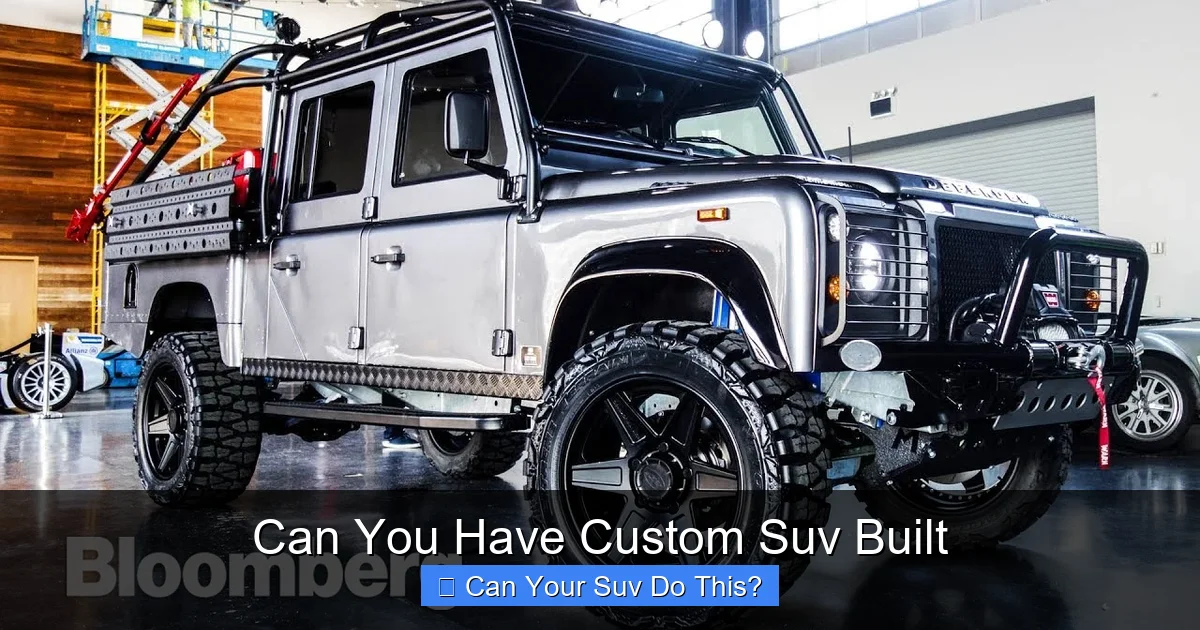
Absolutely—you can have a custom SUV built just for you. From rugged off-road beasts to luxury mobile lounges, manufacturers and specialty shops now offer tailored builds that match your lifestyle, needs, and wildest automotive dreams.
So, you’ve been eyeing that new SUV at the dealership—but something’s missing. Maybe it’s not tough enough for your weekend trail runs. Or perhaps the interior feels too generic for your taste. What if you could have a custom SUV built exactly how you want it? Not just a few dealer add-ons, but a truly personalized vehicle that reflects your personality, needs, and ambitions?
The good news? You absolutely can. The world of custom SUVs has exploded in recent years, blending cutting-edge technology with old-school craftsmanship. Whether you’re dreaming of a stealthy urban cruiser, a desert-dominating overlander, or a chauffeur-driven luxury lounge on wheels, there’s a path to make it real. And it’s not just for the ultra-wealthy—while high-end builds can run into six figures, more accessible options exist for enthusiasts who want meaningful upgrades without breaking the bank.
But before you start sketching designs on a napkin, it’s important to understand what “custom” really means in this context. It’s not just slapping on bigger tires or a flashy wrap (though those are valid steps). True customization involves thoughtful planning, expert collaboration, and a clear understanding of your goals. This guide will walk you through everything you need to know—from the types of custom builds available, to the companies making them happen, to the practical considerations like cost, legality, and long-term value.
Key Takeaways
- Custom SUVs are 100% possible: Whether through factory programs or aftermarket builders, you can design an SUV from the ground up or modify an existing model to suit your exact preferences.
- Options range from mild to wild: Choose subtle upgrades like premium interiors or go full custom with lifted suspensions, armor plating, and bespoke paint jobs.
- Cost varies widely: A basic customization might start at $5,000, while full ground-up builds can exceed $200,000 depending on materials, tech, and labor.
- Legal and safety compliance matters: Any modifications must meet DOT, EPA, and state regulations—especially for lighting, emissions, and structural changes.
- Specialty shops offer expertise: Companies like Lingenfelter, Icon, and Apocalypse specialize in high-end custom SUV builds with proven track records.
- Resale value may be affected: While some custom builds hold value (especially limited editions), overly niche modifications can limit future buyers.
- Start with a clear vision: Define your purpose—adventure, luxury, status, or performance—before diving into design choices.
📑 Table of Contents
What Does “Custom SUV” Really Mean?
When people talk about a custom SUV, they’re usually referring to a vehicle that has been significantly altered from its factory configuration—either by the manufacturer itself or by a third-party specialist. These changes can be cosmetic, functional, or both, and they’re designed to enhance performance, comfort, aesthetics, or utility.
At one end of the spectrum, you have factory-backed customization programs. Brands like Jeep (with its Mopar Custom Shop), Ford (via Ford Performance), and Ram (with its Tradesman and Limited trim personalization) allow buyers to select from a curated list of approved parts and accessories during the ordering process. These are often bolt-on upgrades—like winches, roof racks, or performance exhausts—that maintain warranty coverage and meet federal safety standards.
On the other end are full-scale aftermarket builds. Think of companies like Icon 4×4, which transforms vintage Broncos into modern marvels with fuel-injected engines, air suspension, and hand-stitched leather interiors. Or Apocalypse Manufacturing, known for its apocalyptic-style “Warlord” and “Doomsday” SUVs built on GM chassis with massive tires, reinforced frames, and military-grade finishes. These aren’t just modified vehicles—they’re reimagined machines.
In between, you’ll find tuners and fabricators who offer semi-custom services. They might take a new Land Rover Defender and add a custom suspension lift, upgraded differentials, and a bespoke interior with heated/cooled seats and a premium sound system. The key difference? Factory programs keep things standardized; aftermarket builders thrive on uniqueness.
Types of Customizations Available
Custom SUVs can be tailored in nearly every aspect. Here are the most common categories:
– **Exterior Mods:** Lift kits, oversized tires, custom bumpers, skid plates, LED light bars, paint wraps, vinyl graphics, and body armor.
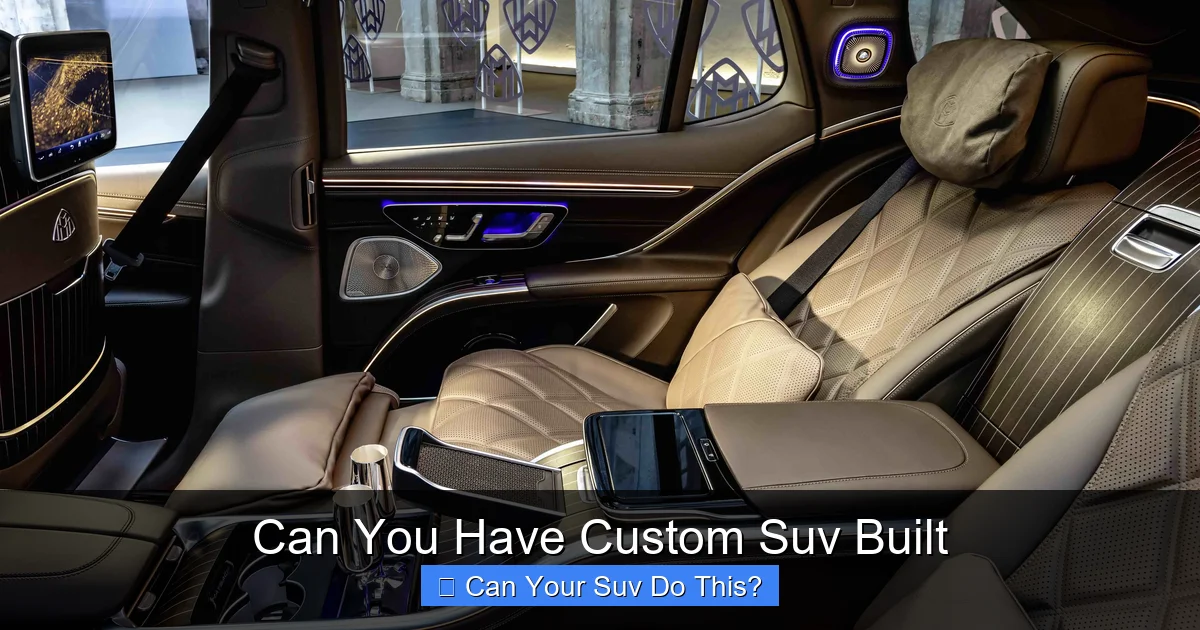
– **Interior Upgrades:** Premium upholstery (leather, Alcantara, or vegan alternatives), custom dashboards, ambient lighting, upgraded infotainment systems, refrigerated consoles, and reclining rear seats.
– **Performance Enhancements:** Engine tuning, turbo/supercharger installations, upgraded brakes, performance exhausts, and differential locks.
– **Off-Road Capabilities:** Locking differentials, crawl control systems, rock sliders, snorkels, and reinforced axles.
– **Luxury & Comfort:** Massage seats, panoramic sunroofs, noise-canceling cabins, Wi-Fi hotspots, and built-in espresso machines (yes, really).
– **Technology Integration:** Dash cams, 360-degree cameras, radar detectors, satellite comms, and advanced driver-assist systems not available from the factory.
The beauty of a custom SUV is that you’re not limited to one category. You can mix and match based on your priorities. Want a luxury overlander? Add plush seating and a kitchenette. Prefer a street-focused performance SUV? Go for lowered suspension and a track-tuned engine.
Who Builds Custom SUVs?
Visual guide about Can You Have Custom Suv Built
Image source: rev.ie
You don’t have to be a mechanic or engineer to get a custom SUV built—but you do need the right partner. Several types of companies specialize in this space, each with different strengths.
Factory Customization Programs
Many automakers now offer official customization paths. For example:
– **Jeep’s Mopar Custom Shop** lets you order a Wrangler or Gladiator with factory-installed accessories like rock rails, winches, and all-weather floor mats—all covered under warranty.
– **Ford’s Raptor and Tremor packages** are essentially pre-built custom trims focused on off-road performance, but buyers can still add dealer-installed options.
– **Mercedes-Maybach GLS** and **BMW Alpina X7** represent factory-built luxury customizations, blending performance with opulence straight from the assembly line.
These programs are ideal if you want reliability, warranty protection, and peace of mind. However, your choices are limited to what the manufacturer offers.
Aftermarket Specialty Shops
For true one-of-a-kind builds, aftermarket builders are the way to go. These companies often start with a base vehicle (new or used) and rebuild it from the ground up. Notable names include:
– **Icon 4×4 (California):** Known for restomodding classic Broncos and Toyota Land Cruisers with modern drivetrains, disc brakes, and luxury interiors. Their builds start around $150,000.
– **Apocalypse Manufacturing (Florida):** Creates aggressive, post-apocalyptic-style SUVs using Chevrolet Suburbans and Tahoes. Features include 40-inch tires, bulletproof glass, and custom paint schemes. Prices range from $100,000 to $300,000+.
– **Lingenfelter Performance Engineering (Indiana):** Focuses on high-horsepower builds, often adding superchargers or twin-turbos to GM SUVs for 700+ hp.
– **Overland Vehicle Solutions (Colorado):** Specializes in expedition-ready builds with rooftop tents, solar panels, and modular storage systems.
These shops often provide full documentation, dyno testing, and even dyno videos to prove performance gains. Many also offer financing and trade-in options.
Local Fabricators & Tuners
Don’t overlook local shops! Many independent garages and fabricators offer custom work at more affordable rates. They might not have the brand recognition of Icon or Apocalypse, but they can deliver excellent results—especially for moderate upgrades like suspension lifts, custom exhausts, or interior reupholstery.
When choosing a builder, always check reviews, ask for build portfolios, and verify insurance and licensing. A reputable shop will welcome questions and provide detailed quotes.
How Much Does a Custom SUV Cost?
Let’s address the elephant in the room: price. The cost of a custom SUV varies dramatically based on scope, quality, and who’s doing the work.
Entry-Level Customizations ($5,000–$20,000)
You can make meaningful improvements without going bankrupt. Examples include:
– Adding a 2–3 inch lift kit and all-terrain tires ($2,000–$4,000)
– Installing a premium sound system and dash cam ($1,500–$3,000)
– Upgrading to leather seats and custom floor mats ($1,000–$2,500)
– Adding a roof rack and LED light bar ($800–$1,500)
These mods are often DIY-friendly or available through dealerships and local shops. They enhance functionality and comfort while keeping the vehicle street-legal and warranty-friendly (if done correctly).
Mid-Range Builds ($20,000–$75,000)
This tier includes more comprehensive upgrades:
– Full suspension overhaul with coilovers and upgraded shocks ($5,000–$10,000)
– Engine tuning or mild forced induction ($3,000–$8,000)
– Custom interior with sound deadening and ambient lighting ($4,000–$7,000)
– Off-road armor (skid plates, rock sliders, bumpers) ($3,000–$6,000)
Many enthusiasts land in this range, creating capable overlanders or daily drivers with serious personality.
High-End & Bespoke Builds ($75,000–$300,000+)
Here, the sky’s the limit. Full restomods, hand-built interiors, custom chassis work, and exotic materials drive costs up. Examples:
– Icon 4×4’s “Derelict” series starts around $150,000
– Apocalypse’s “Doomsday” builds can exceed $250,000
– Custom coachbuilt SUVs (like those from Mansory or Brabus) often start at $200,000 and go much higher
These aren’t just vehicles—they’re rolling works of art. And yes, some include features like built-in coolers, Wi-Fi routers, and even mini-fridges.
Hidden Costs to Consider
Beyond the build itself, factor in:
– **Insurance:** Custom parts may require specialized coverage.
– **Registration & Inspections:** Some states require recertification after major mods.
– **Maintenance:** Custom components may need specialized service.
– **Depreciation:** Highly modified vehicles can lose value faster unless they’re collectible.
Always get a detailed quote that includes labor, parts, taxes, and any certification fees.
Is It Legal to Drive a Custom SUV on Public Roads?
This is a critical question—and the answer depends on where you live and what you’ve changed.
In the U.S., federal law (via the DOT and EPA) sets baseline standards, but individual states have their own rules. Generally, modifications must not compromise safety or emissions.
Common Legal Pitfalls
– **Tire Size & Lift Height:** Most states allow moderate lifts (2–4 inches), but excessively tall vehicles may fail inspection due to bumper height laws or visibility issues.
– **Lighting:** LED light bars are legal off-road but often illegal on public roads unless properly shielded or switched off. Amber fog lights are usually okay; blue or red lights are not.
– **Emissions:** Any engine modification that affects emissions (like deleting catalytic converters) is federally illegal and can result in fines or registration denial.
– **Window Tint:** Varies by state—some allow only 35% VLT (visible light transmission) on front side windows.
– **Noise:** Modified exhausts must comply with local decibel limits.
How to Stay Compliant
– Use CARB (California Air Resources Board)-approved parts if you live in a CARB state.
– Keep receipts and documentation for all modifications.
– Have your vehicle inspected by a certified mechanic or state agency if required.
– Consider a “show car” vs. “street-driven” build—some owners keep two vehicles: one for daily use, one for events.
Many reputable builders ensure their work meets DOT and EPA standards and provide compliance letters. Always ask for this before signing a contract.
Should You Build or Buy Pre-Built?
Another key decision: commission a custom build from scratch, or buy a pre-built custom SUV?
Pros of Building Your Own
– **Total Control:** Every detail matches your vision.
– **Personal Satisfaction:** There’s pride in saying, “I designed this.”
– **Tailored Functionality:** Built specifically for your adventures or lifestyle.
– **Potential Value:** Unique, well-documented builds can appreciate (e.g., classic restomods).
Cons of Building Your Own
– **Time-Consuming:** Builds can take 6–18 months.
– **Budget Overruns:** Unexpected costs are common.
– **Decision Fatigue:** Endless choices can be overwhelming.
– **No Test Drive:** You won’t know how it drives until it’s done.
Pros of Buying Pre-Built
– **Immediate Gratification:** Drive it home the same day.
– **Proven Quality:** The builder has already worked out kinks.
– **Warranty Options:** Some shops offer limited warranties.
– **Resale Potential:** Popular models (like Icon Broncos) have strong markets.
Cons of Buying Pre-Built
– **Less Personalization:** You’re choosing from existing designs.
– **Higher Markup:** Pre-built often costs more than a self-directed build.
– **Limited Availability:** Waitlists can be long.
If you’re new to custom builds, starting with a pre-built model from a trusted shop is a smart move. As you gain experience, you can move toward full customization.
Real-World Examples of Stunning Custom SUVs
Nothing inspires like seeing what’s possible. Here are a few standout examples:
The “Urban Stealth” Tesla Model X
A California-based tuner transformed a Tesla Model X into a silent, all-electric luxury SUV with matte black wrap, lowered suspension, custom 22-inch wheels, and a minimalist interior with carbon fiber accents. Range remains over 300 miles, but now it turns heads at every intersection.
The “Alpine Explorer” Land Rover Defender
Built by a Colorado overland shop, this Defender features a 3-inch lift, 35-inch mud-terrain tires, a rooftop tent, dual battery system, and a custom interior with wool insulation and a propane heater. It’s designed for week-long mountain expeditions—and looks the part.
The “Executive Command” Mercedes G-Wagen
Commissioned by a CEO, this G-Class includes bullet-resistant glass, a conference-style rear cabin with Wi-Fi and video screens, a chilled drink drawer, and a hidden safe. It’s armored, luxurious, and completely discreet.
These builds show that custom SUVs aren’t just for off-roaders—they serve executives, adventurers, families, and collectors alike.
Tips for Starting Your Custom SUV Journey
Ready to begin? Follow these steps:
1. **Define Your Purpose:** Are you building for off-roading, luxury, daily driving, or show? Your goal dictates every choice.
2. **Set a Realistic Budget:** Include a 10–15% buffer for surprises.
3. **Research Builders:** Look at portfolios, read reviews, and visit shops if possible.
4. **Start Small:** Begin with one major upgrade (e.g., suspension) before going all-in.
5. **Document Everything:** Photos, receipts, and build logs add value and help with insurance.
6. **Join Communities:** Forums like Overland Journal, Reddit’s r/overlanding, and Facebook groups offer advice and inspiration.
7. **Think Long-Term:** Will you keep it for years? Plan for maintenance and potential resale.
Remember: a custom SUV is more than a vehicle—it’s an extension of who you are. Take your time, ask questions, and enjoy the process.
Conclusion
So, can you have a custom SUV built? Without a doubt—yes. The modern automotive landscape offers more flexibility, creativity, and capability than ever before. Whether you’re upgrading a new SUV with factory-approved accessories or commissioning a one-off masterpiece from a renowned builder, the tools and talent exist to make your vision a reality.
The key is balancing passion with practicality. Understand your needs, respect legal boundaries, choose reputable partners, and stay within (or plan for) your budget. Done right, a custom SUV isn’t just a mode of transportation—it’s a statement, an adventure machine, and a source of pride for years to come.
And who knows? Your custom build might just inspire the next wave of innovation in the SUV world.
Frequently Asked Questions
Can I legally drive a heavily modified SUV on public roads?
Yes, as long as modifications comply with federal, state, and local laws regarding safety, emissions, lighting, and noise. Always verify regulations in your area and keep documentation for inspections.
Will customizing my SUV void the manufacturer’s warranty?
It depends. Factory-installed accessories usually preserve warranty coverage, but aftermarket modifications—especially to the engine, transmission, or suspension—can void specific parts of the warranty. Check with your dealer and use certified parts when possible.
How long does it take to build a custom SUV?
Timelines vary widely. Simple mods can be done in days, while full restomods or bespoke builds may take 6 to 18 months, depending on complexity, parts availability, and shop workload.
Are custom SUVs reliable for daily driving?
Absolutely—if built by experienced professionals using quality components. Many custom SUVs are designed for daily use and long-term durability, especially those from reputable builders with proven track records.
Can I finance a custom SUV build?
Yes. Some specialty shops offer in-house financing, and you can also secure a personal loan or use a home equity line of credit. Factory custom orders may be financed through the dealership like a standard vehicle.
Do custom SUVs hold their value?
It varies. Well-executed, documented builds from respected shops (like Icon or Apocalypse) can retain or even appreciate in value. However, overly niche or poorly done modifications may reduce resale appeal.