
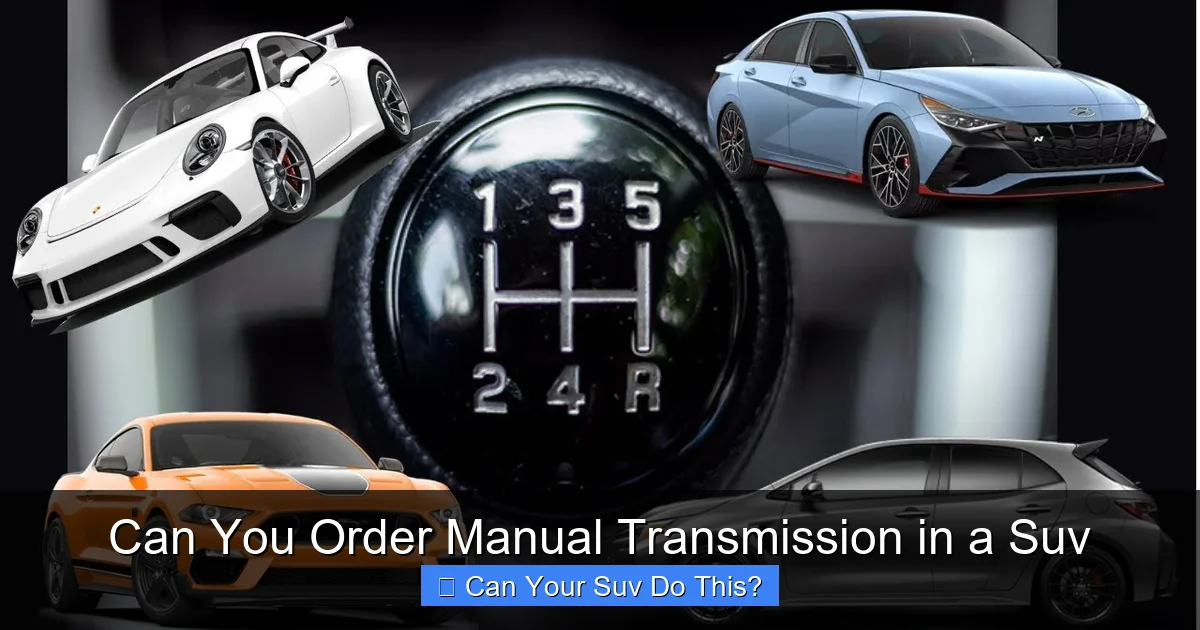
Yes, you can still order manual transmission in select SUVs—though options are limited. Enthusiasts love the control and engagement a stick shift provides, especially for off-roading or towing. While most automakers have shifted to automatics, a few rugged models keep the manual alive.
Key Takeaways
- Manual transmissions are rare but not extinct in SUVs: A handful of models still offer a stick shift, primarily in off-road-focused or performance-oriented vehicles.
- Jeep Wrangler remains a top choice: The Wrangler Rubicon and Sport trims offer a 6-speed manual, ideal for trail driving and driver engagement.
- Off-road capability benefits from manual control: Lower gears and clutch modulation give drivers precise power delivery on steep or uneven terrain.
- Fuel efficiency myths are fading: Modern automatics often outperform manuals in MPG, but manuals still appeal for simplicity and repairability.
- Younger drivers are less familiar with manuals: As automatic and CVT transmissions dominate, fewer people learn to drive stick—making manual SUVs a niche but passionate market.
- Resale value can be higher for manuals: Enthusiast-driven demand means well-maintained manual SUVs often hold value better than their automatic counterparts.
- Check trim levels and packages: Not all SUV trims offer a manual—always verify with the manufacturer or dealer before ordering.
📑 Table of Contents
- Can You Order Manual Transmission in an SUV? The Truth in 2024
- Why Manual Transmissions Are Disappearing from SUVs
- SUVs That Still Offer Manual Transmissions (2024)
- Why Choose a Manual Transmission in an SUV?
- Challenges of Owning a Manual SUV
- Tips for Ordering a Manual SUV
- The Future of Manual Transmissions in SUVs
- Conclusion: Is a Manual SUV Right for You?
Can You Order Manual Transmission in an SUV? The Truth in 2024
If you’ve ever dreamed of shifting gears while cruising down a mountain trail or feeling every bump and turn through the steering wheel and clutch pedal, you’re not alone. For decades, manual transmissions were the standard in nearly every vehicle—cars, trucks, and yes, even SUVs. But as technology advanced and consumer preferences shifted, automatics, CVTs, and dual-clutch systems took over. Today, the question isn’t just “Do SUVs have manual transmissions?” but “Can you actually order one?”
The short answer? Yes—but your options are limited. While most mainstream SUVs have abandoned the stick shift in favor of smoother, more efficient automatics, a few rugged, enthusiast-focused models still offer a manual transmission as an option. These aren’t your average family haulers. We’re talking about vehicles built for adventure, off-roading, and driver engagement. If you’re the type who enjoys the tactile feedback of a clutch pedal and the satisfaction of a perfectly timed downshift, there’s still hope.
In this guide, we’ll explore which SUVs still offer manual transmissions, why they matter, and what you should consider before making the switch. Whether you’re a seasoned stick-shift driver or a curious newcomer, understanding the current landscape will help you decide if a manual SUV is right for you.
Why Manual Transmissions Are Disappearing from SUVs
Visual guide about Can You Order Manual Transmission in a Suv
Image source: i.ytimg.com
It’s no secret: manual transmissions are becoming a rarity. In the U.S., less than 1% of new vehicles sold in 2023 came with a stick shift, according to data from Edmunds and J.D. Power. SUVs, which now dominate the automotive market, are especially unlikely to offer a manual option. But why?
Consumer Preference Shifts Toward Convenience
Let’s face it—most drivers today prioritize comfort and ease of use. Automatic transmissions have evolved dramatically over the past two decades. Modern automatics are faster, smoother, and more fuel-efficient than ever. They can shift gears quicker than a human can, and features like adaptive shift logic learn your driving style to optimize performance.
For the average SUV buyer—someone shuttling kids to school, commuting to work, or running errands—an automatic is simply more practical. It reduces driver fatigue in stop-and-go traffic, requires no special skill to operate, and integrates seamlessly with advanced driver-assistance systems like adaptive cruise control and lane-keeping assist.
Manufacturers Prioritize Efficiency and Cost
Automakers are under constant pressure to improve fuel economy and reduce emissions. Automatic transmissions, especially 8- and 10-speed units, are engineered to keep engines in their most efficient RPM range. Many also feature lock-up torque converters and coasting modes that further boost MPG.
From a production standpoint, offering a manual transmission adds complexity. It requires different tooling, training, and inventory management. With such low demand, most manufacturers have decided it’s not worth the cost. Why invest in a manual option when 99% of buyers won’t choose it?
Technology and Safety Systems Favor Automatics
Modern SUVs are packed with tech—lane departure warnings, automatic emergency braking, blind-spot monitoring, and more. These systems rely on seamless communication between the engine, transmission, and sensors. Automatics integrate more easily with these systems because they can predict and respond to driving conditions in real time.
Manuals, by contrast, require driver input. If you’re focused on shifting gears, you might miss a warning light or fail to react quickly in an emergency. While not inherently less safe, manuals don’t play as nicely with today’s advanced safety suites.
The Rise of Electrification
Electric SUVs don’t have transmissions at all—just single-speed reducers. As brands like Tesla, Rivian, and Ford push toward electrification, the idea of a manual gearbox becomes even more obsolete. Even hybrid SUVs typically use electronically controlled automatics or CVTs.
So while manuals aren’t completely gone, their future is uncertain. But for now, a few passionate automakers are keeping the flame alive—especially in the off-road and performance segments.
SUVs That Still Offer Manual Transmissions (2024)
If you’re set on driving a manual SUV, your best bets are in the rugged, adventure-ready category. These vehicles cater to enthusiasts who value control, simplicity, and the thrill of driving. Here are the top models you can still order with a stick shift.
Jeep Wrangler (Rubicon and Sport Trims)
The Jeep Wrangler is the undisputed king of manual SUVs. For decades, it’s been the go-to choice for off-roaders, overlanders, and anyone who loves the feel of a true mechanical connection to the road—or lack thereof.
The 2024 Wrangler offers a 6-speed manual transmission on the Sport and Rubicon trims when paired with the 3.6L Pentastar V6 engine. The Rubicon, in particular, is built for extreme terrain, with heavy-duty axles, locking differentials, and a 4:1 low-range transfer case. The manual transmission enhances this capability by giving drivers precise control over power delivery.
Why choose the manual? On steep inclines or rocky trails, you can hold a lower gear longer, preventing the engine from lugging or stalling. You can also “feather” the clutch for delicate maneuvers, like crawling over boulders or navigating tight switchbacks. It’s not just about nostalgia—it’s about function.
One caveat: the manual isn’t available with the 2.0L turbocharged 4-cylinder or the plug-in hybrid 4xe powertrain. So if you want efficiency or electrification, you’ll need to go automatic.
Ford Bronco (Base and Big Bend Trims)
The Ford Bronco made a triumphant return in 2021, and one of its most celebrated features was the return of the manual transmission. Available on the Base and Big Bend trims with the 2.3L EcoBoost 4-cylinder engine, the 7-speed manual (yes, seven speeds!) is a joy to use.
Unlike traditional manuals, the Bronco’s gearbox includes a “crawler” gear—an ultra-low first gear designed specifically for off-roading. This gives you incredible torque at very low speeds, perfect for rock crawling or muddy trails. The shifter has a short, precise throw, and the clutch is well-weighted, making it easy to modulate.
Ford also offers a manual-locking rear differential on certain trims, which pairs perfectly with the stick shift for maximum traction. It’s a rare combination of modern tech and old-school driving feel.
Note: The manual is not available on higher trims like the Outer Banks or Wildtrak, nor with the 2.7L V6 engine. So if you want power and a stick, you’ll need to stick with the 2.3L.
Subaru WRX STI (Technically a Sedan, But SUV-Like in Spirit)
Okay, the WRX STI isn’t an SUV—it’s a high-performance sedan. But with its standard all-wheel drive, rally-bred heritage, and aggressive styling, it appeals to the same crowd that might consider a manual SUV. And it’s one of the last performance cars in the U.S. to offer a manual transmission.
The 2024 WRX STI (if available) comes with a 6-speed manual and a turbocharged 2.5L boxer engine. It’s not built for off-roading, but it excels on twisty backroads and track days. The manual gives drivers full control over gear selection, allowing for quick downshifts and engine braking.
While not a true SUV, the STI represents the spirit of manual driving—engagement, precision, and driver involvement. If you’re open to a slightly different body style, it’s worth considering.
International and Niche Models (Limited Availability)
Outside the U.S., a few more SUVs offer manuals. The Toyota Land Cruiser 70 Series (available in Australia, Africa, and parts of Asia) comes with a 5-speed manual and is legendary for its durability. The Mercedes-Benz G-Class still offers a manual in some global markets, though not in the U.S.
These models are often built for extreme conditions—deserts, jungles, war zones—where simplicity and reliability matter most. They’re not sold in large numbers, but they prove that manuals still have a place in the automotive world.
Why Choose a Manual Transmission in an SUV?
You might be wondering: “Why bother with a manual when automatics are so advanced?” It’s a fair question. But for the right driver, a manual SUV offers unique advantages.
Greater Driver Engagement and Control
Driving a manual is an active experience. You’re not just pressing pedals—you’re coordinating clutch, throttle, and gear selection. This creates a deeper connection between driver and machine. Every shift feels intentional. Every engine note is more meaningful.
In an SUV, especially one used for off-roading or spirited driving, this control is invaluable. You can choose the exact gear for the terrain—holding second gear through a muddy section, dropping to first for a steep climb, or using engine braking on a downhill descent. Automatics can do some of this, but they don’t always predict your intentions.
Improved Off-Road Performance
Off-roading is where manuals truly shine. On technical trails, you often need to crawl at very low speeds. A manual lets you “inch” forward using the clutch, something automatics struggle with. You can also prevent unwanted upshifts that might cause loss of traction.
Additionally, manuals are mechanically simpler. Fewer electronic components mean fewer things to break in harsh conditions. If you’re deep in the wilderness with no cell service, a manual transmission is easier to diagnose and repair than a complex automatic.
Lower Maintenance and Repair Costs
Manual transmissions have fewer moving parts than automatics. No torque converter, no complex valve body, no planetary gear sets. This means fewer things can go wrong—and when they do, repairs are often cheaper.
Clutches do wear out, of course, but they’re relatively inexpensive to replace compared to automatic transmission rebuilds. And because manuals are less common, specialists who work on them often charge less due to lower demand.
Fuel Efficiency (In Some Cases)
While modern automatics often beat manuals in EPA ratings, real-world driving can tell a different story. A skilled manual driver can optimize gear selection for efficiency, avoiding unnecessary revs and keeping the engine in its sweet spot.
In stop-and-go traffic, however, automatics usually win. But on highways or open roads, a manual can be just as efficient—sometimes more so.
Higher Resale Value for Enthusiasts
Here’s a surprising benefit: manual SUVs often hold their value better. Why? Because they appeal to a passionate, niche market. Enthusiasts seek out manuals, and well-maintained examples are rare.
A 2018 Jeep Wrangler Rubicon with a manual might sell for more than an identical automatic model. The same goes for a Ford Bronco with a stick shift. Collectors and off-roaders know these vehicles are special—and they’re willing to pay a premium.
Challenges of Owning a Manual SUV
Of course, it’s not all upside. Manual SUVs come with trade-offs.
Steeper Learning Curve
If you didn’t learn to drive a manual as a teen, it can take time to master. Stalling, jerky shifts, and clutch wear are common early challenges. In heavy traffic, constant shifting can be tiring.
But with practice, it becomes second nature. Many drivers find it rewarding—even therapeutic.
Limited Availability and Options
As mentioned, manuals are only available on specific trims and engines. You might have to compromise on features like heated seats, advanced infotainment, or towing packages to get the stick shift.
And if you’re buying used, finding a low-mileage manual SUV can be tough. They’re often driven hard and modified, so condition varies widely.
Resale Market Can Be Niche
While manuals can hold value well, they also appeal to a smaller pool of buyers. If you need to sell quickly, you might have to lower the price or wait longer for the right buyer.
Not Ideal for All Drivers
If you have mobility issues, arthritis, or frequent knee problems, operating a clutch can be painful or difficult. Automatics are simply more accessible for many drivers.
Tips for Ordering a Manual SUV
If you’ve decided to go for it, here’s how to make the process smooth.
Check Trim and Engine Compatibility
Not all trims offer a manual. For example, the Jeep Wrangler manual is only available on Sport and Rubicon with the V6. The Ford Bronco manual is limited to Base and Big Bend with the 2.3L engine. Always verify with the manufacturer or dealer.
Order Early and Be Patient
Manuals are low-volume options. Dealers may not have one in stock, and factory orders can take weeks or months. Be prepared to wait—and possibly pay a markup if demand is high.
Test Drive Before Committing
If possible, test drive a manual version. Pay attention to clutch feel, shifter action, and noise levels. Some manuals are noisy or stiff—especially in off-road SUVs.
Consider Used Options
If a new manual SUV is out of reach, look at used models. Older Wranglers, 4Runners, and even some Land Rovers came with manuals. Just have them inspected by a mechanic familiar with off-road vehicles.
Learn to Drive Stick (If You Haven’t)
If you’re new to manuals, practice in a safe, empty lot. Start with basic starts and stops, then work up to hills and traffic. Many driving schools offer refresher courses.
The Future of Manual Transmissions in SUVs
So, what’s next? Will manuals disappear entirely?
It’s possible. As electrification grows and automatics become even more efficient, the case for manuals weakens. But as long as there are drivers who value control, simplicity, and the joy of driving, there will be a place for the stick shift.
Enthusiast brands like Jeep and Ford understand this. They keep manuals alive not for mass appeal, but for loyalty. These vehicles build communities—off-road clubs, overlanding groups, track days—where the manual transmission is a badge of honor.
And who knows? If demand surges, other automakers might follow. Imagine a manual Toyota 4Runner or a stick-shift Land Rover Defender. It’s unlikely, but not impossible.
For now, the manual SUV is a rare breed—but a beloved one. It’s not for everyone. But for those who choose it, the rewards are real.
Conclusion: Is a Manual SUV Right for You?
So, can you order manual transmission in an SUV? Yes—if you know where to look. The Jeep Wrangler and Ford Bronco lead the charge, offering capable, fun-to-drive SUVs with real stick shifts. They’re not the most practical choices for everyone, but for off-roaders, enthusiasts, and anyone who loves the feel of a mechanical connection, they’re worth considering.
Manuals offer control, engagement, and a sense of adventure that automatics can’t match. They’re simpler, often more reliable, and can even hold their value better. But they require skill, patience, and a willingness to embrace a dying art.
If you’re ready to shift gears—literally—start by researching your options, test driving a manual SUV, and talking to owners. The journey might be harder than buying an automatic, but the destination? That’s where the real fun begins.
Frequently Asked Questions
Can you still buy a new SUV with a manual transmission?
Yes, but options are limited. The Jeep Wrangler and Ford Bronco are the most notable new SUVs that still offer a manual transmission, though only on specific trims and engines.
Is a manual transmission better for off-roading?
Many off-roaders prefer manuals because they offer precise control over gear selection and clutch modulation, which is helpful on steep or technical terrain. However, modern automatics with low-range modes can also perform well.
Do manual SUVs get better gas mileage?
Not necessarily. While manuals can be efficient in skilled hands, modern automatics often achieve better EPA ratings due to advanced gear ratios and shift logic.
Are manual transmissions more reliable than automatics?
Manuals are generally simpler and have fewer components that can fail, making them potentially more reliable and cheaper to repair—though clutch wear is a common maintenance item.
Can I learn to drive a manual SUV as an adult?
Absolutely. Many adults learn to drive stick later in life. It takes practice, but with patience and the right instruction, it’s entirely achievable.
Will manual SUVs become collector’s items?
It’s possible. As manuals disappear, well-maintained examples—especially from iconic models like the Wrangler or Bronco—could become sought-after by enthusiasts and collectors.