
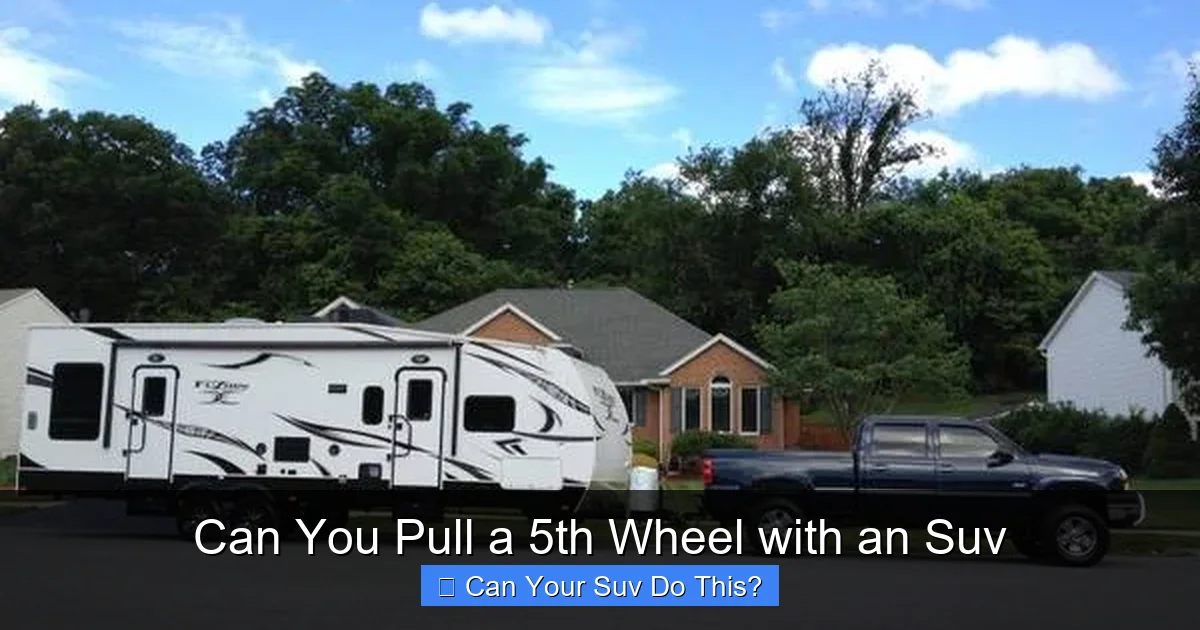
Pulling a 5th wheel with an SUV is possible—but only if your SUV has the right towing capacity, proper hitch setup, and sufficient wheelbase. While most standard SUVs aren’t built for fifth-wheel towing, heavy-duty models like the Ford Expedition, Chevrolet Tahoe, or GMC Yukon can handle it with the correct equipment and modifications.
Key Takeaways
- Not all SUVs can tow a 5th wheel: Only large, heavy-duty SUVs with high towing ratings (10,000+ lbs) are suitable for fifth-wheel trailers.
- Proper hitch installation is critical: A fifth-wheel hitch must be mounted in the bed of a pickup truck or a specially modified SUV with a reinforced frame.
- Wheelbase matters: Longer wheelbases improve stability and reduce sway when towing heavy loads like fifth wheels.
- Payload capacity is just as important as towing capacity: The SUV must handle the hitch weight (typically 15–25% of the trailer’s total weight) without exceeding limits.
- Check your owner’s manual: Always verify towing specs and manufacturer recommendations before attempting to tow a fifth wheel.
- Consider a gooseneck adapter: Some SUVs can use gooseneck-to-5th-wheel adapters if they have a truck-style bed or aftermarket setup.
- Safety and practice are essential: Even if your SUV can technically tow a fifth wheel, practice maneuvering and braking in safe areas first.
📑 Table of Contents
- Can You Pull a 5th Wheel with an SUV? The Real Answer
- Understanding Fifth-Wheel Trailers and Why They’re Different
- SUV Towing Capacity: What You Need to Know
- Hitch Compatibility: Can You Even Install a Fifth-Wheel Hitch?
- Alternative Solutions: What If Your SUV Can’t Handle It?
- Safety Tips for Towing a Fifth Wheel with an SUV
- Final Thoughts: Is It Worth It?
Can You Pull a 5th Wheel with an SUV? The Real Answer
So, you’ve got a shiny SUV in the driveway and a dream of hitting the open road in a cozy fifth-wheel trailer. Maybe you’re eyeing that luxurious 30-foot model with a full kitchen, bunk beds, and a king-sized bed. But here’s the big question: can your SUV actually pull it?
The short answer? Yes—but only under the right conditions. Most standard SUVs, like the Honda CR-V, Toyota RAV4, or even mid-size models like the Ford Explorer, simply aren’t built to handle the weight and dynamics of a fifth-wheel trailer. These vehicles are designed for passenger comfort and light towing, not heavy-duty hauling.
However, if you’re driving a full-size, heavy-duty SUV—think Ford Expedition Max, Chevrolet Suburban, or GMC Yukon XL—you might be in luck. These larger SUVs come with robust frames, powerful engines, and towing capacities that can exceed 10,000 pounds. With the right equipment and setup, they can indeed pull a fifth wheel safely and effectively.
But before you start shopping for a trailer, there’s a lot to consider. Towing a fifth wheel isn’t just about horsepower—it’s about balance, stability, and proper installation. In this guide, we’ll break down everything you need to know about pulling a fifth wheel with an SUV, from towing capacity and hitch requirements to real-world examples and safety tips.
Understanding Fifth-Wheel Trailers and Why They’re Different
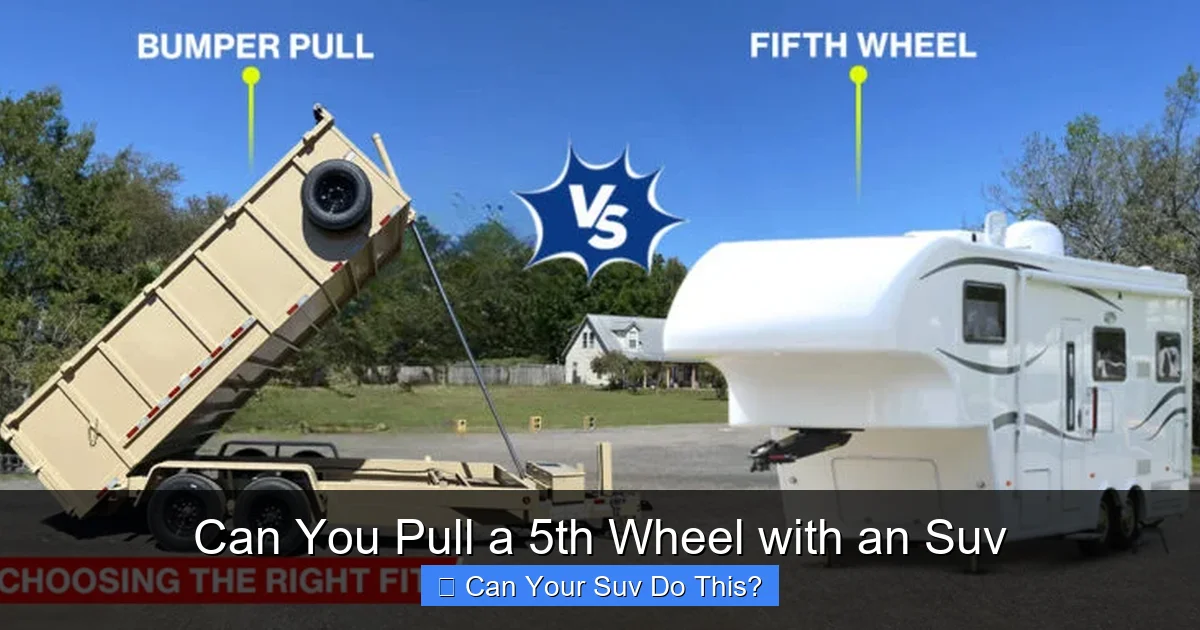
Visual guide about Can You Pull a 5th Wheel with an Suv
Image source: topshelftrailers.com
Before we dive into whether your SUV can handle it, let’s quickly cover what a fifth-wheel trailer actually is—and why it’s not the same as pulling a travel trailer or pop-up camper.
A fifth-wheel trailer is a type of recreational vehicle (RV) that connects to the towing vehicle via a special hitch mounted in the bed of a pickup truck. Unlike a conventional trailer that attaches to a rear hitch, a fifth-wheel uses a kingpin coupling that locks into a fifth-wheel hitch, which sits over the rear axle of the truck. This design allows for better weight distribution, improved stability, and more living space inside the trailer—often with multiple levels, slide-outs, and luxury amenities.
Because of this unique setup, fifth wheels require a specific kind of towing vehicle. Traditionally, that’s been a pickup truck—like a Ford F-350, Ram 3500, or Chevrolet Silverado 3500. These trucks are built with heavy-duty frames, high towing capacities, and the necessary bed space to accommodate the hitch.
But what about SUVs? Can they step into that role?
The challenge is that most SUVs don’t have an open bed like a pickup truck. They have enclosed cargo areas, which means you can’t simply install a standard fifth-wheel hitch. That’s the first major hurdle. However, some SUVs—especially those based on truck platforms—can be modified to accept a fifth-wheel hitch, either through aftermarket solutions or by using adapters.
SUV Towing Capacity: What You Need to Know
The most important factor in determining whether your SUV can pull a fifth wheel is its towing capacity. This is the maximum weight your vehicle can safely tow, as specified by the manufacturer. It’s not just about engine power—it’s about the entire system: transmission, cooling, suspension, brakes, and frame strength.
Let’s look at some real-world examples.
The Ford Expedition Max, for instance, has a maximum towing capacity of up to 9,300 pounds when properly equipped. That’s impressive for an SUV, but still on the lower end for many fifth-wheel trailers, which often weigh between 10,000 and 15,000 pounds—sometimes more when loaded with gear, water, and passengers.
The Chevrolet Tahoe and GMC Yukon (non-XL models) max out around 8,400 pounds. Again, strong for an SUV, but likely insufficient for most fifth wheels.
Now, consider the Chevrolet Suburban or GMC Yukon XL. These longer-wheelbase versions can tow up to 8,300 pounds—still not quite enough for heavier fifth wheels, but closer.
Then there’s the Ford Expedition with the Heavy-Duty Trailer Tow Package, which can reach 9,300 pounds. Still, that’s barely scratching the surface of what many fifth wheels require.
So, while some SUVs come close, very few can match the towing capacity of a heavy-duty pickup truck, which can easily exceed 15,000 or even 20,000 pounds.
But towing capacity isn’t the only number that matters.
Payload Capacity: The Hidden Limitation
Many people focus solely on towing capacity and forget about payload capacity—the total weight your SUV can carry, including passengers, cargo, fuel, and the tongue weight of the trailer.
For fifth-wheel trailers, the hitch weight (also called pin weight) is typically 15% to 25% of the trailer’s total weight. So, a 12,000-pound fifth wheel could have a pin weight of 1,800 to 3,000 pounds. That’s a massive amount of downward force on the rear of your SUV.
Most SUVs have a payload capacity between 1,500 and 2,500 pounds. If your fifth-wheel hitch weighs 2,000 pounds and you’ve got four passengers, luggage, and a full tank of gas, you could easily exceed your SUV’s payload limit—even if the towing capacity seems sufficient.
Exceeding payload capacity can lead to dangerous consequences: sagging rear suspension, poor handling, increased braking distance, and even frame damage. It’s a critical factor that’s often overlooked.
Wheelbase and Stability
Another key consideration is wheelbase—the distance between the front and rear axles. A longer wheelbase improves stability when towing, especially with heavy, high-center-of-gravity loads like fifth wheels.
SUVs like the Suburban, Yukon XL, and Expedition Max have longer wheelbases than their shorter counterparts, which helps. But even then, they’re still not as stable as a pickup truck with a similar wheelbase, because trucks are designed with towing in mind from the ground up.
Shorter SUVs, like the Toyota Highlander or Nissan Pathfinder, have wheelbases under 115 inches—far too short for safe fifth-wheel towing. The risk of sway, jackknifing, or loss of control increases significantly with shorter wheelbases and heavier loads.
Hitch Compatibility: Can You Even Install a Fifth-Wheel Hitch?
Now let’s tackle the elephant in the room: how do you attach a fifth-wheel hitch to an SUV?
As mentioned earlier, fifth-wheel hitch systems are designed to be mounted in the bed of a pickup truck. They require a flat, reinforced surface with access to the frame underneath. Most SUVs don’t have this.
So, can you install a fifth-wheel hitch in an SUV?
The answer is: only with significant modifications.
Some full-size SUVs—particularly those built on truck platforms—can be converted. For example, the Ford Expedition and Lincoln Navigator are based on the Ford F-150 platform. With the right aftermarket kit, it’s possible to modify the rear cargo area to accept a fifth-wheel hitch.
Companies like Hijacker and PullRite offer specialized hitch systems designed for SUVs. These often involve cutting into the rear floor, reinforcing the frame, and installing a custom mounting system. It’s not a DIY job—it requires professional installation and may void your warranty.
Another option is using a gooseneck-to-5th-wheel adapter. If your SUV has a gooseneck hitch installed (which some heavy-duty models can accommodate), you can use an adapter that converts the gooseneck connection to a fifth-wheel kingpin. This allows you to tow a fifth-wheel trailer without a traditional bed-mounted hitch.
However, this still requires a reinforced frame and proper weight distribution. And again, not all SUVs are compatible.
Real-World Example: The Modified Expedition
Let’s say you own a Ford Expedition Max with the Heavy-Duty Trailer Tow Package. You’ve got 9,300 pounds of towing capacity and a payload rating of around 1,800 pounds. You’re eyeing a 28-foot fifth-wheel trailer that weighs 11,500 pounds dry.
At first glance, it seems close—but remember, that’s the dry weight. Add water, propane, gear, and passengers, and you’re easily over 13,000 pounds. Plus, the pin weight could be 2,000 pounds or more.
Even if you modify the Expedition to accept a fifth-wheel hitch, you’re pushing the limits of both towing and payload capacity. One rainy day or sudden stop could spell disaster.
In this case, it’s safer and more practical to either:
– Choose a lighter fifth-wheel trailer (under 8,000 pounds),
– Upgrade to a heavy-duty pickup truck, or
– Consider a different type of trailer, like a travel trailer or toy hauler.
Alternative Solutions: What If Your SUV Can’t Handle It?
If your SUV isn’t up to the task of pulling a fifth wheel, don’t despair. There are still plenty of ways to enjoy RV life without upgrading your vehicle.
Travel Trailers: A Great Alternative
Travel trailers are the most common type of towable RV and are designed to be pulled by a wide range of vehicles, including many SUVs. They attach to a standard hitch at the rear of the vehicle and don’t require a bed-mounted system.
Many travel trailers are lightweight and aerodynamic, making them ideal for SUVs. Models like the Jayco Jay Feather, Forest River R-Pod, or Airstream Basecamp can be towed by SUVs with towing capacities as low as 3,500 pounds.
Even larger travel trailers—up to 30 feet—can be pulled by heavy-duty SUVs like the Expedition or Suburban, as long as you stay within towing and payload limits.
The trade-off? You lose the elevated living space and stability of a fifth wheel. But for many travelers, the convenience and affordability of a travel trailer make it a better fit.
Toy Haulers and Hybrid Trailers
If you’re into outdoor adventures—ATVs, motorcycles, or kayaks—a toy hauler might be the way to go. These trailers have a garage space in the back that doubles as extra living area. Many are designed to be lighter and more aerodynamic, making them suitable for SUV towing.
Hybrid trailers, which combine hard-sided walls with pop-out tent ends, are another lightweight option. They offer more space than a pop-up but are easier to tow than a full-sized trailer.
Consider a Truck-Based SUV
If you’re set on fifth-wheel towing but prefer the comfort of an SUV, consider a vehicle that blurs the line between the two. The Ford F-150 Lightning (electric) and Rivian R1T are electric pickups with SUV-like interiors and advanced tech. While not SUVs per se, they offer the best of both worlds: truck capability with luxury features.
Alternatively, some buyers convert older SUVs into “SUV-trucks” by removing the rear roof and installing a flat bed. This is rare and expensive, but it allows for fifth-wheel towing. However, it’s not practical for most people.
Safety Tips for Towing a Fifth Wheel with an SUV
If you’ve determined that your SUV can safely tow a fifth wheel—congratulations! But before you hit the road, here are some essential safety tips.
1. Never Exceed Manufacturer Limits
This can’t be stressed enough. Towing and payload capacities are not suggestions—they’re hard limits set by engineers. Exceeding them can lead to mechanical failure, loss of control, or accidents.
Always check your owner’s manual and the trailer’s weight ratings. Use a scale to weigh your loaded SUV and trailer at a truck stop or RV facility.
2. Practice Maneuvering
Fifth-wheel towing requires a different driving style. You’ll need to account for the extended length, wider turning radius, and increased sway risk.
Practice in an empty parking lot. Learn how to back up slowly, use your mirrors, and avoid sharp turns. Consider installing a backup camera or blind-spot monitoring system.
3. Use Weight Distribution and Sway Control
Even with a fifth-wheel hitch, sway can be an issue—especially in windy conditions or when passing large trucks.
Invest in a sway control system, such as the Reese Strait Line or Pro Series Sway Control. These devices help keep the trailer tracking straight behind the SUV.
4. Check Tire Pressure and Condition
Underinflated or worn tires are a leading cause of towing accidents. Check tire pressure before every trip and inspect for cracks, bulges, or uneven wear.
Consider upgrading to higher-load-range tires (like LT or E-rated) if you’re regularly towing heavy loads.
5. Brake Controller Is a Must
Fifth-wheel trailers often have electric brakes. Your SUV must have a brake controller installed to activate them.
A brake controller allows you to adjust brake force and timing, improving stopping power and reducing wear on your SUV’s brakes.
6. Secure All Cargo
Loose items in the trailer can shift during travel, affecting balance and safety. Use straps, bins, and non-slip mats to secure everything.
Also, avoid overloading the front of the trailer, which can increase pin weight and strain your SUV’s rear suspension.
Final Thoughts: Is It Worth It?
So, can you pull a 5th wheel with an SUV? Technically, yes—but it’s not always practical, safe, or cost-effective.
For most SUV owners, the answer is no. The modifications required are expensive, the risks are high, and the benefits are limited. You’re better off choosing a travel trailer or upgrading to a pickup truck if fifth-wheel living is your goal.
However, if you already own a heavy-duty SUV with high towing and payload capacity—and you’re willing to invest in professional modifications—it’s possible. Just be realistic about the limitations and prioritize safety above all else.
At the end of the day, the best towing setup is one that matches your vehicle’s capabilities and your travel needs. Don’t force your SUV to do something it wasn’t designed for. Instead, find the right trailer for your SUV—and enjoy the journey with confidence.
Frequently Asked Questions
Can a Toyota Highlander tow a fifth wheel?
No, the Toyota Highlander is not suitable for fifth-wheel towing. With a maximum towing capacity of around 5,000 pounds and no bed for hitch installation, it lacks the power, payload, and physical setup required for safe fifth-wheel towing.
What SUV has the highest towing capacity?
The Ford Expedition Max with the Heavy-Duty Trailer Tow Package currently holds one of the highest towing capacities among SUVs at 9,300 pounds. The Chevrolet Suburban and GMC Yukon XL also offer strong towing, but still fall short of most fifth-wheel requirements.
Can you put a fifth-wheel hitch in an SUV?
Only with extensive modifications. Some full-size SUVs based on truck platforms can be retrofitted with custom hitch systems, but this requires professional installation, frame reinforcement, and may void your warranty.
Is it safe to tow a fifth wheel with an SUV?
It can be safe if the SUV has sufficient towing and payload capacity, a properly installed hitch, and the driver follows safety guidelines. However, most SUVs are not designed for this purpose, and the risk increases significantly with heavier trailers.
What’s the difference between a fifth wheel and a travel trailer?
A fifth wheel attaches to a hitch in the bed of a truck and sits higher, offering more space and stability. A travel trailer attaches to a rear hitch and is generally lighter and easier to tow with SUVs.
Can I use a gooseneck adapter to tow a fifth wheel with my SUV?
Yes, if your SUV has a gooseneck hitch installed and sufficient towing capacity. Gooseneck-to-5th-wheel adapters allow you to connect a fifth-wheel trailer, but frame strength and payload limits still apply.