
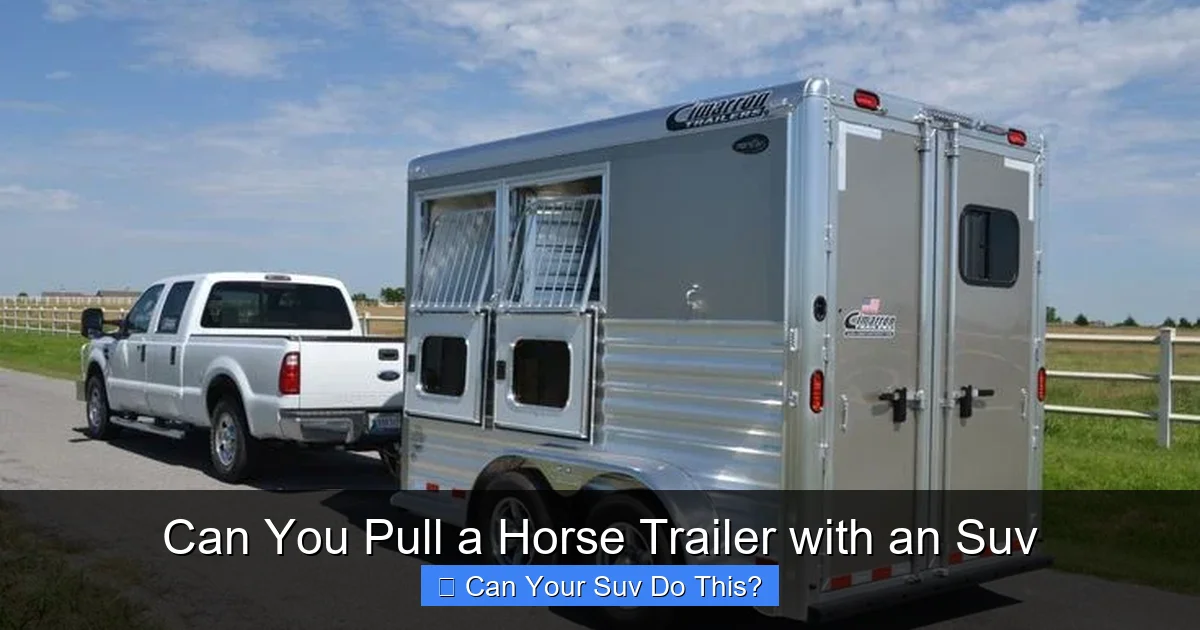
Yes, many SUVs can pull a horse trailer—but only if they’re properly equipped and within their towing capacity. It’s not just about power; safety, hitch setup, and trailer weight matter just as much. Always check your owner’s manual and never exceed your vehicle’s limits.
Key Takeaways
- Check your SUV’s towing capacity: This is the maximum weight your vehicle can safely tow, including the trailer, horses, gear, and fuel. Exceeding it risks mechanical failure and accidents.
- Know the difference between curb weight and GVWR: Curb weight is the SUV’s weight without passengers or cargo. GVWR (Gross Vehicle Weight Rating) includes everything—don’t confuse the two when calculating towing safety.
- Use the right hitch and braking system: A weight-distributing hitch and trailer brakes (especially electric or surge brakes) are essential for control and stopping power.
- Consider the trailer type: Bumper-pull trailers are easier for SUVs to handle than gooseneck models, which usually require truck beds.
- Top SUVs for towing horse trailers: Models like the Ford Expedition, Chevrolet Tahoe, Toyota Sequoia, and Jeep Grand Cherokee offer strong towing capacities up to 9,000 lbs.
- Practice makes perfect: Towing a loaded horse trailer feels different—practice in empty parking lots before hitting the road.
- Safety first: Always secure horses properly, inspect tires and lights, and avoid sudden maneuvers.
📑 Table of Contents
- Can You Pull a Horse Trailer with an SUV?
- Understanding Towing Capacity: The Most Important Number
- Types of Horse Trailers and What SUVs Can Handle
- Top SUVs That Can Safely Tow a Horse Trailer
- Essential Equipment for Safe Towing
- Driving Tips for Towing a Horse Trailer
- Common Mistakes to Avoid
- Final Thoughts: Is Your SUV Up to the Task?
Can You Pull a Horse Trailer with an SUV?
So, you’ve got a horse—or two—and you’re dreaming of weekend trail rides, shows, or just a change of scenery. But here’s the big question: Can your SUV actually pull a horse trailer? The short answer? Maybe. But it’s not as simple as hitching up and hitting the road.
Towing a horse trailer isn’t like dragging a small utility trailer full of lawn chairs. Horses weigh anywhere from 800 to over 2,000 pounds each, and the trailer itself adds several hundred more. Plus, you’ve got feed, water, tack, and maybe even a generator or camping gear. All that weight adds up fast. And if your SUV isn’t built for it—or if you’re not prepared—you could be setting yourself up for a dangerous situation.
But don’t worry. With the right knowledge, equipment, and planning, many SUVs can safely tow a horse trailer. It’s all about understanding your vehicle’s limits, choosing the right setup, and driving smart. In this guide, we’ll walk you through everything you need to know—from checking your towing capacity to picking the best SUV for the job.
Understanding Towing Capacity: The Most Important Number
Visual guide about Can You Pull a Horse Trailer with an Suv
Image source: horsetrailertrader.com
Before you even think about hooking up a trailer, you need to know one critical number: your SUV’s towing capacity. This is the maximum weight your vehicle can safely pull, as determined by the manufacturer. It’s not a suggestion—it’s a hard limit.
You’ll find this number in your owner’s manual, usually under “Towing” or “Specifications.” It might also be listed on a sticker inside the driver’s door jamb. Don’t rely on what the salesperson told you years ago—towing capacities can vary even between model years of the same SUV.
For example, a 2023 Ford Expedition Max can tow up to 9,300 pounds when properly equipped. That’s enough for most two-horse trailers with average-sized horses. But a smaller SUV like the Honda Pilot maxes out around 5,000 pounds—enough for a lightweight single-horse trailer, but not much more.
Why Towing Capacity Matters
Exceeding your SUV’s towing capacity can lead to serious problems. Your engine may overheat, your brakes could fail under heavy loads, and your transmission might wear out prematurely. Worst of all, you risk losing control on the road—especially on hills or in windy conditions.
Imagine driving down a mountain pass with a trailer that’s too heavy. Your SUV’s brakes weren’t designed to stop that much weight. They could fade or fail, putting you, your horses, and other drivers in danger.
How to Calculate Safe Towing Weight
To stay safe, you need to calculate the total weight of everything you’re towing. That includes:
– The trailer’s dry weight (empty weight)
– The weight of the horses
– Water, feed, and bedding
– Tack, grooming supplies, and tools
– Any extra gear (coolers, chairs, etc.)
Add it all up and compare it to your SUV’s towing capacity. But don’t stop there. You also need to consider your SUV’s Gross Combined Weight Rating (GCWR)—the total weight of your vehicle, passengers, cargo, and trailer combined.
For example, if your SUV weighs 6,000 pounds and has a GCWR of 14,000 pounds, you can only tow up to 8,000 pounds—even if your towing capacity is higher. Always stay under both limits.
Types of Horse Trailers and What SUVs Can Handle
Not all horse trailers are created equal—and neither are SUVs. The type of trailer you choose will greatly affect whether your SUV can handle the job.
Bumper-Pull vs. Gooseneck Trailers
Most SUVs are designed to tow bumper-pull (or tag-along) trailers, where the trailer attaches to a hitch mounted on the rear bumper or frame. These are easier to maneuver and don’t require a truck bed.
Gooseneck trailers, on the other hand, attach to a ball hitch in the bed of a pickup truck. They offer better stability and weight distribution, but they’re not practical for most SUVs—unless you have a specialized adapter (which can be expensive and complex).
For SUV owners, bumper-pull is the way to go. Look for trailers with a low center of gravity and a well-balanced design. Aluminum trailers are lighter than steel, which helps keep total weight down.
Single vs. Double Horse Trailers
A single-horse trailer typically weighs between 1,500 and 2,500 pounds empty. Add a 1,000-pound horse, and you’re looking at 2,500 to 3,500 pounds total. That’s within range for many midsize SUVs.
A two-horse trailer can weigh 3,000 to 5,000 pounds empty. With two horses, feed, and gear, you could easily reach 6,000 to 7,000 pounds. That’s pushing the limit for smaller SUVs and requires a heavy-duty model.
If you’re towing two large horses (like draft breeds), you may need a three-horse trailer with a rear tack room—but that could exceed 8,000 pounds. Only full-size SUVs with high towing capacities should attempt this.
Living Quarters Trailers: Think Twice
Some horse trailers come with living quarters—beds, kitchens, bathrooms. These are great for long trips, but they’re heavy. A two-horse trailer with living quarters can weigh 8,000 pounds or more.
Unless you have a heavy-duty SUV like a Chevrolet Suburban or GMC Yukon XL with a Duramax diesel engine, towing a living quarters trailer is probably not safe. Even then, you’ll need a robust hitch system and possibly a brake controller.
Top SUVs That Can Safely Tow a Horse Trailer
Not all SUVs are built for heavy towing. If you’re in the market for a new vehicle—or wondering if your current one is up to the task—here are some of the best SUVs for pulling a horse trailer.
Ford Expedition
The Ford Expedition is a towing powerhouse. With the available 3.5L EcoBoost V6 engine and Max Trailer Tow Package, it can tow up to 9,300 pounds. That’s enough for most two-horse trailers with room to spare.
It also comes with Pro Trailer Backup Assist, which makes backing up with a trailer much easier. Plus, the spacious interior means you can bring along family or friends without sacrificing comfort.
Chevrolet Tahoe and Suburban
The Tahoe and its longer sibling, the Suburban, are excellent choices for horse owners. With the 6.2L V8 engine and Max Trailering Package, both can tow up to 8,300 pounds.
The Suburban’s extra length gives you more cargo space for gear, and the available air suspension helps maintain a level ride when towing. Just make sure to equip it with the trailer brake controller.
Toyota Sequoia
Toyota’s full-size SUV is known for reliability and strength. The 2023 Sequoia, with its twin-turbo V6, can tow up to 9,500 pounds—the highest in its class.
It also comes standard with Trailer-Sway Control and a built-in trailer brake controller. If you want a vehicle that’s built to last and can handle heavy loads, the Sequoia is a top pick.
Jeep Grand Cherokee
For those who want a balance of luxury and capability, the Grand Cherokee is a great option. The standard V6 can tow up to 6,200 pounds, while the available 5.7L V8 bumps that to 7,200 pounds.
The Grand Cherokee also offers advanced towing features like Hill Start Assist and Trailer Sway Damping. It’s not as strong as the full-size SUVs, but it’s perfect for lighter trailers or single-horse setups.
Other Strong Contenders
– **GMC Yukon XL**: Up to 8,400 lbs towing with the 6.2L V8.
– **Nissan Armada**: 8,500 lbs towing capacity, rugged and reliable.
– **Lincoln Navigator**: Luxury meets power with up to 8,700 lbs towing.
Always remember: “Properly equipped” is key. You may need to add a towing package, upgraded cooling, or a heavy-duty alternator to reach the maximum capacity.
Essential Equipment for Safe Towing
Even if your SUV can handle the weight, you still need the right gear to tow safely. Skimping on equipment is a recipe for trouble.
Weight-Distributing Hitch
A weight-distributing hitch spreads the trailer’s weight more evenly across your SUV’s axles. This improves steering, braking, and stability—especially important with heavy loads.
Without one, the trailer can cause your SUV’s rear end to sag, making it harder to control. Most experts recommend a weight-distributing hitch for trailers over 5,000 pounds.
Trailer Brake Controller
Your SUV’s brakes aren’t enough to stop a loaded horse trailer. That’s why you need a brake controller—a device that activates the trailer’s electric brakes when you press the pedal.
Most modern SUVs come with a factory-installed brake controller, but if yours doesn’t, you can add an aftermarket one. Look for models with proportional braking, which applies trailer brakes in sync with your SUV’s speed.
Sway Control Devices
Crosswinds, passing trucks, or uneven roads can cause your trailer to sway. Sway control devices—like friction bars or integrated systems—help keep the trailer in line.
Many weight-distributing hitches include sway control. If yours doesn’t, consider adding a separate sway bar.
Proper Tires and Air Pressure
Your SUV’s tires must be rated for the extra weight. Check the load index on the sidewall—higher numbers mean greater capacity.
Also, inflate your tires to the recommended pressure, especially when towing. Underinflated tires can overheat and blow out, which is dangerous at highway speeds.
Safety Chains and Breakaway System
Always cross your safety chains under the trailer tongue—this creates a cradle to catch the trailer if it detaches. And make sure your trailer has a breakaway system, which activates the brakes if the trailer becomes unhitched.
Driving Tips for Towing a Horse Trailer
Towing a horse trailer changes how your SUV handles. It’s slower to accelerate, harder to stop, and more affected by wind and road conditions. Here’s how to drive safely.
Take It Slow
Don’t rush. Accelerate gently, brake early, and allow extra space between you and other vehicles. Remember: your stopping distance is much longer with a trailer.
Practice Backing Up
Backing up with a trailer is tricky. The trailer moves in the opposite direction of your steering wheel. Practice in an empty parking lot before you need to maneuver in tight spaces.
Use your side mirrors and take it slow. If your SUV has a backup camera or trailer assist feature, use it.
Watch for Hills and Curves
Downhill grades are especially dangerous. Use lower gears to let the engine help slow you down—don’t ride the brakes.
On curves, slow down before the turn. Trailers can tip if you take corners too fast.
Check Your Load
Before you leave, make sure your horses are secured with proper partitions and tied safely. Distribute weight evenly—too much weight in the front can cause sway, too much in the back can lift the SUV’s rear wheels.
Plan Your Route
Avoid narrow roads, low bridges, and steep grades if possible. Use GPS apps that support RV or trailer routing to find the best path.
Common Mistakes to Avoid
Even experienced drivers make towing mistakes. Here are some to watch out for.
Overloading the Trailer
It’s tempting to pack everything—but don’t. Weigh your loaded trailer at a truck stop or scale. Many public scales charge just a few dollars.
Ignoring Maintenance
Towing puts extra strain on your SUV. Regularly check your transmission fluid, coolant, brakes, and tires. Consider a transmission cooler if you tow frequently.
Using the Wrong Hitch
A Class III hitch might not be enough for a heavy trailer. Make sure your hitch rating matches or exceeds your trailer’s weight.
Forgetting to Inspect Lights
Before every trip, check that all trailer lights—brake, turn, and running lights—are working. A broken light can lead to a ticket or worse.
Driving Without Practice
Don’t assume you can handle a trailer just because you’ve driven one before. Every trailer handles differently. Practice in safe areas first.
Final Thoughts: Is Your SUV Up to the Task?
So, can you pull a horse trailer with an SUV? The answer depends on your vehicle, your trailer, and your preparation.
If your SUV has a towing capacity of at least 5,000 pounds and you’re towing a single or lightweight two-horse trailer, you’re likely in good shape. But always do the math, use the right equipment, and drive carefully.
For heavier loads or frequent towing, consider upgrading to a full-size SUV with a strong engine and towing package. It’s an investment in safety and peace of mind.
Remember: your horses depend on you. Taking the time to tow safely isn’t just smart—it’s essential.
Frequently Asked Questions
Can a small SUV like a Honda CR-V tow a horse trailer?
Most small SUVs like the Honda CR-V have a towing capacity of around 1,500 to 3,500 pounds—far too low for even a single horse trailer with a horse. You’d risk damaging your vehicle and endangering everyone on the road.
Do I need a special license to tow a horse trailer?
In most states, no special license is required as long as the trailer and load are under 10,000 pounds GVWR. However, check your local laws—some states have specific rules for animal transport or large trailers.
Can I tow a horse trailer with a hybrid SUV?
Some hybrid SUVs, like the Toyota Highlander Hybrid, can tow up to 3,500 pounds—enough for a very lightweight single-horse trailer. But most hybrids aren’t built for heavy towing, so check your owner’s manual carefully.
How do I know if my SUV has a towing package?
Look for features like a heavy-duty radiator, upgraded alternator, trailer brake controller, and reinforced suspension. You can also check your VIN on the manufacturer’s website or ask a dealership.
Is it safe to tow a horse trailer in the rain or snow?
Towing in bad weather is riskier due to reduced traction and visibility. If you must go, reduce speed, increase following distance, and avoid sudden moves. Consider postponing the trip if conditions are severe.
Can I tow a horse trailer with a roof rack full of gear?
Adding weight to your roof raises your center of gravity and can make towing less stable. It’s better to pack gear inside the SUV or in the trailer’s storage compartments, if available.