
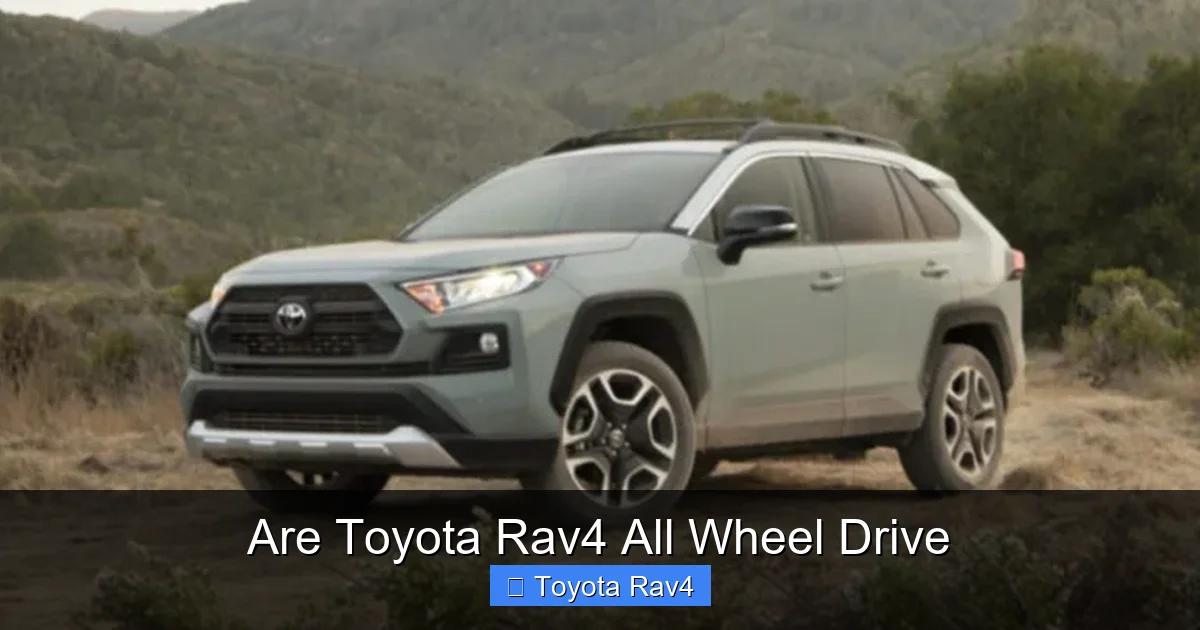
Yes, many Toyota RAV4 models come with all-wheel drive (AWD), but not all trims include it as standard. The RAV4 offers both traditional AWD and the advanced Dynamic Torque Vectoring AWD system, depending on the year and configuration. Whether you’re driving in rain, snow, or off-road trails, the RAV4’s AWD enhances stability and confidence.
If you’re considering a Toyota RAV4, you’ve probably asked yourself: *Are Toyota RAV4 all wheel drive?* It’s a smart question—especially if you live somewhere with unpredictable weather, mountain roads, or just want extra confidence behind the wheel. The short answer is: **many are, but not all.** The RAV4 offers all-wheel drive (AWD) as an option on most trims, and it comes standard on others, including the entire hybrid lineup. But understanding how AWD works in the RAV4—and whether you actually need it—can make a big difference in your driving experience.
The Toyota RAV4 has evolved from a compact, car-based SUV into one of the most popular crossovers in America. Known for reliability, fuel efficiency, and practicality, it’s a favorite among families, commuters, and outdoor enthusiasts alike. But when it comes to traction and handling, the drivetrain plays a crucial role. That’s where AWD comes in. Unlike older SUVs with bulky, always-on four-wheel drive systems, modern AWD in the RAV4 is intelligent, efficient, and designed to help you when you need it most—without wasting fuel when you don’t.
In this guide, we’ll break down everything you need to know about AWD in the Toyota RAV4. We’ll cover which models have it, how the system works, real-world benefits, and how it compares to front-wheel drive. Whether you’re shopping for a new or used RAV4, this information will help you make the right choice for your lifestyle and driving needs.
Key Takeaways
- Not all RAV4s are AWD: Front-wheel drive (FWD) is standard on most trims, but AWD is available as an upgrade or standard on higher trims.
- AWD improves traction: The system automatically sends power to the wheels with the most grip, helping in slippery or uneven conditions.
- Dynamic Torque Vectoring AWD is advanced: Available on newer models, it can send power side-to-side for better cornering and off-road control.
- Hybrid models come standard with AWD: The RAV4 Hybrid includes Electronic On-Demand AWD at no extra cost.
- Fuel efficiency remains strong: Even with AWD, the RAV4 maintains competitive fuel economy thanks to smart engineering.
- AWD is ideal for varied climates: If you live in areas with snow, rain, or rough terrain, AWD adds safety and peace of mind.
- Check the trim and year: AWD availability varies by model year and trim level, so always verify before purchasing.
📑 Table of Contents
Understanding AWD in the Toyota RAV4
All-wheel drive (AWD) means that power is sent to all four wheels of the vehicle, either full-time or on-demand. In the case of the RAV4, the AWD system is primarily **on-demand**, meaning it usually operates in front-wheel drive mode for better fuel economy. When the system detects wheel slip—like when you’re accelerating on ice, driving through mud, or cornering on a wet road—it automatically sends power to the rear wheels to restore traction.
This is different from four-wheel drive (4WD), which is typically found in trucks and off-road vehicles and often requires manual engagement. The RAV4’s AWD is fully automatic and designed for everyday driving, not extreme rock crawling. But don’t let that fool you—it’s more than capable of handling snow-covered streets, gravel backroads, and light off-pavement adventures.
Toyota offers two main types of AWD in the RAV4, depending on the model year and trim:
– **AWD with Dynamic Torque Control:** Found in older models (generally 2019 and earlier), this system uses a mechanical coupling to send power to the rear wheels when needed.
– **Dynamic Torque Vectoring AWD:** Available on newer models (2020 and later, especially on higher trims like the Adventure and TRD Off-Road), this system not only sends power front-to-rear but can also distribute torque side-to-side between the rear wheels. This improves cornering stability and off-road capability.
The key takeaway? The RAV4’s AWD isn’t just about brute force—it’s about smart engineering that helps you stay in control without sacrificing efficiency.
Which RAV4 Trims Come with AWD?

Visual guide about Are Toyota Rav4 All Wheel Drive
Image source: storage.bhs.cloud.ovh.net
One of the most common questions buyers have is: *Which RAV4 models come with all-wheel drive?* The answer depends on the trim level and whether you’re looking at a gas-powered or hybrid version.
Let’s break it down by category.
Gas-Powered RAV4 Trims (2020–2024)
For the current generation (fifth generation, introduced in 2019), most gas-powered RAV4 trims offer AWD as an **optional upgrade**. Here’s how it breaks down:
– **LE and XLE:** Front-wheel drive (FWD) is standard. AWD is available as a $1,400–$1,600 option, depending on the model year.
– **XLE Premium, Limited, and Adventure:** AWD is available as an option. On the Adventure and TRD Off-Road trims, AWD is often included or strongly recommended due to their off-road focus.
– **TRD Off-Road and Adventure:** These trims are designed for more rugged use and come standard with Dynamic Torque Vectoring AWD, which enhances off-road performance and cornering.
So, if you’re shopping for a gas RAV4 and want AWD, you’ll need to either choose a higher trim or add the AWD package to a lower one. Keep in mind that adding AWD may slightly reduce fuel economy—typically by about 1–2 MPG in city driving.
RAV4 Hybrid Trims
Here’s where things get interesting: **every RAV4 Hybrid comes standard with AWD.** That’s right—no extra cost, no upgrade needed. Toyota calls it **Electronic On-Demand AWD**.
This system uses a separate electric motor to power the rear wheels, working in tandem with the gasoline engine. Because it’s electric, it responds instantly to traction loss—often faster than mechanical systems. It’s also highly efficient, contributing to the RAV4 Hybrid’s impressive fuel economy (up to 40 MPG combined).
The hybrid AWD system is available on all hybrid trims: LE Hybrid, XLE Hybrid, XLE Premium Hybrid, Limited Hybrid, and the sporty SE Hybrid. This makes the hybrid lineup a great choice if you want AWD without paying extra.
RAV4 Prime (Plug-In Hybrid)
The RAV4 Prime takes AWD to the next level. As a plug-in hybrid, it combines a gasoline engine with two electric motors—one for the front wheels and one for the rear. This gives it **standard AWD** with even greater torque and responsiveness.
With over 300 horsepower and the ability to drive up to 42 miles on electric power alone, the RAV4 Prime is both powerful and efficient. Its AWD system is among the most advanced in the segment, making it ideal for drivers who want performance, efficiency, and all-weather capability.
How Does the RAV4 AWD System Work?
Now that you know which models have AWD, let’s dive into how it actually works. Understanding the mechanics can help you appreciate why AWD matters—and when it makes a real difference.
On-Demand Power Distribution
The RAV4’s AWD system is primarily **reactive**. Under normal driving conditions—like cruising on dry pavement—the vehicle runs in front-wheel drive to save fuel. Sensors monitor wheel speed, throttle input, steering angle, and other factors. If the front wheels start to slip (for example, when accelerating from a stop on snow), the system detects the loss of traction and sends power to the rear wheels within milliseconds.
This happens automatically, so you don’t need to flip a switch or engage a mode. It’s seamless and invisible—until you need it.
Dynamic Torque Vectoring AWD
On higher trims like the Adventure and TRD Off-Road, Toyota includes **Dynamic Torque Vectoring AWD**. This is a more advanced system that doesn’t just send power front-to-rear—it can also send more power to the left or right rear wheel.
Imagine you’re taking a sharp turn on a wet road. The outside rear wheel needs more grip to prevent understeer (when the front tires lose traction and the car pushes wide). The torque vectoring system detects this and sends extra power to the outside rear wheel, helping the RAV4 rotate more naturally through the turn.
This technology is especially useful in:
– Snowy or icy conditions
– Winding mountain roads
– Light off-road trails
– Wet or slippery pavement
It’s not a substitute for a full 4WD system, but it significantly improves handling and stability in challenging conditions.
Multi-Terrain Select and Crawl Control (Off-Road Trims)
On the Adventure and TRD Off-Road trims, Toyota adds even more capability with **Multi-Terrain Select** and **Crawl Control**.
– **Multi-Terrain Select** lets you choose from different driving modes: Mud & Sand, Rock, or Snow. Each mode adjusts throttle response, traction control, and AWD behavior to suit the terrain.
– **Crawl Control** acts like an off-road cruise control. You set a low speed (like 2 mph), and the system manages braking and acceleration to keep you moving steadily over rough ground—great for rocky trails or deep snow.
These features, combined with AWD, make the RAV4 Adventure and TRD Off-Road surprisingly capable for a crossover. While it won’t replace a Jeep Wrangler or Toyota 4Runner, it can handle forest service roads, snowy driveways, and weekend camping trips with ease.
Benefits of AWD in the RAV4
So, why choose AWD? Is it worth the extra cost? For many drivers, the answer is yes—especially if you face challenging driving conditions. Here are the key benefits of choosing a RAV4 with all-wheel drive.
Improved Traction in Adverse Weather
If you live in a region with snow, ice, or heavy rain, AWD can be a game-changer. It helps prevent wheel spin during acceleration, reduces the risk of skidding, and improves overall stability.
For example, imagine pulling out of your driveway on a snowy morning. With FWD, the front wheels might spin as you try to gain momentum. With AWD, power is sent to all four wheels, giving you better grip and a smoother start.
Similarly, on wet roads, AWD helps maintain control during sudden maneuvers—like swerving to avoid an obstacle. The system detects which wheels have traction and sends power there, reducing the chance of hydroplaning or loss of control.
Enhanced Confidence and Safety
Even if you don’t drive in extreme conditions, AWD adds a layer of confidence. You’ll feel more planted on the road, especially during cornering or highway driving in the rain.
Studies have shown that AWD can reduce the risk of accidents in slippery conditions. While it doesn’t replace safe driving habits, it gives you a mechanical advantage when traction is compromised.
Better Resale Value
Vehicles with AWD often hold their value better than FWD counterparts—especially in colder climates. If you plan to sell or trade in your RAV4 in a few years, having AWD can make it more attractive to buyers.
Light Off-Road Capability
While the RAV4 isn’t a full off-roader, AWD opens up new possibilities. With the right tires and a bit of caution, you can explore gravel roads, forest trails, and snow-covered campsites.
The Adventure and TRD Off-Road trims, in particular, are designed for this. With higher ground clearance, skid plates, and advanced AWD, they can handle more than just city streets.
No Driver Input Required
One of the best things about the RAV4’s AWD system is that it works automatically. You don’t need to think about it—just drive. This makes it ideal for everyday use, where conditions can change quickly.
AWD vs. FWD: Which Should You Choose?
Now for the big decision: AWD or FWD? The answer depends on your driving environment, budget, and priorities.
Choose AWD If:
– You live in a snowy or icy climate
– You frequently drive on wet, slippery, or unpaved roads
– You want maximum safety and confidence in all conditions
– You’re considering the RAV4 Hybrid or Prime (which include AWD standard)
– You plan to keep the vehicle long-term and want better resale value
Choose FWD If:
– You live in a warm, dry climate with minimal rain or snow
– You primarily drive on highways or city streets
– You’re on a tight budget and want to save on upfront cost and fuel
– You prioritize fuel economy over traction
It’s worth noting that the fuel economy difference between AWD and FWD RAV4s is relatively small—usually just 1–2 MPG. For example, a 2023 RAV4 LE FWD gets about 28 MPG combined, while the AWD version gets 27 MPG. That’s a minor trade-off for the added safety and capability.
Also, remember that **tires matter more than drivetrain**. Even the best AWD system can’t overcome bald or mismatched tires. If you live in a snowy area, consider investing in winter tires—they’ll improve traction more than AWD alone.
Real-World Examples and Tips
Let’s look at a few real-world scenarios to help you decide.
Example 1: Commuter in Seattle
Sarah lives in Seattle and commutes 30 miles each way on highways and city streets. It rains frequently, and she occasionally drives to the mountains for hiking. She chooses the RAV4 XLE Hybrid with standard AWD. The hybrid system gives her excellent fuel economy (38 MPG), and the AWD helps her feel secure on wet roads and mountain passes. She never worries about traction—even during sudden downpours.
Example 2: Family in Denver
The Johnsons live in Denver and have two kids. They ski every winter and often drive to mountain resorts. They opt for the RAV4 Adventure with Dynamic Torque Vectoring AWD. The higher ground clearance and off-road modes help them navigate snowy mountain roads, while the spacious interior fits skis, boots, and luggage. They feel confident driving in deep snow, thanks to the AWD and winter tires.
Example 3: Urban Driver in Phoenix
Carlos lives in Phoenix, where it rarely rains and snow is nonexistent. He drives mostly on highways and city streets. He chooses the RAV4 LE FWD to save money and maximize fuel economy. He’s happy with his choice—his RAV4 gets 30 MPG, and he never feels the need for AWD.
Pro Tips for AWD RAV4 Owners
– **Check your tire pressure regularly.** Proper inflation ensures optimal traction and fuel economy.
– **Rotate your tires every 5,000–7,500 miles.** This helps wear them evenly, especially important with AWD.
– **Use winter tires in snowy climates.** AWD helps, but winter tires provide the best grip.
– **Avoid aggressive driving in slippery conditions.** AWD improves traction but doesn’t make you invincible.
– **Keep the AWD system maintained.** Follow Toyota’s service schedule for differential and transfer case fluids.
Conclusion
So, are Toyota RAV4 all wheel drive? The answer is: **many are, and they’re worth considering if you value safety, confidence, and versatility.** While front-wheel drive is standard on most gas models, AWD is available as an option—and it comes standard on every RAV4 Hybrid and Prime.
The RAV4’s AWD system is smart, efficient, and designed for real-world conditions. Whether you’re driving through a snowstorm, navigating a rainy highway, or exploring a gravel trail, AWD gives you an edge. And with advanced features like Dynamic Torque Vectoring and Multi-Terrain Select, higher trims offer even greater capability.
Ultimately, the choice between AWD and FWD depends on your lifestyle and environment. If you face slippery roads or want peace of mind, AWD is a smart investment. But if you live in a dry climate and prioritize fuel economy, FWD may be just fine.
No matter which you choose, the Toyota RAV4 remains one of the most reliable, practical, and popular SUVs on the road. And with AWD, it’s even more capable than ever.
Frequently Asked Questions
Is AWD standard on all Toyota RAV4 models?
No, AWD is not standard on all RAV4 models. It’s optional on most gas-powered trims but comes standard on every RAV4 Hybrid and Prime.
Does AWD reduce fuel economy in the RAV4?
Yes, but only slightly. AWD typically reduces fuel economy by 1–2 MPG compared to FWD, due to added weight and mechanical resistance.
Can I add AWD to a RAV4 after purchase?
No, AWD cannot be added after purchase. It must be selected when ordering or buying the vehicle from a dealer.
Is the RAV4 AWD good for off-roading?
The RAV4 with AWD, especially the Adventure and TRD Off-Road trims, can handle light off-roading like gravel roads and snowy trails. It’s not designed for extreme rock crawling.
How does RAV4 AWD compare to Subaru’s AWD?
Subaru offers full-time AWD on most models, while the RAV4 uses on-demand AWD. Subaru’s system is always active, while Toyota’s is more fuel-efficient but reacts when needed.
Do I need winter tires if my RAV4 has AWD?
Yes, winter tires significantly improve traction in snow and ice. AWD helps with power delivery, but tires determine grip—so winter tires are highly recommended in cold climates.