
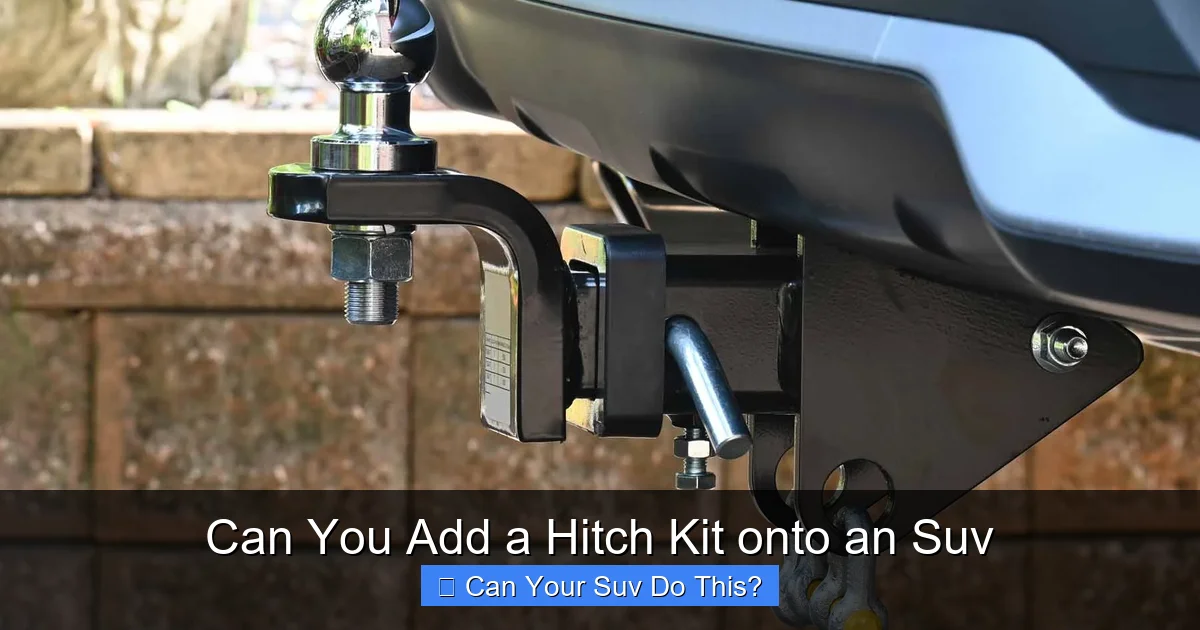
Adding a hitch kit to your SUV is not only possible—it’s a smart upgrade for hauling trailers, bikes, or cargo. With the right equipment and proper installation, most SUVs can safely handle a hitch, boosting their utility and versatility.
So, you’ve got an SUV—maybe it’s a rugged Ford Explorer, a sleek Honda CR-V, or a capable Toyota Highlander. You love its space, its comfort, and its all-terrain charm. But now you’re wondering: *Can you add a hitch kit onto an SUV?* Maybe you want to tow a small camper for weekend getaways, haul a boat to the lake, or just carry extra bikes and gear for family adventures. The good news? **Yes, you absolutely can.** In fact, adding a hitch kit is one of the most practical and popular upgrades SUV owners make.
SUVs are built with versatility in mind. Unlike smaller cars, they often come with reinforced frames, higher ground clearance, and stronger suspension systems—features that make them ideal candidates for towing and hauling. Whether your SUV came from the factory with a hitch or not, there’s a very good chance you can install one. The process is straightforward, widely supported by aftermarket manufacturers, and can dramatically expand what your vehicle can do. From weekend warriors to full-time road trippers, a hitch kit turns your SUV into a true multi-tasker.
But before you rush out to buy the first hitch you see, it’s important to understand the details. Not all hitches are created equal, and not every SUV can handle the same load. Factors like your vehicle’s make and model, engine type, drivetrain, and factory specifications all play a role. This guide will walk you through everything you need to know—from choosing the right hitch class to installation tips and safety considerations—so you can confidently add a hitch kit to your SUV and start using it the right way.
Key Takeaways
- Most SUVs are hitch-ready: The majority of modern SUVs have mounting points designed for hitch installation, making it a common and feasible upgrade.
- Hitch classes vary by towing needs: Choose from Class I to Class V hitches based on your SUV’s towing capacity and what you plan to haul.
- Professional installation is recommended: While DIY is possible, a certified mechanic or hitch specialist ensures safety and proper alignment.
- Check your SUV’s towing capacity: Never exceed your vehicle’s rated towing limit—consult your owner’s manual or manufacturer specs.
- Hitch kits include essential components: A complete kit typically includes the receiver, bolts, wiring harness, and installation instructions.
- Wiring is crucial for trailers: Adding a trailer wiring harness allows brake lights, turn signals, and running lights to function properly.
- Regular maintenance extends hitch life: Inspect for rust, loose bolts, and wear, especially after heavy use or in harsh weather.
📑 Table of Contents
Why Add a Hitch Kit to Your SUV?
Let’s start with the “why.” Why would you even consider adding a hitch kit to your SUV? The answer is simple: **freedom and functionality.** A hitch opens up a world of possibilities that go far beyond just towing. Think about it—how many times have you wished you could bring your mountain bike on a trip, or needed to move a few pieces of furniture, or wanted to take a small trailer full of camping gear into the wilderness? A hitch makes all of that possible.
One of the biggest advantages of a hitch is its versatility. With the right accessories, your SUV can become a mobile basecamp. You can attach a cargo carrier to free up interior space, mount a bike rack for family rides, or even tow a small utility trailer for yard work. For outdoor enthusiasts, a hitch means you can bring your kayak, ATV, or pop-up camper along for the ride. And for families, it’s a game-changer during road trips—no more cramming everything into the cabin or roof rack.
But it’s not just about convenience. A hitch can also improve safety and efficiency. For example, a rear hitch-mounted cargo carrier keeps heavy items low and centered, improving balance and reducing strain on your suspension. It also keeps your trunk accessible, so you’re not digging through piles of gear just to grab your wallet. And when it comes to towing, a properly installed hitch ensures that your trailer is securely attached and aligned, reducing the risk of sway or detachment on the highway.
Another often-overlooked benefit is resale value. SUVs with factory or professionally installed hitches tend to hold their value better, especially among buyers who prioritize towing capability. It’s a sign that the vehicle has been well-maintained and is ready for heavy-duty use. Plus, if you ever decide to upgrade to a larger trailer or camper, having a hitch already in place saves you time and money down the road.
Types of Hitch Kits and How They Work
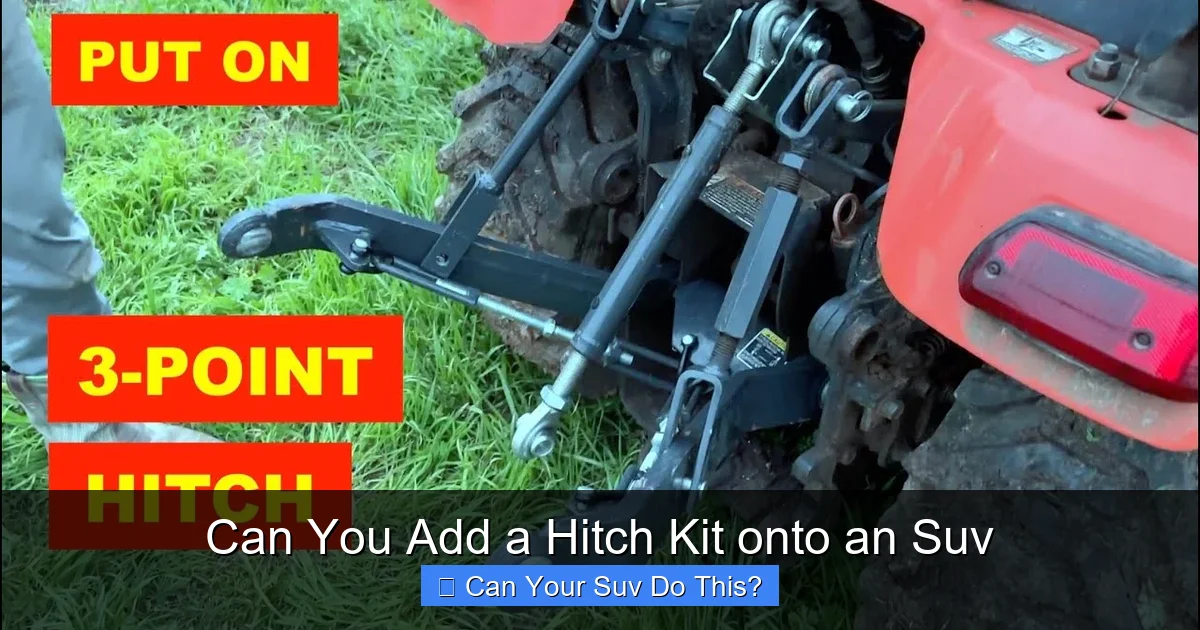
Visual guide about Can You Add a Hitch Kit onto an Suv
Image source: i.ytimg.com
Not all hitch kits are the same. In fact, there are several types designed for different purposes and weight capacities. Understanding these differences is crucial to choosing the right one for your SUV.
The most common type is the **receiver hitch**, which features a square tube (usually 1.25” or 2”) that accepts various accessories like ball mounts, cargo carriers, or bike racks. Receiver hitches are categorized by “classes,” ranging from Class I to Class V, based on their towing capacity. Here’s a quick breakdown:
– **Class I:** Up to 2,000 lbs towing, 200 lbs tongue weight. Ideal for small trailers, bike racks, or cargo carriers. Common on compact SUVs like the Honda CR-V or Toyota RAV4.
– **Class II:** Up to 3,500 lbs towing, 350 lbs tongue weight. Good for light-duty towing like small campers or utility trailers. Found on midsize SUVs such as the Ford Escape or Nissan Rogue.
– **Class III:** Up to 6,000 lbs towing, 600 lbs tongue weight. A popular choice for larger SUVs like the Jeep Grand Cherokee or Toyota 4Runner. Can handle medium-sized trailers and boats.
– **Class IV:** Up to 10,000 lbs towing, 1,000 lbs tongue weight. Designed for heavy-duty use, often on full-size SUVs like the Chevrolet Tahoe or Ford Expedition.
– **Class V:** Over 10,000 lbs towing. Rare and typically used on commercial or modified vehicles.
Another type is the **gooseneck or fifth-wheel hitch**, but these are usually reserved for pickup trucks and large RVs, not standard SUVs. For most SUV owners, a receiver hitch is the way to go.
Hitch kits also come in two main styles: **frame-mounted** and **bumper-mounted**. Frame-mounted hitches are bolted directly to the SUV’s frame and are stronger, more durable, and better for towing. Bumper-mounted hitches attach to the rear bumper and are generally lighter-duty, better suited for cargo carriers or light towing.
When shopping for a hitch kit, look for one that’s specifically designed for your SUV’s make, model, and year. Brands like Curt, Draw-Tite, and Reese offer vehicle-specific kits that ensure a perfect fit. These kits usually include the receiver, mounting hardware, wiring harness (if needed), and detailed instructions.
Is Your SUV Compatible with a Hitch Kit?
Now for the big question: *Can your SUV actually handle a hitch?* The short answer is: **most can.** But compatibility depends on a few key factors.
First, check your SUV’s **towing capacity**. This is the maximum weight your vehicle can safely tow, and it’s usually listed in the owner’s manual or on the manufacturer’s website. For example, a 2023 Subaru Outback has a towing capacity of 2,700 lbs, while a 2023 Ford Expedition can tow up to 9,300 lbs. Never install a hitch that exceeds your SUV’s rated capacity—doing so can damage the frame, transmission, or braking system.
Next, consider your SUV’s **frame and mounting points**. Most modern SUVs are built with reinforced rear frames designed to support hitch installation. Even if your vehicle didn’t come with a hitch, there are often pre-drilled holes or designated mounting locations under the rear bumper. This makes aftermarket installation much easier.
However, some SUVs—especially smaller or crossover models—may have limited space or structural constraints. For example, a compact SUV like the Mazda CX-5 may only support a Class I or II hitch, while a full-size SUV like the GMC Yukon can handle a Class III or IV. Always verify compatibility using your VIN or by consulting a hitch specialist.
Another factor is **drivetrain**. SUVs with all-wheel drive (AWD) or four-wheel drive (4WD) generally have better towing performance than front-wheel drive (FWD) models. This is because AWD/4WD provides better traction and power distribution, which is essential when hauling heavy loads.
Finally, check for **factory options**. Some SUVs come with a “towing package” from the factory, which includes a pre-wired harness, upgraded cooling systems, and sometimes even a built-in hitch receiver. If your SUV has this package, installation will be much simpler. If not, you may need to add a wiring harness separately.
How to Install a Hitch Kit on Your SUV
So, you’ve confirmed your SUV is compatible and you’ve picked the right hitch kit. Now it’s time to install it. While some DIY enthusiasts can handle this project at home, **professional installation is strongly recommended**—especially if you’re not experienced with automotive work.
That said, here’s a general overview of the installation process:
Gather Your Tools and Materials
You’ll need a socket wrench set, torque wrench, jack stands, safety glasses, and possibly a drill (if your kit requires drilling). Most kits come with all the necessary bolts and hardware, but double-check the instructions.
Prepare the Vehicle
Park your SUV on a flat, level surface and engage the parking brake. If needed, lift the rear of the vehicle using a jack and secure it with jack stands. Remove the rear bumper cover or trim if it blocks access to the frame.
Position the Hitch
Line up the hitch receiver with the mounting points on the frame. Most kits are designed to bolt directly into existing holes. Use the provided bolts and washers, and hand-tighten them first to ensure proper alignment.
Secure and Torque the Bolts
Once aligned, tighten the bolts in a crisscross pattern using a torque wrench. Follow the manufacturer’s torque specifications—over-tightening can strip threads, while under-tightening can lead to loosening over time.
Install the Wiring Harness (If Needed)
If you plan to tow a trailer, you’ll need a wiring harness to connect the trailer’s lights to your SUV’s electrical system. Many kits include a plug-and-play harness that connects to the vehicle’s taillight wiring. For vehicles without pre-wired connectors, you may need to splice wires or use a universal harness.
Test the Installation
Lower the vehicle and test the hitch by attaching a ball mount or cargo carrier. Check for any movement or rattling. Also, test the trailer lights (if installed) to ensure they’re working properly.
While DIY installation is possible, many owners opt for professional installation at a dealership or auto shop. This ensures the hitch is mounted correctly, the wiring is safe, and the vehicle’s warranty isn’t voided. Plus, professionals can often complete the job in under an hour.
Safety Tips and Maintenance for Your Hitch
Once your hitch is installed, the real fun begins—but safety should always come first. Here are some essential tips to keep in mind:
Never Exceed Your Towing Capacity
This cannot be stressed enough. Towing beyond your SUV’s limit can cause catastrophic failure, including brake fade, transmission overheating, or even frame damage. Always check the weight of your trailer, cargo, and passengers before hitting the road.
Distribute Weight Properly
When towing, place about 60% of the weight toward the front of the trailer (near the hitch). This helps prevent sway and improves stability. Avoid overloading the rear of the trailer, which can cause fishtailing.
Use Safety Chains and Breakaway Systems
Always cross the safety chains under the trailer tongue and attach them to your SUV’s frame. If the trailer becomes detached, the chains will catch it. For trailers over 1,500 lbs, a breakaway system with its own battery and brake actuator is required.
Inspect Regularly
Before each trip, check the hitch for loose bolts, cracks, or rust. Look at the ball mount, coupler, and wiring connections. A quick visual inspection can prevent accidents.
Clean and Lubricate
After use, especially in wet or salty conditions, clean the hitch and apply a light coat of grease to the ball mount and receiver. This prevents corrosion and ensures smooth operation.
Store Accessories Properly
When not in use, remove bike racks or cargo carriers to prevent theft and reduce drag. Store them in a dry place to avoid rust.
Real-World Examples: SUVs That Benefit from a Hitch
Let’s look at a few real-world examples to see how different SUVs benefit from a hitch kit.
**Example 1: Honda CR-V (Compact SUV)**
The CR-V isn’t built for heavy towing, but it’s perfect for light-duty tasks. With a Class I hitch, you can tow a small utility trailer for moving day or attach a bike rack for weekend rides. A cargo carrier frees up cabin space for groceries or luggage.
**Example 2: Jeep Grand Cherokee (Midsize SUV)**
This rugged SUV can handle a Class III hitch, making it ideal for towing a small camper or boat. Many owners use it for overlanding, adding a roof tent and hitch-mounted storage for extended trips.
**Example 3: Ford Expedition (Full-Size SUV)**
With a Class IV hitch, the Expedition can tow up to 9,300 lbs—enough for a large travel trailer or pontoon boat. It’s a favorite among families who love camping and need serious hauling power.
These examples show that no matter your SUV size, a hitch kit can enhance its capabilities and make life easier.
Conclusion: Yes, You Can—and Should—Add a Hitch Kit
So, can you add a hitch kit onto an SUV? The answer is a resounding **yes.** Whether you drive a compact crossover or a full-size beast, a hitch kit is a practical, affordable, and highly useful upgrade. It expands your vehicle’s functionality, supports your lifestyle, and adds long-term value.
From weekend adventures to everyday errands, a hitch opens doors—literally and figuratively. Just remember to choose the right class, follow installation best practices, and prioritize safety. With the right setup, your SUV will be ready for whatever you throw at it.
Frequently Asked Questions
Can I install a hitch kit myself?
Yes, many hitch kits are designed for DIY installation and come with detailed instructions. However, if you’re not confident working on your vehicle, professional installation is safer and ensures proper alignment and torque.
Will adding a hitch void my SUV’s warranty?
No, adding an aftermarket hitch typically does not void your warranty, as long as it’s installed correctly and doesn’t cause damage. However, always check your warranty terms or consult your dealer to be sure.
Do I need a special license to tow with my SUV?
In most states, no special license is required for towing trailers under 10,000 lbs. However, some states require a trailer endorsement for larger loads. Check your local DMV regulations.
Can I use a hitch for cargo carriers only?
Absolutely. Many SUV owners use hitches exclusively for bike racks, cargo carriers, or ski racks—no towing required. A Class I or II hitch is usually sufficient for these purposes.
How much does it cost to add a hitch kit?
A basic hitch kit costs between $100 and $300, while professional installation adds $100 to $200. Higher-class hitches and wiring harnesses may cost more.
What if my SUV didn’t come with a hitch?
That’s perfectly fine. Most SUVs are designed to accept aftermarket hitches. Just make sure to choose a kit that’s compatible with your specific make, model, and year.