
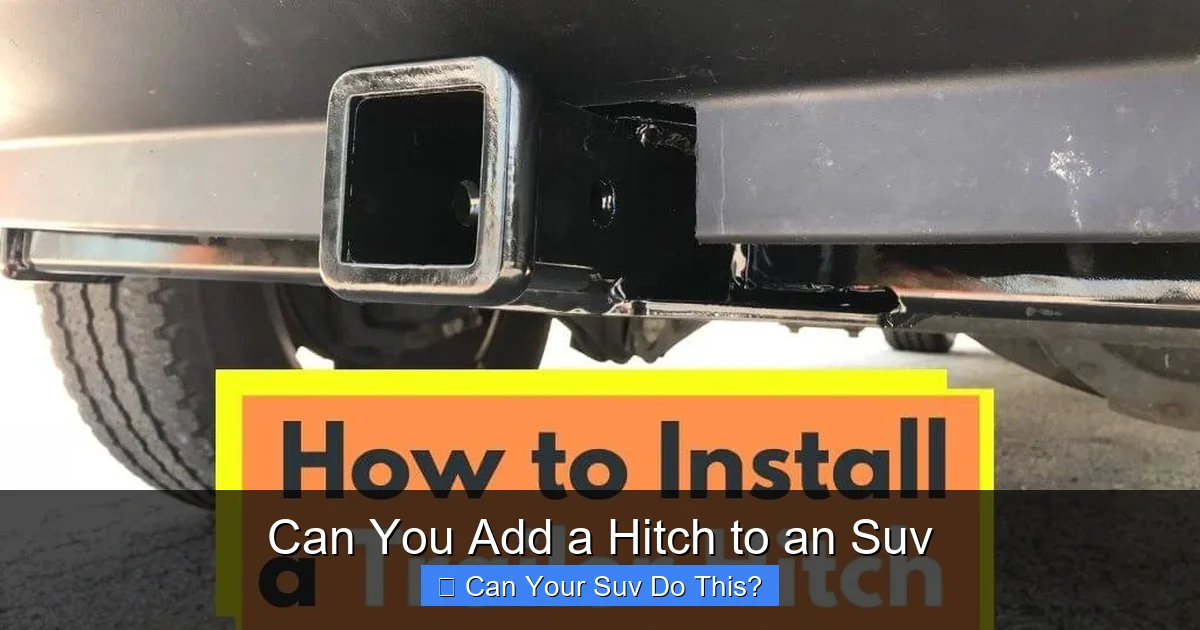
Yes, you can add a hitch to most SUVs—whether it’s a compact crossover or a full-size off-roader. With the right hitch class, proper installation, and towing capacity knowledge, your SUV can tow trailers, campers, bikes, and more. This guide covers everything you need to know to hitch up safely and legally.
Key Takeaways
- Most SUVs can have a hitch installed: Whether factory-equipped or aftermarket, hitches are widely available for nearly every SUV model.
- Hitch classes determine towing capacity: Class I to Class V hitches vary in strength—choose based on your SUV’s towing limits and intended use.
- Professional installation is recommended: While DIY is possible, certified technicians ensure safety, warranty compliance, and proper wiring.
- Check your SUV’s towing capacity first: Never exceed the manufacturer’s rated towing limit—this protects your vehicle and ensures safety.
- Wiring and brake controllers may be needed: For trailers with lights or brakes, proper electrical setup is essential for legal and safe towing.
- Hitches enable versatile use: From bike racks to cargo carriers to travel trailers, a hitch expands your SUV’s functionality.
- Regular maintenance ensures longevity: Inspect your hitch, bolts, and connections before and after each towing trip.
📑 Table of Contents
- Can You Add a Hitch to an SUV? The Short Answer Is Yes
- Why Add a Hitch to Your SUV?
- Types of Hitches for SUVs
- Know Your SUV’s Towing Capacity
- Hitch Installation: DIY vs. Professional
- Wiring, Brake Controllers, and Safety Equipment
- Maintaining Your Hitch and Towing Setup
- Legal and Insurance Considerations
- Conclusion: Yes, Your SUV Can Do This
Can You Add a Hitch to an SUV? The Short Answer Is Yes
If you’ve ever watched a friend tow a boat to the lake or seen a family loading up a camper for a weekend getaway, you’ve probably wondered: *Can my SUV do that too?* The good news is, in most cases, the answer is a resounding yes—you can absolutely add a hitch to an SUV. Whether you drive a compact Honda CR-V, a rugged Toyota 4Runner, or a luxurious BMW X5, there’s likely a hitch solution designed specifically for your vehicle.
Adding a hitch isn’t just about bolting on a piece of metal. It’s about unlocking your SUV’s full potential. A properly installed hitch allows you to tow trailers, carry bikes, haul gear, or even pull a small camper. But before you rush out to buy the first hitch you see, it’s important to understand the types of hitches, your SUV’s capabilities, and the installation process. This guide will walk you through everything you need to know—so you can hitch up with confidence and safety.
Why Add a Hitch to Your SUV?
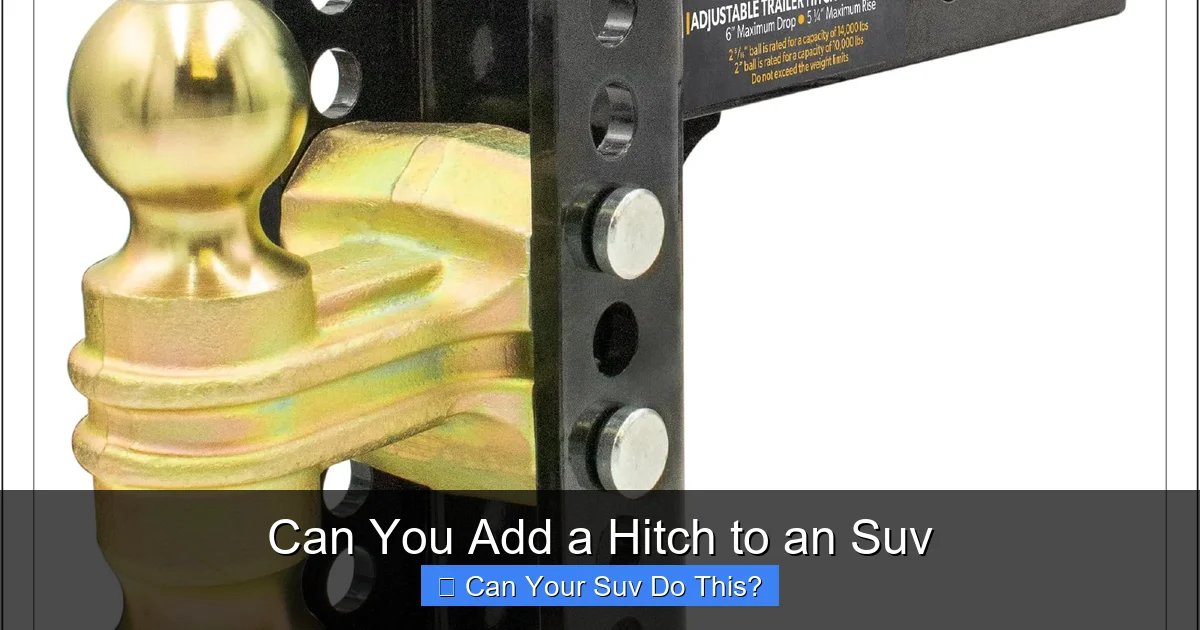
Visual guide about Can You Add a Hitch to an Suv
Image source: m.media-amazon.com
So, why bother adding a hitch in the first place? For many SUV owners, it’s about versatility. SUVs are already known for their space, power, and all-weather capability. Adding a hitch turns that utility vehicle into a true workhorse. Imagine being able to:
– Tow a small trailer for moving furniture or yard debris.
– Haul a motorcycle or ATV to your favorite trail.
– Carry multiple bikes for a family camping trip.
– Pull a pop-up camper for weekend adventures.
– Transport a small boat to the lake or river.
Even if you don’t plan to tow heavy loads, a hitch can be incredibly useful for carrying cargo. Hitch-mounted bike racks, cargo carriers, and even pet ramps are common accessories that make life easier. And let’s be honest—there’s something satisfying about having the option to say “yes” when a friend asks, “Can you help me move this weekend?”
Beyond convenience, adding a hitch can also increase your SUV’s resale value. Many buyers look for vehicles that are already equipped for towing or hauling. A professionally installed hitch shows that the vehicle has been well-maintained and is ready for adventure.
Real-Life Examples of Hitch Use
Let’s look at a few real-world scenarios where a hitch makes all the difference:
– **The Weekend Warrior:** Sarah owns a Subaru Outback and loves outdoor adventures. She added a Class II hitch to carry her mountain bikes and a small cargo carrier for camping gear. Now, she can load up and hit the trail without worrying about space inside the car.
– **The Family Road Tripper:** The Johnsons drive a Ford Explorer and take annual summer trips to national parks. They installed a Class III hitch to tow a lightweight travel trailer. This gives them a comfortable place to sleep without the hassle of setting up tents.
– **The Small Business Owner:** Mike runs a landscaping company and uses his Toyota Highlander to transport tools and mulch. A heavy-duty Class III hitch allows him to tow a utility trailer, saving him time and fuel compared to making multiple trips.
These examples show that hitches aren’t just for big trucks. With the right setup, even modest SUVs can handle impressive loads.
Types of Hitches for SUVs
Not all hitches are created equal. The type of hitch you choose depends on what you plan to tow or carry. Here’s a breakdown of the most common hitch classes and their uses:
Class I Hitches
Class I hitches are the lightest duty option, typically rated for up to 2,000 pounds of towing capacity and 200 pounds of tongue weight (the downward force on the hitch). These are ideal for small SUVs and crossovers like the Honda HR-V, Mazda CX-3, or Nissan Rogue Sport. They’re perfect for carrying bike racks or small cargo carriers—but not for towing trailers.
Most Class I hitches use a 1-1/4-inch receiver tube. They’re affordable, easy to install, and don’t require any modifications to your SUV’s frame. If you only need to carry bikes or light gear, this is the way to go.
Class II Hitches
Stepping up, Class II hitches handle up to 3,500 pounds of towing and 350 pounds of tongue weight. They use a 1-1/4-inch or 2-inch receiver and are common on midsize SUVs like the Toyota RAV4, Ford Escape, or Hyundai Santa Fe. These hitches can tow small utility trailers, lightweight campers, or even a small boat.
Class II hitches are a great middle ground—offering more capability than Class I without the bulk of heavier-duty options. Many come with built-in wiring harnesses for trailer lights, making setup easier.
Class III Hitches
Class III hitches are the most popular for SUVs. They support up to 6,000 pounds of towing and 600 pounds of tongue weight, with a standard 2-inch receiver. These are found on larger SUVs like the Jeep Grand Cherokee, Chevrolet Tahoe, or Ford Expedition.
With a Class III hitch, you can tow mid-sized trailers, pop-up campers, small boats, or even a compact travel trailer. Many Class III hitches are also compatible with weight-distributing hitches, which help balance heavy loads and improve stability.
Class IV and Class V Hitches
For heavy-duty towing, Class IV (up to 10,000 pounds) and Class V (up to 12,000–18,000 pounds) hitches are available. These are typically used on full-size SUVs like the Ford F-150-based Expedition or the heavy-duty Chevrolet Suburban. They require reinforced frames and professional installation.
While most SUV owners won’t need this level of capacity, it’s good to know the option exists—especially if you’re planning to tow a large camper or equipment trailer.
Specialty Hitches
Beyond standard receiver hitches, there are also:
– **Gooseneck and Fifth-Wheel Hitches:** These are more common on pickup trucks but can be adapted for some large SUVs. They offer superior towing stability for very heavy loads.
– **Weight-Distributing Hitches:** Used with Class III and higher hitches to evenly distribute weight across all axles, improving handling and safety.
– **Pintle Hitches:** Common in commercial and military vehicles, these are rugged but less common for personal SUV use.
When choosing a hitch, always match it to your SUV’s towing capacity—not the hitch’s maximum rating. More on that next.
Know Your SUV’s Towing Capacity
Before you buy any hitch, you must know your SUV’s towing capacity. This is the maximum weight your vehicle can safely tow, as specified by the manufacturer. Exceeding this limit can damage your transmission, brakes, or frame—and it’s a major safety risk.
How to Find Your SUV’s Towing Capacity
You can find your SUV’s towing capacity in several places:
– **Owner’s Manual:** The most reliable source. Look for the “Towing” or “Trailer Towing” section.
– **Manufacturer’s Website:** Most automakers provide towing specs by model and trim level.
– **Door Jamb Sticker:** Some SUVs have a sticker on the driver’s side door jamb with towing info.
– **Online Towing Guides:** Sites like Edmunds, Kelley Blue Book, or the manufacturer’s configurator let you look up specs by year, make, and model.
For example:
– A 2023 Honda CR-V has a towing capacity of 1,500 pounds (with the proper equipment).
– A 2023 Toyota 4Runner can tow up to 5,000 pounds.
– A 2023 Ford Expedition can handle up to 9,300 pounds.
Note that towing capacity can vary based on engine type, drivetrain (AWD vs. 4WD), and whether your SUV has a factory towing package. Always check the exact configuration of your vehicle.
Factors That Affect Towing Capacity
Several factors can reduce your SUV’s effective towing capacity:
– **Passenger and Cargo Weight:** The more weight inside the SUV, the less you can safely tow.
– **Altitude:** Higher elevations reduce engine power, which can affect towing performance.
– **Trailer Type:** Travel trailers with high wind resistance (like large campers) may require a lower towing limit than enclosed utility trailers.
– **Driving Conditions:** Towing in hilly or mountainous terrain puts more strain on your vehicle.
Always use a trailer weight calculator and weigh your loaded trailer at a certified scale before hitting the road.
Hitch Installation: DIY vs. Professional
Now that you know what hitch you need and your SUV’s limits, it’s time to talk installation. Should you do it yourself or hire a pro?
DIY Installation: Pros and Cons
Installing a hitch yourself can save money—typically $100–$300 in labor costs. Many aftermarket hitches (like those from Curt, Draw-Tite, or Reese) come with detailed instructions and are designed for bolt-on installation. No welding is usually required.
**Pros:**
– Cost savings
– Satisfaction of doing it yourself
– Can be done in a few hours with basic tools
**Cons:**
– Risk of improper installation (loose bolts, misalignment)
– May void warranty if not done correctly
– Wiring harness installation can be tricky
– No professional inspection or certification
If you’re experienced with automotive work and have the right tools (socket set, torque wrench, jack stands), DIY can work. But for most people, especially those new to towing, professional installation is the safer choice.
Professional Installation: Why It’s Worth It
A certified technician will:
– Ensure the hitch is properly aligned and torqued to spec
– Install the wiring harness correctly (if needed)
– Verify compatibility with your SUV’s frame and bumper
– Provide a warranty on the installation
– Offer advice on safe towing practices
Many auto parts stores (like AutoZone, O’Reilly, or Advance Auto Parts) offer installation services. Dealerships and specialized towing shops also provide professional setup.
**Tip:** Ask if the installer is certified by the manufacturer or a towing association. This ensures quality work.
What About Factory Hitches?
Some SUVs come with a factory-installed hitch or towing package. These are often higher quality and integrated with the vehicle’s electronics (like trailer sway control or brake assist). If your SUV has one, great—you’re all set. If not, an aftermarket hitch is a reliable alternative.
Wiring, Brake Controllers, and Safety Equipment
A hitch is only part of the equation. To tow safely and legally, you’ll likely need additional equipment.
Trailer Wiring Harness
If your trailer has lights (brake, turn, tail), you’ll need a wiring harness to connect it to your SUV. Most modern SUVs have a plug-and-play harness that connects to the vehicle’s taillight system. These are often included with the hitch or sold separately.
**Tip:** Test all lights before every trip. A faulty brake light on a trailer can lead to accidents or tickets.
Brake Controller
For trailers over 1,500–3,000 pounds (depending on state laws), electric brakes are often required. These need a brake controller installed inside your SUV—usually under the dashboard.
The controller allows you to adjust brake force and activate trailer brakes manually. It’s essential for safe stopping, especially with heavy loads.
**Note:** Some SUVs (like the Ford F-150-based models) have integrated brake controllers. Others require an aftermarket unit.
Safety Chains and Breakaway Systems
Always use safety chains crossed under the trailer tongue to catch it if it detaches. For larger trailers, a breakaway system (with a battery and switch) can activate the trailer’s brakes if it becomes unhitched.
Tow Mirrors and Backup Cameras
When towing, your view can be obstructed. Consider adding extended tow mirrors or using a backup camera with a trailer mode (available on some newer SUVs).
Maintaining Your Hitch and Towing Setup
Once your hitch is installed, don’t forget to maintain it. Regular checks prevent accidents and extend the life of your equipment.
Pre-Trip Inspection Checklist
Before every towing trip, check:
– Hitch bolts are tight (use a torque wrench)
– Receiver and hitch ball are clean and undamaged
– Safety chains are properly attached
– Wiring connections are secure and lights work
– Trailer tires are inflated and in good condition
– Brake controller is functioning (if equipped)
Seasonal Maintenance
– Clean the hitch and receiver to remove dirt, salt, and debris.
– Apply a light coat of grease to the hitch ball to prevent rust and ensure smooth operation.
– Inspect welds and frame mounts for cracks or corrosion.
Storage Tips
When not in use, remove the hitch ball and store it in a dry place. Consider using a hitch cover to protect the receiver from the elements.
Legal and Insurance Considerations
Towing isn’t just about mechanics—it’s also about laws and coverage.
State and Federal Laws
Towing regulations vary by state. Common requirements include:
– Trailer registration and license plates
– Maximum trailer width (usually 8.5 feet)
– Brake requirements for trailers over a certain weight
– Speed limits when towing
Check your state’s Department of Motor Vehicles (DMV) website for specifics.
Insurance Coverage
Most auto insurance policies cover towing-related accidents, but it’s wise to confirm with your provider. Some insurers offer additional towing or roadside assistance packages.
Liability and Safety
Remember: you’re responsible for everything you tow. If your trailer causes damage or injury, you could be held liable. Always tow within your limits and drive defensively.
Conclusion: Yes, Your SUV Can Do This
So, can you add a hitch to an SUV? Absolutely. With the right hitch class, proper installation, and a clear understanding of your vehicle’s towing capacity, your SUV can become a versatile towing machine. Whether you’re hauling bikes, a small trailer, or a weekend camper, a hitch opens up a world of possibilities.
The key is to do your homework. Know your SUV’s limits, choose the right equipment, and prioritize safety. Whether you install it yourself or hire a pro, the investment pays off in convenience, adventure, and peace of mind.
So go ahead—hitch up and hit the road. Your SUV is ready for more than you think.
Frequently Asked Questions
Can any SUV have a hitch installed?
Most SUVs can have a hitch added, but it depends on the make, model, and year. Compact crossovers may only support light-duty hitches, while larger SUVs can handle heavy-duty towing. Always check compatibility with the hitch manufacturer.
How much does it cost to add a hitch to an SUV?
The cost varies: a Class I hitch may cost $100–$200 for parts, while a Class III can run $200–$500. Professional installation adds $100–$300. Total cost typically ranges from $200 to $800, depending on the hitch and labor.
Will adding a hitch void my SUV’s warranty?
Generally, no—adding a hitch doesn’t void your warranty unless it causes damage. However, improper installation might. Use certified technicians and keep records to protect your coverage.
Can I install a hitch myself?
Yes, if you have mechanical skills and the right tools. Many hitches are bolt-on and come with instructions. However, professional installation is recommended for safety and warranty reasons.
Do I need a special license to tow with my SUV?
In most states, no special license is required for towing trailers under 10,000 pounds. However, some states require a trailer endorsement for larger loads. Check your local DMV regulations.
What’s the difference between a hitch and a tow package?
A hitch is the physical receiver that attaches to your SUV. A tow package includes the hitch, wiring, transmission cooler, upgraded alternator, and sometimes a brake controller—everything needed for safe towing.