
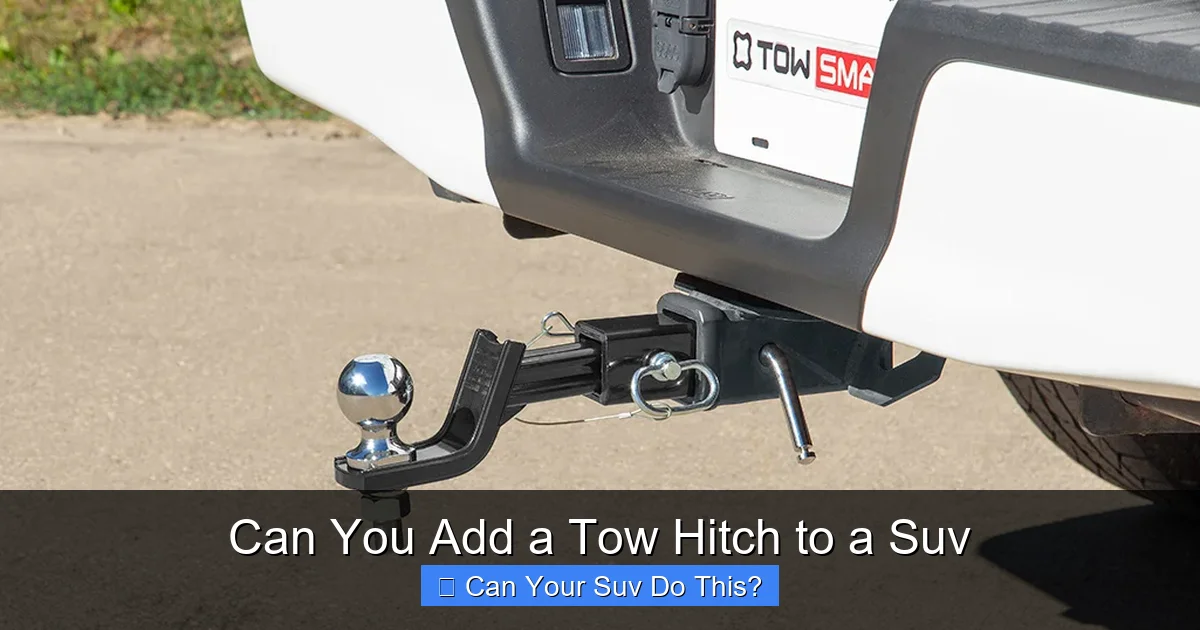
Yes, you can add a tow hitch to most SUVs—even if it didn’t come factory-equipped. With the right equipment, professional installation, and knowledge of your vehicle’s towing capacity, adding a tow hitch opens up new possibilities for hauling trailers, bikes, or gear.
So, you’ve got an SUV—maybe it’s a sleek crossover like a Honda CR-V or a rugged beast like a Toyota 4Runner. It’s great for road trips, school runs, and weekend adventures. But now you’re eyeing that pop-up camper, a small utility trailer, or maybe even a jet ski. The big question pops up: *Can you add a tow hitch to a SUV?*
The short answer? **Yes—most of the time.** Even if your SUV rolled off the lot without a hitch, there’s a very good chance you can install one. But it’s not just about slapping on a piece of metal and calling it a day. Adding a tow hitch involves understanding your vehicle’s limits, choosing the right equipment, and ensuring everything is installed safely and legally.
In this guide, we’ll walk you through everything you need to know about adding a tow hitch to your SUV. Whether you’re a weekend warrior hauling a bike rack or planning to tow a full-sized travel trailer, we’ve got you covered. We’ll break down the types of hitches, how to pick the right one, installation options, and what to watch out for. By the end, you’ll know exactly whether your SUV is ready to pull its weight—and how to make it happen.
Key Takeaways
- Understanding can you add a tow hitch to a suv: Provides essential knowledge
📑 Table of Contents
Why Add a Tow Hitch to Your SUV?
Let’s start with the “why.” Why would you even consider adding a tow hitch? After all, SUVs are already versatile—they’ve got space, power, and all-wheel drive. But a tow hitch unlocks a whole new level of functionality.
Imagine being able to haul a small camper to the mountains for a weekend getaway. Or transport a boat to the lake without renting a truck. Maybe you’ve got a landscaping side hustle and need to move mulch, tools, or a small trailer full of plants. A tow hitch makes all of this possible.
Even if you don’t plan to tow heavy loads, a hitch can be useful for lighter tasks. Bike racks, cargo carriers, and even some wheelchair lifts attach to a hitch receiver. These accessories free up interior space and keep your passengers comfortable.
And let’s not forget resale value. Many buyers look for SUVs with towing capability. If you install a high-quality hitch now, it could make your vehicle more attractive down the road—especially if you’re selling to someone who needs towing power.
But here’s the catch: not all SUVs are created equal when it comes to towing. Some are built for light-duty hauling, while others can handle serious weight. That’s why the next step is understanding your SUV’s towing capacity.
Understanding Your SUV’s Towing Capacity
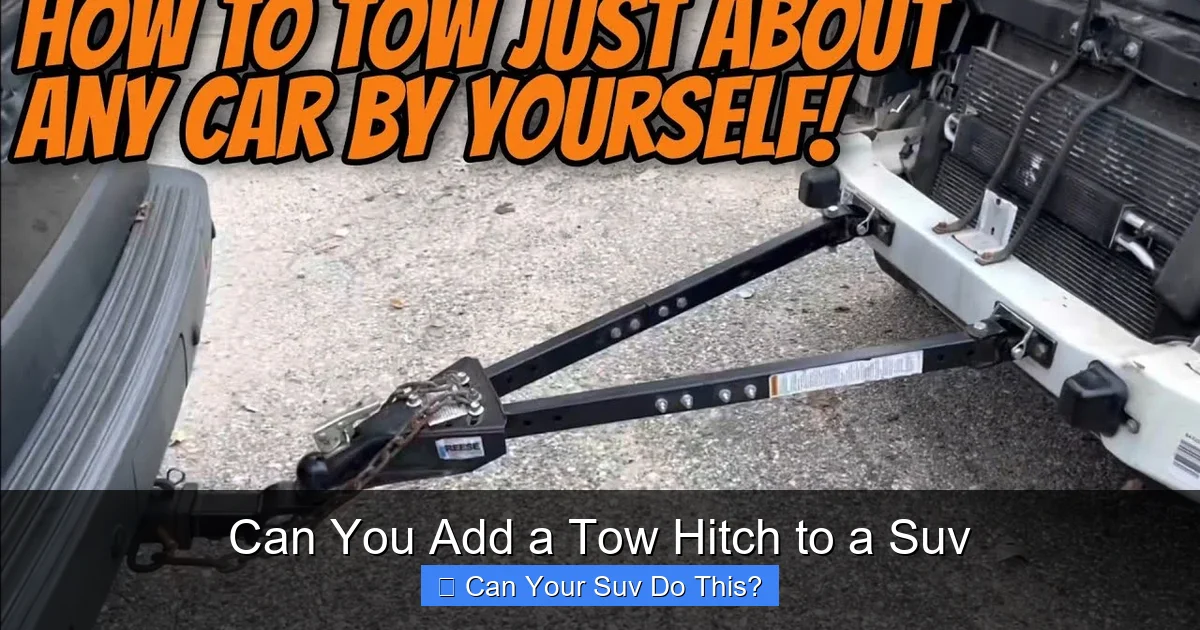
Visual guide about Can You Add a Tow Hitch to a Suv
Image source: i.ytimg.com
Before you even think about buying a hitch, you need to know how much your SUV can safely tow. This number is called the **towing capacity**, and it’s determined by the manufacturer based on the vehicle’s engine, transmission, suspension, and frame strength.
You can find your SUV’s towing capacity in the owner’s manual, on the manufacturer’s website, or by checking the door jamb sticker (usually on the driver’s side). Don’t rely on guesswork—towing beyond your vehicle’s limit can cause engine overheating, transmission failure, or even accidents.
For example, a compact SUV like the Mazda CX-5 has a towing capacity of around 2,000 pounds when properly equipped. That’s enough for a small trailer or a couple of ATVs. On the other hand, a full-size SUV like the Ford Expedition can tow up to 9,300 pounds—enough for a large travel trailer or a pontoon boat.
But here’s a common mistake: people assume that adding a hitch automatically gives them the ability to tow heavy loads. That’s not true. The hitch is just the connector—the real limit is your SUV’s mechanical capability.
Also, note that towing capacity can vary based on configuration. For instance, a 4WD model might have a higher towing capacity than a 2WD version of the same SUV. Engine type matters too—turbocharged or diesel engines often provide more torque for towing.
How to Find Your SUV’s Towing Specs
If you’re not sure where to look, here’s a quick guide:
– **Check the owner’s manual:** This is the most reliable source. Look for a section titled “Towing” or “Trailer Towing.”
– **Visit the manufacturer’s website:** Most automakers have a “build and price” tool where you can enter your VIN or model details to see towing specs.
– **Use online databases:** Sites like Edmunds, Kelley Blue Book, or Trailer Life have towing capacity charts for nearly every SUV.
– **Contact a dealership:** If all else fails, call your local dealer with your VIN. They can pull up exact towing information.
Once you know your SUV’s towing capacity, you can choose the right hitch class.
Types of Tow Hitches for SUVs
Not all tow hitches are the same. They come in different classes, styles, and mounting types—each designed for specific towing needs. Let’s break down the most common types you’ll encounter when adding a tow hitch to your SUV.
Receiver Hitches (Most Common)
Receiver hitches are the most popular type for SUVs. They feature a square tube (usually 1.25” or 2”) that accepts removable balls, bike racks, or cargo carriers. These hitches are mounted to the frame of the vehicle and are rated by class.
– **Class I:** Up to 2,000 lbs towing, 200 lbs tongue weight. Ideal for small trailers or bike racks. Common on compact SUVs.
– **Class II:** Up to 3,500 lbs towing, 350 lbs tongue weight. Good for small campers or utility trailers.
– **Class III:** Up to 6,000–8,000 lbs towing, 600–800 lbs tongue weight. Used for mid-size trailers, boats, or RVs.
– **Class IV:** Up to 10,000–12,000 lbs towing. For heavy-duty SUVs and large trailers.
– **Class V:** Over 12,000 lbs. Rare for SUVs—more common on trucks.
Most SUVs will use a Class II or III receiver hitch, depending on their size and towing capacity.
Weight-Carrying vs. Weight-Distributing Hitches
There are two main ways hitches handle trailer weight:
– **Weight-carrying hitches:** The trailer’s weight rests directly on the hitch and vehicle. Suitable for lighter loads (under 5,000 lbs).
– **Weight-distributing hitches:** Use spring bars to spread the trailer’s weight across all axles of the tow vehicle. Required for heavier trailers to improve stability and control.
If you’re towing a trailer over 5,000 lbs, you’ll likely need a weight-distributing system—even if your SUV can handle the weight.
Gooseneck and Fifth-Wheel Hitches (Less Common for SUVs)
These are typically used on pickup trucks, not SUVs. Gooseneck hitches mount in the truck bed and are used for heavy trailers. Fifth-wheel hitches require a special bed setup. Most SUVs aren’t designed for these, so stick with receiver hitches.
Hidden or Removable Hitches
Some SUV owners prefer hitches that don’t stick out when not in use. Hidden hitches tuck behind the bumper, while removable ones let you take the ball mount out. These are great for maintaining your SUV’s look and preventing scrapes in parking lots.
Can You Install a Tow Hitch Yourself?
Now for the big question: *Can you install a tow hitch yourself?* The answer is: **maybe—but it depends.**
Many tow hitches are designed for DIY installation. Companies like Curt, Draw-Tite, and Reese offer bolt-on kits that don’t require welding. These kits come with detailed instructions, mounting hardware, and sometimes even video tutorials.
If you’re handy with tools, have a jack and jack stands, and can follow step-by-step directions, you might be able to install a hitch in a few hours. But there are risks.
Pros of DIY Installation
– **Cost savings:** Professional installation can cost $200–$500. DIY kits start around $150.
– **Satisfaction:** There’s something rewarding about doing it yourself.
– **Flexibility:** You can install it on your schedule.
Cons of DIY Installation
– **Safety risks:** A poorly installed hitch can detach while driving, causing serious accidents.
– **Warranty issues:** Some manufacturers void warranties if modifications are made incorrectly.
– **Complexity:** Some SUVs require drilling, trimming, or removing parts of the bumper or exhaust.
When to Hire a Professional
We strongly recommend professional installation if:
– You’re not confident in your mechanical skills.
– The installation requires welding or major modifications.
– Your SUV has advanced safety systems (like adaptive cruise control) that could be affected.
– You’re installing a heavy-duty hitch (Class III or higher).
Many auto shops, trailer specialty stores, and even some dealerships offer hitch installation services. They’ll ensure everything is mounted securely and aligned properly.
What Else Do You Need to Tow Safely?
Adding a tow hitch is just the first step. To tow safely and legally, you’ll likely need additional equipment.
Wiring Harness
If your trailer has lights (brake, turn, tail), you’ll need a wiring harness to connect it to your SUV’s electrical system. Most hitches come with a plug-and-play harness that matches your vehicle’s connector type (4-pin, 6-pin, or 7-pin).
Some SUVs have factory-installed towing packages that include pre-wired connectors. If not, you’ll need to install a harness. This can be DIY-friendly, but if you’re not comfortable with wiring, let a pro handle it.
Brake Controller
If your trailer weighs over 1,500–2,000 lbs (check local laws), it likely needs electric brakes. These require a brake controller inside your SUV to activate the trailer’s brakes when you press the pedal.
Brake controllers mount under the dashboard and sync with your vehicle’s braking system. They’re essential for safe stopping, especially with heavy loads.
Sway Control and Weight Distribution
For trailers over 5,000 lbs, consider adding sway control devices and a weight distribution hitch. These help prevent fishtailing and improve handling.
Tow Ball and Safety Chains
Don’t forget the basics: a properly sized tow ball (usually 2” or 2-5/16”), safety chains (crossed under the tongue), and a locking pin. Always double-check that everything is secure before hitting the road.
Legal and Safety Considerations
Towing isn’t just about mechanics—it’s also about following the rules.
State and Local Laws
Laws vary by state, but common requirements include:
– Trailer brakes for trailers over a certain weight (often 3,000 lbs).
– Proper lighting (brake, turn, tail, and license plate lights).
– Safety chains and breakaway systems for larger trailers.
– Speed limits (often lower when towing).
Check your state’s Department of Motor Vehicles (DMV) website for specific rules.
Insurance and Registration
Some states require trailers to be registered and insured separately. Even if not required, it’s smart to notify your insurance company that you’re towing. This ensures you’re covered in case of an accident.
Regular Maintenance
Towing puts extra strain on your SUV. After heavy use, check:
– Transmission fluid (can overheat when towing).
– Tire pressure and tread.
– Brake condition.
– Hitch and wiring connections.
Regular maintenance keeps you safe and extends your vehicle’s life.
Real-World Examples: SUVs and Towing
Let’s look at a few real-world scenarios to see how adding a tow hitch works in practice.
Example 1: Honda CR-V with a Small Camper
Sarah owns a 2020 Honda CR-V. She loves camping but didn’t buy it with towing in mind. Her CR-V has a towing capacity of 1,500 lbs. She installs a Class I receiver hitch and a 4-pin wiring harness. Now she can tow a small pop-up camper (weighing 1,200 lbs) to state parks. She uses a bike rack on the hitch when not towing. Total cost: $250 for the hitch and harness, installed professionally.
Example 2: Toyota Highlander Towing a Boat
Mike has a 2022 Toyota Highlander with a 5,000-lb towing capacity. He buys a Class III hitch, brake controller, and 7-pin wiring harness. He tows his 3,800-lb fishing boat to the lake every weekend. He also uses a weight distribution hitch for better control. Total investment: $600 for parts and installation.
Example 3: Jeep Grand Cherokee with a Travel Trailer
Lisa’s Grand Cherokee can tow up to 7,200 lbs. She installs a Class IV hitch, brake controller, and sway control system. She tows a 6,500-lb travel trailer across the country. She checks her hitch and chains before every trip and keeps a towing checklist in her glovebox.
These examples show that with the right setup, even non-truck vehicles can handle serious towing tasks.
Final Thoughts: Is Adding a Tow Hitch Worth It?
So, can you add a tow hitch to a SUV? Absolutely. And for many owners, it’s one of the best upgrades you can make.
A tow hitch transforms your SUV from a passenger vehicle into a versatile workhorse. Whether you’re hauling gear, towing a trailer, or just need extra storage, it opens up new possibilities.
But remember: safety comes first. Know your SUV’s limits, choose the right hitch, and don’t skip professional help if you’re unsure. With proper installation and equipment, your SUV can handle towing with confidence.
And if you’re on the fence? Think about how often you’ll use it. If you tow even a few times a year, the convenience and freedom are worth the investment. Plus, it could pay off when it’s time to sell.
So go ahead—add that hitch. Your next adventure is waiting.
Frequently Asked Questions
Can you add a tow hitch to any SUV?
Most SUVs can be fitted with a tow hitch, even if they didn’t come with one. However, availability depends on the make, model, and year. Check with hitch manufacturers like Curt or Draw-Tite to see if a compatible hitch exists for your vehicle.
Will adding a tow hitch void my SUV’s warranty?
Generally, no—adding a tow hitch won’t void your warranty as long as it’s installed correctly and doesn’t cause damage. However, if a problem arises that’s directly related to the hitch or installation, the manufacturer may deny coverage. Always use reputable parts and professional installers.
How much does it cost to add a tow hitch to an SUV?
Costs vary, but expect to pay $150–$400 for a basic hitch kit, plus $100–$300 for professional installation. Additional equipment like wiring harnesses or brake controllers can add $50–$200 more.
Can I tow a trailer without a brake controller?
It depends on the trailer’s weight and local laws. Trailers under 1,500–2,000 lbs often don’t require brakes. Heavier trailers usually do, and a brake controller is essential for safe stopping.
Do I need a special license to tow with my SUV?
In most states, no special license is required for towing with an SUV, as long as the combined weight of the vehicle and trailer is under 26,000 lbs. However, some states require a special endorsement for larger trailers—check your local DMV.
Can I use a tow hitch for bike racks or cargo carriers?
Yes! Even if you don’t plan to tow, a hitch receiver lets you attach bike racks, cargo carriers, and other accessories. Just make sure the hitch class matches the accessory’s weight rating.