
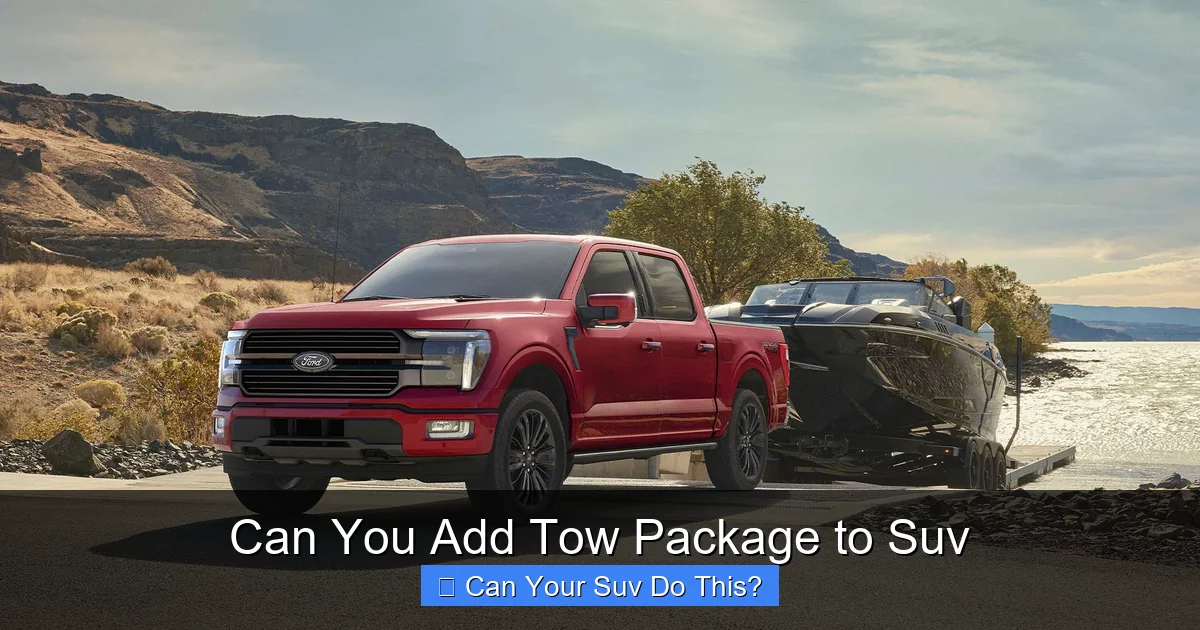
Yes, you can often add a tow package to an SUV—but it depends on your vehicle’s make, model, and factory specs. While some SUVs support aftermarket towing upgrades, others require factory-installed components for safe and reliable performance. Always consult your owner’s manual and a certified mechanic before making changes.
So, you’ve got an SUV—maybe it’s your daily driver, weekend adventurer, or family hauler—and now you’re wondering: *Can I add a tow package to my SUV?* Maybe you want to pull a small trailer for camping gear, a boat for lake weekends, or even a tiny teardrop camper for road trips. The good news? In many cases, the answer is yes. But it’s not always as simple as bolting on a hitch and calling it a day.
Adding a tow package to your SUV can open up a whole new world of possibilities. Whether you’re hauling a jet ski, a utility trailer, or a pop-up camper, having the right setup makes all the difference. But before you start shopping for hitches and wiring kits, it’s crucial to understand what a tow package actually includes, whether your SUV can handle it, and what steps you need to take to do it safely and legally.
This guide will walk you through everything you need to know—from understanding your SUV’s towing limits to choosing between factory and aftermarket options, and even what to expect in terms of cost and installation. By the end, you’ll know exactly whether your SUV can do this—and how to make it happen.
Key Takeaways
- Not all SUVs can be retrofitted with a tow package: Some models lack the necessary structural or cooling systems to handle added towing weight safely.
- Factory tow packages are often more reliable: They include integrated wiring, transmission coolers, and reinforced frames designed specifically for your SUV.
- Aftermarket installations are possible but require expertise: Professional installation ensures safety and prevents voiding your warranty.
- Towing capacity varies widely by SUV: Compact SUVs may tow 1,500–3,500 lbs, while full-size models can handle 5,000–10,000+ lbs.
- Legal and insurance implications matter: Adding a tow package may affect registration, insurance premiums, and compliance with local laws.
- Costs range from $500 to $3,000+: Prices depend on parts, labor, and whether you’re upgrading wiring, hitch, or entire drivetrain components.
- Always check your owner’s manual first: It lists your SUV’s maximum towing capacity and whether factory or dealer-installed towing is supported.
📑 Table of Contents
- What Is a Tow Package, Anyway?
- Can You Add a Tow Package to Any SUV?
- Factory Tow Packages vs. Aftermarket Upgrades
- What Does It Cost to Add a Tow Package?
- Step-by-Step: How to Add a Tow Package to Your SUV
- Real-World Examples: SUVs That Can (and Can’t) Tow
- Legal and Safety Considerations
- Conclusion: Should You Add a Tow Package to Your SUV?
What Is a Tow Package, Anyway?
Before we dive into whether you can add one, let’s clarify what a “tow package” actually means. It’s not just a hitch slapped onto the back of your SUV. A true tow package is a collection of components designed to help your vehicle safely and efficiently pull heavy loads. These packages are typically offered by manufacturers as optional upgrades when you buy a new SUV, but the term is also used more loosely to describe aftermarket towing setups.
A standard tow package usually includes several key parts:
– **Class III or IV trailer hitch receiver:** This is the metal frame that attaches to your SUV’s chassis and accepts a ball mount or other towing accessory.
– **Wiring harness:** Connects your SUV’s electrical system to the trailer’s lights (brake, turn, and running lights), ensuring visibility and safety.
– **Transmission cooler:** Helps prevent overheating when towing heavy loads, especially important for automatic transmissions.
– **Upgraded suspension:** Reinforced shocks, springs, or sway bars to handle the extra weight and maintain stability.
– **Engine oil cooler (on some models):** Keeps engine temperatures in check during long hauls or steep climbs.
– **Heavy-duty alternator or battery:** Ensures your electrical system can handle the added demand from trailer lights and accessories.
– **Tow/haul mode (in newer SUVs):** A driving mode that adjusts shift points and throttle response for better control while towing.
Some high-end tow packages also include integrated brake controllers, which allow you to manually adjust trailer brake pressure from inside the cabin—critical for safe stopping with heavy loads.
The key takeaway? A tow package isn’t just about adding a hitch. It’s about upgrading multiple systems to work together under stress. That’s why simply buying a hitch online and installing it yourself might not be enough—or safe—for serious towing.
Can You Add a Tow Package to Any SUV?
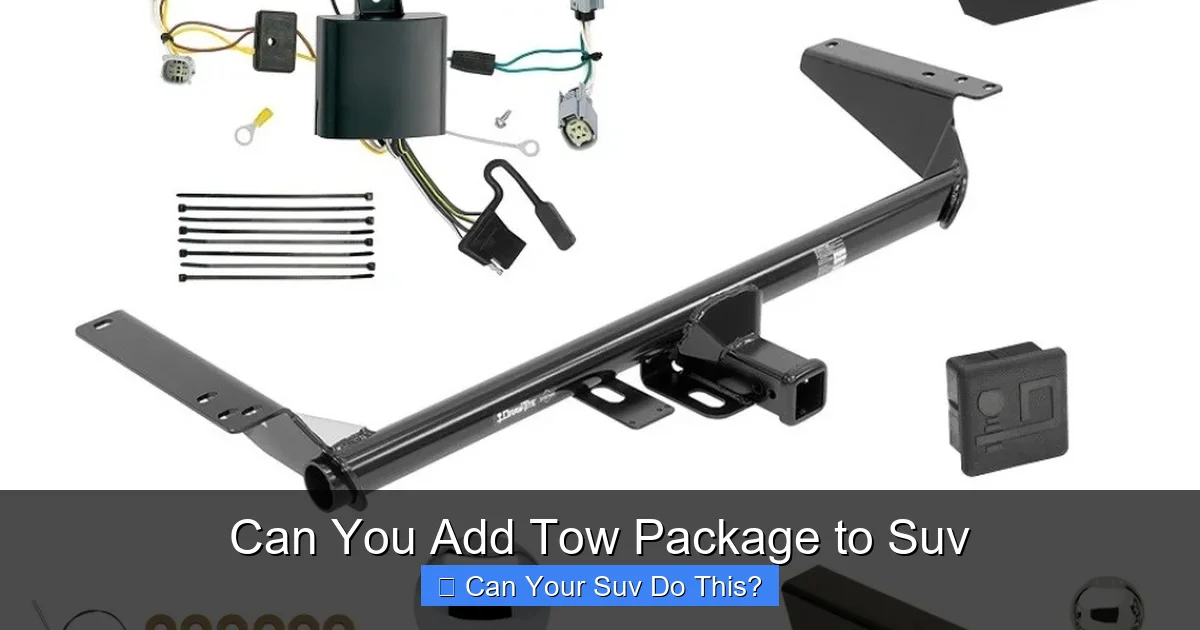
Visual guide about Can You Add Tow Package to Suv
Image source: trailerjacks.com
Now for the big question: *Can you add a tow package to your SUV?* The short answer is: **it depends**. Not every SUV is built to handle towing, and not every model can be safely retrofitted with a full tow package. Here’s what determines whether your SUV is a candidate.
Factory Towing Capacity Matters Most
Every SUV has a maximum towing capacity set by the manufacturer. This number is based on the vehicle’s engine power, transmission strength, frame design, cooling systems, and braking capability. You can find this information in your owner’s manual or on the manufacturer’s website.
For example:
– A **Honda CR-V** has a towing capacity of around 1,500 lbs—enough for a small trailer or pop-up camper.
– A **Toyota Highlander** can tow up to 5,000 lbs with the right equipment.
– A **Ford Expedition** or **Chevrolet Tahoe** can handle 8,000–9,000 lbs or more.
If your SUV wasn’t designed to tow heavy loads, adding a tow package won’t magically increase its capacity. In fact, exceeding the rated towing limit can damage your transmission, overheat your engine, or even cause brake failure.
Structural and Mechanical Limitations
Some SUVs—especially compact or crossover models—are built on car platforms rather than truck frames. These unibody designs are lighter and more fuel-efficient but aren’t as strong as traditional body-on-frame SUVs. Adding a tow package to a unibody SUV may require reinforcing the frame or subframe, which can be expensive and complex.
Additionally, if your SUV doesn’t have a transmission cooler or heavy-duty suspension, towing even moderate loads could lead to premature wear or failure. For instance, continuously towing 3,000 lbs in a vehicle only rated for 1,500 lbs can overheat the transmission and shorten its lifespan.
Factory vs. Aftermarket Options
Many SUVs can be retrofitted with aftermarket tow packages, but the feasibility depends on the model. Some manufacturers design their vehicles with towing in mind, even if the package isn’t installed at the factory. For example, a **Subaru Outback** or **Audi Q5** may have pre-wiring for trailer lights and mounting points for a hitch, making aftermarket installation easier.
On the other hand, some SUVs—especially luxury or performance models—may not support towing at all. For instance, certain high-end SUVs like the **Lamborghini Urus** or **Porsche Cayenne** (in some trims) are not rated for towing, and adding a hitch could void the warranty or damage the vehicle.
Check Your Owner’s Manual
The best place to start is your owner’s manual. It will tell you:
– Whether your SUV is designed for towing
– The maximum towing capacity
– Whether a factory tow package is available
– If aftermarket installations are recommended or prohibited
If the manual says “towing not recommended,” adding a tow package is risky and likely not worth it. But if it lists a towing capacity—even a modest one—you may be able to safely add the necessary components.
Factory Tow Packages vs. Aftermarket Upgrades
Once you’ve confirmed your SUV can handle towing, the next decision is whether to go with a factory-installed tow package or an aftermarket solution. Each has pros and cons.
Factory Tow Packages: The Gold Standard
Factory tow packages are installed by the manufacturer or dealer before delivery. They’re engineered specifically for your SUV’s make and model, ensuring compatibility and reliability.
**Pros:**
– Designed and tested by the manufacturer
– Often include integrated systems (like brake controllers and tow modes)
– Usually covered under warranty
– May increase resale value
– Easier to insure
**Cons:**
– Can be expensive when added at purchase (sometimes $1,000–$2,000)
– Not available on all trims or models
– May require upgrading to a higher trim level
For example, the **Jeep Grand Cherokee** offers a factory tow package that includes a Class IV hitch, trailer brake controller, and upgraded cooling—ideal for towing up to 7,200 lbs.
Aftermarket Tow Packages: Flexibility and Cost Savings
Aftermarket tow packages are installed after you buy the vehicle. They’re available from brands like **Draw-Tite**, **Curt**, **Reese**, and **Westin**, and can be customized to your needs.
**Pros:**
– Often cheaper than factory options
– Available for a wider range of vehicles
– Can be installed at any time
– Wide selection of hitches, wiring kits, and accessories
**Cons:**
– May not integrate as seamlessly with your SUV’s electronics
– Could void parts of your warranty if not installed correctly
– Requires professional installation for safety
– May not include advanced features like integrated brake controllers
For instance, you can buy a Curt Class III hitch for a **Toyota RAV4** for around $200–$300, plus $100–$200 for a wiring harness. Installation might cost another $150–$300 at a shop.
Hybrid Approach: Dealer-Installed Aftermarket
Some dealerships offer “dealer-installed” tow packages that use aftermarket parts but are installed and certified by the dealer. This can be a good middle ground—you get professional installation and often retain warranty coverage, while still saving money compared to a full factory package.
What Does It Cost to Add a Tow Package?
Cost is a major factor when deciding whether to add a tow package. Prices vary widely based on your SUV, the components needed, and whether you do it yourself or hire a pro.
Breakdown of Typical Costs
| Component | Average Cost |
|———|————–|
| Class III/IV Hitch | $150–$500 |
| Wiring Harness | $50–$200 |
| Transmission Cooler | $100–$300 |
| Brake Controller | $100–$300 |
| Installation (Labor) | $100–$500 |
| **Total (Aftermarket)** | **$500–$1,800** |
Factory tow packages can cost $1,000–$3,000 or more when added at purchase, but they’re often bundled with other features.
DIY vs. Professional Installation
If you’re handy with tools, you might save money by installing the hitch and wiring yourself. Many hitches come with detailed instructions, and YouTube tutorials make it easier than ever.
However, **professional installation is strongly recommended** for several reasons:
– Ensures proper alignment and secure mounting
– Prevents damage to your SUV’s frame or electrical system
– Often includes a warranty on the work
– May be required to maintain your vehicle’s warranty
For example, improperly installing a hitch can lead to frame stress, rattling, or even detachment while driving—definitely not something you want on the highway.
Hidden Costs to Consider
Beyond the initial setup, consider ongoing costs:
– **Fuel economy:** Towing reduces mileage significantly. Expect a 20–40% drop when pulling heavy loads.
– **Maintenance:** More strain on brakes, transmission, and suspension means more frequent servicing.
– **Insurance:** Some insurers may adjust premiums if you’re regularly towing heavy loads.
– **Trailer registration and licensing:** Required in most states, with fees ranging from $20–$100+ per year.
Step-by-Step: How to Add a Tow Package to Your SUV
Ready to move forward? Here’s a practical guide to adding a tow package safely and effectively.
Step 1: Confirm Your SUV’s Towing Capacity
Check your owner’s manual or the manufacturer’s website. Look for:
– Maximum towing capacity
– Whether a tow package is supported
– Required equipment (e.g., transmission cooler)
If your SUV isn’t rated for towing, stop here. Don’t risk damage or safety issues.
Step 2: Choose the Right Hitch Class
Hitches are classified by weight capacity:
– **Class I:** Up to 2,000 lbs (small trailers, bike racks)
– **Class II:** Up to 3,500 lbs (light campers, small boats)
– **Class III:** Up to 6,000–8,000 lbs (most SUVs)
– **Class IV:** Up to 10,000+ lbs (heavy-duty towing)
Match the hitch class to your towing needs and SUV’s capacity.
Step 3: Buy a Complete Tow Package Kit
Look for kits that include:
– Hitch receiver
– Mounting hardware
– Wiring harness (with plug-and-play connector if possible)
– Ball mount and hitch pin
Brands like Curt and Draw-Tite offer vehicle-specific kits that simplify installation.
Step 4: Install the Hitch and Wiring
If you’re DIY-ing:
– Use a torque wrench to tighten bolts to spec
– Route wiring carefully to avoid pinching or chafing
– Test all lights (brake, turn, running) before hitting the road
If hiring a pro:
– Choose a reputable shop or dealership
– Ask about warranty on parts and labor
– Request a post-installation inspection
Step 5: Add Optional Upgrades
For heavier towing, consider:
– **Transmission cooler:** Essential for frequent or long-distance towing
– **Brake controller:** Required if your trailer has electric brakes
– **Weight distribution hitch:** Improves stability with heavy loads
– **Sway control:** Reduces trailer sway on windy roads
Step 6: Test and Maintain
Before towing anything heavy:
– Practice hooking up and driving with an empty trailer
– Check all connections and lights
– Monitor transmission and engine temperatures
Regular maintenance is key—inspect hitch bolts, wiring, and trailer components before each trip.
Real-World Examples: SUVs That Can (and Can’t) Tow
Let’s look at a few real SUVs to see how they stack up.
Can Tow: Toyota 4Runner
The 4Runner is a body-on-frame SUV built for off-roading and towing. With the factory tow package, it can handle up to 5,000 lbs. Aftermarket hitches are widely available, and many owners add transmission coolers for peace of mind.
Can Tow (With Limits): Honda Pilot
The Pilot can tow up to 5,000 lbs when properly equipped. However, it requires the factory towing package or a dealer-installed hitch. Without the transmission cooler, towing near max capacity can lead to overheating.
Limited Towing: Mazda CX-5
The CX-5 has a towing capacity of just 2,000 lbs—enough for a small trailer or jet ski. But it lacks a transmission cooler and heavy-duty suspension, so frequent towing isn’t recommended.
Cannot Tow: Tesla Model Y
Despite its size, the Model Y has no official towing rating in most markets. Adding a hitch could damage the electric drivetrain or void the warranty. Tesla does offer a tow hitch accessory, but it’s only for light loads (like bike racks), not trailers.
Legal and Safety Considerations
Adding a tow package isn’t just about mechanics—it’s also about law and safety.
State and Local Laws
Most states require:
– Trailer registration and license plates
– Working brake lights, turn signals, and reflectors
– A brake controller for trailers over a certain weight (often 3,000 lbs)
– Speed limits for towing (usually lower than regular driving)
Check your state’s Department of Motor Vehicles (DMV) website for specifics.
Insurance Implications
Notify your insurer if you’re regularly towing heavy loads. Some policies exclude coverage for towing-related accidents unless specifically included. You may need to add a rider or upgrade to a commercial policy for frequent heavy towing.
Safety Tips for Towing
– **Distribute weight properly:** 60% of the load should be in front of the trailer axle.
– **Use safety chains:** Always cross them under the hitch for a cradle effect.
– **Check tire pressure:** Both SUV and trailer tires should be inflated to recommended levels.
– **Practice backing up:** It’s tricky—go slow and use a spotter if possible.
– **Never exceed your SUV’s towing capacity:** Even if the hitch can handle more.
Conclusion: Should You Add a Tow Package to Your SUV?
So, can you add a tow package to your SUV? In many cases, yes—but only if your vehicle is designed for it and you do it the right way. A proper tow package isn’t just a hitch; it’s a system upgrade that ensures safety, reliability, and peace of mind.
Start by checking your owner’s manual. If your SUV has a towing rating, you’re likely in the clear. Then, decide whether a factory, aftermarket, or dealer-installed package makes the most sense for your budget and needs. And always, *always* have it installed by a professional if you’re not confident in your skills.
Adding a tow package can transform your SUV into a capable hauler—perfect for weekend adventures, moving day, or that dream camper trip. But don’t rush it. Take the time to do it right, and you’ll enjoy safe, stress-free towing for years to come.
Your SUV can do this—if you give it the right tools.
Frequently Asked Questions
Can I add a tow package to a used SUV?
Yes, you can add a tow package to a used SUV as long as it’s rated for towing and has the necessary structural support. Check the owner’s manual and consult a mechanic before proceeding.
Will adding a tow package void my warranty?
It depends. Factory or dealer-installed packages usually don’t void warranties. Aftermarket installations may affect certain components if not done properly—always check with your dealer.
Do I need a special license to tow with my SUV?
In most states, no special license is required for towing trailers under 10,000 lbs. However, larger trailers or commercial use may require a special endorsement—check your local DMV.
Can I install a tow hitch myself?
Yes, many people do. But for safety and warranty reasons, professional installation is recommended, especially for wiring and brake controllers.
What’s the difference between a tow hitch and a tow package?
A tow hitch is just the physical receiver. A tow package includes the hitch, wiring, cooling systems, and other components needed for safe towing.
How much does it cost to add a tow package to an SUV?
Aftermarket packages typically cost $500–$1,800, including parts and installation. Factory packages can range from $1,000 to $3,000 or more when added at purchase.