
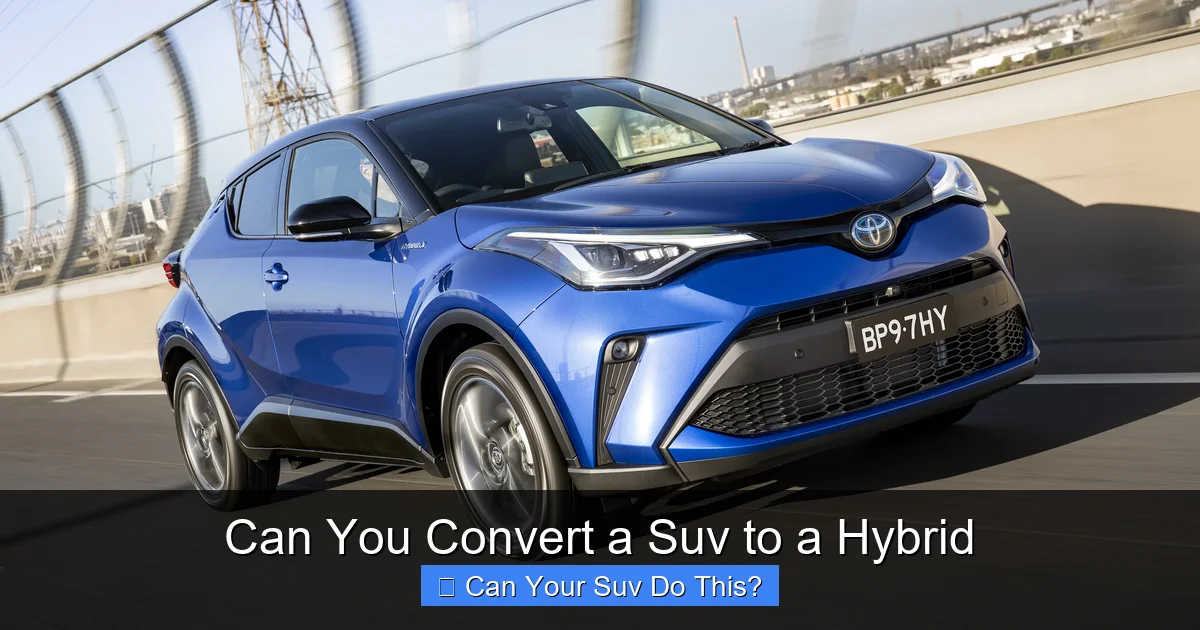
Converting an SUV to a hybrid is possible but complex, expensive, and often not practical for most drivers. While DIY kits and professional retrofits exist, they require significant mechanical knowledge, regulatory compliance, and upfront investment. For many, buying a factory-built hybrid SUV remains the smarter, safer choice.
Key Takeaways
- Hybrid conversion is technically feasible: With advanced engineering and specialized kits, it’s possible to retrofit an SUV with hybrid technology.
- Costs are high: Professional conversions can exceed $15,000, often rivaling the price of a new hybrid SUV.
- DIY conversions require expertise: Only experienced mechanics or engineers should attempt this due to safety and complexity.
- Not all SUVs are good candidates: Older, less efficient models may not benefit enough to justify the conversion cost.
- Factory hybrids offer better reliability: OEM systems are tested, warrantied, and optimized for performance and safety.
- Environmental benefits vary: While conversions reduce emissions, the carbon footprint of the process may offset gains.
- Check local regulations: Some regions don’t allow modified vehicles to pass emissions or safety inspections.
📑 Table of Contents
- Can You Really Convert a SUV to a Hybrid?
- What Does a Hybrid Conversion Actually Involve?
- DIY vs. Professional Hybrid Conversions: What’s the Difference?
- Is Your SUV a Good Candidate for Conversion?
- Factory Hybrid SUVs: A Better Alternative?
- The Future of Hybrid Conversions
- Final Thoughts: Should You Convert Your SUV?
Can You Really Convert a SUV to a Hybrid?
You’ve got your trusty SUV—maybe it’s a 2010 Ford Explorer or a 2008 Toyota Highlander. It’s reliable, roomy, and perfect for family trips. But lately, you’ve been eyeing those sleek hybrid SUVs gliding silently down the highway, sipping fuel instead of guzzling it. You start wondering: *Can I convert my SUV to a hybrid?* It sounds like a dream—keeping the vehicle you love while slashing fuel costs and reducing your carbon footprint.
The short answer? Yes, it’s technically possible. But the longer, more honest answer is that it’s complicated, costly, and rarely worth it for the average driver. Hybrid conversion isn’t like swapping out a carburetor or upgrading your stereo. It involves integrating electric motors, high-voltage batteries, sophisticated control systems, and software that must work seamlessly with your SUV’s existing engine and transmission. It’s not a weekend project—it’s more like a full-scale automotive engineering challenge.
Still, the idea is appealing. With rising gas prices and growing environmental concerns, many SUV owners are looking for ways to go greener without ditching their current ride. And while factory-built hybrid SUVs are more common than ever, they often come with a higher price tag. So, the temptation to retrofit is understandable. But before you start shopping for electric motors and battery packs, it’s important to understand what’s involved, what it costs, and whether it’s truly a smart move.
What Does a Hybrid Conversion Actually Involve?
Visual guide about Can You Convert a Suv to a Hybrid
Image source: websitebuilderinsider.com
To convert an SUV to a hybrid, you’re essentially turning a traditional internal combustion engine (ICE) vehicle into a hybrid electric vehicle (HEV) or even a plug-in hybrid (PHEV). That means adding an electric motor, a battery pack, a power inverter, and a control system that manages when the engine or motor—or both—are used.
Let’s break it down.
The Core Components of a Hybrid System
At the heart of any hybrid conversion are three main components: the electric motor, the battery pack, and the control unit.
The electric motor is responsible for assisting the gasoline engine during acceleration or powering the vehicle at low speeds. In some conversions, the motor replaces the starter and alternator (called a belt-alternator starter or BAS system), while in more advanced setups, it’s integrated into the transmission or driveshaft.
The battery pack stores electrical energy. Most conversions use lithium-ion batteries similar to those in modern EVs, though some older or budget kits may use lead-acid or nickel-metal hydride. The size of the battery determines how much electric-only range you get—anywhere from a few miles to over 30 in plug-in setups.
The control unit (often called the hybrid controller or energy management system) is the brain of the operation. It decides when to use the engine, when to use the motor, and when to recharge the battery through regenerative braking. This software must be carefully calibrated to match your SUV’s weight, aerodynamics, and driving patterns.
Types of Hybrid Conversions
There are different levels of hybrid conversion, each with its own complexity and performance benefits.
A mild hybrid conversion adds a small electric motor (usually 10–20 kW) that assists the engine but can’t power the vehicle on its own. This is the simplest and cheapest option, often used to improve fuel economy by 10–15%. It’s common in commercial fleet upgrades.
A full hybrid conversion allows the SUV to run on electric power alone at low speeds. The motor and engine can work together or independently. This requires a larger battery and more advanced controls, increasing cost and complexity.
A plug-in hybrid conversion includes a larger battery that can be charged from an external power source. This gives you 20–40 miles of electric-only driving, ideal for short commutes. However, it demands significant space for batteries and a more robust electrical system.
Where Do You Put All This Stuff?
One of the biggest challenges in converting an SUV is finding space for the new components. SUVs are roomy, but not all that space is usable.
The battery pack is the bulkiest part. In many conversions, it’s installed in the cargo area, under the rear seats, or even in the spare tire well. This can reduce storage space and add significant weight—sometimes over 500 pounds. That extra mass can actually hurt fuel economy if not managed properly.
The electric motor might be mounted between the engine and transmission (a “through-the-road” setup) or on one of the axles. Some conversions use a dual-motor system—one for the front wheels, one for the rear—to enable all-wheel drive.
Wiring, cooling systems, and safety components (like high-voltage disconnects) also take up space. And don’t forget the need for a charging port if you’re going plug-in.
DIY vs. Professional Hybrid Conversions: What’s the Difference?
Now that you know what’s involved, you’re probably wondering: *Should I do this myself or hire a pro?*
The answer depends on your skills, budget, and goals.
DIY Hybrid Conversions: A Labor of Love
For the mechanically inclined, a DIY hybrid conversion can be a rewarding project. There are kits available from companies like Hymotion (now part of A123 Systems), Hybrid Electric Vehicle Technologies, and Electric Car Conversion Kits. These kits typically include the motor, battery, controller, and wiring harness, along with installation guides.
But here’s the catch: these kits are not “plug-and-play.” You’ll need to modify your SUV’s drivetrain, reprogram the engine control unit (ECU), and ensure all systems communicate properly. You’ll also need to handle high-voltage wiring safely—mistakes can lead to fires, shocks, or even death.
Many DIYers spend months—or even years—on their conversions. They join online forums, attend EV conversion workshops, and consult with experts. Some succeed brilliantly. Others end up with a garage full of parts and a non-running SUV.
One real-world example is a 2005 Honda Pilot converted by a team of engineers in California. They installed a 60 kW electric motor and a 12 kWh lithium battery pack, achieving 35 miles of electric range and a combined fuel economy of 45 mpg. But the project took over a year and cost nearly $20,000 in parts and labor.
Professional Conversions: Expertise at a Price
If you’re not ready to tackle this yourself, professional conversion shops offer a safer, more reliable path. Companies like XL Hybrids (now XL Fleet), Hyliion, and Electric Classic Cars specialize in retrofitting vehicles with hybrid systems.
These shops have the tools, experience, and certifications to handle complex electrical and mechanical work. They often provide warranties and ensure the vehicle meets safety and emissions standards.
For example, XL Fleet offered a mild hybrid conversion for fleet vehicles like the Ford F-150 and Chevy Silverado. Their system added a 5 kWh battery and a 48-volt motor, improving fuel economy by up to 25% without major drivetrain changes. The cost? Around $12,000 per vehicle—but with fleet discounts and potential fuel savings, it could pay off over time.
However, most professional conversions are aimed at commercial fleets, not individual consumers. Finding a shop that will convert your personal SUV can be difficult, and the cost is often prohibitive.
The Hidden Costs of Conversion
Even if you do it yourself, the costs add up quickly.
– Parts: A quality conversion kit can cost $8,000–$15,000.
– Labor: If you hire help, expect to pay $50–$100 per hour.
– Software and tuning: ECU reprogramming and calibration can run $1,000–$3,000.
– Insurance and registration: Some insurers charge more for modified vehicles, and registration may require special inspections.
– Maintenance: Hybrid systems need specialized care. Battery degradation, software updates, and motor servicing aren’t cheap.
And remember: your SUV’s original engine and transmission weren’t designed for hybrid operation. Over time, the added stress could lead to premature wear.
Is Your SUV a Good Candidate for Conversion?
Not every SUV is worth converting. The success of a hybrid conversion depends heavily on the vehicle’s age, condition, and design.
Best Candidates for Conversion
Older SUVs with simple, robust engines and transmissions are often the best candidates. Think models from the late 1990s to mid-2000s—like the Toyota 4Runner, Ford Explorer, or Jeep Grand Cherokee. These vehicles have mechanical systems that are easier to modify and aren’t bogged down by complex electronics.
SUVs with rear-wheel drive or four-wheel drive are also better suited, as they often have more space under the chassis for motor and battery placement.
Another factor is weight. Heavier SUVs benefit more from electric assist because the motor can help overcome inertia during acceleration. But if the SUV is already very inefficient—like a V8-powered Suburban—the conversion may not deliver enough fuel savings to justify the cost.
When Conversion Doesn’t Make Sense
Newer SUVs with advanced engine management systems, turbocharging, or continuously variable transmissions (CVTs) are harder to convert. Their ECUs are tightly integrated, and tampering can trigger error codes or disable the vehicle.
Also, if your SUV is already fuel-efficient—like a modern Honda CR-V or Toyota RAV4—the gains from conversion may be minimal. These vehicles already use lightweight materials, aerodynamic designs, and efficient engines. Adding a hybrid system might only improve fuel economy by 10–15%, which isn’t impressive compared to the effort.
And let’s be honest: if your SUV is nearing the end of its life, pouring thousands into a conversion may not be wise. You might be better off selling it and putting that money toward a new hybrid SUV.
Environmental Impact: Is It Really Greener?
One of the main reasons people want to convert their SUV is to reduce their environmental impact. But is a conversion actually better for the planet?
It depends.
Manufacturing a new hybrid SUV requires mining rare earth metals, producing batteries, and assembling complex systems—all of which have a significant carbon footprint. By converting an existing vehicle, you’re extending its life and avoiding the emissions associated with building a new one.
However, the conversion process itself isn’t carbon-neutral. Producing lithium-ion batteries emits CO₂, and shipping heavy components adds to the footprint. Plus, if the conversion reduces fuel economy by only a small margin, the long-term environmental benefit may be negligible.
Studies suggest that converting a vehicle only makes environmental sense if it’s driven extensively over many years. For example, a fleet vehicle that logs 30,000 miles a year might justify the conversion. But for a typical driver putting on 12,000 miles annually, the payback period could be decades.
Factory Hybrid SUVs: A Better Alternative?
Given the complexity and cost of conversion, many experts recommend simply buying a factory-built hybrid SUV instead.
Modern hybrid SUVs—like the Toyota RAV4 Hybrid, Ford Escape Hybrid, or Lexus RX 450h—are designed from the ground up for efficiency and reliability. They come with warranties, certified emissions compliance, and integrated safety features. And thanks to growing demand, prices are more affordable than ever.
For example, a new Toyota RAV4 Hybrid starts around $32,000 and delivers over 40 mpg combined. That’s better fuel economy than most conversions can achieve—and without the risk of electrical fires, software glitches, or failed inspections.
Even used hybrid SUVs are a smart choice. A 2018–2020 model with moderate mileage can be found for $20,000–$25,000 and still offer excellent efficiency and reliability.
What About Plug-In Hybrids?
If you want even more electric range, consider a plug-in hybrid SUV (PHEV). Models like the Toyota RAV4 Prime, Ford Escape PHEV, or Hyundai Tucson PHEV offer 30–45 miles of electric-only driving—perfect for daily commutes. After that, the gas engine kicks in, so you never worry about range anxiety.
These vehicles are ideal for drivers who want the best of both worlds: zero-emission driving for short trips and long-range capability for road trips.
The Future of Hybrid Conversions
While converting an SUV to a hybrid is challenging today, the future may bring easier, more affordable options.
Advances in battery technology, motor efficiency, and software are making retrofits more viable. Companies are developing modular kits that can be installed in a few days, and some are even offering leasing or financing for conversions.
Governments are also getting involved. In California and other states, incentives for vehicle electrification could eventually include conversion rebates. And as EV adoption grows, more mechanics will be trained in high-voltage systems, reducing labor costs.
But for now, the barrier to entry remains high. Unless you’re a skilled engineer with deep pockets, a factory hybrid SUV is still the best way to go green.
Final Thoughts: Should You Convert Your SUV?
So, can you convert a SUV to a hybrid? Absolutely. Is it worth it? For most people, probably not.
Hybrid conversion is a fascinating blend of engineering, environmentalism, and DIY spirit. It’s a testament to human ingenuity and the desire to make better use of what we already have. But it’s also a reminder that not every good idea is a practical one.
If you’re passionate about sustainability and have the skills and resources, a conversion could be a rewarding project. But if you’re looking for better fuel economy, lower emissions, and peace of mind, a factory-built hybrid SUV is the smarter, safer, and more reliable choice.
In the end, the goal isn’t just to convert your SUV—it’s to drive smarter, cleaner, and more efficiently. And sometimes, the best way to do that is to let the experts handle it.
Frequently Asked Questions
Can any SUV be converted to a hybrid?
Not every SUV is suitable for conversion. Older, simpler models with mechanical engines and ample space are better candidates. Newer SUVs with complex electronics may be too difficult or costly to modify.
How much does it cost to convert an SUV to a hybrid?
Professional conversions typically cost $12,000–$20,000 or more. DIY kits start around $8,000 but require significant time, tools, and expertise. Additional costs include labor, software tuning, and potential insurance increases.
Will a hybrid conversion improve my SUV’s fuel economy?
Yes, but the improvement varies. Mild hybrids may boost fuel economy by 10–25%, while plug-in conversions can offer 30–50+ mpg equivalent. However, added weight and system inefficiencies can offset some gains.
Is a hybrid conversion legal?
It depends on your location. In the U.S., converted vehicles must pass emissions and safety inspections. Some states require certification from a licensed engineer. Always check local regulations before starting a conversion.
Can I convert my SUV to a full electric vehicle instead?
Yes, full EV conversions are possible and sometimes more straightforward than hybrid conversions. However, they require even larger batteries, more space, and higher costs—often exceeding $25,000.
What happens to my SUV’s warranty after a conversion?
Any factory warranty will likely be voided once major modifications are made. Even if you do the conversion yourself, manufacturers won’t cover damage related to the hybrid system or altered components.