
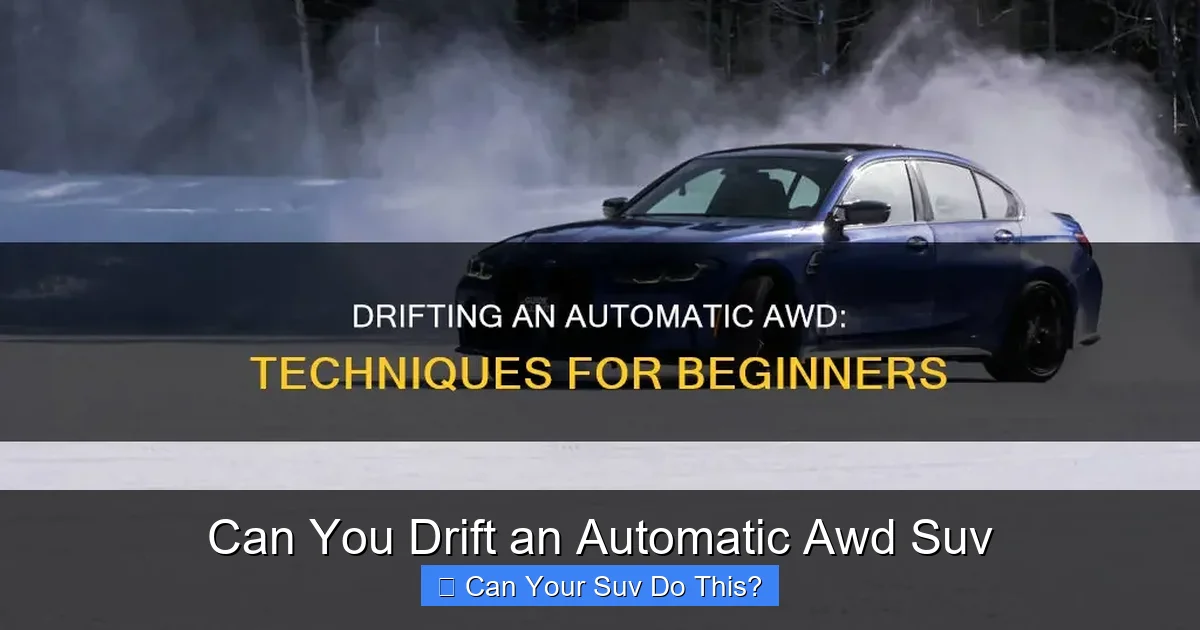
Yes, you can drift an automatic AWD SUV—but it’s not easy. While these vehicles aren’t built for sliding, skilled drivers can induce controlled drifts using advanced techniques and the right conditions. It requires understanding your SUV’s limits, terrain, and safety precautions.
Key Takeaways
- Drifting an automatic AWD SUV is possible but challenging: These vehicles prioritize stability and traction, making intentional slides difficult without modifications or expert technique.
- Electronic stability control (ESC) is a major obstacle: Most modern SUVs have ESC systems that prevent loss of traction, so disabling it is often necessary for drifting.
- Weight and center of gravity matter: SUVs are heavier and taller than sports cars, increasing rollover risk during aggressive maneuvers.
- Surface conditions are critical: Low-traction surfaces like gravel, snow, or wet pavement make drifting safer and more achievable.
- Driver skill outweighs vehicle type: Even with the right SUV, success depends on throttle control, steering input, and timing.
- Modifications can help—but aren’t required: Upgrades like performance tires, limited-slip differentials, or tuning can improve drift potential.
- Safety should always come first: Always practice drifting in controlled environments like closed tracks or empty lots with proper safety gear.
📑 Table of Contents
- Can You Drift an Automatic AWD SUV?
- Understanding Drifting: What It Really Means
- Why Automatic AWD SUVs Are a Challenge
- When and Where You Can Drift an Automatic AWD SUV
- Techniques for Drifting an Automatic AWD SUV
- Modifications That Can Help
- Safety First: Risks and Precautions
- Real-World Examples and Success Stories
- Conclusion: Yes, You Can—But Should You?
Can You Drift an Automatic AWD SUV?
You’ve seen it in movies—cars sliding sideways through corners, tires smoking, drivers in complete control. But what if your ride isn’t a lightweight rear-wheel-drive coupe? What if you’re behind the wheel of a modern automatic all-wheel-drive SUV? Can you still drift? The short answer is yes—but it’s not as simple as flooring the gas and turning the wheel.
Drifting has long been associated with lightweight, rear-wheel-drive sports cars like the Nissan 240SX or Toyota Supra. These vehicles are designed for balance, responsiveness, and controlled oversteer. But today’s SUVs—especially automatic AWD models—are built for comfort, safety, and all-weather capability. They’re heavier, taller, and packed with electronic aids that resist sliding. So while drifting an automatic AWD SUV isn’t impossible, it requires a different approach, a solid understanding of vehicle dynamics, and a healthy respect for physics.
This article dives deep into the world of SUV drifting. We’ll explore what makes drifting possible (or difficult) in these vehicles, the techniques involved, real-world examples, and safety considerations. Whether you’re curious about trying it yourself or just want to understand the mechanics behind the madness, you’ll find practical insights and expert tips here. Let’s slide into it.
Understanding Drifting: What It Really Means
Visual guide about Can You Drift an Automatic Awd Suv
Image source: tenwheel.com
Before we talk about SUVs, let’s clarify what drifting actually is. At its core, drifting is a driving technique where the driver intentionally oversteers, causing the rear wheels to lose traction and slide through a corner. Unlike racing lines that prioritize speed and grip, drifting emphasizes control during a loss of traction. It’s a skill that blends precision, timing, and car control.
There are different types of drifting:
- Power-over drift: Applying throttle to break rear traction while turning.
- Feint drift (or Scandinavian flick): Shifting weight to unsettle the car before initiating the slide.
- Clutch kick: Briefly engaging and releasing the clutch to shock the drivetrain (not applicable to automatics).
- Brake drift: Using the brakes to shift weight forward and break rear grip.
In traditional drifting, rear-wheel-drive (RWD) cars dominate because they naturally allow the rear to step out when power is applied. Front-wheel-drive (FWD) cars can drift too, but it’s less common and often involves handbrake turns. All-wheel-drive (AWD) vehicles, however, distribute power to all four wheels, which typically increases grip and reduces the likelihood of oversteer.
But here’s the twist: AWD can actually help in certain drift scenarios. When power is sent to all wheels, it can create more balanced slides, especially on low-traction surfaces. The key is managing that power and overcoming the vehicle’s natural tendency to stay planted.
Why Automatic AWD SUVs Are a Challenge
Now, let’s talk about why drifting an automatic AWD SUV is harder than it sounds. These vehicles are engineered for safety, comfort, and everyday usability—not high-performance sliding. Several factors work against you when trying to drift:
Electronic Stability Control (ESC)
Most modern SUVs come equipped with ESC, a system designed to prevent skidding and loss of control. It uses sensors to monitor wheel speed, steering angle, and lateral G-forces. If the system detects oversteer or understeer, it automatically applies brakes to individual wheels and reduces engine power. This is great for avoiding accidents—but terrible for drifting.
To drift successfully, you’ll likely need to disable ESC. Many SUVs have a “sport” or “off-road” mode that partially disables ESC, and some allow full deactivation via a button or menu. However, not all models offer this option, and doing so may void warranties or affect insurance coverage.
Weight and Center of Gravity
SUVs are significantly heavier than sports cars. A typical midsize SUV weighs between 4,000 and 5,000 pounds, compared to 2,800–3,200 pounds for a performance coupe. That extra mass makes it harder to initiate and sustain a drift. More importantly, SUVs have a higher center of gravity due to their taller ride height. This increases the risk of rollover during aggressive maneuvers, especially when sliding sideways.
Imagine trying to slide a refrigerator versus a skateboard. The refrigerator has more inertia and wants to stay upright—until it tips. The same principle applies to SUVs. A sudden drift at high speed can cause the vehicle to roll, particularly if the suspension isn’t tuned for performance.
All-Wheel Drive Dynamics
AWD systems are designed to maximize traction. Whether it’s full-time AWD (like Subaru’s Symmetrical AWD) or part-time (like many Toyota and Ford systems), the goal is to send power where it’s needed most. This means that when one wheel loses grip, the system redirects torque to the others—exactly the opposite of what you want when drifting.
Some performance-oriented AWD systems, like those in the Audi RS Q8 or Mercedes-AMG GLE 63, have rear-biased torque distribution and can be tuned for sportier handling. But even these are optimized for grip, not slide. Without a limited-slip differential (LSD) or torque-vectoring system, it’s tough to break rear traction consistently.
Automatic Transmissions and Throttle Response
Automatic transmissions in SUVs are built for smoothness and fuel efficiency, not performance. They often have slower shift times and conservative programming that limits aggressive throttle input. While many modern automatics have “sport” or “manual” modes, they still can’t match the responsiveness of a manual or dual-clutch transmission.
Additionally, torque converters in traditional automatics can absorb power and delay response, making it harder to modulate throttle for precise drift control. Continuously variable transmissions (CVTs), common in many AWD SUVs, are even less suited for drifting due to their rubber-band effect and lack of direct gear engagement.
When and Where You Can Drift an Automatic AWD SUV
So, is it hopeless? Not quite. While drifting an automatic AWD SUV isn’t ideal, it’s absolutely possible under the right conditions. The key is choosing the right environment and understanding your vehicle’s capabilities.
Low-Traction Surfaces Are Your Best Friend
The easiest way to drift an SUV is on a surface with reduced grip. Think gravel, snow, ice, or wet grass. These conditions naturally reduce traction, making it easier to break rear wheels loose without extreme throttle or steering inputs.
For example, in snowy climates, many drivers practice “snow drifting” for fun or winter driving practice. On a snow-covered parking lot, even a stock SUV can slide with moderate throttle and steering. Gravel roads are another great option—just make sure it’s private property or a designated off-road area.
One viral video shows a Toyota RAV4 AWD drifting sideways through a snowy field, using nothing more than momentum and gentle throttle. No modifications, no racing tires—just smart driving and the right conditions.
Closed Courses and Tracks
If you’re serious about learning to drift, a closed course is the safest and most effective place to practice. Many driving schools and motorsport clubs offer drifting clinics, and some even use SUVs or crossovers for training. These environments allow you to experiment with techniques without endangering yourself or others.
For instance, the “Drift Experience” program in the UK has used modified Subaru Foresters to teach drifting fundamentals. The instructors emphasize throttle control, weight transfer, and recovery techniques—all applicable to stock SUVs.
Performance SUVs: The Closest Thing to a Drift Machine
Not all SUVs are created equal. Some high-performance models come closer to drifting capability than others. Vehicles like the:
- Audi RS Q8
- BMW X5 M
- Mercedes-AMG GLE 63 S
- Porsche Cayenne Turbo
- Jeep Grand Cherokee Trackhawk
These SUVs pack supercar-level power (500–700+ horsepower), advanced AWD systems, and sport-tuned suspensions. While still heavy, they’re engineered for performance and can handle aggressive driving better than mainstream models.
The Porsche Cayenne, for example, has a rear-biased AWD system and optional rear-axle steering, making it surprisingly agile. With ESC disabled and the right tires, it can initiate controlled slides on dry pavement. The Trackhawk, with its 707-horsepower Hellcat engine, can easily break traction—but its weight and height make sustained drifts risky.
Techniques for Drifting an Automatic AWD SUV
Now that we’ve covered the challenges and opportunities, let’s talk about how to actually drift your SUV. These techniques require practice, patience, and a safe environment.
Power-Over Drift
This is the most straightforward method: apply throttle while turning to break rear traction. In an AWD SUV, you’ll need to be aggressive with the gas, especially if ESC is partially active.
Steps:
- Approach a corner at moderate speed (20–30 mph).
- Turn the steering wheel into the corner.
- Quickly apply throttle to overload the rear tires.
- Countersteer as the rear begins to slide.
- Modulate throttle to maintain the drift.
Tip: Use “sport” mode if available, as it often increases throttle response and delays upshifts.
Feint Drift (Scandinavian Flick)
This technique involves shifting the vehicle’s weight to unsettle it before initiating the slide. It’s commonly used in rally driving and works well on loose surfaces.
Steps:
- Approach the corner and steer slightly away from it.
- Quickly flick the wheel into the corner while applying throttle.
- The sudden weight transfer breaks rear traction.
- Countersteer and balance the slide with throttle.
This method is more effective on gravel or snow, where the tires can easily lose grip.
Brake Drift
Using the brakes to shift weight forward can help break rear traction, especially in heavier vehicles.
Steps:
- Brake hard just before the corner to transfer weight to the front.
- Turn in and release the brake while applying throttle.
- The rear end will step out due to reduced grip.
- Countersteer and control the slide.
Caution: This technique increases rollover risk in tall SUVs. Use only at low speeds and on safe surfaces.
Handbrake Turn
Pulling the handbrake (or electronic parking brake) locks the rear wheels, forcing a slide. This is a classic rally move but requires quick release to avoid spinning.
Steps:
- Approach the corner at low speed.
- Turn in and pull the handbrake while applying slight throttle.
- Release the handbrake as the rear begins to slide.
- Countersteer and balance with throttle.
Note: Many modern SUVs have electronic parking brakes that can’t be pulled while moving. Check your owner’s manual.
Modifications That Can Help
While you can drift a stock SUV, certain modifications can improve your chances of success—and safety.
Tires
Tires are the most important factor in traction. For drifting, you want a balance between grip and slip. All-season or performance tires are better than all-terrain or highway tires, which are too grippy.
Consider:
- Summer performance tires: Offer better lateral grip and responsiveness.
- Studded or winter tires: Great for snow drifting.
- Cheap used tires: Save your good tires—drifting wears them out fast.
Avoid overly aggressive off-road tires, as they can make the SUV unstable on pavement.
Suspension Upgrades
Stiffer suspension reduces body roll and improves weight transfer. Upgrades like performance shocks, lowering springs, or sway bars can help, but be cautious—lowering an SUV too much affects ground clearance and ride quality.
Limited-Slip Differential (LSD)
An LSD helps distribute power evenly between the rear wheels, making it easier to initiate and sustain drifts. Some SUVs come with factory LSDs, but aftermarket options are limited. Consider a welded differential for off-road use (not recommended for street driving).
ECU Tuning
Performance tuning can increase throttle response, disable traction control more effectively, and adjust shift points. However, tuning may void warranties and increase wear on the transmission.
Weight Reduction
Removing unnecessary weight (spare tires, rear seats, etc.) can improve agility. But don’t compromise safety—keep essential components intact.
Safety First: Risks and Precautions
Drifting is inherently risky, especially in a tall, heavy SUV. Here’s how to stay safe:
Choose the Right Location
Never drift on public roads. Use closed courses, private property, or designated off-road areas. Make sure the surface is clear of debris, pedestrians, and obstacles.
Wear Proper Gear
Even at low speeds, a rollover or spin can cause injury. Wear a helmet, seatbelt, and consider a roll bar if modifying your SUV.
Know Your Limits
Start slow. Practice basic slides before attempting full drifts. Learn how your SUV responds to throttle, steering, and braking.
Check Your Vehicle
Ensure tires, brakes, and suspension are in good condition. Low tire pressure or worn brakes can lead to loss of control.
Have an Exit Strategy
Always know how to recover from a spin or slide. Practice countersteering and throttle modulation in a safe environment.
Real-World Examples and Success Stories
Despite the challenges, many drivers have successfully drifted automatic AWD SUVs. Here are a few inspiring examples:
The Subaru WRX STI Wagon Drift
While not a traditional SUV, the lifted Subaru WRX STI wagon has AWD, an automatic transmission (in some models), and rally heritage. Enthusiasts have used it for drifting on gravel and snow, proving that AWD vehicles can slide with the right setup.
Toyota Land Cruiser on Sand
In desert environments, modified Land Cruisers with automatic transmissions are often drifted for fun. The loose sand reduces traction, and the vehicle’s durability handles the abuse. Videos show drivers sliding sideways through dunes with ease.
Jeep Wrangler JK on Snow
With its solid axles and part-time 4WD, the Wrangler can be drifted in snow with ESC disabled. The short wheelbase helps with rotation, and the open differentials allow wheels to spin independently.
These examples show that with creativity and the right conditions, even unlikely vehicles can drift.
Conclusion: Yes, You Can—But Should You?
So, can you drift an automatic AWD SUV? Absolutely. Is it easy? Not really. Is it safe? Only if you take the right precautions.
Drifting an SUV is a test of skill, patience, and understanding. It’s not about mimicking movie stunts—it’s about mastering vehicle dynamics and pushing your limits in a controlled way. While these vehicles aren’t designed for sliding, they can do it under the right conditions, with the right techniques, and in the right environment.
If you’re passionate about driving and want to explore the limits of your SUV, start small. Practice in snow or gravel, disable ESC, and focus on control over speed. Remember, the goal isn’t to smoke tires or win trophies—it’s to learn, have fun, and stay safe.
And who knows? You might just discover that your family hauler has a hidden wild side.
Frequently Asked Questions
Can any automatic AWD SUV drift?
Technically, yes—most automatic AWD SUVs can drift under the right conditions, such as low-traction surfaces or with ESC disabled. However, success depends on the driver’s skill, vehicle setup, and environment.
Do I need to modify my SUV to drift it?
No, modifications aren’t required. Many drivers drift stock SUVs on snow or gravel. However, upgrades like performance tires, suspension tuning, or LSDs can improve control and consistency.
Is drifting an SUV dangerous?
Yes, it can be. SUVs have a high center of gravity, increasing rollover risk during aggressive slides. Always practice in safe, controlled environments and wear proper safety gear.
Can I drift on dry pavement?
It’s possible with high-performance SUVs and ESC disabled, but it’s difficult and risky due to high traction. Low-grip surfaces like snow, gravel, or wet grass are much safer and more effective.
Will drifting damage my SUV?
Frequent drifting can wear out tires, brakes, and suspension components faster. It may also strain the transmission and drivetrain. Occasional practice in safe conditions is unlikely to cause major damage.
What’s the best SUV for drifting?
Performance models like the Audi RS Q8, Porsche Cayenne Turbo, or Jeep Grand Cherokee Trackhawk are better suited due to their power, AWD tuning, and sport suspensions. However, even mainstream SUVs can drift with skill and the right conditions.