
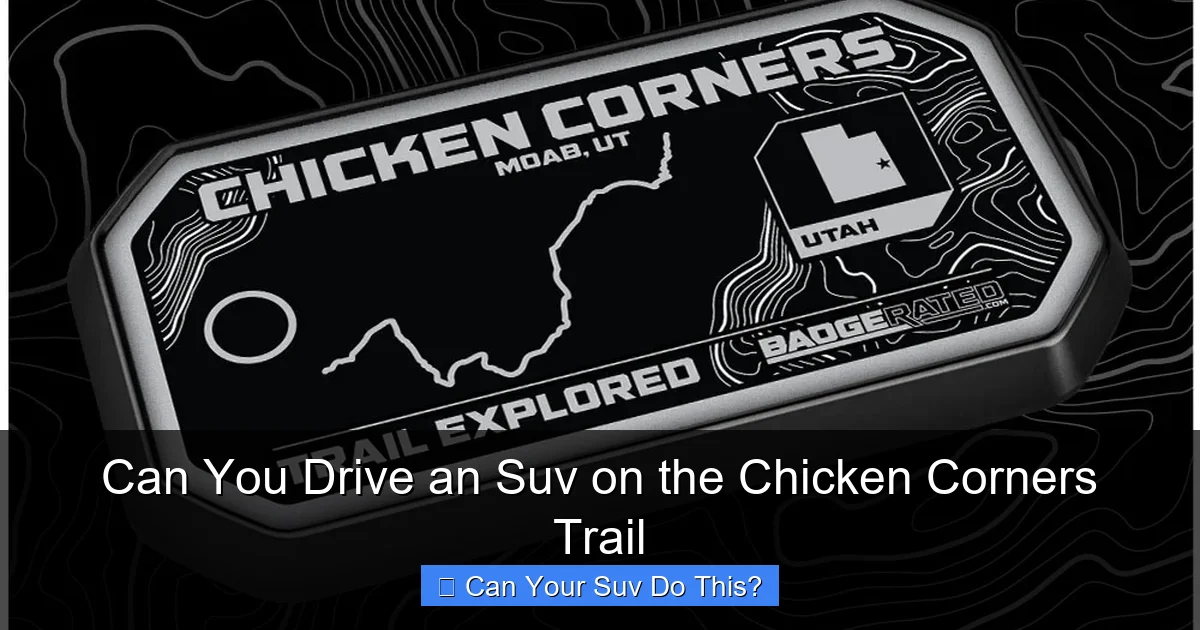
Yes, you can drive an SUV on the Chicken Corners Trail—but only if it’s properly equipped, experienced, and prepared. This challenging off-road route in Utah demands high clearance, 4WD, and skilled driving to navigate steep drops, narrow ledges, and rocky terrain safely.
If you’ve ever stared at a map of southeastern Utah and wondered whether your SUV could handle one of its most infamous backcountry trails, you’re not alone. The Chicken Corners Trail—a rugged, remote route that snakes through red rock canyons and along cliff edges near Moab—has become legendary among off-roaders, overlanders, and adventure seekers. But just because it’s *possible* to drive doesn’t mean it’s *easy*, or even advisable for every vehicle.
So, can you drive an SUV on the Chicken Corners Trail? The short answer is: maybe. The long answer involves understanding your SUV’s capabilities, assessing your own driving skills, preparing for extreme conditions, and respecting both the trail and the environment. This isn’t a Sunday drive through the suburbs—it’s a serious off-road challenge that has turned confident drivers into humbled beginners and sent unprepared rigs home on flatbeds.
In this guide, we’ll break down everything you need to know before attempting Chicken Corners in your SUV. From vehicle requirements and trail conditions to safety tips and real-world examples, we’ll help you decide whether your ride—and your nerve—are up to the task.
Key Takeaways
- SUV Compatibility Depends on Model & Mods: Not all SUVs are created equal—only lifted, 4WD models with skid plates and all-terrain tires should attempt Chicken Corners.
- Trail Difficulty Is Serious: Rated as a “5” on the standard off-road scale, this trail features narrow paths, steep inclines, and exposure to sheer drop-offs.
- Experience Matters More Than Vehicle: Even the most capable SUV won’t save an inexperienced driver from mistakes on this technical route.
- Seasonal Conditions Change Everything: Spring runoff or summer thunderstorms can turn dry rock into slippery mud or create flash floods in washes.
- Permits and Regulations Apply: The trail is on public land managed by the BLM—no permit is required, but stay on designated routes to protect fragile desert ecosystems.
- Safety Gear Is Non-Negotiable: Bring recovery gear (winch, traction boards), extra water, GPS, and a satellite communicator—cell service is nonexistent.
- Respect the Environment: Practice Leave No Trace principles; this area is home to rare plants, wildlife, and ancient cultural sites.
📑 Table of Contents
- What Is the Chicken Corners Trail?
- Can Your SUV Handle Chicken Corners?
- Skill Level: Why Driver Experience Trumps Vehicle Capability
- Seasonal and Environmental Considerations
- Safety Essentials: What to Bring
- Real Stories: Lessons from the Trail
- Conclusion: Should You Attempt Chicken Corners in Your SUV?
What Is the Chicken Corners Trail?
Nestled in the heart of Utah’s Canyonlands region, the Chicken Corners Trail is a 17-mile off-road route that connects Highway 128 near Castle Valley to the Potash Road corridor west of Moab. Despite its unassuming name, this trail is anything but tame. It cuts through dramatic desert landscapes, offering jaw-dropping views of the Colorado River, towering sandstone cliffs, and vast open skies.
The trail got its quirky name from local lore: early ranchers supposedly used the area to graze chickens because the terrain was too rough for cattle. Today, it’s known for something far more intense—technical rock crawling, narrow ledges with thousand-foot drops, and sections where one wrong turn could spell disaster.
Chicken Corners is classified as a “5” on the standard off-road difficulty scale (where 1 is a dirt road and 5 is expert-only). That means it’s designed for highly modified 4×4 vehicles driven by experienced operators. While some sections are manageable for well-prepared stock SUVs, others require precise wheel placement, low-range gearing, and nerves of steel.
Trail Highlights and Challenges
One of the most notorious sections is the “Chicken Corners Overlook,” a narrow spine of rock perched high above the Colorado River. The trail here is barely wider than a vehicle, with drop-offs on both sides and no room for error. Another tough spot is the “Rock Garden,” a jumble of house-sized boulders that demands careful navigation and often requires winching or spotting.
Weather plays a huge role too. In spring, melting snow can turn washes into raging torrents. Summer brings scorching heat and sudden thunderstorms that flood dry creek beds in minutes. Winter offers cooler temps but introduces ice on shaded rock faces—a silent hazard that can send even seasoned drivers sliding.
Can Your SUV Handle Chicken Corners?
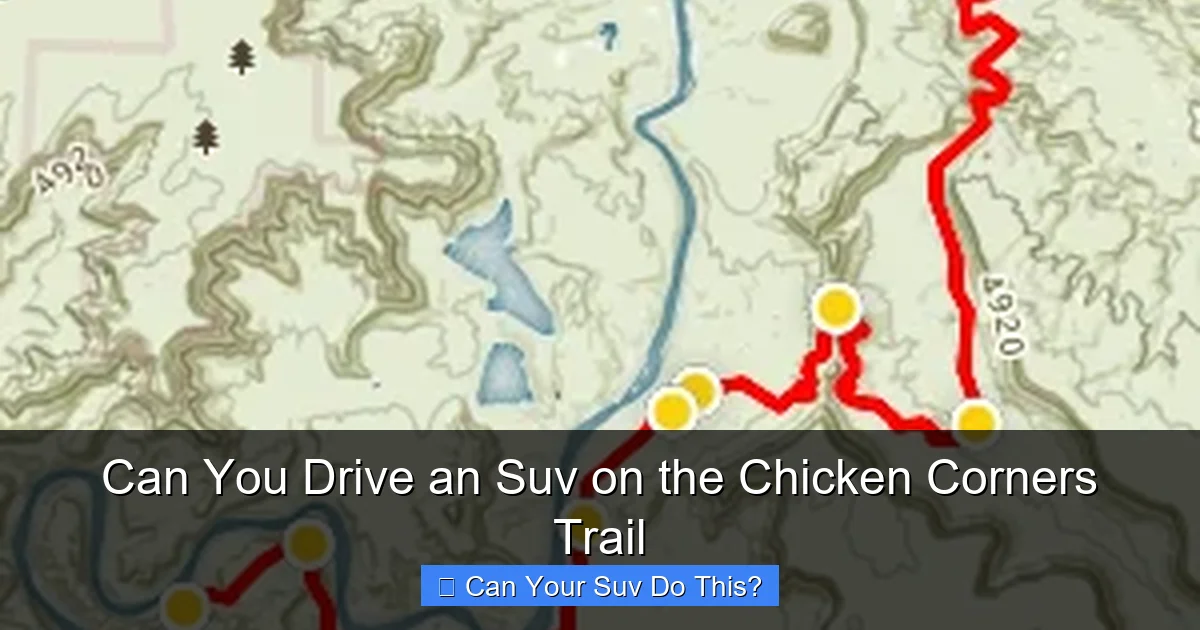
Visual guide about Can You Drive an Suv on the Chicken Corners Trail
Image source: i.pinimg.com
Not all SUVs are built for extreme off-roading. While many modern SUVs boast “adventure-ready” marketing, most are actually crossovers—unibody vehicles designed more for pavement than boulders. To tackle Chicken Corners, your SUV needs specific mechanical and physical attributes.
Essential Vehicle Requirements
First and foremost, you need **four-wheel drive (4WD)** with a low-range transfer case. Two-wheel-drive SUVs—even large ones like the Toyota Highlander or Honda Pilot—are immediately disqualified. Without low range, you won’t have the torque control needed for steep climbs or technical descents.
Next, **ground clearance** is critical. Stock SUVs often have only 7–8 inches of clearance, which isn’t enough for Chicken Corners’ rocky terrain. You’ll want at least 9–10 inches, preferably more if you’re running larger tires. Lift kits (2–3 inches) are common among trail veterans, but even a modest lift can make a big difference.
**Tires matter too.** All-terrain (A/T) or mud-terrain (M/T) tires with aggressive tread patterns provide the grip needed on loose rock and slick sandstone. Highway tires will slip, wear quickly, and increase your risk of getting stuck—or worse.
Don’t forget **skid plates**. The undercarriage of your SUV is vulnerable to rocks, ledges, and debris. Factory skid plates are often thin and inadequate. Aftermarket aluminum or steel plates protect your oil pan, transfer case, and fuel tank from damage.
Finally, consider **approach, departure, and breakover angles**. These measurements determine how steep an obstacle your SUV can climb or descend without scraping or high-centering. SUVs with short wheelbases (like the Jeep Wrangler or Ford Bronco) generally perform better than long-wheelbase models (like the Chevy Tahoe or Toyota Sequoia).
Real-World SUV Examples
Let’s look at a few popular SUVs and how they stack up:
– **Jeep Wrangler Rubicon**: Arguably the gold standard for this trail. With 4:1 low range, electronic locking differentials, and 10+ inches of clearance, it’s built for Chicken Corners straight from the factory.
– **Ford Bronco Badlands**: Equipped with Sasquatch package (35-inch tires, lifted suspension, front/rear lockers), it’s a strong contender. Stock models without the package may struggle.
– **Toyota 4Runner TRD Pro**: Solid 4WD system, good clearance, and proven reliability. With A/T tires and skid plates, it can handle most of the trail—but the Rock Garden might require extra caution.
– **Chevrolet Tahoe Z71**: Despite its off-road trim, the Tahoe’s long wheelbase and limited breakover angle make it a poor fit. It’s better suited for forest service roads than technical rock trails.
– **Subaru Outback or Forester**: These are crossovers, not true off-roaders. They lack low-range gearing and sufficient clearance. Attempting Chicken Corners in one is strongly discouraged.
The bottom line? If your SUV isn’t specifically designed or modified for serious off-roading, Chicken Corners is probably beyond its limits.
Skill Level: Why Driver Experience Trumps Vehicle Capability
Here’s a hard truth: no amount of aftermarket mods can compensate for poor driving technique. Chicken Corners isn’t just a test of your SUV—it’s a test of your judgment, patience, and ability to read terrain.
Many accidents on this trail happen not because the vehicle failed, but because the driver misjudged a ledge, panicked on a steep slope, or didn’t use a spotter. Off-road driving requires slow, deliberate movements, constant communication (if running with a group), and the willingness to turn back if conditions feel unsafe.
Key Skills You Need
– **Rock Crawling Technique**: Learn to use your throttle and brakes gently. Let the tires find traction rather than forcing momentum.
– **Spotting**: Have someone outside the vehicle guide you through tight or blind sections. A good spotter can prevent rollovers and undercarriage damage.
– **Recovery Knowledge**: Understand how to use a winch, traction boards, and kinetic recovery ropes. Getting stuck is part of the game—but being unprepared to get *unstuck* is dangerous.
– **Route Planning**: Study GPS tracks (like those from Gaia GPS or OnX Offroad) beforehand. Know where the hardest sections are so you can mentally prepare.
– **Situational Awareness**: Watch for changes in weather, trail conditions, and your own fatigue. Off-roading is mentally exhausting—push too hard, and mistakes happen.
If you’re new to technical off-roading, consider starting with easier trails like Hell’s Revenge or Fins and Things near Moab. Build your skills gradually before attempting Chicken Corners.
Seasonal and Environmental Considerations
Timing your trip right can mean the difference between a successful adventure and a rescue call. The desert climate in southeastern Utah is unpredictable, and Chicken Corners is especially sensitive to seasonal changes.
Best Times to Go
**Spring (March–May)** and **fall (September–October)** offer the most favorable conditions. Temperatures are mild, and rainfall is minimal. However, spring can bring muddy washes from snowmelt, so check recent trail reports.
**Summer (June–August)** is brutally hot—often exceeding 100°F (38°C). Dehydration and heatstroke are real risks. Afternoon thunderstorms can cause flash floods in dry washes, cutting off access or trapping vehicles. If you must go in summer, start early (before sunrise) and carry extra water (at least 1 gallon per person per day).
**Winter (November–February)** brings cold nights and possible ice. Shaded rock faces may freeze overnight, creating slippery conditions. Snow is rare but not impossible. Tire chains aren’t typically needed, but tire pressure adjustments (lowering to increase footprint) can help on icy rock.
Environmental Responsibility
The Chicken Corners area is part of the Bureau of Land Management (BLM) public lands. While no permit is required, you must follow strict guidelines:
– **Stay on designated routes**: Creating new trails damages cryptobiotic soil—a fragile crust that takes decades to regenerate.
– **Pack out all trash**: Including food wrappers, toilet paper, and human waste (use a WAG bag if no restroom is available).
– **Respect cultural sites**: Petroglyphs and ruins are common. Do not touch, climb on, or disturb them.
– **Minimize noise and light pollution**: This is a remote, pristine area. Keep generators and loud music to a minimum.
Remember: you’re a guest in this landscape. Leave it better than you found it.
Safety Essentials: What to Bring
Even the most capable SUV and skilled driver can encounter trouble. Being prepared could save your life—or your vehicle.
Must-Have Gear Checklist
– **Recovery Equipment**: Winch (with synthetic rope), recovery straps, D-rings, traction boards (like Maxtrax), and a high-lift jack.
– **Communication Devices**: Satellite messenger (Garmin inReach, Zoleo) or PLB (Personal Locator Beacon). Cell phones don’t work out here.
– **Navigation Tools**: GPS device with preloaded maps, paper backup maps, and a compass.
– **Emergency Supplies**: First aid kit, fire extinguisher, extra food, water (minimum 3 days’ worth), warm clothing, and a emergency blanket.
– **Vehicle Maintenance Items**: Spare tire, jack, tire repair kit, extra fluids (oil, coolant), and basic tools.
– **Lighting**: Extra headlights, LED light bars, and headlamps for night recovery.
Always let someone know your itinerary—where you’re going, when you plan to return, and who to contact if you’re overdue.
Traveling in a Group
Never attempt Chicken Corners alone. A minimum of two vehicles is strongly recommended. If one gets stuck or breaks down, the other can assist with recovery or summon help. Plus, there’s safety in numbers—if someone gets injured, others can provide aid.
Real Stories: Lessons from the Trail
Stories from Chicken Corners illustrate why preparation matters.
In 2021, a lifted Toyota 4Runner rolled onto its side after misjudging a ledge near the overlook. The driver wasn’t injured, but the vehicle was severely damaged. Recovery took hours and cost thousands. The lesson? Even capable SUVs need careful driving.
Another group in a stock Ford Explorer attempted the trail in spring. They got high-centered in the Rock Garden and spent six hours digging out with shovels. They made it out—but only after calling for help via satellite messenger. Their takeaway: “We should’ve turned back sooner.”
On the flip side, experienced overlanders in modified Jeeps often complete the trail in a few hours, stopping to enjoy the views and take photos. Their secret? Patience, preparation, and respect for the terrain.
Conclusion: Should You Attempt Chicken Corners in Your SUV?
So, can you drive an SUV on the Chicken Corners Trail? Yes—but only if your vehicle is truly capable, your skills are sharp, and you’re prepared for the unexpected. This isn’t a trail for casual adventurers or weekend warriors. It demands respect, humility, and a commitment to safety.
If you check all the boxes—proper 4WD, adequate clearance, good tires, essential gear, and solid experience—then Chicken Corners can be an unforgettable adventure. But if you’re unsure about any of these factors, it’s wiser to choose a less extreme route and build your confidence first.
Ultimately, the goal isn’t just to say “I drove Chicken Corners.” It’s to return home safely, with great stories, and with the desert still intact for others to enjoy. Your SUV might be able to do it—but make sure you can too.
Frequently Asked Questions
Do I need a special permit to drive the Chicken Corners Trail?
No permit is required. The trail is on BLM-managed public land, and access is free. However, you must stay on designated routes and follow all local regulations.
Can a stock SUV make it through Chicken Corners?
Some well-equipped stock SUVs (like a Jeep Wrangler Rubicon or Ford Bronco Badlands) can handle most of the trail, but sections like the Rock Garden may still pose challenges without modifications.
Is Chicken Corners suitable for beginners?
No. This trail is rated for expert drivers only. Beginners should start with easier routes like Porcupine Rim or Kane Creek to build skills before attempting Chicken Corners.
What happens if I get stuck or break down?
Call for help using a satellite communicator. Recovery can take hours or days, and towing services are limited in this remote area. Always travel with a buddy vehicle if possible.
Are there restrooms or water sources on the trail?
No. There are no facilities along the route. Bring all the water and supplies you’ll need, including a way to dispose of human waste responsibly.
Can I camp along the Chicken Corners Trail?
Dispersed camping is allowed on BLM land, but not within 200 feet of water sources or trails. Check current fire restrictions and practice Leave No Trace principles.