
Yes, you can drive an SUV on the Shafer Trail—but only if it’s properly equipped and driven by an experienced off-roader. This iconic Utah trail offers stunning views and thrilling terrain, but it’s not for stock SUVs or beginners. Proper preparation, modifications, and caution are essential.
So, you’ve got your rugged SUV, a sense of adventure, and you’re eyeing that epic photo op from the top of the Shafer Trail in Moab, Utah. You’ve seen the videos—dusty Jeeps crawling up near-vertical switchbacks, panoramic views of the Colorado River, and that satisfying feeling of conquering one of the most iconic off-road trails in the American West. But before you pack your cooler and hit the gas, let’s answer the real question: Can you actually drive an SUV on the Shafer Trail?
The short answer? Yes—but with major caveats. This isn’t your average weekend trail. The Shafer Trail is a legendary 4×4 route that cuts through the red rock canyons of southeastern Utah, connecting the town of Moab to the White Rim Road in Canyonlands National Park. It’s known for its steep grades, loose shale, narrow ledges, and heart-stopping drop-offs. While it’s technically open to high-clearance vehicles, it’s far from a casual drive. Think of it less like a scenic byway and more like a technical obstacle course carved into the desert.
In this guide, we’ll break down everything you need to know before attempting the Shafer Trail in your SUV. From vehicle requirements and driving techniques to safety tips and environmental ethics, we’ll help you decide whether your rig—and your skills—are up to the challenge. Whether you’re driving a lifted Jeep Grand Cherokee, a Toyota 4Runner TRD Pro, or a Ford Bronco, this trail demands respect. So buckle up, because we’re diving deep into what it really takes to conquer one of Utah’s most thrilling off-road adventures.
Key Takeaways
- Vehicle Requirements Matter: Only modified, high-clearance 4×4 SUVs with locking differentials and aggressive tires should attempt the Shafer Trail.
- Experience is Non-Negotiable: Novice drivers should not attempt this trail due to steep inclines, loose rock, and exposure to cliffs.
- Seasonal Conditions Impact Safety: Spring and fall are ideal; summer heat and winter snow make the trail more dangerous.
- Permits and Regulations Apply: Access may require a backcountry permit or guided tour, especially in sensitive areas near Canyonlands National Park.
- Recovery Gear is Essential: Always carry winches, traction boards, spare tires, and communication devices—cell service is nonexistent.
- Environmental Responsibility is Key: Practice Leave No Trace principles to preserve the fragile desert ecosystem.
- Guided Tours Reduce Risk: First-timers should consider joining a reputable off-road tour group for safety and local knowledge.
📑 Table of Contents
What Is the Shafer Trail?
Nestled in the heart of Utah’s red rock country, the Shafer Trail is more than just a dirt road—it’s a bucket-list experience for off-road enthusiasts. Named after prospector John Shafer, who first blazed a path through the canyon in the early 1900s, this trail has evolved from a mining route into one of the most famous 4×4 trails in the United States. Stretching approximately 15 miles from Highway 128 near Moab down to the White Rim Road in Canyonlands National Park, the trail descends over 2,000 feet through dramatic switchbacks, narrow ledges, and exposed cliffside sections.
What makes the Shafer Trail so legendary is its combination of technical difficulty and breathtaking scenery. As you wind your way down—or up—the trail, you’ll pass through layers of sandstone that reveal millions of years of geological history. The views of the Colorado River, the La Sal Mountains, and the vast expanse of the Canyonlands basin are nothing short of spectacular. It’s no wonder that photographers, filmmakers, and off-roaders flock to this trail year after year.
But don’t let the beauty fool you. The Shafer Trail is rated as a Class 4 trail by the BLM (Bureau of Land Management), which means it’s extremely difficult and suitable only for highly modified 4×4 vehicles with experienced drivers. The trail features grades up to 25%, loose rock and gravel, tight turns with minimal runoff, and sections where one wrong move could send you over the edge. There are no guardrails, no cell service, and no quick rescue options. If something goes wrong, you’re on your own.
A Brief History of the Trail
The Shafer Trail wasn’t always a recreational destination. In the late 1800s, John Shafer and his brother used the route to transport ore from their mining claims in the canyon below. The original path was little more than a goat trail, barely wide enough for a wagon. Over time, it was widened and improved, but it remained a dangerous and isolated route.
In the mid-20th century, the trail gained popularity among explorers and off-roaders. By the 1970s, it had become a rite of passage for serious 4×4 enthusiasts. Today, it’s managed by the BLM and the National Park Service, with access regulated to protect both the environment and public safety. While it’s open to the public, the trail is not maintained for regular vehicle traffic—meaning conditions can change rapidly after rain or snow.
Why the Shafer Trail Is So Popular
So why do people risk it all to drive this trail? For many, it’s the ultimate test of skill and vehicle capability. The Shafer Trail offers a rare combination of technical challenge and natural beauty. It’s not just about getting from point A to point B—it’s about the journey, the adrenaline, and the sense of accomplishment.
Photographers love the trail for its dramatic lighting and sweeping vistas. The descent into the canyon often happens in the late afternoon, when the sun casts long shadows across the red rock, creating a cinematic backdrop. Off-road clubs and tour companies frequently organize group runs, turning the trail into a social event as much as an adventure.
But popularity brings responsibility. With more vehicles on the trail, the risk of accidents and environmental damage increases. That’s why understanding the trail’s rules, your vehicle’s limits, and your own abilities is more important than ever.
Can Your SUV Handle the Shafer Trail?
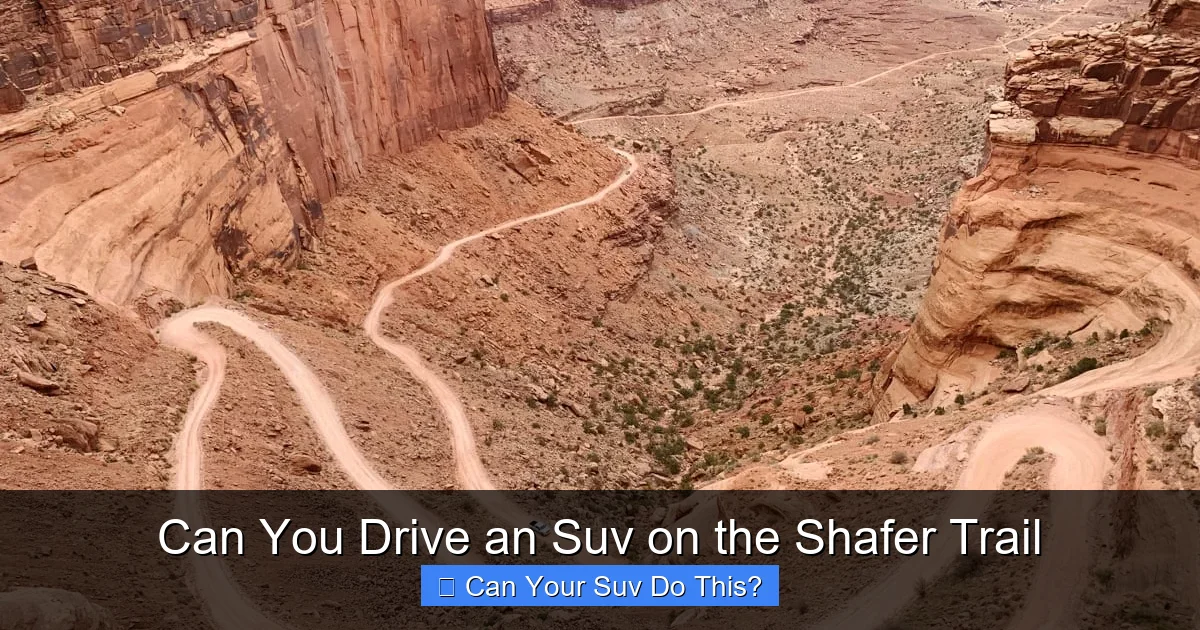
Visual guide about Can You Drive an Suv on the Shafer Trail
Image source: csginger.com
Now for the million-dollar question: Is your SUV up to the task? The answer depends on several factors—your vehicle’s make and model, its modifications, your driving experience, and the current trail conditions. Let’s break it down.
First, let’s clarify what we mean by “SUV.” In this context, we’re talking about true off-road-capable sport utility vehicles—not crossovers like the Honda CR-V or Toyota RAV4. While those vehicles are great for city driving and light trails, they lack the ground clearance, suspension travel, and four-wheel-drive systems needed for the Shafer Trail.
So, which SUVs can make it? Vehicles like the Jeep Wrangler Rubicon, Toyota 4Runner TRD Pro, Ford Bronco Badlands, and Land Rover Defender are strong candidates—but only if they’re properly equipped. A stock SUV, even a rugged one, will likely struggle or fail on this trail. Here’s what you need:
Essential Vehicle Modifications
To tackle the Shafer Trail safely, your SUV should have the following modifications:
– **High Ground Clearance:** At least 10 inches of clearance is recommended. The trail has deep ruts, rocks, and ledges that can high-center a low-slung vehicle.
– **Locking Differentials:** Front and rear lockers are ideal. They ensure power is distributed to all wheels, even if one or more lose traction.
– **Aggressive Off-Road Tires:** Mud-terrain or all-terrain tires with deep tread are a must. Stock highway tires will slip and fail on loose rock.
– **Skid Plates:** Protect your undercarriage from rocks and debris. The last thing you want is a punctured oil pan in the middle of nowhere.
– **Upgraded Suspension:** Long-travel shocks and reinforced springs help absorb impacts and maintain stability on uneven terrain.
– **Winch and Recovery Gear:** A front-mounted winch, recovery straps, and traction boards (like Maxtrax) are essential for self-recovery.
– **Low-Range 4WD:** Your SUV must have a two-speed transfer case with a low-range gear (usually 2.72:1 or lower). This gives you the torque needed for steep climbs and descents.
Even with these mods, some SUVs are better suited than others. For example, the Jeep Wrangler Rubicon comes factory-equipped with many of these features, making it a popular choice. The Toyota 4Runner TRD Pro offers excellent durability and off-road performance, though it may need additional skid plates and a winch. The Ford Bronco, especially in Sasquatch Package trim, is designed for exactly this kind of terrain.
Stock SUVs: A Risky Bet
If your SUV is stock—meaning it hasn’t been modified beyond factory specs—it’s probably not ready for the Shafer Trail. Many SUVs marketed as “off-road capable” are actually more suited for light trails and forest service roads. For example, a stock Jeep Grand Cherokee Trailhawk has decent ground clearance and all-wheel drive, but it lacks locking differentials and aggressive tires. It might make it down the trail, but the return trip—especially the steep ascent—could be disastrous.
Similarly, a stock Land Rover Discovery or Mercedes GLE may look tough, but their electronics and low-profile tires aren’t built for sustained off-road abuse. One misstep on a loose rock could result in a flat tire, a broken axle, or worse.
Real-World Examples
Let’s look at a few real-world scenarios:
– **Case 1:** A modified 2020 Jeep Wrangler Rubicon with 35-inch tires, front and rear lockers, and a winch successfully completed the Shafer Trail in both directions. The driver had over 10 years of off-road experience and took it slow, especially on the exposed sections.
– **Case 2:** A stock 2018 Toyota 4Runner TRD Off-Road attempted the trail but got stuck on a steep section due to lack of traction. The driver had to be winched out by a passing group. No damage occurred, but it was a close call.
– **Case 3:** A lifted Ford Bronco with 37-inch tires and a custom suspension rolled on a tight switchback due to overconfidence and poor line choice. The vehicle was totaled, and the driver was injured. Rescue took over 6 hours.
These examples show that even capable vehicles can fail without proper preparation and skill.
Driving Techniques for the Shafer Trail
Assuming your SUV is ready, the next challenge is driving it. The Shafer Trail demands precision, patience, and respect for the terrain. Here are some key techniques to keep in mind:
Mastering the Descent
The descent into the canyon is often the most intimidating part. The trail drops sharply, with grades up to 25%. Here’s how to handle it:
– **Use Low Range:** Shift into 4L (four-wheel-drive low) before you start down. This gives you maximum torque and engine braking.
– **Go Slow:** Speed is your enemy. Crawl down at 2–5 mph, using your brakes sparingly. Rely on engine braking to control your speed.
– **Pick Your Line:** Look ahead and choose the smoothest, most stable path. Avoid loose rocks and deep ruts. If you’re unsure, get out and walk the section first.
– **Stay Centered:** Keep your wheels on the high side of the trail to avoid sliding off the edge. Never stop on a steep grade unless absolutely necessary.
Navigating Switchbacks
The Shafer Trail is famous for its tight, exposed switchbacks. These turns require careful maneuvering:
– **Use Spotters:** Have someone outside the vehicle guide you through blind corners. Communication is key—use hand signals or a radio.
– **Turn Wide:** Approach the turn from the outside, then cut in sharply. This gives you more room and reduces the risk of going over the edge.
– **Don’t Overcorrect:** If you start to slide, ease off the throttle and steer into the slide. Jerky movements can cause loss of control.
Ascending the Trail
Climbing out of the canyon is even harder than going down. The loose rock and steep grades can cause wheels to spin and vehicles to roll back.
– **Momentum is Key:** Build a little speed before the climb, but not too much. You want enough to maintain traction without losing control.
– **Use Lockers:** Engage your front and rear lockers to ensure all wheels are driving. This prevents one wheel from spinning uselessly.
– **Stay in Gear:** Don’t shift gears mid-climb. Stay in low range and let the engine do the work.
Dealing with Emergencies
No matter how prepared you are, things can go wrong. Here’s how to handle common issues:
– **Flat Tire:** Carry a full-size spare and a high-lift jack. Practice changing a tire off-road before you go.
– **Stuck Vehicle:** Use your winch and recovery straps. If you don’t have a winch, traction boards can help you gain grip.
– **Overheating:** Desert temperatures can exceed 100°F. Monitor your engine temperature and carry extra coolant.
– **No Cell Service:** Always carry a satellite communicator (like a Garmin inReach) or a CB radio. Let someone know your plans and expected return time.
When and How to Attempt the Shafer Trail
Timing is everything when it comes to the Shafer Trail. The best times to go are spring (March to May) and fall (September to October). During these seasons, temperatures are mild, and the trail is usually dry and stable.
Avoiding the Worst Conditions
– **Summer:** Temperatures can soar above 100°F, increasing the risk of heatstroke and vehicle overheating. Afternoon thunderstorms can turn the trail into a muddy, slippery mess.
– **Winter:** Snow and ice make the trail extremely dangerous. Even with snow tires, the exposed sections are treacherous. Most experts recommend avoiding the trail from November to February.
– **After Rain:** Never drive the trail immediately after rain. The clay-rich soil turns to slick mud, and rocks become loose. Wait at least 48 hours after a storm.
Planning Your Trip
Before you go, do your homework:
– **Check Trail Conditions:** Visit the BLM Moab Field Office website or call their hotline for updates on trail status.
– **Get Permits:** While the trail itself doesn’t require a permit, access to certain areas (like the White Rim Road) may. Check with the National Park Service.
– **Travel in Groups:** Never go alone. A minimum of two vehicles is recommended, with at least one capable of towing or winching.
– **Pack Smart:** Bring plenty of water, food, first aid supplies, tools, and recovery gear. A full tank of gas is essential—there are no gas stations on the trail.
Guided Tours: A Safer Option
If you’re new to off-roading or unsure about your skills, consider joining a guided tour. Companies like Moab Tour Company, Red Rock 4×4, and Cliffhanger Guided Tours offer Shafer Trail excursions with experienced guides, well-maintained vehicles, and safety support.
Guided tours are especially helpful for first-timers. Guides know the best lines, can assist with recovery, and provide valuable tips on driving technique. Plus, they often include extras like lunch, photography stops, and historical insights.
Safety and Environmental Responsibility
The Shafer Trail isn’t just a test of your vehicle—it’s a test of your character. With great adventure comes great responsibility.
Safety First
– **Wear Seatbelts:** Even at low speeds, rollovers can happen. Always buckle up.
– **Stay with Your Vehicle:** If you break down, stay with your SUV. It’s easier for rescuers to find you.
– **Know Your Limits:** If a section looks too risky, turn around. Pride has no place on the trail.
– **Respect Others:** Yield to uphill traffic. Be courteous and share the trail.
Leave No Trace
The desert ecosystem is fragile. Follow these principles:
– **Pack It In, Pack It Out:** Carry all trash, including food wrappers and human waste (use a WAG bag if necessary).
– **Stay on the Trail:** Don’t cut switchbacks or drive off designated paths. This causes erosion and damages vegetation.
– **Minimize Campfires:** If you camp, use a stove instead of a fire. Fire scars can last for decades in the desert.
– **Protect Wildlife:** Observe animals from a distance. Don’t feed them or disturb their habitat.
Trail Etiquette
– **Communicate:** Use hand signals or radios to coordinate with other vehicles.
– **Be Prepared to Help:** If you see someone in trouble, offer assistance—within your limits.
– **Leave Gates as You Find Them:** Many trails have gates to control access. Don’t leave them open or closed incorrectly.
Conclusion: Is the Shafer Trail Right for You?
So, can you drive an SUV on the Shafer Trail? The answer is yes—if your vehicle is properly modified, you’re an experienced off-roader, and you respect the trail’s challenges and beauty.
This isn’t a trail for the faint of heart or the unprepared. It demands skill, preparation, and humility. But for those who are ready, the rewards are immense: unforgettable views, a sense of accomplishment, and the thrill of conquering one of the most iconic off-road routes in the world.
Before you go, ask yourself: Is my SUV ready? Am I ready? Do I have the right gear, the right attitude, and the right support? If the answer is yes, then gear up, stay safe, and enjoy the ride. The Shafer Trail is waiting.
Frequently Asked Questions
Can a stock SUV make it down the Shafer Trail?
It’s highly unlikely. Stock SUVs lack the ground clearance, locking differentials, and aggressive tires needed for the trail’s steep, rocky terrain. Even capable models like the 4Runner or Bronco need modifications to safely complete the route.
Do I need a permit to drive the Shafer Trail?
No permit is required for the trail itself, but access to connected routes like the White Rim Road in Canyonlands National Park may require a backcountry permit. Always check with the BLM or NPS before your trip.
What’s the best time of year to drive the Shafer Trail?
Spring (March–May) and fall (September–October) are ideal. Temperatures are mild, and the trail is usually dry. Avoid summer heat and winter snow, which make the trail more dangerous.
Can I drive the Shafer Trail alone?
It’s not recommended. Always travel with at least one other vehicle equipped for recovery. Cell service is nonexistent, and help can be hours away in an emergency.
What should I do if my SUV gets stuck on the trail?
Use your winch, recovery straps, and traction boards to free your vehicle. If you’re unable to recover, stay with your SUV and use a satellite communicator to call for help. Never abandon your vehicle in the desert.
Are there guided tours for the Shafer Trail?
Yes, several reputable companies offer guided tours, including Moab Tour Company and Red Rock 4×4. These tours provide experienced guides, safety support, and well-maintained vehicles—ideal for first-timers.