
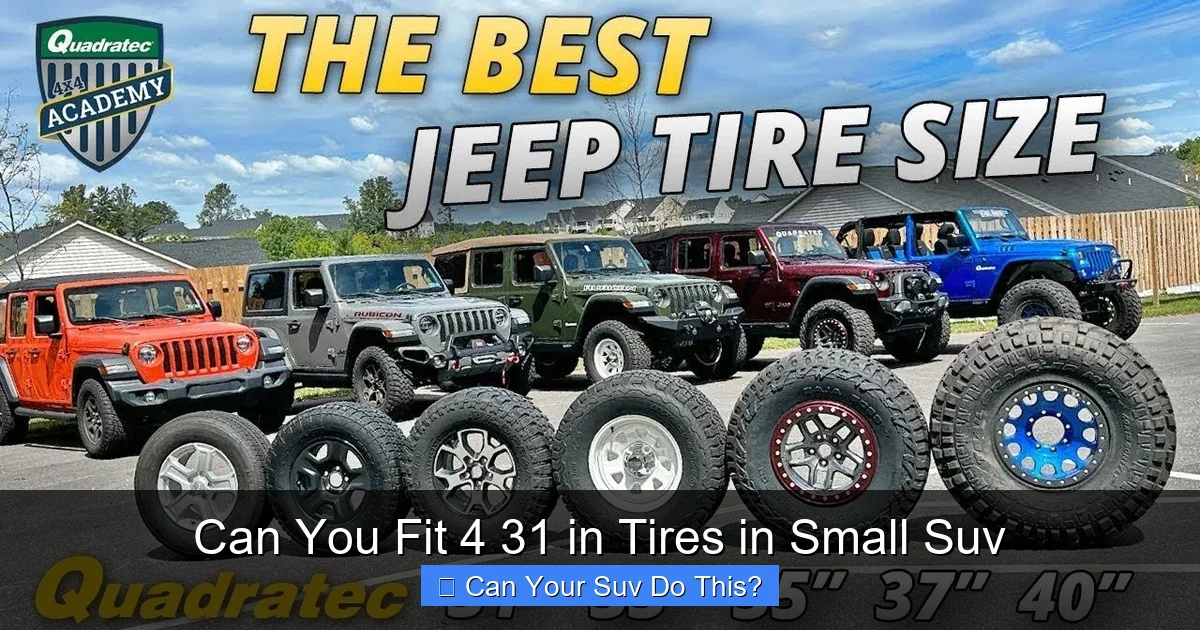
Fitting 4 31-inch tires in a small SUV is possible—but not always straightforward. It depends on your vehicle’s make, model, suspension setup, and modifications. With proper research and adjustments, many small SUVs can handle the upgrade, improving off-road performance and ground clearance.
[FEATURED_IMAGE_PLACEHODEL]
So, you’ve got a small SUV—maybe a Jeep Cherokee, a Subaru Forester, or even a Ford Escape—and you’re dreaming of bigger, beefier tires. Specifically, you’re wondering: *Can you fit 4 31-inch tires in a small SUV?* It’s a great question, and one that comes up a lot among off-road enthusiasts, weekend adventurers, and anyone who wants a more aggressive look and better performance from their ride.
The short answer? Yes, it’s often possible—but it’s not always plug-and-play. Unlike full-size trucks or large SUVs, small SUVs come with tighter packaging, lower ground clearance, and more limited suspension travel. That means fitting 31-inch tires (which are about 31 inches in diameter) requires careful planning, some research, and possibly a few modifications. But don’t let that scare you off. With the right approach, many compact and midsize SUVs can not only fit 31-inch tires but thrive with them.
In this guide, we’ll walk you through everything you need to know—from understanding tire sizing and vehicle compatibility to the modifications that make it work. We’ll look at real-world examples, talk about common pitfalls, and give you practical tips to make your upgrade safe, legal, and effective. Whether you’re aiming for better off-road traction, improved ride height, or just a more rugged appearance, this article will help you decide if your small SUV is ready for the big tires.
Key Takeaways
- Not all small SUVs can fit 31-inch tires without modifications: Stock suspension and wheel wells may not accommodate larger tires, especially on compact models like the Honda CR-V or Toyota RAV4.
- Lift kits and spacers are often necessary: Adding a 1.5 to 2-inch lift and wheel spacers can create the clearance needed for 31-inch tires to fit without rubbing.
- Tire width matters as much as diameter: A 31×10.50 tire may fit better than a 31×12.50 due to reduced sidewall bulge and less interference with fenders.
- Check for drivetrain and speedometer impacts: Larger tires can affect gearing, fuel economy, and speedometer accuracy—requiring recalibration.
- Popular small SUVs like the Jeep Cherokee and Subaru Forester can often handle 31s: These models have more robust suspension and aftermarket support, making upgrades easier.
- Professional installation and alignment are recommended: Improper fitment can lead to premature wear, handling issues, or damage to suspension components.
- Always test fit before finalizing: Mount one tire and rotate it through full steering and suspension travel to check for clearance issues.
📑 Table of Contents
- Understanding Tire Sizing: What Does “31-Inch” Really Mean?
- Which Small SUVs Can Handle 31-Inch Tires?
- Modifications Needed to Fit 31-Inch Tires
- Potential Issues and How to Avoid Them
- Real-World Examples: Success Stories and Lessons Learned
- Is It Worth It? Weighing the Pros and Cons
- Final Tips for a Successful Upgrade
- Conclusion
Understanding Tire Sizing: What Does “31-Inch” Really Mean?
Before we dive into whether your small SUV can handle 31-inch tires, let’s make sure we’re all on the same page about what that measurement actually means. When people say “31-inch tires,” they’re usually referring to the overall diameter of the tire—the distance from the ground, over the top, and back down to the ground again.
But tires aren’t just defined by diameter. They have three key dimensions: width, aspect ratio, and rim diameter. These are usually written in a format like **265/70R16** or **31×10.50R15**. Let’s break that down:
– **265** = tread width in millimeters (about 10.4 inches)
– **70** = aspect ratio (sidewall height is 70% of the tread width)
– **R16** = radial construction, fits a 16-inch rim
So a 265/70R16 tire has a calculated diameter of roughly 30.6 inches—close enough to be called a “31-inch” tire in casual conversation. Similarly, a 31×10.50R15 tire is 31 inches tall, 10.5 inches wide, and fits a 15-inch wheel.
Why does this matter? Because two tires labeled “31-inch” can actually have very different widths and sidewall profiles. A narrower 31-inch tire (like a 265/70R16) will be easier to fit in a small SUV than a wider one (like a 31×12.50R15), which has a much larger footprint and may rub against fenders or suspension components.
Why Tire Width and Sidewall Matter
When fitting larger tires, it’s not just about height—it’s also about how much space the tire takes up when it rotates. A wider tire has more surface area, which can lead to rubbing against the inner fender, control arms, or sway bars during full suspension compression or sharp turns.
For example, a 31×10.50R15 tire might fit fine on a lifted Jeep Cherokee, but a 31×12.50R15 could hit the frame or inner wheel well on the same vehicle. That’s why many enthusiasts opt for narrower 31-inch tires when upgrading small SUVs—they offer the height and look without the extra bulk.
Additionally, the sidewall profile (aspect ratio) affects how much the tire “bulges” outward. A lower aspect ratio (like 60 or 65) means a shorter, stiffer sidewall, which can help reduce flex and improve handling—but may also increase the risk of rubbing if not properly spaced.
Which Small SUVs Can Handle 31-Inch Tires?
Visual guide about Can You Fit 4 31 in Tires in Small Suv
Image source: tireer.com
Now that we understand tire sizing, let’s talk about which small SUVs are actually capable of fitting 31-inch tires. The answer varies widely depending on the make, model, and year of your vehicle. Some small SUVs are surprisingly capable, while others are better off sticking with stock or slightly larger tires.
Top Contenders: Small SUVs That Can Fit 31s
Here are a few popular small SUVs that are known to handle 31-inch tires—especially with minor modifications:
– **Jeep Cherokee (XJ and KL models):** The classic XJ Cherokee (1984–2001) is a favorite among off-roaders. With a 2-inch lift and minor trimming, it can easily fit 31-inch tires. The newer KL Cherokee (2014–present) is a bit tighter, but a 1.5 to 2-inch lift and aftermarket wheels with proper offset can make it work.
– **Subaru Forester (2009–2013 and newer):** The Forester has a reputation for being capable off-road. With a 1.5-inch lift kit and 31×10.50 tires, many owners report successful fitment with minimal rubbing. The 2014+ models have slightly more room, making them even better candidates.
– **Toyota RAV4 (3rd and 4th gen):** The third-generation RAV4 (2006–2012) can fit 31-inch tires with a 2-inch lift and wheel spacers. The fourth-gen (2013–2018) is a bit tighter, but still possible with careful selection of tire width and offset.
– **Honda CR-V (3rd and 4th gen):** The CR-V is more of a challenge. Stock, it can’t fit 31s without major modifications. But with a 2-inch lift, aftermarket wheels, and possibly some fender trimming, it’s doable—though not ideal for daily driving.
– **Ford Escape / Mazda Tribute:** These twins are less common for off-road builds, but with a lift and narrow 31-inch tires (like 265/70R16), some owners have made it work. Expect to do some fender work and possibly upgrade suspension components.
Vehicles That Struggle with 31-Inch Tires
Not all small SUVs are created equal. Some are simply too compact or have suspension designs that make 31-inch tires a stretch—literally. Here are a few that typically require significant work or aren’t recommended:
– **Nissan Rogue / X-Trail:** These crossovers have very tight wheel wells and low ground clearance. Even with a lift, fitting 31s often leads to constant rubbing and handling issues.
– **Hyundai Tucson / Kia Sportage:** Similar to the Rogue, these models are built for city driving, not off-roading. Suspension travel is limited, and fender clearance is minimal.
– **Chevrolet Equinox / GMC Terrain:** These are more truck-based than some others, but still have tight packaging. A 2-inch lift might help, but expect to trim fenders and possibly modify suspension mounts.
The key takeaway? Always research your specific model and year. Online forums, YouTube videos, and owner groups are goldmines of real-world experience. Someone has probably already tried what you’re thinking of—and can tell you exactly what worked (or didn’t).
Modifications Needed to Fit 31-Inch Tires
So, you’ve picked a capable small SUV. Now, how do you actually make 31-inch tires fit? The answer usually involves one or more of the following modifications:
Lift Kits: The Foundation of Fitment
A lift kit is often the first step in fitting larger tires. It raises the body or suspension, creating more space between the tire and the fender. For small SUVs, a 1.5 to 2-inch lift is usually sufficient for 31-inch tires.
There are two main types of lifts:
– **Body Lift:** Raises the body off the frame using spacers. It’s cheaper and easier but doesn’t improve suspension travel. Best for cosmetic lifts or when you only need a little extra height.
– **Suspension Lift:** Replaces or modifies suspension components (like struts, springs, or control arms) to raise the entire vehicle. This improves ground clearance and allows for better articulation—ideal for off-roading.
For most small SUVs aiming for 31-inch tires, a 2-inch suspension lift is the sweet spot. It provides enough clearance without requiring major drivetrain modifications.
Wheel Spacers and Offset Wheels
Even with a lift, the tire might still rub against the inner fender or suspension components. That’s where wheel spacers come in. These devices push the wheel outward, creating more clearance between the tire and the vehicle’s body.
Spacers typically add 0.5 to 2 inches of offset. For example, a 1.5-inch spacer on a stock wheel can move the tire out enough to prevent rubbing on a lifted Forester or Cherokee.
Alternatively, you can buy aftermarket wheels with a lower offset (measured in ET or backspacing). A lower offset means the wheel sits further outward, achieving the same effect as a spacer—but without adding extra hardware.
Just be cautious: spacers and low-offset wheels increase stress on wheel bearings and suspension joints. Always use high-quality components and have them installed by a professional.
Fender Trimming and Modifications
Sometimes, even with a lift and spacers, the tire still rubs during full suspension compression or sharp turns. In these cases, minor fender trimming may be necessary.
This involves cutting or rolling the inner fender liner and possibly the outer fender lip to create more room. It’s a common practice in the off-road community, but it’s not for the faint of heart. Once you cut metal, there’s no going back.
If you’re not comfortable with fabrication, consider using a fender flare kit. These bolt-on extensions widen the fender opening, giving you the look of a wider stance while providing extra clearance.
Suspension Upgrades for Better Performance
Fitting 31-inch tires isn’t just about clearance—it’s also about performance. Larger tires are heavier and can strain stock suspension components. Upgrading to heavy-duty shocks, springs, or control arms can improve ride quality, handling, and durability.
For example, a lifted Cherokee with 31-inch tires might benefit from longer shocks and adjustable control arms to maintain proper alignment and suspension geometry. Similarly, a Forester with upgraded struts and sway bars will handle better on and off-road.
Potential Issues and How to Avoid Them
While fitting 31-inch tires can be rewarding, it’s not without risks. Here are some common problems and how to avoid them:
Rubbing and Clearance Issues
The most obvious issue is tire rubbing. This happens when the tire contacts the fender, suspension, or frame during movement. It can cause premature tire wear, damage to body panels, or even blowouts in extreme cases.
To avoid rubbing:
– Always test fit one tire before installing all four.
– Rotate the steering lock-to-lock and compress the suspension to check for interference.
– Use a tire with a narrower width if space is tight.
Speedometer and Odometer Inaccuracy
Larger tires cover more ground per revolution, which means your speedometer will read slower than your actual speed. For example, with 31-inch tires instead of 28-inch stock tires, you might be going 65 mph when the speedo says 60.
This can lead to speeding tickets or incorrect odometer readings. To fix it, you’ll need to recalibrate your speedometer. Many modern vehicles allow this through the ECU or a tuning device. Older vehicles may require a gear change in the transmission or a recalibrated speed sensor.
Reduced Fuel Economy and Performance
Bigger, heavier tires increase rolling resistance and rotational mass. This can reduce fuel economy by 1–3 mpg and make the vehicle feel sluggish, especially during acceleration.
To minimize the impact:
– Choose lighter tires (look for “LT” or “P-metric” ratings).
– Avoid overly aggressive tread patterns unless you need them.
– Keep tires properly inflated.
Drivetrain Stress and Gear Ratio Mismatch
If your small SUV has a manual transmission or low-range transfer case, the larger tires can strain the drivetrain. The engine has to work harder to turn the tires, which can lead to overheating, premature wear, or even failure.
In extreme cases, you may need to re-gear the differentials to restore proper torque and performance. This is more common in serious off-road builds but worth considering if you plan to do heavy trail use.
Real-World Examples: Success Stories and Lessons Learned
Let’s look at a few real-world examples of small SUVs that successfully fit 31-inch tires—and what it took to make it happen.
Case Study: 2012 Jeep Cherokee KL with 31×10.50R15 Tires
Owner: Mike, off-road enthusiast
Modifications: 2-inch lift, 1.5-inch wheel spacers, aftermarket 15-inch wheels
Result: No rubbing, improved off-road capability, slight decrease in fuel economy
Mike’s Cherokee was stock when he bought it. After researching forums, he decided to go with 31×10.50R15 all-terrain tires. He installed a 2-inch suspension lift and added 1.5-inch spacers to push the wheels out. He also trimmed the rear fender liner slightly to prevent rubbing during full compression.
“It rides great now,” Mike says. “I can tackle trails I couldn’t before, and the look is exactly what I wanted. The only downside is I lost about 2 mpg, but it’s worth it for the capability.”
Case Study: 2015 Subaru Forester with 265/70R16 Tires
Owner: Sarah, weekend camper
Modifications: 1.5-inch lift, stock wheels with new tires
Result: Minimal rubbing, improved ground clearance, no major issues
Sarah wanted better clearance for forest roads but didn’t want to go full off-road. She found that 265/70R16 tires (about 30.6 inches tall) fit perfectly with just a 1.5-inch lift. She didn’t need spacers or trimming.
“I was nervous about modifying my Forester,” she says. “But the lift was easy to install, and the tires fit like a glove. I’ve driven thousands of miles with no problems.”
Lessons from Failures
Not every attempt is successful. Some owners try to fit 31-inch tires on vehicles like the Honda CR-V or Nissan Rogue without enough lift or proper wheels—and end up with constant rubbing, poor handling, or damaged components.
One common mistake is assuming all 31-inch tires are the same. A 31×12.50 tire on a lifted CR-V might rub the frame, while a 265/70R16 might fit fine. Always measure and test before committing.
Is It Worth It? Weighing the Pros and Cons
So, after all this, is fitting 4 31-inch tires in a small SUV worth it? The answer depends on your goals.
Pros
– Improved ground clearance for off-roading
– More aggressive, rugged appearance
– Better traction on loose or uneven terrain
– Enhanced capability for camping, overlanding, or trail driving
Cons
– Reduced fuel economy
– Potential for rubbing or clearance issues
– Higher cost for tires, lift kits, and modifications
– Possible need for speedometer recalibration
– Increased wear on suspension and drivetrain
If you’re using your small SUV for light off-roading, camping, or just want a more capable look, the upgrade can be very rewarding. But if you’re mostly driving in the city or on highways, the downsides might outweigh the benefits.
Final Tips for a Successful Upgrade
Before you start shopping for tires and lift kits, keep these tips in mind:
– **Research your specific vehicle:** Look for build threads, forums, and YouTube videos from owners who’ve done similar mods.
– **Start small:** Try a 1.5-inch lift and test fit one tire before going all-in.
– **Choose the right tire:** Narrower 31-inch tires (like 265/70R16) are easier to fit than wide ones.
– **Get professional help:** If you’re not confident in your mechanical skills, hire a shop experienced in off-road modifications.
– **Check local laws:** Some states have regulations on tire size, lift height, and fender coverage.
– **Budget for extras:** Include costs for alignment, speedometer recalibration, and potential repairs.
Conclusion
So, can you fit 4 31-inch tires in a small SUV? The answer is a cautious but optimistic *yes*—for many models, with the right modifications and careful planning. While not every small SUV is a natural candidate, vehicles like the Jeep Cherokee, Subaru Forester, and Toyota RAV4 can often handle the upgrade with a lift, spacers, and the right tire choice.
It’s not a decision to take lightly. You’ll need to weigh the benefits of improved capability and appearance against potential downsides like reduced fuel economy and added complexity. But for those who love adventure and want their small SUV to do more than just commute, fitting 31-inch tires can be a game-changer.
Just remember: do your homework, test fit before you commit, and don’t be afraid to ask for help. With the right approach, your small SUV can not only fit 31-inch tires—it can thrive with them.
Frequently Asked Questions
Can I fit 31-inch tires on a stock small SUV?
No, most small SUVs cannot fit 31-inch tires without modifications. Stock suspension and wheel wells are too tight. A lift kit and possibly wheel spacers are usually required.
Will 31-inch tires hurt my small SUV’s performance?
They can reduce fuel economy and make the vehicle feel slower due to increased weight and rolling resistance. However, proper gearing and tire choice can minimize these effects.
Do I need to recalibrate my speedometer after installing 31-inch tires?
Yes, larger tires change the distance traveled per revolution, making your speedometer read slower than actual speed. Recalibration ensures accuracy and avoids speeding tickets.
What’s the best tire size for a small SUV aiming for 31-inch height?
A narrower tire like 265/70R16 or 31×10.50R15 is often the best choice. These offer the height with less width, reducing the risk of rubbing.
Can I install 31-inch tires myself?
If you have mechanical experience, yes—but it’s recommended to have a professional handle the lift, alignment, and speedometer recalibration for safety and performance.
Are lift kits legal for street use?
In most states, yes, as long as the lift doesn’t exceed legal height limits (usually 2–4 inches) and the tires don’t protrude beyond the fenders. Check local regulations.