
Yes, you can fit a full keg into most SUVs—but it’s not as simple as just tossing it in the back. With the right preparation, vehicle choice, and safety precautions, transporting a full keg is totally doable for parties, events, or homebrew setups.
So, you’ve got a party coming up—maybe a backyard BBQ, a tailgate, or a wedding reception—and you’re thinking, “Can I just throw a full keg in my SUV and call it a day?” Great question. And the short answer? Yes, you probably can. But like most things in life, it’s not quite that simple.
SUVs are known for their versatility. They’re the Swiss Army knives of the automotive world—great for road trips, hauling gear, and yes, even transporting a full-sized keg of beer. But whether or not you can actually fit one depends on a few key factors: the size of your SUV, the type of keg, how you pack it, and how safely you secure it. Let’s break it all down so you can roll up to your next event with confidence—and a cold one ready to pour.
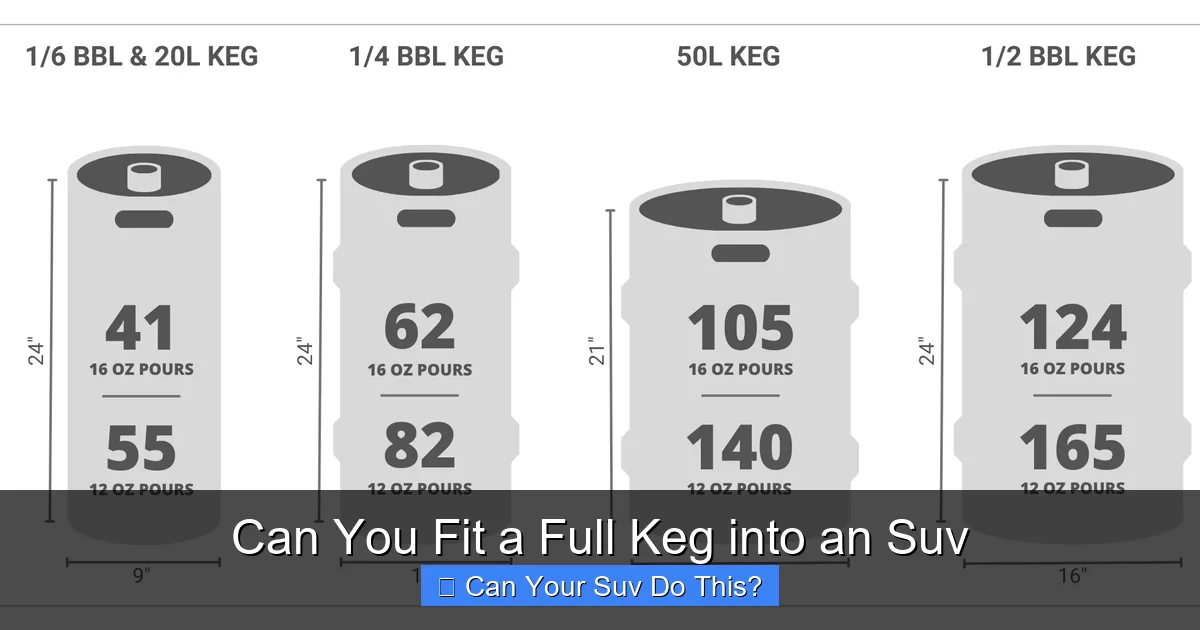
Before we dive in, let’s clarify what we mean by a “full keg.” We’re talking about the standard half-barrel keg, which holds about 15.5 gallons (or 1,984 ounces) of beer. That’s enough to fill roughly 165 twelve-ounce cups. It’s the most common size used at bars, restaurants, and large gatherings. There are smaller options like quarter-barrels (7.75 gallons) and sixth-barrels (5.16 gallons), but the half-barrel is the heavyweight champ—and the one most people are curious about fitting into their SUV.
Now, imagine this: you’re standing in the parking lot of your local liquor store or brewery, keg in hand (or on a dolly), staring at your SUV. The rear hatch is open. The seats are down. But is there really enough room? And more importantly—will it be safe? Let’s find out.
Key Takeaways
- Most midsize to large SUVs can fit a full keg when rear seats are folded down or removed, but compact SUVs may require creative packing.
- Weight matters—a full keg weighs 160–170 pounds, so secure it properly to avoid injury or damage during transit.
- Always transport kegs upright to prevent leaks, foaming, and damage to the tap system.
- Use non-slip mats, straps, or cargo nets to keep the keg from sliding around, especially during sudden stops or turns.
- Check local laws and brewery policies—some places restrict keg transport or require return deposits.
- Plan your route and parking—narrow streets, low bridges, or tight driveways can make delivery tricky.
- Consider a dolly or hand truck for easier loading and unloading, especially if you’re doing it solo.
📑 Table of Contents
Understanding Keg Sizes and Weights
Not all kegs are created equal. While the half-barrel is the standard, there are several other sizes you might encounter, each with different dimensions and weights. Knowing these details is crucial when planning your transport strategy.
Half-Barrel Keg (15.5 gallons)
This is the big one—the workhorse of the beer world. It measures approximately 23 inches in height and 16 inches in diameter. When full, it weighs between 160 and 170 pounds, depending on the type of beer and the keg material (stainless steel is heavier than aluminum). That’s roughly the weight of a large suitcase filled with bricks—definitely not something you want rolling around in your cargo area.
Quarter-Barrel Keg (7.75 gallons)
Also known as a “pony keg,” this smaller version is about 13.8 inches tall and 16 inches wide. It holds half the volume of a half-barrel and weighs around 87 pounds when full. It’s a popular choice for smaller gatherings and is much easier to handle and transport.
Sixth-Barrel Keg (5.16 gallons)
Sometimes called a “sixth” or “sixtel,” this keg is shorter and slimmer—about 19.5 inches tall and 9.5 inches in diameter. It weighs roughly 58 pounds when full and is ideal for home use or intimate parties. Its compact size makes it a breeze to fit into almost any SUV, even compact models.
Mini Kegs (1.32 gallons)
These are the small, portable kegs often sold in grocery stores. They’re about the size of a large milk jug and weigh around 14 pounds. While not “full” in the traditional sense, they’re worth mentioning because they’re so easy to transport—no SUV required.
Why does weight matter? Because a 170-pound keg can become a dangerous projectile if not secured properly. In a sudden stop or collision, an unsecured keg could slam into your back seats—or worse, through the front windshield. That’s why understanding the physical demands of keg transport is just as important as knowing whether it fits.
SUV Cargo Space: What You’re Working With

Visual guide about Can You Fit a Full Keg into an Suv
Image source: brewtogether.com
Now that we know what we’re hauling, let’s look at where we’re putting it. SUVs come in all shapes and sizes, from tiny crossovers to full-size beasts. The amount of cargo space varies widely, and that directly impacts your keg-carrying capability.
Compact SUVs (e.g., Honda CR-V, Toyota RAV4)
These are great for daily driving and light hauling, but they’re on the smaller side. With rear seats up, you’ll get about 30–35 cubic feet of cargo space. Fold the seats down, and you might reach 60–70 cubic feet. A half-barrel keg is about 3.2 cubic feet in volume, so space-wise, it should fit. But here’s the catch: the shape matters. The keg is tall and round, and compact SUVs often have sloped rear windows and limited floor length. You may need to angle it or remove the rear seats entirely to make it work.
Midsize SUVs (e.g., Ford Explorer, Hyundai Santa Fe)
These offer a sweet spot between size and practicality. With rear seats folded, you’re looking at 70–80 cubic feet of space. That’s plenty for a half-barrel keg, especially if you lay it on its side (more on that later). The wider wheelbase and longer cargo area make loading and securing the keg much easier.
Full-Size SUVs (e.g., Chevrolet Suburban, Ford Expedition)
If you’ve got one of these beasts, you’re in luck. These vehicles offer 90–140 cubic feet of cargo space with all seats down. You could fit multiple kegs, coolers, chairs, and a small sofa if you wanted. The Suburban, for example, has a flat load floor and plenty of tie-down points, making it ideal for heavy, bulky items like kegs.
Three-Row SUVs: To Fold or Not to Fold?
Many SUVs have third-row seating, which can be a blessing or a curse. If you need the seats for passengers, you’re limited to the cargo area behind the third row—usually just 10–15 cubic feet. That’s not enough for a half-barrel keg. But if you can fold or remove the third-row seats, you unlock a massive amount of space. Most modern SUVs allow you to fold the second and third rows flat, creating a nearly seamless cargo area.
Pro tip: Check your owner’s manual for seat-folding instructions. Some models require you to remove headrests or adjust seatbacks in a specific order. Do this ahead of time so you’re not fumbling at the liquor store.
How to Load a Keg Safely and Securely
Fitting a keg into your SUV is one thing. Doing it safely is another. A rolling keg can cause serious damage—to your vehicle, your back, or even other drivers. Here’s how to do it right.
Step 1: Prepare Your Vehicle
Clear out the cargo area. Remove any loose items that could shift during transit. Lay down a non-slip mat or rubber cargo liner to prevent the keg from sliding. If your SUV has carpet, consider using a tarp or moving blanket to protect it from condensation or leaks.
Step 2: Use a Dolly or Hand Truck
Kegs are heavy and awkward to carry. A keg dolly—a small wheeled platform with a strap—is a game-changer. It lets you roll the keg right up to your SUV and tilt it into the cargo area. If you don’t have a dolly, a standard hand truck (the kind movers use) works in a pinch. Just make sure the keg is strapped in securely.
Step 3: Load Upright (If Possible)
Always transport kegs upright. Laying them on their side can cause the beer to foam excessively when tapped, and it may damage the internal components. The keg’s design relies on gravity to keep the beer and gas separated. Tipping it disrupts that balance.
If your SUV is tall enough—like a full-size model with a high roof—you can load the keg standing up. Use the rear hatch or side doors to slide it in. Secure it with straps anchored to the cargo hooks.
Step 4: Secure It Properly
This is non-negotiable. Use ratchet straps, bungee cords, or cargo nets to tie the keg down. Anchor points are usually located in the cargo floor or along the sides. Loop the straps around the keg’s handles or through the opening where the tap connects. Tighten until the keg doesn’t move when you push it.
Never rely on just friction or gravity. Even a small bump can shift a 170-pound keg. And never place the keg on top of other items—it should sit directly on the floor.
Step 5: Drive Carefully
Once the keg is loaded, drive like you’re carrying a newborn. Avoid sudden stops, sharp turns, and potholes. The extra weight in the back can affect your SUV’s handling, especially if it’s not evenly distributed. If possible, place the keg near the rear axle for better balance.
Creative Solutions for Tight Spaces
What if your SUV is on the smaller side? Or what if you need to carry passengers and a keg at the same time? Don’t worry—there are workarounds.
Remove the Rear Seats
Some SUVs allow you to completely remove the second-row seats. This creates a flat, open space perfect for a keg. Check your owner’s manual—some models have quick-release mechanisms. Just remember: removing seats may affect your vehicle’s resale value or warranty, so proceed with caution.
Use the Front Passenger Footwell
In a pinch, you can place a smaller keg (like a sixth-barrel) in the front passenger footwell. It’s not ideal—passenger comfort takes a hit—but it works for short trips. Make sure the keg is secured and won’t roll into the pedals.
Roof Rack or Cargo Carrier
For the truly adventurous, a roof-mounted cargo box or basket can hold a keg. But this is risky. Kegs are heavy, and placing that much weight on the roof raises your SUV’s center of gravity, increasing the risk of rollover. Plus, you’ll need a ladder to load it. Only consider this if you have experience with roof racks and secure tie-downs.
Trailer or Utility Cart
If you’re transporting multiple kegs or don’t want to risk your SUV’s interior, a small trailer or utility cart is a smart investment. You can pull it behind your SUV and unload at your destination. Many breweries even offer keg delivery services—worth considering if you’re not confident in your hauling skills.
Legal and Practical Considerations
Before you load up and hit the road, there are a few legal and logistical things to keep in mind.
Keg Registration Laws
In some states, you’re required to register a keg with the alcohol control board. This usually involves providing your name, address, and the event details. The purpose is to track kegs and reduce underage drinking. Check your local laws—failure to register could result in fines.
Brewery Policies
Many breweries require a deposit when you rent or buy a keg. This deposit is refunded when you return the empty keg. Some also have rules about transport—like requiring a keg coupler or specific tap system. Ask about their policies before you leave.
Insurance and Liability
If you’re transporting a keg for a public event, check your homeowner’s or renter’s insurance. Some policies cover liability for alcohol-related incidents. If you’re hosting a large party, consider event insurance for extra protection.
Temperature Control
Beer should be kept cold—ideally between 38°F and 40°F. If you’re driving in hot weather, use insulated blankets or place the keg in a cooler with ice packs. Avoid leaving it in a hot SUV for extended periods, as heat can spoil the beer and increase pressure inside the keg.
Real-World Examples: Who’s Doing It?
Let’s look at a few real-life scenarios to see how people are making it work.
Tailgating with a Toyota Highlander
Mike, a college football fan, uses his 2020 Toyota Highlander to haul a half-barrel keg to every home game. He folds down the third-row seats, lays a rubber mat on the floor, and uses two ratchet straps to secure the keg upright. “It fits perfectly,” he says. “I even have room for coolers and chairs.”
Wedding Reception in a Honda CR-V
Sarah rented a sixth-barrel keg for her backyard wedding. Her CR-V’s rear seats were up, but she placed the keg in the footwell of the front passenger seat, secured with a bungee cord. “It was tight, but it worked,” she laughs. “Just don’t let the bridesmaids sit there.”
Homebrew Delivery with a Ford F-150
While not an SUV, Jake’s pickup truck shows how versatile keg transport can be. He uses a keg dolly to roll it into the bed, then covers it with a tarp. “Easier than an SUV,” he says. “No folding seats, no tight spaces.”
These stories prove that with a little planning, almost any vehicle can handle a keg—even if it’s not the most glamorous part of the party.
Final Tips and Pro Advice
Before we wrap up, here are a few final tips from the pros:
- Label the keg with your name and event date. This helps with returns and prevents mix-ups.
- Bring a keg coupler and tap if the brewery doesn’t provide one. You’ll need it to pour the beer.
- Use a keg jacket—an insulated cover that keeps the beer cold and protects the keg during transport.
- Don’t overfill the cargo area. Leave space for other essentials like ice, cups, and food.
- Practice loading and unloading before the big day. You don’t want to be figuring it out in the rain at 9 p.m.
Transporting a full keg in an SUV isn’t just possible—it’s practical, with the right approach. Whether you’re a weekend warrior or a seasoned party planner, knowing how to safely and efficiently haul your beer can make all the difference.
So next time someone asks, “Can you fit a full keg into an SUV?” you can smile, nod, and say, “Absolutely—and here’s how.”
Frequently Asked Questions
Can I lay a keg on its side in my SUV?
It’s not recommended. Laying a keg on its side can cause excessive foaming when tapped and may damage the internal components. Always transport kegs upright to maintain proper pressure and beer quality.
Will a half-barrel keg fit in a compact SUV?
It might, but it depends on the model. With rear seats folded, some compact SUVs can accommodate a half-barrel keg, but you may need to angle it or remove seats. A sixth-barrel keg is a safer bet for smaller vehicles.
How do I keep the keg from sliding around?
Use non-slip mats, ratchet straps, or cargo nets anchored to your SUV’s tie-down points. Never rely on just placing it in the cargo area—secure it firmly to prevent movement during transit.
Can I transport a keg with passengers in the car?
Yes, but only if there’s enough space and the keg is secured properly. Avoid placing it in passenger footwells unless absolutely necessary, and never let it block airbags or emergency exits.
Do I need a special permit to transport a keg?
In most places, no—but some states require keg registration for events. Check your local alcohol control board for specific rules, especially if you’re hosting a public gathering.
What’s the best way to unload a keg from an SUV?
Use a keg dolly or hand truck to roll it out. Have someone assist you if possible, and always lift with your legs—not your back. Never drag the keg, as it can damage the floor or the keg itself.