
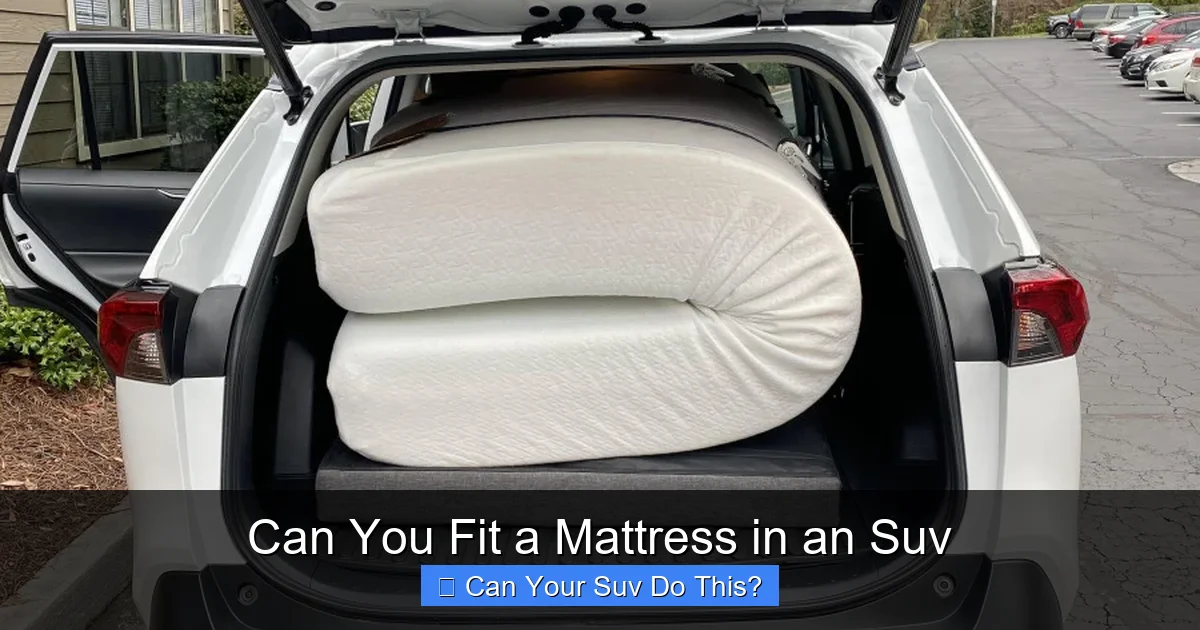
Yes, you can fit a mattress in an SUV—but it depends on the mattress size, SUV model, and how you configure the interior. With smart folding, roof racks, or trailer options, even a king-size mattress can make the trip.
So, you’ve just bought a new mattress—congrats! But now comes the real challenge: how on earth are you going to get it home? If you’re driving an SUV, you’re in luck. SUVs are known for their spacious interiors and versatile cargo areas, making them one of the best vehicle types for hauling large items like mattresses. But can you actually fit a mattress in an SUV? The short answer is: yes, most of the time. The long answer? It depends on a few key factors—like the size of your mattress, the type of SUV you drive, and how willing you are to get creative with folding, angling, or even strapping things to the roof.
Let’s be real—nobody wants to make multiple trips or risk damaging their new mattress by dragging it through the rain. And while delivery services are convenient, sometimes you just want to do it yourself. Maybe you’re moving on a tight budget, or perhaps you’re picking up a gently used mattress from a friend. Whatever the reason, knowing how to transport a mattress in your SUV can save you time, money, and stress. In this guide, we’ll walk you through everything you need to know—from measuring your space to securing your load—so you can get that mattress home safely and efficiently.
Whether you drive a compact crossover like a Honda CR-V or a full-size beast like a Chevrolet Suburban, we’ve got tips tailored to your ride. We’ll cover different mattress types, SUV configurations, and even alternative transport methods like roof racks and trailers. By the end, you’ll feel confident tackling this common moving challenge like a pro.
Key Takeaways
- Most SUVs can fit a twin or full mattress with seats folded down. Compact and midsize SUVs often accommodate these sizes without extra gear.
- Queen and king mattresses require more planning. You may need to fold seats, angle the mattress, or use a roof rack for longer models.
- Foldable or memory foam mattresses are easier to transport. These compress well and fit in tighter spaces than traditional spring mattresses.
- Roof racks and cargo carriers expand your options. If the mattress doesn’t fit inside, secure it safely on top using straps and protective covers.
- Always measure your SUV’s cargo area and the mattress beforehand. Knowing exact dimensions prevents last-minute surprises.
- Use moving blankets and tie-downs for safety. Protect both your mattress and your vehicle during transport.
- Some SUVs have hidden storage or adjustable floors. Check your owner’s manual for clever cargo solutions.
📑 Table of Contents
Understanding Mattress Sizes and SUV Cargo Space
Before you even think about loading that mattress into your SUV, it’s crucial to understand the dimensions you’re working with. Mattresses come in standard sizes, but not all SUVs are created equal when it comes to cargo space. Let’s break it down.
Standard Mattress Dimensions
Mattresses are available in several standard sizes, each with specific length and width measurements. Here’s a quick rundown:
– Twin: 38” x 75” – Great for kids’ rooms or small spaces.
– Twin XL: 38” x 80” – Slightly longer than a twin, often used in college dorms.
– Full (Double): 54” x 75” – A popular choice for single adults or couples in tighter spaces.
– Queen: 60” x 80” – The most common size for master bedrooms.
– King: 76” x 80” – Offers plenty of space for couples or families.
– California King: 72” x 84” – Longer and narrower than a standard king.
Knowing these dimensions helps you assess whether your mattress will fit inside your SUV—or if you’ll need to get creative.
Measuring Your SUV’s Cargo Area
Every SUV has a different cargo capacity, and even within the same model, configurations can vary based on seat settings and optional features. To determine if your mattress will fit, you’ll need to measure the cargo area with the rear seats folded down.
Start by folding down the second-row seats (and third row, if applicable). Use a tape measure to check the length from the back of the front seats to the tailgate, the width between the wheel wells, and the height from the floor to the ceiling. Most SUVs list cargo volume in cubic feet in the owner’s manual or on the manufacturer’s website, but real-world space can differ—especially if you have bulky seat mechanisms or a sloped roofline.
For example:
– A Honda CR-V offers about 39.2 cubic feet behind the second row and up to 75.8 cubic feet with seats folded.
– A Toyota RAV4 provides around 37.5 cubic feet behind the rear seats and 69.8 cubic feet with them down.
– A Ford Explorer boasts up to 87.8 cubic feet with both rear rows folded.
– A Chevrolet Tahoe can offer over 120 cubic feet in maximum configuration.
These numbers give you a rough idea, but always measure your specific vehicle. Wheel wells, seat contours, and cargo covers can reduce usable space.
Comparing Mattress Size to SUV Capacity
Now, let’s match mattress sizes to typical SUV capabilities:
– Twin and Twin XL: These are the easiest to fit. Most compact SUVs can handle them with ease, even with passengers in the back seat.
– Full: Still manageable in most SUVs. You’ll likely need to fold down the rear seats, but it should fit flat or at a slight angle.
– Queen: This is where things get interesting. In smaller SUVs like the CR-V or RAV4, a queen mattress may not lie flat. You might need to angle it diagonally or let one end stick out slightly (more on that later).
– King and California King: These are the real challenge. In most standard SUVs, they won’t fit inside without modification. You’ll likely need to use the roof or a trailer.
Keep in mind that thickness matters too. A 12-inch memory foam mattress takes up more vertical space than a 6-inch innerspring. So even if the length and width seem okay, the height could be an issue in SUVs with low rooflines.
Types of Mattresses and Their Transportability

Visual guide about Can You Fit a Mattress in an Suv
Image source: mobileabode.net
Not all mattresses are created equal—especially when it comes to transport. The type of mattress you’re moving can make a big difference in how easily it fits in your SUV.
Traditional Innerspring Mattresses
These are the most common mattresses on the market. They’re firm, supportive, and typically 8–12 inches thick. The downside? They’re rigid and don’t compress well. This makes them harder to fit into tight spaces or angle through doors.
If you’re transporting an innerspring mattress, you’ll need to rely on the full cargo length of your SUV. They’re best suited for larger SUVs or when using a roof rack.
Memory Foam and Latex Mattresses
Memory foam and latex mattresses are more flexible than innerspring models. Many are designed to be rolled or compressed for shipping—especially bed-in-a-box brands like Casper, Purple, or Tuft & Needle. This makes them ideal for SUV transport.
If your mattress comes rolled in a box, you can often fit it in even a compact SUV without folding down any seats. Once unrolled, it expands to full size. Just be sure to let it air out for a few hours before use.
Hybrid Mattresses
Hybrid mattresses combine innerspring coils with foam or latex layers. They offer the support of springs with the comfort of foam. However, they’re usually thicker and less compressible than all-foam models. Transportability depends on the specific design—some can be rolled, while others cannot.
Folding or Tri-Fold Mattresses
These are specialty mattresses designed for easy storage and transport. They fold into thirds like a futon and are often used for guests or camping. If you’re buying one of these, you’ll have no trouble fitting it in any SUV—even with the seats up.
Air Mattresses
While not a permanent sleeping solution, air mattresses are incredibly portable. Deflated, they take up almost no space. Inflated, they’re bulky but flexible. You can often fit an air mattress in a compact SUV with room to spare.
How to Fit a Mattress in Different SUV Sizes
Now that you know your mattress type and SUV dimensions, let’s talk strategy. The approach you take will depend on your vehicle’s size and layout.
Compact and Midsize SUVs (e.g., Honda CR-V, Toyota RAV4, Ford Escape)
These SUVs are great for daily driving and light hauling, but their cargo space is limited. Here’s how to make it work:
– Twin and Full Mattresses: Fold down the rear seats and lay the mattress flat. It should fit with room to spare.
– Queen Mattress: You’ll likely need to angle it diagonally from the rear passenger door to the front driver’s side. This uses the full length and width of the cargo area. Alternatively, let one end extend slightly out the tailgate—just secure it well.
– King Mattress: Not recommended for inside transport. Use a roof rack or consider a trailer.
Pro tip: Remove headrests from the front seats to create more clearance. Also, slide the front seats forward to maximize rear cargo length.
Large SUVs (e.g., Ford Explorer, Chevrolet Traverse, Toyota Highlander)
These three-row SUVs offer more flexibility. With the third row folded, you gain significant cargo space.
– Queen Mattress: Should fit flat with the second and third rows folded.
– King Mattress: May fit diagonally or with one end sticking out. In some models, like the Traverse, it can lie flat if you remove the second-row seats (not recommended unless you’re experienced).
– California King: Likely too long for most large SUVs. Roof transport is your best bet.
Bonus: Some large SUVs have adjustable cargo floors or under-floor storage. Check your owner’s manual for hidden compartments that might help organize smaller items.
Full-Size SUVs (e.g., Chevrolet Suburban, Ford Expedition, GMC Yukon)
These are the heavyweights of the SUV world. With all seats folded, they offer van-like space.
– Queen and King Mattresses: Should fit flat with ease.
– California King: May fit diagonally or with minor overhang.
– Multiple Mattresses: You could even transport two full-size mattresses at once.
These vehicles often have power-folding seats and wide rear openings, making loading a breeze. Just be mindful of weight distribution—don’t overload one side.
Creative Solutions for Tight Spaces
Sometimes, even with careful planning, your mattress just won’t fit inside. Don’t panic—there are several creative solutions to get it home safely.
Using the Roof Rack
If your SUV has a roof rack or crossbars, you can strap the mattress to the roof. This is a common method for transporting large items like kayaks or lumber.
Steps to roof-mount a mattress:
1. Wrap the mattress in a waterproof moving blanket or plastic wrap to protect it from dirt and rain.
2. Place it flat on the roof, centered over the crossbars.
3. Use ratchet straps or bungee cords to secure it tightly. Loop the straps through the crossbars and around the mattress.
4. Double-check all connections before driving. Give the mattress a firm tug to ensure it’s secure.
5. Drive slowly and avoid high speeds or sudden maneuvers.
Safety tip: Never exceed your vehicle’s roof load limit (usually 100–165 lbs). A standard mattress weighs 50–100 lbs, so you’re usually safe—but check your owner’s manual.
Using a Trailer or Cargo Carrier
If you frequently transport large items, consider investing in a small utility trailer or hitch-mounted cargo carrier. These attach to your SUV’s trailer hitch and provide a flat, secure platform.
Trailers are ideal for king or California king mattresses. They keep the mattress off the roof and reduce wind resistance. Plus, you can load other items alongside it.
Cargo carriers are smaller and sit behind the vehicle. They’re great for lighter loads but may not support a full mattress unless it’s folded or rolled.
Folding or Rolling the Mattress
If your mattress is compressible (like memory foam), ask the retailer if they can roll it for you. Many bed-in-a-box companies do this automatically.
Once rolled, the mattress becomes a long, narrow cylinder that fits easily in most SUVs—even with the seats up. Just secure it with straps to prevent unrolling during transit.
For non-compressible mattresses, folding isn’t recommended. It can damage the internal structure and void warranties.
Partial Overhang Strategy
If your mattress is just a few inches too long, you can let one end extend slightly out the tailgate. This works best for queen mattresses in midsize SUVs.
To do this safely:
– Fold down the rear seats.
– Angle the mattress so the front end reaches the back of the front seats.
– Let the rear end extend 6–12 inches out the back.
– Use a red flag or reflective tape to make the overhang visible to other drivers.
– Secure the mattress with straps through the rear door openings.
Never let more than 1/3 of the mattress hang out. And always drive cautiously—avoid highways if possible.
Safety Tips for Transporting a Mattress
Transporting a mattress isn’t just about fitting it in—it’s about doing it safely. A loose or poorly secured mattress can become a dangerous projectile in a sudden stop or accident.
Use Proper Tie-Downs
Always use ratchet straps or heavy-duty bungee cords to secure the mattress. Avoid using rope or twine—they can snap under tension.
Anchor the straps to sturdy points like seat anchors, cargo hooks, or roof crossbars. Never tie them to door handles or mirrors.
Protect the Mattress and Your Vehicle
Use moving blankets or thick towels to protect the mattress from scratches and your SUV’s interior from dirt. If transporting on the roof, wrap the mattress in plastic or a tarp to keep it dry.
Inside the vehicle, lay down a tarp or old sheet to catch any dust or debris.
Check Local Laws
Some states have regulations about how far an item can extend beyond a vehicle. For example, California allows up to 4 feet of overhang if marked with a red flag. Check your local DMV website for rules.
Also, ensure your license plate and taillights are visible at all times.
Drive Cautiously
A mattress on the roof increases wind resistance and can affect handling. Drive slower than usual, especially on highways or in windy conditions.
Avoid sudden braking or sharp turns. If possible, take back roads or less busy routes.
Real-World Examples and Tips from SUV Owners
Still unsure? Let’s look at some real-life scenarios from SUV owners who’ve been there.
Case Study: Fitting a Queen Mattress in a Honda CR-V
Sarah, a CR-V owner, needed to transport a queen mattress from IKEA. She folded down the rear seats and angled the mattress diagonally from the rear passenger door to the front driver’s seat. It stuck out about 8 inches, so she used a red flag and secured it with two ratchet straps. She drove slowly and made it home without issues.
Case Study: Roof-Mounting a King Mattress on a Ford Explorer
Mike used his Explorer’s roof rack to transport a king mattress. He wrapped it in plastic, placed it flat on the crossbars, and secured it with four straps. He drove at 55 mph on the highway and arrived safely. “It looked funny,” he said, “but it worked.”
Pro Tips from Experienced Movers
– Go early or late: Avoid rush hour to reduce stress and traffic.
– Bring a friend: An extra set of hands makes loading and securing much easier.
– Use a mattress bag: Many retailers sell reusable mattress bags designed for transport.
– Check the weather: Avoid transporting in rain or snow unless absolutely necessary.
– Test the fit first: If possible, measure the mattress at the store before buying.
Conclusion
So, can you fit a mattress in an SUV? Absolutely—with the right preparation and a little creativity. Whether you’re driving a compact crossover or a full-size SUV, there’s a solution that will work for your mattress size and vehicle type.
Start by measuring both your mattress and your SUV’s cargo area. Choose the right transport method based on size: fold down seats for smaller mattresses, use the roof for larger ones, or consider a trailer for frequent hauling. Always prioritize safety by using proper tie-downs, protective covers, and cautious driving.
Remember, not all mattresses are equally portable. Memory foam and hybrid models offer more flexibility, while traditional innerspring mattresses require more space. And if you’re buying new, consider a bed-in-a-box option that arrives compressed and easy to transport.
With these tips, you’ll be able to move your mattress like a pro—no delivery fee required. Your SUV isn’t just for groceries and road trips. It’s a versatile tool that can handle everything from furniture to family adventures. So the next time you’re faced with a mattress-moving dilemma, don’t stress. You’ve got this.
Frequently Asked Questions
Can you fit a king mattress in a Honda CR-V?
It’s unlikely a king mattress will fit inside a Honda CR-V without extending out the back or using the roof. The CR-V’s cargo space is too small for a 76” x 80” mattress to lie flat. Consider using a roof rack or a trailer instead.
Do I need a permit to transport a mattress on my SUV’s roof?
Generally, no permit is required for a mattress on a roof rack as long as it’s securely fastened and doesn’t obstruct your view or lights. However, check local laws—some states have specific rules about overhang length and visibility.
Can I transport a mattress with passengers in the back seat?
Yes, for smaller mattresses like twin or full, you can often keep the rear seats up and place the mattress on top or beside passengers. For larger mattresses, you’ll likely need to fold the seats down, which may limit passenger space.
Will folding a mattress damage it?
Folding a traditional innerspring mattress can damage the coils and void the warranty. Memory foam and hybrid mattresses designed to be rolled are safer to compress. Always check the manufacturer’s guidelines before folding.
How do I keep my mattress clean during transport?
Use a mattress bag or wrap it in plastic and moving blankets. If transporting on the roof, secure a tarp over it to protect against rain, dirt, and road debris. Avoid placing it directly on dirty surfaces.
What’s the best way to secure a mattress on a roof rack?
Use ratchet straps or heavy-duty bungee cords anchored to the crossbars. Wrap the mattress in a protective cover, center it on the roof, and tighten the straps evenly. Double-check all connections before driving and re-tighten after a few miles.