
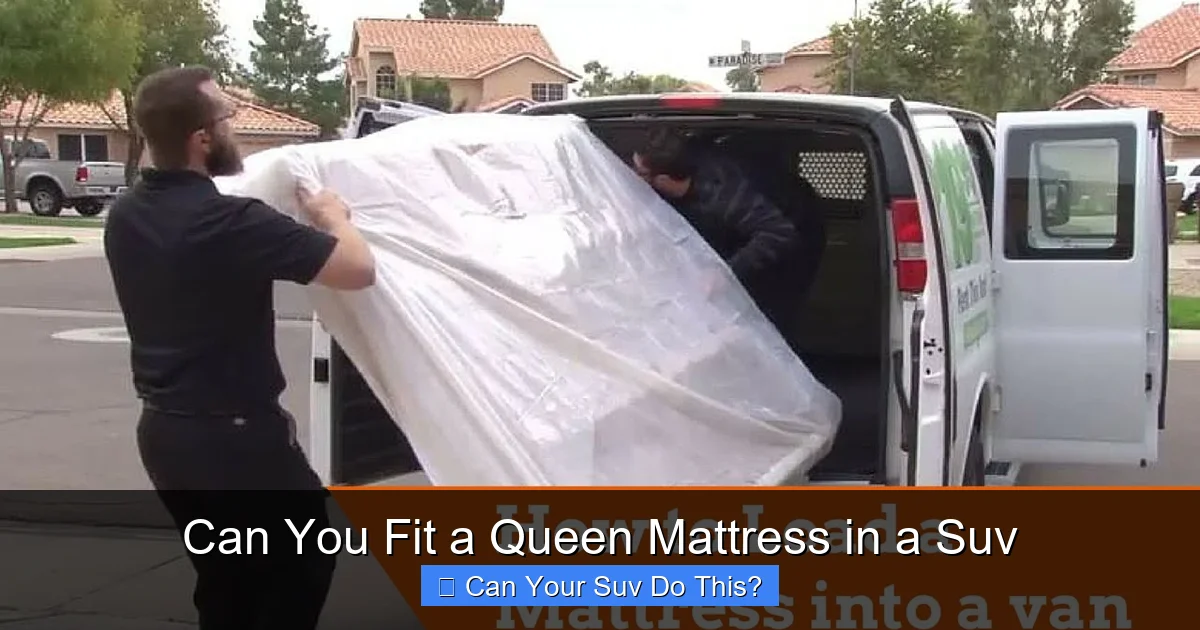
Yes, you can fit a queen mattress in many SUVs—but it depends on the vehicle, mattress type, and how you configure the interior. With the right preparation, folding techniques, and sometimes removing doors or seats, even compact SUVs can handle this surprisingly common moving challenge.
So, you’ve just bought a brand-new queen mattress—or maybe you’re helping a friend move—and now you’re staring at your SUV, wondering: *Can you fit a queen mattress in a SUV?* It’s a surprisingly common question, and the short answer is: **yes, you probably can**. But like most things in life, it’s not quite that simple.
The real answer depends on several factors: the size and layout of your SUV, the type of mattress you’re transporting, how much you’re willing to modify your vehicle’s interior, and even the weather conditions on moving day. While a queen mattress measures roughly 60 inches wide by 80 inches long (that’s 5 feet by 6.7 feet), SUVs vary widely in cargo capacity. Some can swallow it whole with room to spare; others will require some clever maneuvering—or even a bit of DIY problem-solving.
But don’t worry. Whether you’re driving a compact crossover or a full-size family hauler, this guide will walk you through everything you need to know to get that mattress home safely, securely, and without damaging your vehicle—or your back. We’ll cover which SUVs are best suited for the job, how to prepare your mattress and vehicle, practical loading techniques, and pro tips to make the process as smooth as possible. By the end, you’ll know exactly whether your SUV can handle the task—and how to do it like a pro.
Key Takeaways
- Most midsize to full-size SUVs can fit a queen mattress: Vehicles like the Honda CR-V, Toyota RAV4, Ford Explorer, and Chevrolet Tahoe have enough cargo space when rear seats are folded or removed.
- Compact SUVs may require creative solutions: Smaller models like the Nissan Rogue or Mazda CX-5 might need the mattress angled, windows down, or doors removed to accommodate the length.
- Mattress type matters: A traditional innerspring queen mattress is rigid and harder to maneuver, while a memory foam or hybrid mattress can be compressed or rolled for easier transport.
- Proper securing is essential: Always use ratchet straps, bungee cords, or rope to anchor the mattress so it doesn’t shift during transit—this prevents damage and ensures safety.
- Weather protection is a must: Use a mattress bag or heavy-duty plastic wrap to shield your mattress from rain, dirt, and road debris during transport.
- Check local laws: Some states regulate how far cargo can extend beyond your vehicle; exceeding limits may result in fines or safety hazards.
- Practice loading beforehand: Do a dry run with cardboard or a blanket to test fit and refine your approach before moving the actual mattress.
📑 Table of Contents
Understanding Queen Mattress Dimensions and SUV Cargo Space
Before we dive into the nitty-gritty of loading and securing, let’s get familiar with the key players in this equation: the mattress and the SUV.
A standard queen mattress is 60 inches wide, 80 inches long, and typically 8 to 14 inches thick, depending on the model and materials. That’s a substantial piece of cargo—larger than many people realize. To put it in perspective, that’s longer than the average adult is tall. Now, compare that to the cargo space of your SUV.
SUVs come in a range of sizes, from subcompact models like the Hyundai Kona to full-size beasts like the Ford Expedition. Cargo volume—measured in cubic feet with rear seats up or down—varies dramatically. For example:
– A compact SUV like the Honda CR-V offers about 39 cubic feet behind the rear seats and up to 75 cubic feet with the seats folded.
– A midsize SUV like the Toyota Highlander provides around 48 cubic feet behind the third row and up to 84 cubic feet with all rear seats down.
– A full-size SUV like the Chevrolet Suburban boasts a staggering 144 cubic feet of maximum cargo space.
But cubic feet alone don’t tell the whole story. You also need to consider the **length, width, and height** of the cargo area, as well as the shape of the opening (tailgate height and width), the presence of headrests, and whether the rear seats fold flat.
For instance, even if an SUV has enough volume, a narrow tailgate or high floor might prevent a long mattress from fitting diagonally. That’s why it’s crucial to measure your specific vehicle’s cargo dimensions—not just rely on manufacturer specs.
Measuring Your SUV’s Cargo Area
To determine if your SUV can fit a queen mattress, grab a tape measure and check these key dimensions:
– **Cargo length**: Measure from the back of the front seats (or dashboard if seats are removed) to the inside of the tailgate when closed.
– **Cargo width**: Measure the narrowest point between the wheel wells or interior panels.
– **Cargo height**: Measure from the floor to the ceiling with the rear seats folded.
– **Tailgate opening**: Check the height and width of the opening—this is often the limiting factor.
For most midsize and larger SUVs, the cargo length with rear seats folded is between 60 and 80 inches—right in the ballpark of a queen mattress. But remember: the mattress is 80 inches long, so you’ll likely need to angle it or extend it slightly beyond the vehicle unless you have a very long cargo area.
Queen Mattress Types and Their Impact on Fit
Not all queen mattresses are created equal—and that affects how easily they’ll fit in your SUV.
– **Innerspring mattresses**: These are the most traditional and rigid. They don’t bend or compress, making them the hardest to fit in tight spaces. If your SUV has a short cargo area, an innerspring queen mattress may not fit without extending beyond the vehicle.
– **Memory foam mattresses**: These are more flexible and can often be compressed or rolled (especially if they’re delivered in a box). Many memory foam mattresses come vacuum-sealed and rolled, making them easy to transport—even in smaller SUVs. Once unrolled at your destination, they expand to full size.
– **Hybrid mattresses**: These combine innerspring coils with foam layers. They’re more flexible than pure innerspring but less so than memory foam. Some hybrids can be rolled, but it depends on the brand and construction.
– **Latex mattresses**: Typically firmer and less compressible, latex mattresses are harder to bend or roll. They’re best transported flat.
If you’re buying a new mattress, consider opting for a rollable model—especially if you’re driving a compact SUV. Many online mattress companies (like Casper, Purple, or Tuft & Needle) offer compressed, boxed mattresses that are ideal for SUV transport.
Which SUVs Can Fit a Queen Mattress?

Visual guide about Can You Fit a Queen Mattress in a Suv
Image source: theoutcamp.com
Now that we understand the dimensions and variables, let’s look at real-world examples. Which SUVs are most likely to fit a queen mattress—and which ones might give you trouble?
Compact SUVs: Possible, But Tricky
Compact SUVs like the Honda CR-V, Toyota RAV4, Nissan Rogue, and Mazda CX-5 are popular for their fuel efficiency and maneuverability. But their cargo space is limited.
– **Honda CR-V**: With rear seats folded, cargo length is about 70 inches—short of the 80-inch mattress. You’ll likely need to angle the mattress diagonally or extend it slightly beyond the tailgate. Some owners report success by removing the rear headrests and tilting the front passenger seat forward.
– **Toyota RAV4**: Similar to the CR-V, the RAV4 has around 69 inches of cargo length. Again, diagonal loading or partial overhang may be necessary.
– **Nissan Rogue**: Cargo length is about 68 inches. You might need to remove the rear seats entirely or use a roof rack (more on that later).
– **Mazda CX-5**: Slightly shorter at 66 inches. Fitting a queen mattress will require creative positioning—possibly with the front passenger seat removed or the mattress extending out the side window.
In these vehicles, success often comes down to **angles, seat removal, and patience**. It’s not impossible, but it’s not a straightforward drop-in either.
Midsize SUVs: The Sweet Spot
Midsize SUVs like the Toyota Highlander, Ford Explorer, Hyundai Santa Fe, and Kia Sorento offer a better balance of space and practicality.
– **Toyota Highlander**: With all rear seats folded, cargo length reaches about 78 inches—just 2 inches short of a queen mattress. Many owners report fitting a queen mattress by angling it slightly or using the third-row footwell.
– **Ford Explorer**: Cargo length is around 80 inches with seats folded—perfect for a queen mattress laid flat. The wide tailgate and low load floor make loading easier.
– **Hyundai Santa Fe**: Offers about 77 inches of cargo length. Close enough that a little maneuvering will do the trick.
– **Kia Sorento**: Similar to the Santa Fe, with around 76 inches. You might need to tilt the mattress or remove a seat, but it’s very doable.
These SUVs are ideal for mattress transport—especially if you’re not in a rush and can take your time positioning the mattress.
Full-Size SUVs: No Problem Here
If you drive a full-size SUV like the Chevrolet Tahoe, Ford Expedition, or GMC Yukon, you’re in the clear.
– **Chevrolet Tahoe**: With rear seats folded, cargo length exceeds 90 inches—more than enough for a queen mattress with room to spare. You could even fit a king mattress if needed.
– **Ford Expedition**: Offers up to 104 inches of cargo length. Plenty of space for a queen mattress, plus luggage, boxes, or even a second mattress.
– **GMC Yukon**: Similar to the Tahoe, with generous cargo dimensions and a wide, low tailgate.
These vehicles are built for heavy-duty hauling. Fitting a queen mattress is almost effortless—just slide it in, secure it, and go.
How to Load a Queen Mattress into Your SUV
Knowing your SUV can fit the mattress is one thing—actually getting it in is another. Here’s a step-by-step guide to loading your queen mattress safely and efficiently.
Step 1: Prepare Your Vehicle
Before you even touch the mattress, get your SUV ready:
– **Fold down the rear seats**: Most SUVs have 60/40 or 40/60 split-folding rear seats. Fold them completely flat to maximize cargo length.
– **Remove headrests**: Take off the rear headrests to lower the seatback height and create more vertical space.
– **Clear the cargo area**: Remove any bags, boxes, or gear that could interfere with loading.
– **Protect the interior**: Lay down moving blankets, cardboard, or a tarp to prevent scratches and dirt.
Step 2: Prepare the Mattress
– **Use a mattress bag**: Invest in a heavy-duty mattress protector or moving bag. This keeps the mattress clean and dry, especially if it’s raining or you’re driving with the tailgate open.
– **Compress if possible**: If your mattress is rollable (like a memory foam model), compress it as much as you can. Some people use vacuum bags for extra compression—though this isn’t always necessary.
– **Label the mattress**: Use tape and a marker to label “TOP” and “BOTTOM” so you don’t accidentally flip it during transport.
Step 3: Loading Techniques
Now for the fun part—getting the mattress into the SUV.
– **Diagonal loading**: In smaller SUVs, angle the mattress diagonally from the rear passenger side to the front driver side. This uses the longest internal diagonal of the cargo area.
– **Front seat removal**: In tight spaces, consider removing the front passenger seat (if it’s not bolted down permanently). This creates a straight path for the mattress.
– **Roof rack option**: If the mattress won’t fit inside, use a roof rack with mattress straps. Secure it tightly and cover it with a tarp. Note: This is less ideal due to wind resistance and safety concerns, but it works in a pinch.
– **Tailgate extension**: Some people leave the tailgate down and secure the mattress with straps over the bumper. Check local laws—some states prohibit cargo extending more than 4 feet beyond the vehicle.
Step 4: Secure the Mattress
This is critical. A shifting mattress can damage your SUV’s interior or become a dangerous projectile in a sudden stop.
– **Use ratchet straps**: Anchor the mattress to the SUV’s cargo tie-down points (usually located in the floor or seatbacks). Cross the straps over the mattress for maximum stability.
– **Avoid bungee cords alone**: They can stretch or snap under pressure. Use them only as secondary support.
– **Check tightness**: Give the mattress a firm tug. It shouldn’t move more than an inch in any direction.
Safety, Legal, and Practical Considerations
Transporting a mattress isn’t just about fit—it’s about safety, legality, and common sense.
Safety First
– **Never obstruct your view**: If the mattress extends into the cabin, make sure it doesn’t block your rearview or side mirrors.
– **Secure all doors and windows**: If the mattress extends out a window or door, ensure it’s tightly strapped and won’t fly off.
– **Drive carefully**: A loaded SUV handles differently. Avoid sudden stops, sharp turns, and high speeds.
Legal Limits
Laws vary by state, but most regulate how far cargo can extend beyond your vehicle:
– **Rear overhang**: Typically limited to 4 feet beyond the bumper. If your mattress extends more than that, you may need a red flag or light.
– **Side overhang**: Usually limited to 4–6 inches beyond the side of the vehicle.
– **Height restrictions**: Cargo shouldn’t obstruct license plates or lights.
Check your state’s Department of Motor Vehicles (DMV) website for specific rules. When in doubt, keep the mattress inside the vehicle or use a trailer.
Weather Protection
Rain, snow, and road grime can ruin a mattress. Always use a waterproof mattress bag or heavy-duty plastic wrap. If you’re using a roof rack, cover the mattress completely with a tarp and secure it with bungee nets.
Pro Tips and Real-World Examples
Still unsure? Here are some real-world tips from people who’ve done it:
– **“I fit a queen mattress in my RAV4 by removing the rear seats and tilting the front passenger seat forward. Took 20 minutes, but it worked.”** – Sarah, Toyota RAV4 owner
– **“I bought a rolled memory foam mattress online. It fit in my CX-5 like a dream—literally.”** – James, Mazda CX-5 driver
– **“I used ratchet straps and a tarp on my Tahoe’s roof rack. Drove 200 miles in the rain—mattress stayed dry and secure.”** – Maria, Chevrolet Tahoe owner
Other tips:
– **Enlist help**: Mattresses are heavy and awkward. Have at least one other person to assist.
– **Use a dolly**: A furniture dolly or hand truck can make moving the mattress from the store to your SUV much easier.
– **Practice first**: Do a dry run with a large blanket or cardboard box to test your loading strategy.
When You Should Consider Alternatives
Despite all the tips, there are times when fitting a queen mattress in your SUV just isn’t practical.
– **You drive a subcompact SUV**: Models like the Kia Soul or Hyundai Venue have very limited cargo space. Even with seats removed, fitting a queen mattress is unlikely.
– **You’re transporting multiple items**: If you’re moving more than just the mattress, you may not have enough room.
– **You’re on a long trip**: Extended overhang or roof transport increases risk and fuel consumption.
– **Weather is severe**: High winds, heavy rain, or snow make roof transport dangerous.
In these cases, consider:
– **Renting a trailer**: A small utility trailer can be hitched to most SUVs and provides ample space.
– **Using a moving service**: Companies like U-Haul or professional movers can transport your mattress safely.
– **Buying a rollable mattress**: If you’re shopping for a new mattress, choose one that comes compressed and boxed.
Conclusion
So, can you fit a queen mattress in a SUV? **Absolutely—most of the time.** With the right preparation, a bit of creativity, and attention to safety, even compact SUVs can handle this common moving challenge. Midsize and full-size SUVs make it even easier, often requiring little more than folding down the seats and sliding the mattress in.
The key is understanding your vehicle’s limits, choosing the right mattress type, and using proper loading and securing techniques. Whether you’re moving across town or helping a friend upgrade their sleep setup, knowing how to transport a queen mattress in your SUV is a valuable skill—one that combines practicality, problem-solving, and a little bit of DIY spirit.
So next time you’re staring at that queen mattress and wondering if it’ll fit, remember: it probably will. And now, you know exactly how to make it happen.
Frequently Asked Questions
Can you fit a queen mattress in a compact SUV?
Yes, but it may require angling the mattress diagonally, removing rear seats, or extending it slightly beyond the vehicle. Models like the Honda CR-V or Toyota RAV4 can work with careful loading.
Do I need to remove the rear seats to fit a queen mattress?
Not always. In midsize and full-size SUVs, folding the seats down is usually enough. In compact SUVs, removing seats may help, but it’s not always necessary—try angling the mattress first.
Can a rolled mattress fit in any SUV?
Most rollable mattresses (like memory foam) can fit in nearly any SUV, even compact ones, because they’re compressed and flexible. Just make sure the rolled package fits through the door.
Is it safe to transport a mattress on the roof of my SUV?
It can be, but only if the mattress is securely strapped, covered with a tarp, and doesn’t extend too far. Roof transport increases wind resistance and risk, so use caution and check local laws.
What’s the best way to secure a mattress in an SUV?
Use ratchet straps anchored to the vehicle’s tie-down points. Cross the straps over the mattress and check for movement. Avoid relying solely on bungee cords.
Can I fit a queen mattress in a Honda CR-V?
Yes, many owners have done it by folding the rear seats, removing headrests, and angling the mattress diagonally. It may extend slightly beyond the tailgate, so secure it well.