
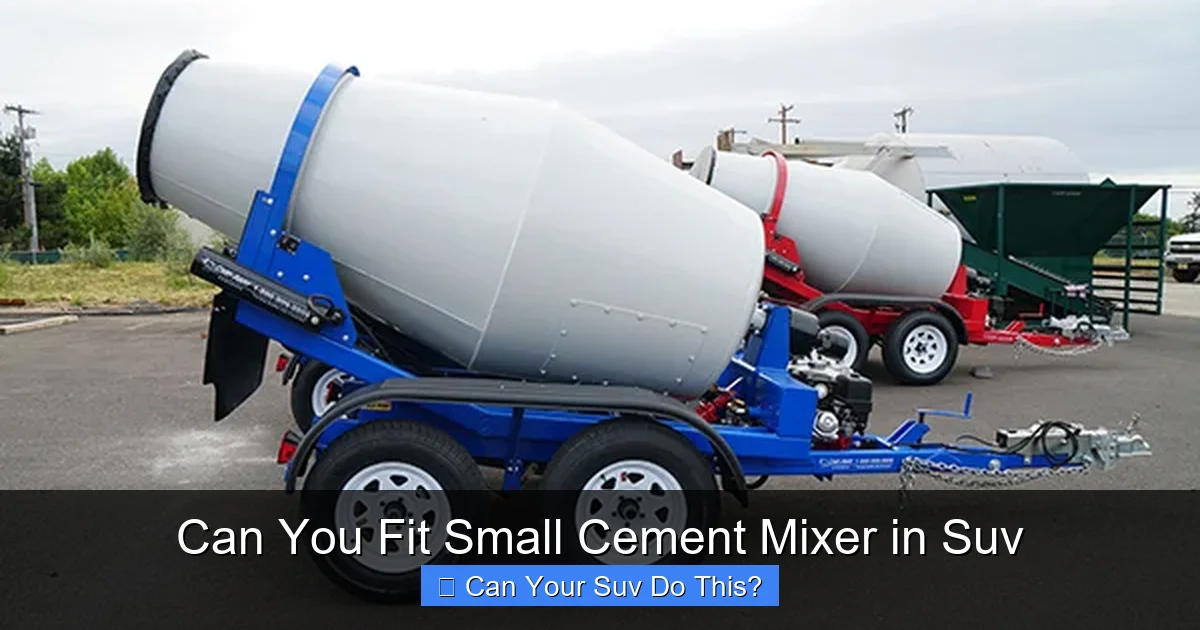
Yes, you can fit a small cement mixer in many SUVs—but it depends on the model, mixer size, and how you load it. With proper planning, folding seats, and the right equipment, even compact SUVs can handle mini mixers for DIY projects.
So, you’ve got a backyard patio project, a new garden path, or maybe just a stubborn DIY itch that only fresh concrete can scratch. You’re ready to mix your own cement—but there’s one big question standing between you and that smooth finish: Can you fit a small cement mixer in your SUV?
It’s a surprisingly common dilemma. You don’t want to rent a truck just for one weekend project, but you also don’t want to show up at the hardware store only to realize your SUV can’t handle the gear. The good news? In most cases, the answer is yes—especially if you’re working with a compact or mini cement mixer. But it’s not as simple as tossing it in the back and driving off. There are dimensions to consider, weight limits to respect, and safety steps to follow.
This guide will walk you through everything you need to know about transporting a small cement mixer in your SUV. Whether you drive a compact crossover like a Honda CR-V or a full-size beast like a Chevrolet Tahoe, we’ll help you figure out if your ride can handle the load—and how to do it safely and efficiently.
Key Takeaways
- Size matters: Most small cement mixers (1.25–3 cubic feet) can fit in midsize to large SUVs with rear seats folded down.
- Check cargo dimensions: Measure your SUV’s cargo area length, width, and height before buying or renting a mixer.
- Weight is critical: Even small mixers can weigh 100–200 pounds—ensure your SUV’s payload capacity can handle it.
- Use ramps and straps: Loading heavy equipment safely requires ramps, tie-downs, and possibly a helper.
- Rent vs. buy: For one-time use, renting a portable mixer may be more practical than purchasing and storing.
- Alternative transport: If it doesn’t fit, consider a trailer, pickup truck rental, or delivery service.
- Safety first: Always secure the mixer during transport and avoid overloading your vehicle.
📑 Table of Contents
Understanding Small Cement Mixers: What You’re Working With
Before we dive into SUV compatibility, let’s clarify what we mean by a “small” cement mixer. These aren’t the industrial-sized drum trucks you see on construction sites. Instead, we’re talking about portable, electric or gas-powered mixers designed for home use. They’re perfect for small jobs like setting fence posts, pouring sidewalks, or mixing mortar for brickwork.
Common Types of Small Cement Mixers
There are two main types of small cement mixers: electric and gas-powered. Electric models are quieter, cleaner, and ideal for indoor or residential use. Gas-powered versions offer more power and mobility but require ventilation and fuel. Both come in varying sizes, but the most common for DIYers are:
– 1.25 cubic foot mixers: Great for light tasks like patching concrete or mixing small batches of mortar. These are the smallest and most SUV-friendly.
– 2–3 cubic foot mixers: Better for medium projects like pouring a small slab or multiple fence post holes. Still manageable for most SUVs with some planning.
– 5 cubic foot mixers: These are on the larger side and may require a pickup truck or trailer. We’ll touch on alternatives later.
Typical Dimensions and Weight
Let’s look at some real-world examples. A popular 1.25 cubic foot electric mixer, like the Kushlan Products 350DD, measures roughly 30 inches long, 24 inches wide, and 36 inches tall when assembled. It weighs about 85 pounds dry. A 3 cubic foot gas mixer, such as the Yardmax YM0141, is closer to 48 inches long, 30 inches wide, and 42 inches tall, weighing around 160 pounds.
These numbers are crucial. Your SUV’s cargo space must accommodate both the footprint and the height—especially if the mixer has wheels and a tilting drum. Also, remember that weight adds up quickly when you include bags of cement, water, tools, and safety gear.
Why Size Isn’t the Only Factor
While physical dimensions are important, don’t overlook weight distribution and center of gravity. A tall, top-heavy mixer can shift during turns or sudden stops, creating a safety hazard. That’s why securing the load properly is just as important as whether it fits at all.
Measuring Your SUV’s Cargo Capacity

Visual guide about Can You Fit Small Cement Mixer in Suv
Image source: detuogroup.com
Now that you know what you’re trying to fit, it’s time to assess your SUV. Not all SUVs are created equal when it comes to cargo space. A compact SUV like a Toyota RAV4 offers less room than a three-row SUV like a Ford Explorer or a GMC Yukon.
How to Measure Your Cargo Area
Grab a tape measure and head to your vehicle. Start by folding down the rear seats (if possible) to maximize space. Then measure:
– Length: From the back of the front seats to the tailgate opening.
– Width: Between the wheel wells (this is often the narrowest point).
– Height: From the cargo floor to the roof liner with the tailgate closed.
For example, a Honda CR-V has about 39 inches of length, 40 inches of width (between wheel wells), and 30 inches of height with seats folded. That’s enough for a 1.25 cubic foot mixer laid on its side, but a 3 cubic foot model might be a tight squeeze.
Check the Owner’s Manual
Your SUV’s owner’s manual will list cargo volume in cubic feet and maximum payload capacity. Payload includes passengers, luggage, and any equipment you’re carrying. For instance, a 2023 Subaru Outback has a payload of around 1,200 pounds. If you and your passengers weigh 400 pounds combined, you’ve got about 800 pounds left for gear—plenty for a small mixer and supplies.
But don’t forget: the mixer itself isn’t the only weight. A 3 cubic foot mixer at 160 pounds, plus 4 bags of cement (each 94 pounds), a wheelbarrow, shovels, and water, can easily add up to 600+ pounds. Stay under your payload limit to avoid damaging your suspension or compromising safety.
Real-World SUV Examples
Let’s compare a few popular SUVs:
– Compact SUV (Honda CR-V): Cargo volume: 39.2 cu ft (seats up), 75.8 cu ft (seats down). Best for 1.25–2 cu ft mixers.
– Midsize SUV (Toyota Highlander): Cargo volume: 16 cu ft (third row up), 84.3 cu ft (all seats down). Can handle up to 3 cu ft mixers with ease.
– Full-Size SUV (Chevrolet Tahoe): Cargo volume: 25.5 cu ft (third row up), 93.9 cu ft (all seats down). Ideal for larger mixers or multiple trips.
If you’re unsure, visit a dealership or check online specs for your exact model and year. Many manufacturers provide detailed cargo diagrams.
Loading and Securing the Mixer Safely
Fitting the mixer in your SUV is only half the battle. Getting it in—and keeping it secure—is where many people run into trouble.
Use Ramps for Heavy Loads
Even a 100-pound mixer can be tough to lift into an SUV, especially if you’re working alone. A pair of lightweight loading ramps (available at hardware stores or online) can make all the difference. Position the ramps at the tailgate, tilt the mixer onto its wheels, and roll it up gently. Always have a spotter if possible.
Secure with Tie-Downs
Never transport a loose mixer. Use ratchet straps or heavy-duty bungee cords to anchor it to the SUV’s cargo hooks. Attach straps to the mixer’s frame—not the drum—and cross them over the top for stability. If your SUV has a cargo net or barrier, use it to prevent forward movement.
Protect Your Interior
Concrete mixers can leak water, dust, or residue. Line the cargo area with heavy-duty plastic sheeting or a moving blanket. Consider using a cargo liner or rubber mat to protect the floor. If you’re transporting cement bags, keep them in a separate, sealed container to avoid spills.
Drive Carefully
With a heavy load in the back, your SUV’s handling will change. Take turns slowly, increase following distance, and avoid sudden braking. If the mixer shifts even slightly, it can affect steering and braking performance.
Alternative Solutions When It Doesn’t Fit
Sometimes, despite your best efforts, the mixer just won’t fit—or it’s too heavy for your SUV’s payload. Don’t panic. There are several smart alternatives.
Rent a Trailer
Many home improvement stores (like Home Depot or Lowe’s) offer equipment rentals, including small utility trailers. A 4’x8’ trailer can easily carry a cement mixer, bags of cement, and tools. Most SUVs can tow up to 1,500–3,500 pounds, so check your towing capacity first. You’ll need a hitch receiver and possibly a brake controller for heavier loads.
Borrow or Rent a Pickup Truck
If you don’t have a trailer, consider renting a pickup for the day. A midsize truck like a Ford Ranger or Toyota Tacoma can handle a mixer with room to spare. Rental costs are often under $100 for 24 hours—cheaper than buying a mixer you’ll only use once.
Use a Delivery Service
Some hardware stores and concrete suppliers offer delivery for mixers and materials. While this adds cost, it saves time, effort, and wear on your vehicle. Perfect for one-time projects.
Break the Job into Smaller Batches
If you’re mixing concrete for a small project, consider using pre-mixed bags that only require water. You can mix them in a wheelbarrow or bucket, eliminating the need for a mixer altogether. It’s more labor-intensive, but it keeps your SUV free of heavy equipment.
Top Small Cement Mixers That Fit in SUVs
Not all mixers are created equal when it comes to portability. Here are a few models known for their compact design and SUV-friendly dimensions.
Kushlan Products 350DD (1.25 cu ft)
This electric mixer is a favorite among DIYers. It’s lightweight (85 lbs), compact, and easy to maneuver. With its foldable legs and removable drum, it can be stored vertically or laid flat in most SUVs. Perfect for small repairs and patch jobs.
Yardmax YM0141 (3 cu ft)
A step up in size and power, this gas-powered mixer is great for medium projects. At 160 pounds, it’s heavier but still manageable with ramps. Its wide wheelbase provides stability, and the tilting drum makes pouring easy. Fits in most midsize and large SUVs with seats folded.
Strongway 2.5 cu ft Electric Mixer
A solid middle-ground option, this mixer balances capacity and portability. It’s quieter than gas models and doesn’t require fuel. At about 120 pounds, it’s light enough for one person to load with assistance.
When choosing a mixer, consider not just size but also ease of cleaning, noise level, and power source. Electric models are better for quiet neighborhoods, while gas mixers offer more freedom on remote job sites.
Tips for First-Time Users
If you’re new to mixing concrete, a few tips can make the process smoother—and safer.
Plan Your Project
Calculate how much concrete you’ll need before you buy materials. Too little, and you’ll have to make a second trip. Too much, and you’ll waste money and effort. Use online concrete calculators to estimate volume based on length, width, and depth.
Wear Protective Gear
Concrete is caustic and can irritate skin and lungs. Always wear gloves, safety goggles, long sleeves, and a dust mask. Work in a well-ventilated area, and wash thoroughly after use.
Clean the Mixer Immediately
Never let concrete dry inside the drum. Rinse it out with water as soon as you’re done. A stiff brush helps remove residue. Proper cleaning extends the mixer’s life and prevents clogs.
Store Properly
If you bought the mixer, store it in a dry, covered area. Cover it with a tarp to protect from dust and moisture. Keep it off the ground to prevent rust.
Conclusion
So, can you fit a small cement mixer in your SUV? In most cases, yes—especially if you choose a compact model and prepare your vehicle properly. Measure your cargo space, check your payload, use ramps and straps, and consider alternatives if needed. With the right approach, your SUV can be a reliable workhorse for weekend projects.
Remember, it’s not just about whether it fits—it’s about doing it safely and efficiently. Whether you’re pouring a new driveway or fixing a cracked walkway, the right tools and planning make all the difference. And who knows? Once you’ve mastered the mixer, you might just find yourself tackling bigger builds—one SUV load at a time.
Frequently Asked Questions
Can a small cement mixer fit in a compact SUV like a Honda CR-V?
Yes, a 1.25 cubic foot mixer can usually fit in a compact SUV like the CR-V with the rear seats folded down. However, a 3 cubic foot model may be too large unless you remove wheels or tilt it carefully.
How much does a small cement mixer weigh?
Most small mixers weigh between 85 and 160 pounds dry. Add water, cement, and tools, and the total load can exceed 300 pounds—so always check your SUV’s payload capacity.
Do I need a trailer to transport a cement mixer?
Not always. If the mixer fits securely in your SUV and you stay under the weight limit, a trailer isn’t necessary. But for larger mixers or frequent use, a trailer is safer and more convenient.
Can I lay a cement mixer on its side in my SUV?
Yes, many mixers can be transported on their side, but check the manufacturer’s guidelines first. Some models have seals or motors that shouldn’t be tilted to avoid damage.
What’s the best way to load a heavy mixer into an SUV?
Use a pair of loading ramps and have a helper if possible. Secure the mixer with ratchet straps once inside, and protect your interior with plastic or blankets.
Should I rent or buy a small cement mixer?
If you’re doing a one-time project, renting is often more cost-effective. But if you plan multiple DIY jobs, buying a compact mixer can save money and time in the long run.