
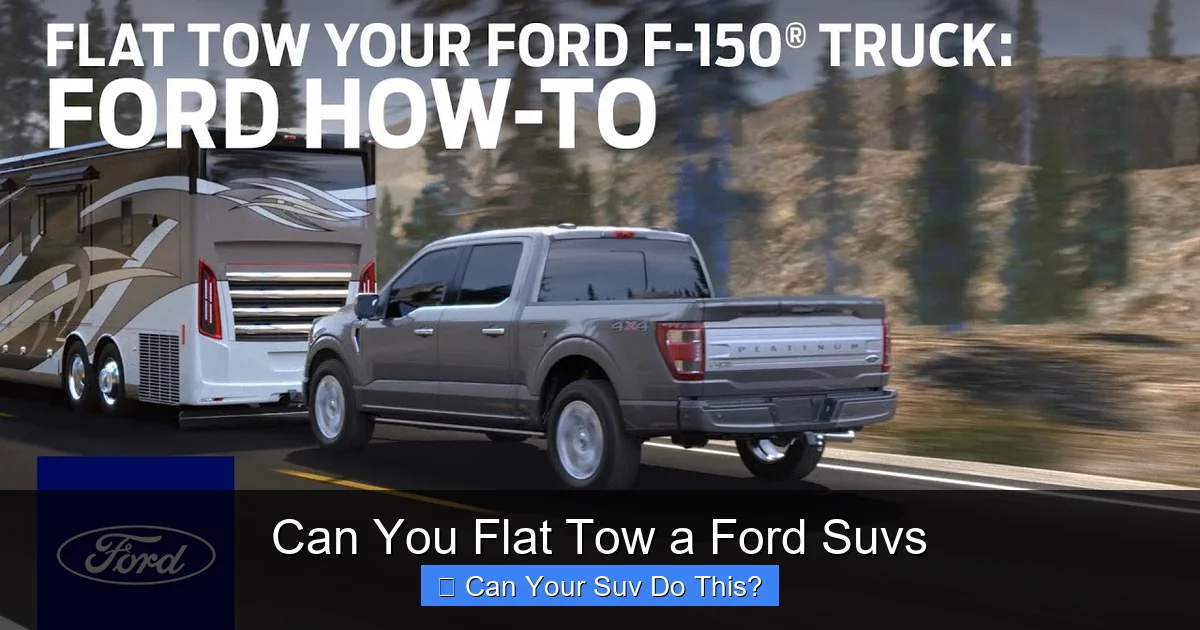
Yes, many Ford SUVs can be flat towed—but not all models are created equal. Whether you’re planning a cross-country RV trip or need to move your SUV behind a motorhome, knowing which Ford SUVs are flat-towable and how to do it safely is crucial. This guide breaks down everything you need to know, from compatible models to must-have equipment and common mistakes to avoid.
Key Takeaways
- Not all Ford SUVs can be flat towed: Only specific models with the right drivetrain and transmission setup are approved for flat towing.
- Check the owner’s manual first: Ford provides clear towing guidelines—always consult your vehicle’s manual before attempting to flat tow.
- Four-wheel drive (4WD) and all-wheel drive (AWD) matter: Many AWD and 4WD Ford SUVs require special procedures or cannot be flat towed at all.
- Use a quality tow bar and base plate: Proper equipment ensures safe, secure towing and protects your SUV from damage.
- Neutral tow mode is essential: Some Ford SUVs have a factory-installed neutral tow feature that disengages the transmission for safe flat towing.
- Regular maintenance is key: Even when flat towed correctly, your SUV may need extra attention to fluids and systems after long trips.
- Professional installation is recommended: Improper setup can void warranties or cause mechanical failure—don’t skip expert help.
📑 Table of Contents
Can You Flat Tow a Ford SUV? The Complete Guide
So, you’ve got a Ford SUV and you’re dreaming of hitting the open road in your motorhome—only to realize you’ll need to bring your SUV along for the ride. That’s where flat towing comes in. Also known as “four-down towing,” flat towing means pulling your vehicle behind an RV with all four wheels on the ground. It’s convenient, cost-effective, and lets you have a car ready at your destination without the hassle of a trailer.
But here’s the big question: Can you flat tow a Ford SUV?
The short answer is: it depends. Not every Ford SUV is designed for flat towing, and doing it wrong can lead to serious transmission damage, voided warranties, or even safety hazards. The good news? Many popular Ford SUVs—especially those with manual transmissions or specific drivetrain configurations—are flat-towable when done correctly.
In this guide, we’ll walk you through everything you need to know about flat towing Ford SUVs. From which models are safe to tow to the equipment you’ll need and the steps to follow, we’ve got you covered. Whether you’re driving a rugged Ford Bronco, a family-friendly Ford Explorer, or a capable Ford Expedition, we’ll help you determine if your SUV can join you on your next adventure—safely and legally.
What Is Flat Towing and Why Does It Matter?
Flat towing is a method of towing a vehicle behind a motorhome or RV with all four wheels in contact with the road. Unlike dolly towing (which lifts the front wheels) or trailer towing (which lifts all wheels), flat towing keeps the vehicle fully grounded. This makes it ideal for SUVs and trucks that you want to drive independently once you reach your destination.
But why does this matter for Ford SUVs?
Because not all vehicles are built to handle the stress of being towed this way. When a vehicle is flat towed, its drivetrain and transmission are still connected to the wheels. If the transmission isn’t properly disengaged or lubricated during towing, internal components can overheat, wear out, or fail—leading to expensive repairs.
That’s why Ford provides specific towing instructions for each model. Some SUVs are designed with flat towing in mind, while others require modifications or simply cannot be flat towed at all. Ignoring these guidelines can void your warranty or cause irreversible damage.
How Flat Towing Works
When you flat tow a vehicle, the wheels turn the axles, which in turn rotate the transmission and drivetrain components—even when the engine is off. In manual transmission vehicles, this is usually safe because the transmission can be put in neutral, allowing the gears to spin freely without engaging the engine.
But in automatic transmissions—common in most modern Ford SUVs—the situation is more complex. Automatic transmissions rely on engine-driven pumps to circulate fluid and keep components lubricated. When the engine is off, these pumps don’t run, which means internal parts can overheat if the vehicle is towed for long distances.
This is why many Ford SUVs with automatic transmissions either cannot be flat towed or require a special “neutral tow” mode that disengages the transmission and allows safe towing.
Benefits of Flat Towing
Flat towing offers several advantages over other towing methods:
– Convenience: You don’t need a trailer or dolly—just a tow bar and base plate.
– Cost-effective: No need to rent or store a trailer.
– Easy access: Your SUV is ready to drive as soon as you arrive.
– Better fuel efficiency: Towing a vehicle with all wheels down is often more aerodynamic than using a trailer.
But these benefits only apply if your Ford SUV is compatible and properly prepared for flat towing.
Which Ford SUVs Can Be Flat Towed?
Now for the million-dollar question: which Ford SUVs are safe to flat tow?
The answer varies by model, year, drivetrain, and transmission type. Let’s break it down by popular Ford SUV models.
Ford Bronco
The Ford Bronco is one of the most flat-towable SUVs in Ford’s lineup—especially the newer models (2021 and later). Most Bronco trims with manual transmissions can be flat towed without issue. Simply put the transmission in neutral, turn off the ignition, and you’re good to go.
However, Bronco models with automatic transmissions require caution. Some trims come with a factory-installed “Neutral Tow” mode, which disengages the transmission and allows safe flat towing. This feature is typically available on 4WD models with the 2.3L or 2.7L EcoBoost engine.
Tip: Always check your owner’s manual. If your Bronco has the Neutral Tow feature, enable it before towing. If not, flat towing may damage the transmission.
Ford Explorer
The Ford Explorer is a popular family SUV, but flat towing compatibility depends heavily on the drivetrain and transmission.
– Front-wheel drive (FWD) Explorers with automatic transmissions: Generally cannot be flat towed. The transmission lacks a neutral tow mode, and towing can cause overheating and damage.
– All-wheel drive (AWD) Explorers: Most AWD models also cannot be flat towed due to complex drivetrain systems that require power from the engine to lubricate components.
– Older manual transmission Explorers (pre-2000s): These may be flat-towable, but they’re rare today.
Exception: Some 2020–2023 Ford Explorer ST and Platinum trims with the 3.0L EcoBoost engine and AWD may have a Neutral Tow mode. Check your manual or contact Ford for confirmation.
Ford Expedition
The Ford Expedition is a full-size SUV often used for towing—but can it be flat towed itself?
Most modern Expeditions (2018 and newer) with automatic transmissions and 4WD or AWD cannot be flat towed. The 10-speed automatic transmission and advanced drivetrain require engine power to lubricate internal components.
However, older Expeditions (pre-2018) with manual transfer cases and 4WD may allow flat towing if the transfer case is shifted into neutral. This disengages the front and rear axles, preventing transmission damage.
Important: Never flat tow a modern Expedition without confirming Neutral Tow capability. Doing so can destroy the transmission.
Ford Escape
The Ford Escape is a compact SUV with limited flat-towing potential.
– FWD Escapes with automatic transmissions: Not recommended for flat towing. No Neutral Tow mode is available.
– AWD Escapes: Even less suitable due to the complex all-wheel-drive system.
– Manual transmission Escapes (older models): May be flat-towable, but these are uncommon.
In general, the Escape is better suited for dolly or trailer towing if you need to bring it along.
Ford Edge
The Ford Edge shares many components with the Explorer and has similar towing limitations.
Most Edge models—especially those with AWD and automatic transmissions—cannot be flat towed. There is no factory Neutral Tow mode, and the transmission is not designed for extended towing with the engine off.
Older Edge models with manual transmissions (very rare) might be exceptions, but they’re not practical for most owners.
Ford Flex (Discontinued)
The Ford Flex, though discontinued after 2020, was a unique SUV with a boxy design and AWD option.
Like other AWD Ford SUVs, the Flex cannot be flat towed due to its automatic transmission and lack of Neutral Tow capability. Towing it four-down risks severe transmission damage.
How to Safely Flat Tow a Ford SUV
If your Ford SUV is approved for flat towing, follow these steps to do it safely and correctly.
Step 1: Consult the Owner’s Manual
This cannot be stressed enough. Your owner’s manual is the definitive source for towing instructions. Look for sections titled “Towing,” “Recreational Towing,” or “Flat Towing.” Ford often includes step-by-step procedures, warnings, and required equipment.
If your manual says “Do not flat tow,” don’t ignore it. The risk of damage is real.
Step 2: Use the Right Equipment
Flat towing requires more than just a tow rope. You’ll need:
– Tow bar: A rigid or self-aligning bar that connects your SUV to the RV. Popular brands include Blue Ox, Roadmaster, and Demco.
– Base plate: A mounting bracket installed on the front of your SUV to attach the tow bar. Must be vehicle-specific.
– Safety cables or chains: Backup connections in case the tow bar fails.
– Brake system (recommended):strong> A supplemental braking system for your SUV, such as a portable brake controller or proportional brake system. This ensures your SUV doesn’t push the RV during stops.
Tip: Have your tow bar and base plate professionally installed. Improper mounting can cause damage or detachment during towing.
Step 3: Prepare the Vehicle
Before hitting the road, prepare your Ford SUV:
– Enable Neutral Tow mode (if available): On compatible models, this mode disengages the transmission. Follow the manual’s instructions—usually involving turning the ignition to “on” without starting the engine, shifting to neutral, and pressing a specific button.
– Turn off the ignition: Once in Neutral Tow mode, turn the key to the “off” position. Do not remove the key if it’s needed for steering or brake function.
– Check lights and signals: Ensure your SUV’s brake lights, turn signals, and hazard lights work. Some RVs require a separate light kit for the towed vehicle.
– Secure loose items: Remove or stow anything that could shift or fall during travel.
Step 4: Practice Before You Go
If it’s your first time flat towing, practice in an empty parking lot. Get comfortable with connecting the tow bar, checking connections, and driving with the SUV attached. Pay attention to turning radius, braking distance, and sway.
Step 5: Monitor During Travel
Even with proper setup, keep an eye on your SUV:
– Check connections regularly.
– Avoid sudden maneuvers.
– Take breaks every few hours to inspect the vehicle.
– If your SUV has a dashboard warning light for Neutral Tow, ensure it stays off.
Common Mistakes to Avoid
Flat towing seems simple, but small mistakes can lead to big problems.
Towing Without Checking the Manual
Assuming your Ford SUV can be flat towed because it’s “just like” another model is a recipe for disaster. Always verify compatibility.
Ignoring the Transmission Type
Automatic transmissions are the biggest risk. Never flat tow an automatic SUV without confirming Neutral Tow capability.
Using Improper Equipment
A cheap tow bar or mismatched base plate can fail on the highway. Invest in quality, vehicle-specific gear.
Forgetting the Brake System
Without supplemental brakes, your SUV can push the RV during sudden stops, especially on hills or in traffic.
Towing Too Far or Too Fast
Even with Neutral Tow mode, avoid extremely long distances or high speeds. Most manufacturers recommend speeds under 65 mph and distances under 500 miles without stopping.
Alternatives to Flat Towing
If your Ford SUV cannot be flat towed, don’t worry—there are other options.
Dolly Towing
A tow dolly lifts the front wheels off the ground, allowing the rear wheels to roll freely. This works for FWD vehicles but is not suitable for AWD or 4WD SUVs.
Trailer Towing
A full trailer lifts all four wheels. It’s the safest option for AWD and 4WD SUVs but requires more space, fuel, and setup time.
Drive It Separately
For shorter trips, consider driving your SUV to the destination. It’s simple, safe, and avoids towing altogether.
Final Thoughts: Is Flat Towing Right for You?
Flat towing a Ford SUV can be a game-changer for RV enthusiasts, but it’s not a one-size-fits-all solution. The key is knowing your vehicle’s capabilities and following Ford’s guidelines to the letter.
If your SUV is approved for flat towing—and you’ve got the right equipment and knowledge—you can enjoy the freedom of having your car ready at every stop. But if your model isn’t compatible, don’t force it. The cost of transmission repair far outweighs the convenience of flat towing.
Take the time to research, prepare, and practice. Your Ford SUV—and your peace of mind—will thank you.
Frequently Asked Questions
Can you flat tow a Ford Explorer?
Most Ford Explorers with automatic transmissions cannot be flat towed due to lack of Neutral Tow mode. Only specific trims with factory-enabled Neutral Tow capability may be safe—check your owner’s manual.
Is flat towing bad for a Ford Bronco?
No, if done correctly. Bronco models with manual transmissions or Neutral Tow mode can be flat towed safely. Always follow Ford’s instructions to avoid transmission damage.
Do I need a brake system when flat towing?
Yes, a supplemental brake system is highly recommended. It prevents your SUV from pushing the RV during braking, especially on hills or in traffic.
Can you flat tow a Ford Expedition?
Most modern Ford Expeditions cannot be flat towed. Older 4WD models with manual transfer cases may allow it if the transfer case is in neutral—verify with your manual.
What happens if you flat tow a non-compatible SUV?
Towing a non-compatible SUV can overheat and damage the transmission, void your warranty, or cause safety hazards. Always confirm compatibility first.
How do I know if my Ford SUV has Neutral Tow mode?
Check your owner’s manual under “Towing” or “Recreational Towing.” Ford lists which models and trims include this feature. You can also contact a Ford dealer with your VIN.