

Yes, you can get a queen mattress in an SUV—but it depends on your vehicle, the mattress type, and how you pack it. With smart folding, seat removal, and proper planning, even compact SUVs can handle the job. This guide breaks down everything you need to know.
So, you’ve just bought a brand-new queen mattress—congrats! It’s plush, supportive, and promises better sleep. But now comes the real challenge: how on earth are you going to get it home? You don’t have a pickup truck, and calling a friend with a van feels like too much to ask. You drive an SUV. So, can you get a queen mattress in a SUV?
The short answer? Yes—most of the time. But it’s not always easy, and it definitely requires some planning. Whether you’re driving a compact crossover like a Honda CR-V or a full-size beast like a Chevrolet Tahoe, there’s usually a way to make it work. The key is knowing your vehicle’s limits, understanding your mattress options, and being ready to get a little creative with space.
In this guide, we’ll walk you through everything you need to know about transporting a queen mattress in an SUV. From measuring your cargo area to choosing the right mattress type, we’ll cover practical tips, common pitfalls, and real-world examples. By the end, you’ll know exactly whether your SUV can handle the job—and how to do it safely and efficiently.
Key Takeaways
- Most SUVs can fit a queen mattress with rear seats folded down or removed, especially mid-size and full-size models.
- Mattress type matters—foam mattresses are easier to compress and fold than traditional spring or hybrid models.
- Measure your SUV’s cargo space before buying or moving a mattress to avoid surprises.
- Use protective covers and straps to keep the mattress clean and secure during transport.
- Renting a truck or using delivery services may be smarter for one-time moves or fragile mattresses.
- Practice loading beforehand if possible, especially if you’re doing it solo.
- Check local laws about transporting large items on public roads—some require warning flags or lights.
📑 Table of Contents
- Understanding Mattress Dimensions and SUV Cargo Space
- Types of Mattresses and How They Affect Transport
- How to Load a Queen Mattress into Your SUV
- Real-World Examples: Which SUVs Can Handle a Queen Mattress?
- When to Consider Alternatives
- Safety and Legal Considerations
- Tips for a Smooth Mattress Move
- Conclusion
Understanding Mattress Dimensions and SUV Cargo Space
Before you even think about loading that mattress, you need to understand two things: how big a queen mattress actually is, and how much room your SUV really has.
A standard queen mattress measures 60 inches wide by 80 inches long (that’s 5 feet by 6.67 feet). It’s not just the length that’s tricky—it’s the width. Most SUVs have cargo areas that are narrower than 60 inches when measured between the wheel wells. That means you can’t lay the mattress flat across the back unless your SUV is unusually wide or you remove the rear seats.
Let’s break it down by SUV size:
Compact SUVs (e.g., Honda CR-V, Toyota RAV4, Mazda CX-5)
These vehicles are great for city driving and fuel efficiency, but their cargo space is limited. With rear seats up, you’ll get around 30–35 cubic feet of space. Fold the seats down, and you might reach 65–70 cubic feet. But even then, the width between the wheel wells is typically around 40–45 inches—too narrow for a queen mattress laid flat.
However, compact SUVs often have a long, flat cargo floor when the seats are folded. This means you can angle the mattress diagonally or fold it (if it’s a flexible foam model). Some owners even remove the rear seats entirely for extra space, though this isn’t recommended unless you’re comfortable doing it yourself and plan to reinstall them later.
Mid-Size SUVs (e.g., Ford Explorer, Hyundai Santa Fe, Subaru Ascent)
These offer a sweet spot between size and usability. With rear seats folded, you’ll typically get 70–80 cubic feet of cargo space. The width is better too—often 45–50 inches between wheel wells. That’s still not enough for a flat queen mattress, but it’s much more manageable.
Many mid-size SUVs also have a third row that folds flat, giving you a longer, uninterrupted cargo area. This makes it easier to slide the mattress in at an angle or even lay it partially across the back if you’re careful.
Full-Size SUVs (e.g., Chevrolet Tahoe, Ford Expedition, Toyota Sequoia)
If you drive one of these, you’re in luck. Full-size SUVs are built for hauling. With all rear seats folded or removed, you can easily get over 100 cubic feet of space. The cargo area is wide and long—often more than 50 inches wide and over 7 feet long when fully extended.
In many cases, you can lay a queen mattress flat across the back of a full-size SUV without any folding. Some models even have a powered third row that folds automatically, making loading even easier.
Measuring Your SUV’s Cargo Area
Don’t rely on manufacturer specs alone. Every SUV is a little different, and things like spare tire compartments, seat mechanisms, and interior trim can reduce usable space.
Here’s how to measure:
– Open the rear hatch and fold down all rear seats.
– Use a tape measure to check the width between the wheel wells (the widest point).
– Measure the length from the back of the front seats to the hatch.
– Note any obstacles like seat anchors, cup holders, or storage bins.
Compare these measurements to your mattress size. If the length is over 80 inches and the width is close to 60 inches, you’re in good shape. If not, you’ll need to get creative.
Types of Mattresses and How They Affect Transport
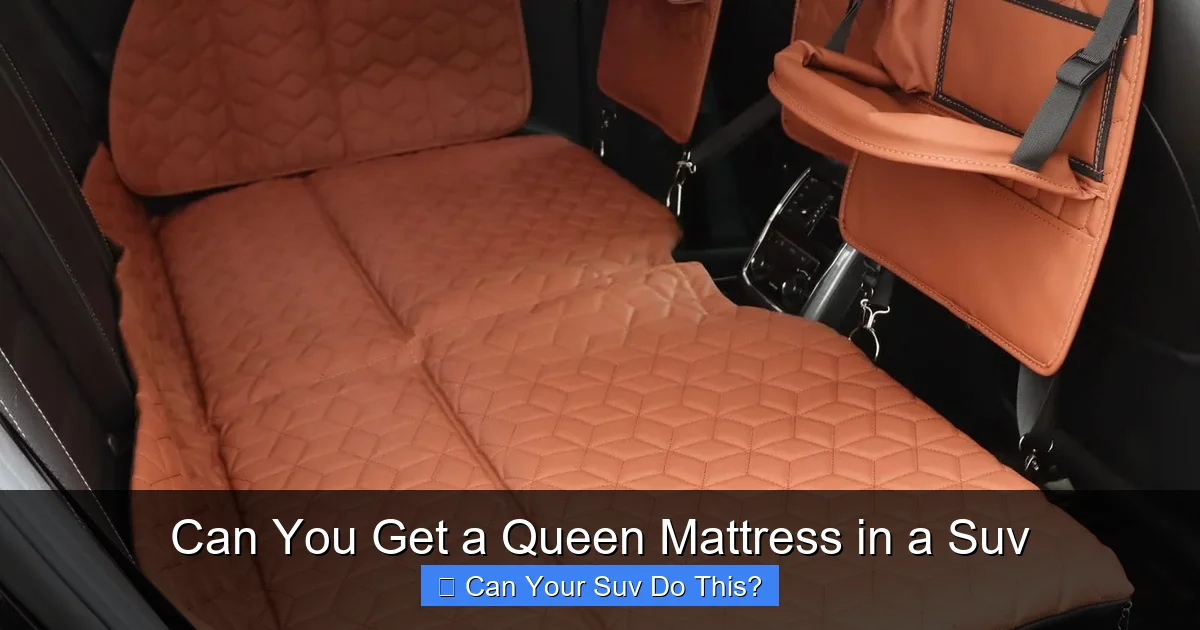
Visual guide about Can You Get a Queen Mattress in a Suv
Image source: m.media-amazon.com
Not all mattresses are created equal—especially when it comes to transport. The type of mattress you buy will have a big impact on whether it can fit in your SUV.
Foam Mattresses (Memory Foam, Latex, Hybrid Foam)
These are your best bet for SUV transport. Most foam mattresses are compressed and rolled into a box for shipping—this is called a “bed in a box.” They’re designed to be flexible and can often be folded or bent slightly to fit tight spaces.
Even after unboxing, foam mattresses retain some flexibility. You can angle them, tuck them diagonally, or even fold them in half (temporarily) if needed. Just be careful not to crease or damage the foam.
Pros:
– Lightweight (usually 50–80 lbs for a queen)
– Compressible and flexible
– Often come with handles or carrying straps
Cons:
– Can take 24–72 hours to fully expand
– May retain odors initially (off-gassing)
Innerspring and Hybrid Mattresses
Traditional spring mattresses are rigid and don’t compress well. They’re also heavier—often 100 lbs or more for a queen. These are much harder to fit in an SUV, especially compact models.
Hybrid mattresses (foam + springs) fall somewhere in between. They’re more flexible than pure spring models but still stiffer than all-foam options.
Pros:
– Better edge support and durability
– Cooler sleep surface (for some)
Cons:
– Heavy and inflexible
– Hard to fold or angle
– Often require professional delivery
Adjustable or Luxury Mattresses
High-end mattresses with cooling gel layers, copper infusions, or built-in air chambers are usually heavy and rigid. They’re not designed to be folded or compressed. Transporting these in an SUV is possible but challenging—especially if you’re doing it alone.
Mattress in a Box vs. Traditional Delivery
If you’re buying online, a “mattress in a box” is your best friend. These arrive compressed and rolled, often in a long, narrow box that’s easy to fit in an SUV—even a compact one.
For example, a queen memory foam mattress might arrive in a box that’s only 18 inches wide and 70 inches long. That’s small enough to slide into most SUVs without folding the seats.
On the other hand, if you buy from a traditional mattress store, they may deliver it flat and uncompressed. That’s when things get tricky. Some stores offer white-glove delivery (they bring it inside and set it up), which removes the transport problem entirely. But if you’re picking it up yourself, you’ll need to plan carefully.
How to Load a Queen Mattress into Your SUV
Now that you know your SUV’s limits and your mattress type, it’s time to load it up. Here’s a step-by-step guide to make the process smooth and safe.
Step 1: Prepare Your SUV
– Fold down all rear seats. In most SUVs, this creates a flat, continuous surface.
– Remove any loose items from the cargo area—bags, tools, or pet carriers.
– Lay down a protective cover or old blanket to prevent scratches and keep the mattress clean.
– If your SUV has a cargo mat or rubber liner, make sure it’s secure so it doesn’t slide.
Step 2: Protect the Mattress
– Use a mattress bag or plastic cover if the mattress didn’t come with one. This keeps it clean and dry.
– If you’re folding or bending the mattress, avoid sharp creases. Foam can recover, but repeated folding can damage the structure.
– Consider using moving straps or bungee cords to secure the mattress once it’s in place.
Step 3: Loading Techniques
There are a few ways to get that mattress in:
Diagonal Loading: Angle the mattress from one corner of the cargo area to the opposite corner. This uses the longest possible space and often works in mid-size and full-size SUVs.
Folding (Foam Only): If you have a flexible foam mattress, you can fold it in half lengthwise or roll it slightly. Be gentle—don’t force it. Some people use a mattress strap to hold it in a folded position.
Partial Overhang: If the mattress is a few inches too long, you can let it extend slightly out of the hatch. Just make sure it’s secured and doesn’t block your view. Use warning flags if required by local laws.
Roof Rack (Last Resort): If all else fails, you can strap the mattress to a roof rack. Use heavy-duty straps and cover it with a tarp to protect it from rain and road debris. This is risky and not recommended for long distances or high speeds.
Step 4: Secure the Load
Once the mattress is in, don’t just close the hatch and drive. Use cargo straps or bungee cords to tie it down. Anchor points are usually found in the cargo floor or on the sides of the SUV.
Make sure the mattress can’t slide forward and hit the back of the front seats. If it shifts during driving, it could damage your vehicle or become a hazard.
Step 5: Drive Carefully
– Avoid sudden stops or sharp turns.
– Keep your speed moderate—wind resistance can catch a loose mattress.
– Check the load periodically, especially on long trips.
Real-World Examples: Which SUVs Can Handle a Queen Mattress?
Let’s look at a few popular SUVs and see how they stack up.
Honda CR-V (Compact SUV)
– Cargo volume (seats down): 75.8 cubic feet
– Width between wheel wells: ~43 inches
– Can it fit a queen mattress? Yes, but not flat. You’ll need to angle it or fold a foam mattress. A mattress in a box will fit easily.
Toyota RAV4 (Compact SUV)
– Cargo volume: 69.8 cubic feet
– Width: ~42 inches
– Verdict: Similar to the CR-V. Foam mattresses work best. Traditional spring mattresses will be a tight squeeze.
Ford Explorer (Mid-Size SUV)
– Cargo volume: 87.8 cubic feet
– Width: ~48 inches
– Verdict: Much better. You can likely fit a queen mattress diagonally or even flat if you remove the third row. Foam or hybrid mattresses work well.
Chevrolet Tahoe (Full-Size SUV)
– Cargo volume: 122.0 cubic feet
– Width: ~52 inches
– Verdict: No problem. You can lay a queen mattress flat across the back with room to spare. Even heavy spring mattresses are manageable.
Subaru Outback (Wagon/SUV Hybrid)
– Cargo volume: 75.7 cubic feet
– Width: ~42 inches
– Verdict: Great for foam mattresses. The long, flat cargo area makes diagonal loading easy.
When to Consider Alternatives
Even if your SUV can technically fit a queen mattress, sometimes it’s not the best idea.
Rent a Truck or Van
For one-time moves or heavy mattresses, renting a pickup truck or cargo van might be worth it. U-Haul, Home Depot, and other retailers offer affordable rentals. A small truck bed is usually 6–8 feet long—plenty of space for a queen mattress.
Pros:
– Easier loading and unloading
– No risk of damaging your SUV’s interior
– Can transport other items at the same time
Cons:
– Extra cost ($20–$50 for a few hours)
– Requires a valid driver’s license and insurance
Use a Delivery Service
Many mattress retailers offer delivery and setup for a fee (usually $50–$150). This is the easiest option if you don’t want to deal with the hassle.
Pros:
– No lifting or driving required
– Mattress is placed in your bedroom
– Often includes old mattress removal
Cons:
– Extra cost
– Less control over timing
Ask a Friend with a Larger Vehicle
If you have a friend with a pickup truck or minivan, ask for help. Offer pizza and gas money as a thank-you.
Safety and Legal Considerations
Transporting a large item like a mattress isn’t just about fitting it—it’s about doing it safely and legally.
Secure the Load
An unsecured mattress can become a dangerous projectile in a crash. Always use straps or ropes to tie it down. Check your SUV’s owner’s manual for recommended anchor points.
Don’t Block Your View
If the mattress extends out of the hatch, make sure it doesn’t block your rearview mirror. You should still be able to see behind you.
Use Warning Devices
In some states, items extending more than 4 feet from the rear of the vehicle require a red flag or light. Check your local Department of Motor Vehicles (DMV) rules.
Avoid Overhanging on Highways
Driving at high speeds with a mattress sticking out can create wind lift, making your vehicle unstable. If possible, keep the overhang minimal or use a roof rack with proper securing.
Tips for a Smooth Mattress Move
Here are a few extra tips to make your mattress transport as easy as possible:
- Go during daylight hours—better visibility makes loading safer.
- Bring a friend—mattresses are awkward to handle alone.
- Use a dolly or hand truck—especially helpful for heavy spring mattresses.
- Pack a toolkit—you might need to remove seats or adjust anchors.
- Check the weather—avoid rainy or windy days if possible.
- Take your time—rushing increases the risk of damage or injury.
Conclusion
So, can you get a queen mattress in a SUV? Absolutely—most of the time. With the right preparation, a flexible mattress, and a little creativity, even compact SUVs can handle the job. Mid-size and full-size SUVs make it even easier, often allowing you to lay the mattress flat or load it diagonally without folding.
The key is knowing your vehicle’s cargo dimensions, choosing the right type of mattress, and using proper loading techniques. Don’t forget to secure the load, protect the mattress, and follow local safety laws.
If you’re unsure or dealing with a heavy, rigid mattress, consider renting a truck or using a delivery service. It might cost a little extra, but it could save you time, stress, and potential damage.
At the end of the day, getting your new mattress home is just the first step toward better sleep. With a little planning, your SUV can be the hero of the day—no pickup truck required.
Frequently Asked Questions
Can a queen mattress fit in a Honda CR-V?
Yes, but not flat. You’ll need to angle it diagonally or fold a flexible foam mattress. A mattress in a box will fit easily in the cargo area with seats folded down.
Do I need to remove the rear seats to fit a queen mattress?
Not always. In most mid-size and full-size SUVs, folding the seats is enough. Compact SUVs may require seat removal for a tight fit, but it’s not recommended unless you’re experienced.
Can I transport a queen mattress on the roof of my SUV?
Yes, but only as a last resort. Use a roof rack, heavy-duty straps, and a tarp to protect it. Avoid high speeds and long distances, and check local laws about overhanging loads.
Is it safe to fold a memory foam mattress?
Yes, temporarily. Most foam mattresses can be folded or rolled for transport, but avoid sharp creases. Let it expand fully after unloading.
What’s the best type of mattress for SUV transport?
Foam mattresses, especially those sold in a box, are the easiest to transport. They’re lightweight, compressible, and flexible.
Can I drive with a mattress sticking out of the hatch?
Yes, but only if it’s secured and doesn’t block your view. Use warning flags if required by law, and avoid highways or high speeds.