
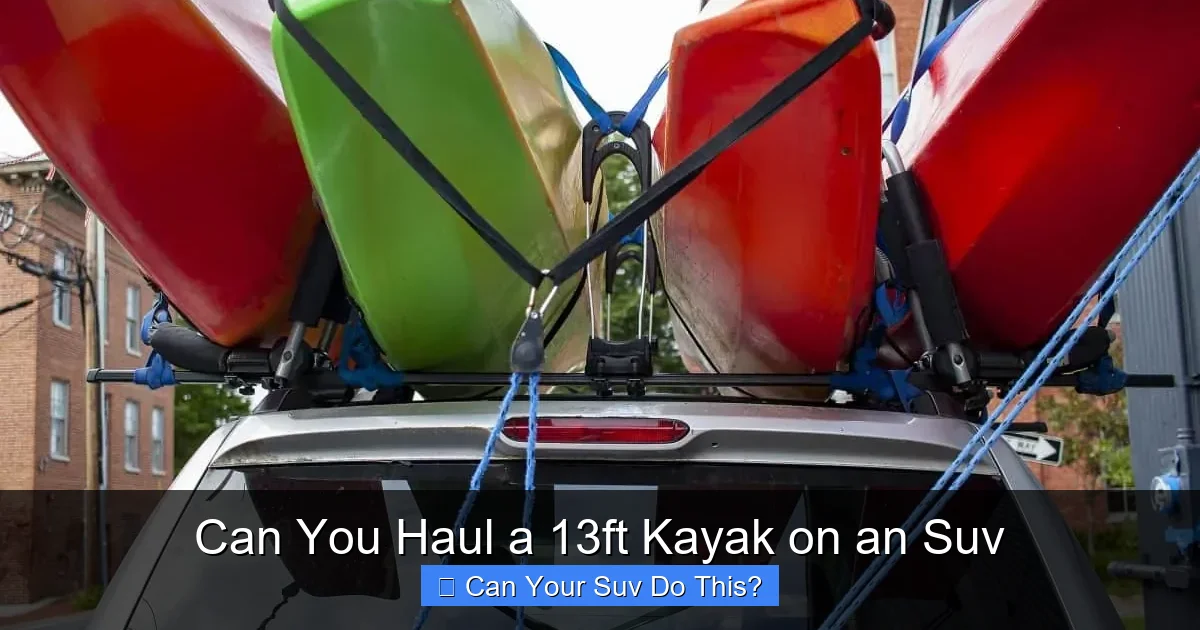
Yes, you can haul a 13ft kayak on most SUVs with the right setup. Whether you use roof racks, foam blocks, or a trailer, proper securing and weight distribution are key. With a little prep, your SUV becomes the perfect kayak hauler for weekend adventures.
So, you’ve got a 13ft kayak and an SUV—congrats! You’re already halfway to your next lakeside escape or river adventure. But now comes the big question: *Can you haul a 13ft kayak on an SUV?* The short answer is yes—but like most things in life, it depends on how you do it.
SUVs are among the most versatile vehicles on the road. They’re built for space, height, and hauling power, which makes them ideal candidates for outdoor gear like kayaks. A 13ft kayak is a popular size—long enough for stability and speed on open water, but not so long that it becomes unwieldy. Whether you’re into calm lake paddling, weekend fishing trips, or exploring coastal waters, this kayak length strikes a sweet spot for many enthusiasts.
But just because your SUV *can* carry a kayak doesn’t mean it’s automatic. You’ll need the right equipment, a solid understanding of weight limits, and a few smart techniques to make sure your kayak arrives safely—and your vehicle stays intact. In this guide, we’ll walk you through everything you need to know to haul your 13ft kayak confidently, whether you’re using roof racks, foam blocks, or a trailer.
Let’s dive in.
Key Takeaways
- Most SUVs can safely carry a 13ft kayak: With proper roof racks or crossbars, even compact SUVs can handle the load when weight limits are respected.
- Roof racks are the most common solution: J-style, saddle, or stack-style kayak carriers work well, but ensure they’re rated for your kayak’s weight and length.
- Foam blocks offer a budget-friendly option: Great for short trips or vehicles without factory racks, but less secure for highway speeds or long distances.
- Trailers provide the most stability: Ideal for frequent use, multiple kayaks, or heavier models, though they require a hitch and extra space.
- Proper tie-downs are non-negotiable: Use cam straps or ratchet straps with bow and stern lines to prevent shifting or wind lift.
- Check your SUV’s weight capacity: Always verify dynamic roof load limits (typically 100–165 lbs) to avoid damage or safety risks.
- Practice loading and unloading: Especially if you’re doing it solo—use a kayak loader or ask for help to avoid injury.
📑 Table of Contents
- Understanding Your SUV’s Roof Capacity
- Roof Racks: The Gold Standard for Kayak Transport
- Foam Blocks: A Budget-Friendly Alternative
- Using a Kayak Trailer: When Roof Space Isn’t Enough
- Securing Your Kayak: The Importance of Proper Tie-Downs
- Loading and Unloading Tips for Solo Users
- Real-World Examples: Which SUVs Handle a 13ft Kayak Best?
- Final Thoughts: Yes, Your SUV Can Do This
Understanding Your SUV’s Roof Capacity
Before you even think about strapping a kayak to your SUV, you need to know what your vehicle can handle. Not all roofs are created equal. SUVs come in all shapes and sizes—from compact crossovers like the Honda CR-V to full-size beasts like the Ford Expedition. And while they all look rugged, their roof load capacities can vary widely.
The key number to look for is the **dynamic roof load limit**. This is the maximum weight your SUV’s roof can safely carry while the vehicle is in motion. It’s not the same as the static load (which is much higher when the vehicle is parked). Most SUVs have a dynamic roof capacity between 100 and 165 pounds. That includes the weight of the kayak, the rack system, and any additional gear.
For example, a typical 13ft recreational kayak weighs around 50 to 70 pounds. Add a roof rack system (usually 10–20 lbs), and you’re looking at 60–90 pounds total. That’s well within the range of most SUVs—*if* you’re using the right setup.
But here’s the catch: some SUVs, especially older models or those with panoramic sunroofs, have lower weight limits. Always check your owner’s manual or the manufacturer’s website. Look for phrases like “roof load capacity” or “maximum dynamic load.” If you can’t find it, call the dealership or check online forums for your specific make and model.
Another thing to consider is roof strength. Some SUVs have reinforced roof rails, while others rely on flush-mounted side rails or even just bare roof panels. If your SUV only has flush rails (the ones that run along the sides but don’t stick up), you’ll need crossbars to create a stable platform. These crossbars must be compatible with your vehicle and rated for the weight you’re carrying.
Pro tip: Don’t assume your factory-installed roof rails can handle heavy loads. Some are purely cosmetic. Always verify the weight rating of both the rails and the crossbars.
Roof Racks: The Gold Standard for Kayak Transport
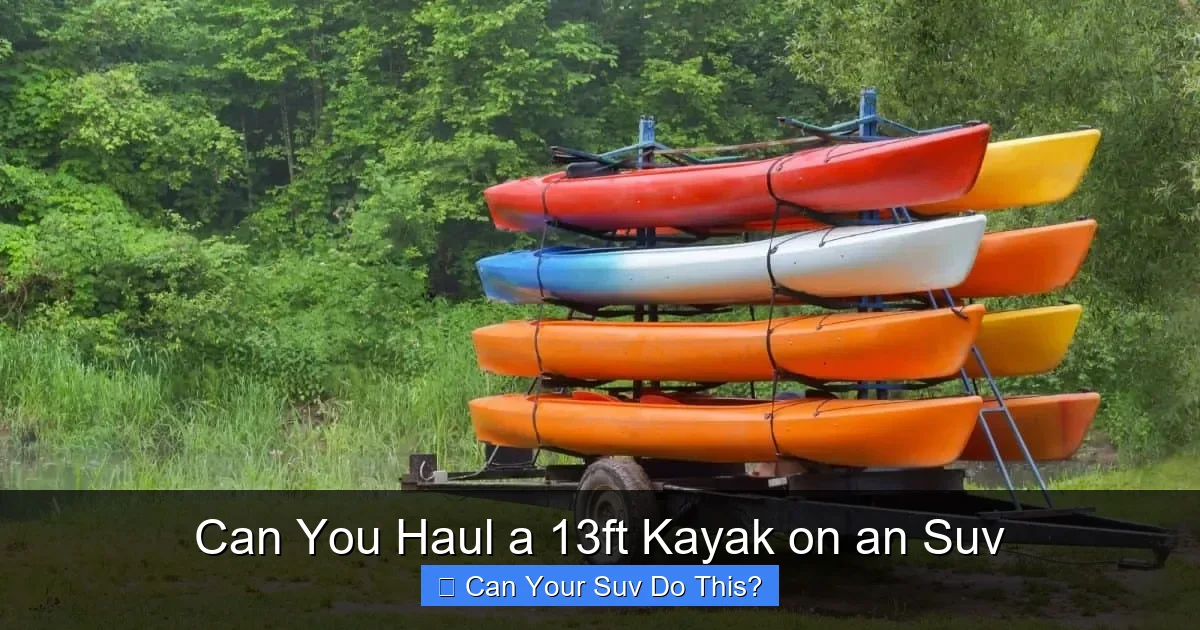
Visual guide about Can You Haul a 13ft Kayak on an Suv
Image source: watersportswhiz.com
If you’re serious about kayaking, investing in a quality roof rack system is one of the best decisions you can make. Roof racks are the most secure, reliable, and widely used method for hauling a 13ft kayak on an SUV. They’re designed to distribute weight evenly, reduce wind resistance, and keep your kayak firmly in place—even at highway speeds.
There are several types of roof rack systems, each with its own pros and cons. Let’s break them down.
J-Style Kayak Carriers
J-style carriers are shaped like the letter “J” and hold the kayak on its side. They’re popular because they take up less roof space than other styles, leaving room for bikes, cargo boxes, or a second kayak. They’re also relatively easy to load, especially if you have a helper.
Most J-style carriers can handle kayaks up to 14 feet long and 35 inches wide, making them perfect for a 13ft model. They typically clamp onto your crossbars and include padded arms to protect the kayak’s hull. Some models even have locking mechanisms to deter theft.
One downside: J-style carriers can make your vehicle taller, which might be an issue in low-clearance areas like parking garages. Also, because the kayak sits at an angle, it can catch more wind, potentially affecting fuel efficiency.
Saddle-Style Carriers
Saddle carriers hold the kayak upright, resting it directly on the crossbars with padded supports on either side. This style is great for long, heavy kayaks because it provides excellent support along the hull. It also keeps the kayak low and centered, reducing wind drag.
Saddle carriers are often used in pairs—one at the front and one at the back—to create a stable cradle. They’re ideal for touring or sea kayaks, which are longer and more sensitive to flexing.
The main drawback? They take up more roof space. If you’re carrying just one kayak, you might not be able to fit much else up top. Also, loading a heavy kayak onto a saddle carrier can be tricky without help.
Stack-Style Carriers
Stack carriers allow you to carry multiple kayaks by stacking them vertically. They’re less common for single-kayak users but can be useful if you’re transporting gear for a group or family trip.
These carriers use vertical posts that clamp to the crossbars, with padded arms that hold each kayak in place. They’re strong and secure but can make your vehicle very tall—sometimes over 9 feet. That’s a problem if you’re driving under bridges or into tight spaces.
For a single 13ft kayak, stack-style carriers are usually overkill. But if you plan to expand your fleet, they’re worth considering.
Universal vs. Vehicle-Specific Racks
When shopping for roof racks, you’ll see two main types: universal and vehicle-specific. Universal racks are adjustable and can fit a wide range of vehicles, but they may not provide the same level of security or aerodynamics as custom-fit systems.
Vehicle-specific racks are designed for your exact SUV model. They often attach directly to factory mounting points, offering a cleaner look and better weight distribution. They’re usually more expensive, but the peace of mind is worth it.
Brands like Thule, Yakima, and Malone offer high-quality, vehicle-specific rack systems. They also provide online fit guides so you can confirm compatibility before buying.
Foam Blocks: A Budget-Friendly Alternative
Not everyone wants to spend hundreds on a roof rack system—and that’s okay. If you’re on a tight budget or only plan to transport your kayak occasionally, foam blocks can be a viable alternative.
Foam blocks are simple padded cushions that sit directly on your SUV’s roof, with straps that loop over the kayak and through the doors. They’re inexpensive (usually $30–$60 for a set), easy to store, and don’t require permanent installation.
They work best on vehicles with a flat, wide roof—like many SUVs. A 13ft kayak will fit comfortably across the roof of most midsize to large SUVs, such as the Toyota Highlander, Subaru Ascent, or Jeep Grand Cherokee.
But here’s the catch: foam blocks are less secure than roof racks. They rely on the friction between the foam and the roof, plus the tension of the straps. At high speeds or in windy conditions, there’s a risk of the kayak shifting or even lifting off the roof.
To improve safety, always use **bow and stern lines**—additional straps that connect the front and back of the kayak to the vehicle’s bumper or tow hooks. These lines prevent the kayak from sliding forward or backward and help resist wind lift.
Also, avoid using foam blocks on vehicles with sunroofs, soft tops, or fragile roof panels. The pressure from the straps can damage these features.
Foam blocks are best for short trips on calm days. If you’re driving more than 50 miles or planning to hit the highway, consider upgrading to a proper rack system.
Using a Kayak Trailer: When Roof Space Isn’t Enough
For some kayakers, a trailer is the ultimate solution. If you’re hauling multiple kayaks, a heavy tandem model, or frequently traveling long distances, a trailer offers unmatched stability and convenience.
Kayak trailers are small, single-axle units designed specifically for watercraft. They typically have a flat bed with padded cradles or upright posts to hold the kayak in place. Most can carry one or two kayaks, though larger models exist.
One major advantage of trailers is that they don’t put any weight on your SUV’s roof. This means you can still use your roof for cargo boxes, bikes, or other gear. It also eliminates concerns about roof load limits or wind resistance.
Trailers also make loading and unloading much easier—especially if you’re doing it alone. You can roll the kayak onto the trailer at ground level, rather than lifting it overhead.
But trailers aren’t without drawbacks. First, you need a hitch. Most SUVs come with a factory-installed hitch or can be fitted with one, but it’s an added expense (typically $200–$500 for installation). You’ll also need to register the trailer in most states, which involves fees and paperwork.
Storage is another issue. Trailers take up space in your garage or driveway, and not everyone has room for one. They’re also less convenient for quick trips—hooking up and unhitching takes time.
Still, if you’re a serious kayaker or frequently transport gear, a trailer can be a worthwhile investment. Look for models with galvanized frames (to resist rust), LED lights, and a tilt bed for easier loading.
Securing Your Kayak: The Importance of Proper Tie-Downs
No matter which transport method you choose, securing your kayak properly is critical. A loose kayak can shift, flap, or even fly off your SUV—causing damage to your vehicle, other drivers, or yourself.
The golden rule: **always use at least four tie-down points**. That means two straps over the kayak (front and back) and two bow and stern lines.
Cam Straps vs. Ratchet Straps
Cam straps are the most common choice for kayak transport. They’re easy to use, don’t overtighten, and won’t damage your kayak’s hull. Look for straps with padded buckles and a length of at least 10 feet.
Ratchet straps are stronger and provide more tension, but they can be overkill for kayaks. If you use them, be very careful not to overtighten—this can warp the hull or damage the rack.
Bow and Stern Lines
These are essential. Bow and stern lines connect the front (bow) and back (stern) of the kayak to the vehicle’s bumper, tow hooks, or frame. They prevent the kayak from moving forward or backward and help resist wind lift at high speeds.
Use sturdy rope or webbing, and make sure the attachment points on your SUV are strong. Avoid clipping to plastic trim or weak hooks.
Checking Your Load
Before hitting the road, do a quick safety check:
– Are all straps tight and secure?
– Are the bow and stern lines attached?
– Is the kayak centered on the roof or trailer?
– Can you wiggle the kayak? It should move no more than an inch in any direction.
Drive slowly for the first few minutes and listen for unusual noises. If something feels off, pull over and recheck your setup.
Loading and Unloading Tips for Solo Users
Let’s face it—loading a 13ft kayak onto an SUV isn’t easy, especially if you’re doing it alone. But with the right technique, it’s totally doable.
Use a Kayak Loader
A kayak loader is a simple device that helps you slide the kayak onto the roof. It usually consists of a padded ramp that rests on the roof and a strap to guide the kayak up. Some models attach to the rear bumper or hitch.
These tools can save your back and make solo loading much safer.
The “Lift and Slide” Method
If you don’t have a loader, try this:
1. Position the kayak parallel to the SUV, with the bow facing the front.
2. Lift the stern (back) of the kayak and rest it on the roof.
3. Walk to the front and lift the bow, sliding the kayak fully onto the roof.
4. Center it and secure it with straps.
Use your legs, not your back, and take your time. If the kayak feels too heavy, don’t hesitate to ask for help.
Protect Your Vehicle and Kayak
Place a towel or foam pad under the kayak where it contacts the roof to prevent scratches. Avoid dragging the kayak across the paint.
Also, be mindful of your SUV’s height when driving under low bridges, drive-thrus, or parking garages. A 13ft kayak can add 12–18 inches to your vehicle’s height.
Real-World Examples: Which SUVs Handle a 13ft Kayak Best?
Let’s look at a few popular SUV models and how they perform with a 13ft kayak.
Toyota RAV4
The RAV4 is a compact SUV with a dynamic roof load limit of 150 lbs. With a 60-lb kayak and a 15-lb rack, you’re well within limits. Factory roof rails make it easy to install crossbars. J-style carriers work great here.
Ford Explorer
This midsize SUV has a 165-lb roof capacity and wide roof rails. It’s ideal for saddle or J-style carriers. The higher roofline makes loading easier, though it adds height.
Jeep Wrangler
The Wrangler has a lower roof capacity (100 lbs) and a curved roof, which can make rack installation tricky. Foam blocks or a trailer may be better options. Avoid roof racks if you have a soft top.
Subaru Outback
Though technically a wagon, the Outback is SUV-like in function. It has a 150-lb roof limit and excellent factory crossbars. A 13ft kayak fits perfectly with a J-style carrier.
Final Thoughts: Yes, Your SUV Can Do This
So, can you haul a 13ft kayak on an SUV? Absolutely. With the right equipment, a little planning, and attention to safety, your SUV can become your go-to adventure vehicle.
Whether you choose roof racks, foam blocks, or a trailer, the key is to match your setup to your needs, budget, and vehicle capabilities. Always respect weight limits, use proper tie-downs, and practice loading before your first big trip.
Remember, the goal isn’t just to get your kayak to the water—it’s to do it safely, confidently, and without damaging your gear or your SUV. Once you’ve got the hang of it, you’ll wonder how you ever lived without it.
Now grab your paddle, load up your kayak, and hit the water. Your next adventure is waiting.
Frequently Asked Questions
Can I haul a 13ft kayak on a small SUV?
Yes, many small SUVs like the Honda CR-V or Mazda CX-5 can carry a 13ft kayak if they have proper roof racks and stay within the dynamic roof load limit (usually 100–150 lbs). Always check your vehicle’s specifications first.
Do I need a special rack for a 13ft kayak?
Not necessarily. Most standard kayak carriers are designed to handle kayaks up to 14 feet long. J-style and saddle carriers work well, as long as they’re securely mounted to compatible crossbars.
Can I use foam blocks on a sunroof?
It’s not recommended. The pressure from straps can damage sunroofs or fragile roof panels. Use foam blocks only on solid, flat roofs without sunroofs or panoramic glass.
How do I prevent wind lift when driving?
Use bow and stern lines in addition to roof straps. These lines anchor the front and back of the kayak to the vehicle, preventing it from lifting in strong winds or at high speeds.
Is it safe to drive long distances with a kayak on the roof?
Yes, as long as the kayak is properly secured and your SUV’s roof capacity isn’t exceeded. Check straps periodically during long trips and avoid sudden maneuvers.
Can I carry two 13ft kayaks on one SUV?
It depends on your roof space and weight limit. Some SUVs can handle two kayaks with stack-style carriers or a trailer. Always ensure the total weight (kayaks + racks) stays under the dynamic roof load limit.