
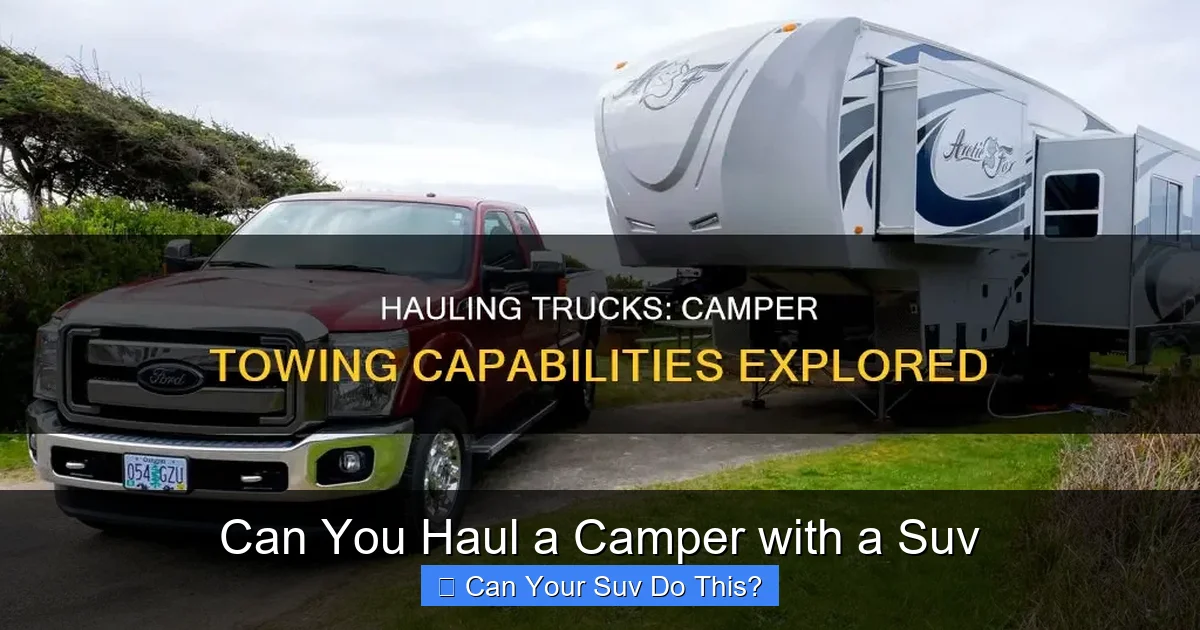
Yes, you can haul a camper with an SUV—but only if your vehicle has the right towing capacity and setup. Not all SUVs are built equal when it comes to towing, so it’s crucial to match your SUV’s capabilities with the weight and type of camper you plan to pull.
So, you’ve got an SUV—maybe a rugged Jeep Grand Cherokee, a family-friendly Honda Pilot, or a sleek Toyota Highlander—and you’re dreaming of weekend getaways under the stars. You’ve found the perfect little camper, packed your cooler, and mapped out a scenic route. But then reality hits: *Can you actually haul a camper with your SUV?*
The short answer? **Yes—but it depends.** Just because your SUV has a hitch doesn’t mean it’s ready to pull a 5,000-pound travel trailer up a mountain pass. Towing a camper isn’t just about horsepower; it’s about matching your vehicle’s capabilities with the demands of the load. Many SUVs today are surprisingly capable, especially newer models designed with adventure in mind. But without the right knowledge, you could end up with a dangerous situation on the road—or worse, damage to your vehicle.
In this guide, we’ll walk you through everything you need to know about hauling a camper with an SUV. From understanding towing capacity to choosing the right camper and equipment, we’ll help you make smart, safe decisions so you can hit the road with confidence. Whether you’re a weekend warrior or planning a cross-country trip, this article will give you the tools to determine if your SUV is up for the job—and how to do it right.
Key Takeaways
- Check your SUV’s towing capacity: This is the maximum weight your SUV can safely tow, found in the owner’s manual or manufacturer’s website.
- Know your camper’s weight: Include the dry weight plus gear, water, propane, and passengers to get the true loaded weight.
- Choose the right hitch and equipment: A Class III or IV hitch, brake controller, and sway bars are often necessary for safe towing.
- Consider drivetrain and engine power: All-wheel drive (AWD) or four-wheel drive (4WD) SUVs often handle towing better than front-wheel drive models.
- Drive cautiously and practice: Towing changes handling, braking, and visibility—practice in empty parking lots before hitting the road.
- Maintain your SUV regularly: Towing puts extra strain on brakes, transmission, and cooling systems—routine checks are essential.
- Not all campers work with every SUV: Small travel trailers or pop-up campers are best for mid-size SUVs; larger fifth wheels need heavy-duty trucks.
📑 Table of Contents
- Understanding Towing Capacity: The Foundation of Safe Hauling
- Matching Your SUV to the Right Type of Camper
- Essential Towing Equipment: What You Need to Get Right
- Driving Tips for Towing a Camper with Your SUV
- Maintenance and Safety Checks Before You Go
- Real-World Examples: SUVs That Can (and Can’t) Tow Campers
- Final Thoughts: Is Your SUV Ready?
Understanding Towing Capacity: The Foundation of Safe Hauling
Before you even think about attaching a camper to your SUV, you need to know one critical number: your vehicle’s **towing capacity**. This is the maximum weight your SUV can safely pull, as determined by the manufacturer. It’s not a suggestion—it’s a hard limit designed to protect your vehicle, your passengers, and other drivers on the road.
Towing capacity varies widely between SUV models and even between different trims of the same vehicle. For example, a base-model Ford Explorer might tow 5,000 pounds, while a higher-trim Explorer with the tow package can handle up to 5,600 pounds. Similarly, a Toyota RAV4 typically maxes out around 1,500 to 3,500 pounds, depending on the engine and drivetrain, while a Chevy Tahoe can tow up to 8,400 pounds.
So where do you find this number? Start with your owner’s manual—it’s the most reliable source. You can also check the manufacturer’s website or look for a sticker on the driver’s side door jamb that lists towing specs. Some automakers even provide online towing calculators where you input your vehicle’s VIN to get precise details.
But here’s the catch: **towing capacity isn’t just about the engine.** It also depends on factors like the transmission, cooling system, suspension, and whether your SUV has a factory-installed tow package. A tow package often includes a heavy-duty radiator, upgraded brakes, a transmission cooler, and a wiring harness for trailer lights. Without these, even a high-capacity SUV might struggle under load.
Let’s say you drive a 2022 Subaru Outback. Its towing capacity is 2,700 pounds—enough for a small pop-up camper or a lightweight teardrop trailer. But if you load that camper with gear, water, and a couple of bikes, you could easily exceed that limit. That’s why it’s not enough to just know the number—you need to understand what it means in real-world terms.
Why Towing Capacity Matters More Than You Think
Exceeding your SUV’s towing capacity is dangerous. It can lead to brake failure, transmission overheating, loss of control, and even complete vehicle breakdown. On steep inclines or during sudden stops, an overloaded trailer can push your SUV off the road or cause a jackknife.
Even if you stay under the limit, improper weight distribution can be just as risky. Trailers should have about 10–15% of their total weight on the tongue (the part that connects to the hitch). Too little tongue weight, and the trailer can sway; too much, and it can overload the rear suspension and reduce steering control.
So, always calculate the **fully loaded weight** of your camper—not just the dry weight listed by the manufacturer. Add in water tanks, propane, food, clothing, bikes, and any other gear. A 3,000-pound dry camper can easily weigh 4,000 pounds or more when fully equipped.
Matching Your SUV to the Right Type of Camper
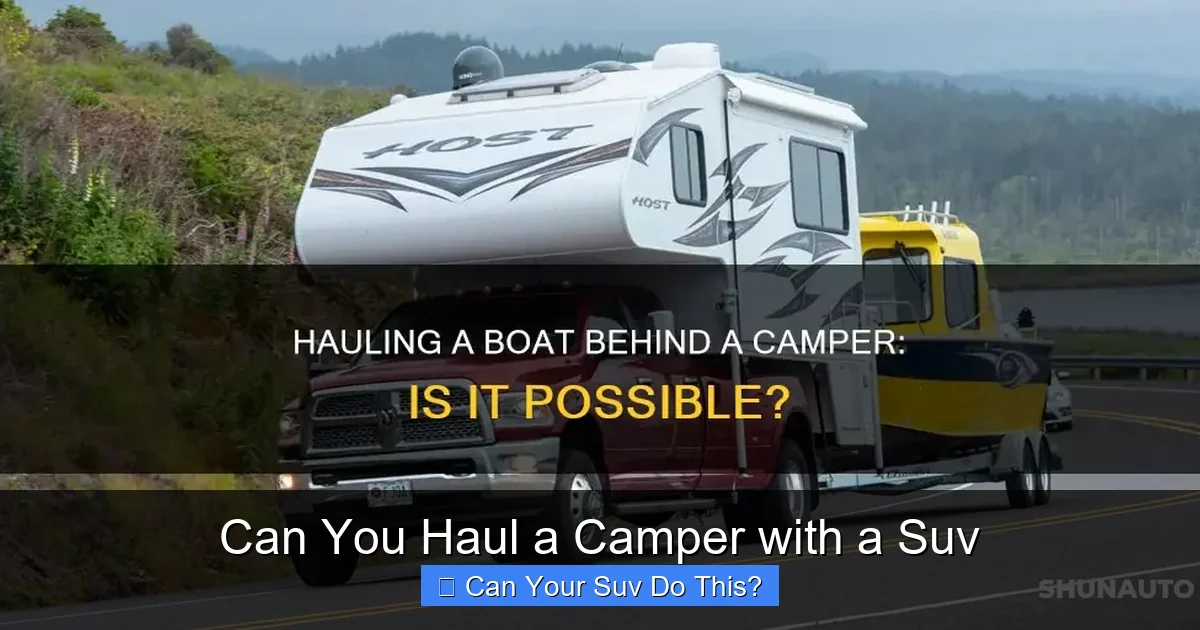
Visual guide about Can You Haul a Camper with a Suv
Image source: shunauto.com
Not all campers are created equal—and neither are SUVs. The key to a successful towing experience is matching your vehicle’s capabilities to the right kind of camper. Let’s break down the most common types of campers and which SUVs can handle them.
Pop-Up Campers: The Lightweight Option
Pop-up campers (also called tent trailers) are a great starting point for SUV owners. They’re compact, lightweight, and fold down for easy storage and better aerodynamics while driving. Most pop-ups weigh between 1,500 and 3,500 pounds when loaded, making them ideal for smaller SUVs like the Honda CR-V, Toyota RAV4, or Subaru Forester.
These campers are perfect for weekend trips, national park visits, or casual camping. They offer basic amenities like sleeping areas, small kitchens, and sometimes even bathrooms. Because they’re light, they put less strain on your SUV’s engine and brakes, and they’re easier to maneuver on tight roads.
One popular example is the Jayco Jay Series pop-up, which weighs around 2,200 pounds dry. Paired with a 2023 Ford Escape with a 3,500-pound towing capacity, it’s a safe and practical combo for a family of four.
Travel Trailers: Mid-Size Adventure Machines
Travel trailers are the most common type of camper and come in a wide range of sizes and styles. They’re fully enclosed, with kitchens, bathrooms, and sleeping areas, and they range from 3,000 to 8,000 pounds or more.
For these, you’ll need a mid-size to full-size SUV with a towing capacity of at least 5,000 pounds. Models like the Toyota Highlander, Hyundai Palisade, or Ford Explorer are solid choices. The 2023 Chevrolet Traverse, for instance, can tow up to 5,000 pounds—enough for a 4,500-pound travel trailer like the Winnebago Micro Minnie.
Keep in mind that larger travel trailers require more power, better brakes, and often a weight distribution hitch. They also affect your SUV’s fuel economy significantly—expect a 20–30% drop in MPG when towing.
Teardrop Trailers: Compact and Cool
Teardrop trailers are tiny, stylish, and ultra-lightweight—usually under 2,000 pounds. They’re perfect for solo travelers or couples who want a cozy, minimalist setup. Many teardrops don’t even have bathrooms, relying on external camp facilities.
Because of their low weight, almost any SUV with a hitch can pull a teardrop. Even a compact SUV like the Mazda CX-5 (with a 2,000-pound capacity) can handle one. Popular models include the Little Guy Mini Max and the Happier Camper HC1.
These trailers are aerodynamic and easy to tow, making them ideal for long road trips or off-grid adventures. Just remember: space is limited, so pack light!
Fifth Wheel and Large Trailers: Not for Most SUVs
Fifth wheel trailers and large toy haulers are heavy—often 10,000 pounds or more—and require a pickup truck with a special hitch in the bed. Most SUVs simply aren’t designed to handle this kind of load.
Even the largest SUVs, like the Ford Expedition or GMC Yukon XL, max out around 8,000–9,000 pounds. That’s not enough for a typical fifth wheel. If you’re dreaming of a luxury fifth wheel with a full kitchen, master bedroom, and garage for ATVs, you’ll likely need to upgrade to a heavy-duty truck.
Essential Towing Equipment: What You Need to Get Right
You can’t just hook a camper to your SUV and hit the road. Safe towing requires the right equipment. Skipping any of these components can lead to dangerous situations, damage, or even accidents.
The Right Hitch: Class Matters
Hitches come in different classes based on their weight capacity:
– **Class I:** Up to 2,000 pounds (for small trailers or bike racks)
– **Class II:** Up to 3,500 pounds (common for compact SUVs)
– **Class III:** Up to 6,000 pounds (standard for mid-size SUVs)
– **Class IV:** Up to 10,000 pounds (for large SUVs and trucks)
Most campers require at least a Class III hitch. Make sure your hitch is rated for the weight you’re towing—and that it’s properly installed. A professional installation is worth the cost for peace of mind.
Weight Distribution and Sway Control
When towing a heavier camper, a standard ball mount isn’t enough. You’ll need a **weight distribution hitch**, which spreads the tongue weight across all four wheels of your SUV. This improves stability, steering, and braking.
Sway control devices—like friction bars or dual-cam systems—help prevent the trailer from fishtailing, especially in windy conditions or when passing trucks. These are essential for travel trailers over 4,000 pounds.
Brake Controller: Non-Negotiable for Heavy Loads
If your camper has electric brakes (most do over 3,000 pounds), you need a **brake controller** inside your SUV. This device lets you manually activate the trailer’s brakes and adjust their sensitivity.
Without a brake controller, your SUV’s brakes alone may not be enough to stop the combined weight of the vehicle and trailer—especially downhill. Most modern SUVs can have a brake controller installed, even if it’s not factory-equipped.
Wiring Harness and Lights
Your camper’s brake lights, turn signals, and running lights must sync with your SUV. A 4-pin or 7-pin wiring harness connects the two. Make sure all lights work before every trip—broken lights are a common cause of towing tickets and accidents.
Tire Pressure and Load Ratings
Towing puts extra stress on your SUV’s tires. Check the tire pressure regularly and ensure your tires are rated for the load. Consider upgrading to higher-load-range tires if you plan to tow frequently.
Driving Tips for Towing a Camper with Your SUV
Towing changes everything about how your SUV handles. It’s heavier, slower to accelerate, and harder to stop. Here’s how to drive safely with a camper in tow.
Slow Down and Leave More Space
Always drive below the speed limit when towing. High speeds increase sway and reduce control. Leave at least 5–6 seconds of following distance behind the vehicle in front of you—double the normal gap.
Practice in a Safe Area
Before your first real trip, practice in an empty parking lot. Try turning, backing up, and braking. Backing up a trailer is counterintuitive—turn the wheel in the opposite direction you want the trailer to go.
Use Lower Gears on Hills
When climbing or descending steep grades, shift into a lower gear (like “L” or “2”) to reduce strain on the engine and brakes. This is called “engine braking” and helps prevent overheating.
Watch for Wind and Traffic
Strong crosswinds can push your trailer sideways. Grip the wheel firmly and make small corrections. When large trucks pass, they create turbulence—be ready to steady the wheel.
Plan Your Route
Avoid narrow roads, low bridges, and tight turns. Use GPS apps that support RV or trailer routing, like RV LIFE or CoPilot RV. These can help you avoid roads with low clearances or weight restrictions.
Maintenance and Safety Checks Before You Go
Towing puts extra wear on your SUV. A little maintenance goes a long way in preventing breakdowns.
Check Fluids and Cooling Systems
Engine oil, transmission fluid, and coolant should all be at proper levels. Towing generates more heat, so ensure your radiator and transmission cooler are clean and functioning.
Inspect Brakes and Suspension
Have your brakes checked before a long trip. Worn pads or rotors can fail under heavy load. Also, inspect shocks and struts—sagging suspension affects handling.
Test All Lights and Connections
Before every trip, walk around the camper and test brake lights, turn signals, and running lights. Make sure the hitch is secure and the safety chains are crossed under the tongue.
Secure Your Load
Use straps or bungee cords to keep gear from shifting inside the camper. Loose items can become dangerous projectiles in a sudden stop.
Real-World Examples: SUVs That Can (and Can’t) Tow Campers
Let’s look at a few real-world scenarios to see how different SUVs stack up.
Example 1: Honda CR-V Towing a Pop-Up
The 2023 Honda CR-V has a towing capacity of 1,500 pounds (with the right package). That’s enough for a lightweight pop-up like the Aliner Classic, which weighs about 1,800 pounds loaded. With proper equipment and careful loading, this combo works for weekend trips—but not for long hauls or heavy gear.
Example 2: Ford Explorer Towing a Travel Trailer
The 2023 Ford Explorer with the Class III tow package can tow up to 5,600 pounds. That’s perfect for a 4,800-pound travel trailer like the Forest River R-Pod. With a weight distribution hitch and brake controller, this setup is safe and capable for family vacations.
Example 3: Toyota RAV4 Towing a Teardrop
The RAV4 Hybrid can tow 1,500 pounds—enough for a 1,200-pound teardrop like the Retro by Happier Camper. It’s a great match for solo travelers or couples who want efficiency and style.
When It Doesn’t Work: Jeep Cherokee and a Large Trailer
The Jeep Cherokee maxes out at 4,500 pounds. Trying to tow a 5,500-pound travel trailer is a recipe for trouble. The engine will struggle, brakes will overheat, and handling will be compromised. In this case, it’s better to downsize the camper or upgrade the vehicle.
Final Thoughts: Is Your SUV Ready?
So, can you haul a camper with an SUV? The answer is a resounding **yes—if you do it right**. Many modern SUVs are more than capable of towing small to mid-size campers, especially with the right equipment and preparation.
But it’s not just about power. It’s about responsibility. Know your limits, respect the weight, and never cut corners on safety. A well-matched SUV and camper combo can open the door to unforgettable adventures—quiet lakeside mornings, mountain sunrises, and star-filled nights far from the city.
Before you buy that camper, ask yourself:
– What’s my SUV’s towing capacity?
– How much does my camper weigh—fully loaded?
– Do I have the right hitch, brakes, and lights?
– Am I prepared to drive differently?
If you can answer “yes” to all of these, you’re ready to roll. And if not? No shame in starting small. A pop-up or teardrop camper is a great way to test the waters. As your confidence—and your SUV’s capabilities—grow, so can your adventures.
Towing a camper with an SUV isn’t just possible—it’s a smart, flexible way to explore the great outdoors. With the right knowledge and preparation, your SUV can be your gateway to freedom on the open road.
Frequently Asked Questions
Can any SUV tow a camper?
Not all SUVs can tow a camper. It depends on the vehicle’s towing capacity, which varies by make, model, and trim. Smaller SUVs like the Honda CR-V may only handle lightweight pop-ups, while larger models like the Ford Expedition can tow heavier travel trailers.
What’s the average towing capacity of an SUV?
The average towing capacity for a mid-size SUV is around 3,500 to 5,000 pounds. Compact SUVs typically range from 1,500 to 3,500 pounds, while full-size SUVs can often tow 7,000 pounds or more, especially with a tow package.
Do I need a special hitch to tow a camper?
Yes, you’ll need at least a Class III hitch for most campers. Heavier trailers may require a weight distribution hitch and sway control system. Always use a hitch rated for your camper’s weight and have it professionally installed.
Can I tow a camper without a brake controller?
If your camper has electric brakes (usually over 3,000 pounds), you must have a brake controller. It allows you to activate the trailer’s brakes from inside your SUV and is essential for safe stopping, especially on hills.
How does towing affect my SUV’s fuel economy?
Towing significantly reduces fuel economy—often by 20–30% or more. The heavier the camper and the faster you drive, the greater the impact. Plan for more frequent fuel stops and higher costs on long trips.
Can I tow a camper with a hybrid SUV?
Yes, many hybrid SUVs like the Toyota Highlander Hybrid or Ford Escape Hybrid can tow campers. However, check the specific towing capacity, as hybrid systems may have different limits than gas-only versions. Always follow manufacturer guidelines.