
Yes, you can increase SUV towing capacity—but only up to a point. With the right upgrades like suspension enhancements, cooling systems, and brake improvements, many SUVs can safely handle more weight. However, never exceed the manufacturer’s gross combined weight rating (GCWR) or compromise structural integrity.
So, you’ve got an SUV—maybe it’s a midsize like a Toyota Highlander or a full-size beast like a Ford Expedition—and you’re eyeing that shiny new travel trailer, boat, or utility hauler. But there’s one big question hanging over your plans: *Can you increase SUV towing capacity?*
The short answer? Yes… but with serious caveats. Unlike tuning a sports car for speed, boosting towing isn’t just about slapping on a few aftermarket parts and hoping for the best. Towing involves physics, engineering limits, and real-world safety. Your SUV was designed with specific capabilities in mind—and pushing beyond those without proper understanding can lead to blown transmissions, brake failure, or even catastrophic accidents.
That said, many SUV owners successfully tow heavier loads than their stock ratings suggest—thanks to smart, targeted upgrades that work *within* the vehicle’s structural and mechanical boundaries. The key is knowing what you can safely modify, what you should avoid, and when it’s time to admit your current ride just isn’t cut out for the job.
In this guide, we’ll walk you through everything you need to know about increasing your SUV’s towing capacity—from essential upgrades to critical safety checks—so you can hit the road with confidence (and your gear in tow).
Key Takeaways
- Understand your SUV’s limits: Always check the owner’s manual for factory-rated towing capacity and GCWR before making any modifications.
- Upgrade suspension systems: Heavy-duty shocks, air springs, and sway bars improve stability and load distribution when towing heavier loads.
- Enhance braking performance: Install trailer brake controllers and high-performance brake pads to safely stop increased weight.
- Improve engine cooling: Add auxiliary transmission coolers and engine oil coolers to prevent overheating during long or steep tows.
- Use proper towing equipment: Weight-distribution hitches and sway control devices maximize safety and control with heavier trailers.
- Avoid illegal or unsafe mods: Never alter frame rails or engine internals solely to increase towing—these can void warranties and create hazards.
- Consider a different vehicle: If you regularly need more than 8,000 lbs of towing, a truck or heavy-duty SUV may be a safer long-term solution.
📑 Table of Contents
Know Your SUV’s True Towing Limits
Before you even think about modifications, you must understand your SUV’s baseline capabilities. Every vehicle comes with a factory-rated towing capacity, but this number isn’t arbitrary—it’s based on rigorous testing of the engine, transmission, frame, axles, brakes, and cooling systems.
Start by checking your owner’s manual or the manufacturer’s website. Look for two key numbers:
– **Towing Capacity**: The maximum weight your SUV can pull (e.g., 5,000 lbs).
– **Gross Combined Weight Rating (GCWR)**: The total allowable weight of your loaded SUV plus the fully loaded trailer.
For example, a 2023 Honda Pilot has a towing capacity of 5,000 lbs when properly equipped—but its GCWR is around 10,200 lbs. If your loaded SUV weighs 5,200 lbs, you can only tow up to 5,000 lbs. Exceed that, and you’re risking damage or loss of control.
Why Factory Ratings Matter
Manufacturers set these limits not to limit your fun, but to ensure safety under real-world conditions—like mountain passes, sudden stops, or crosswinds. They also account for wear and tear over time. Ignoring these ratings means you’re operating outside the vehicle’s engineered safety envelope.
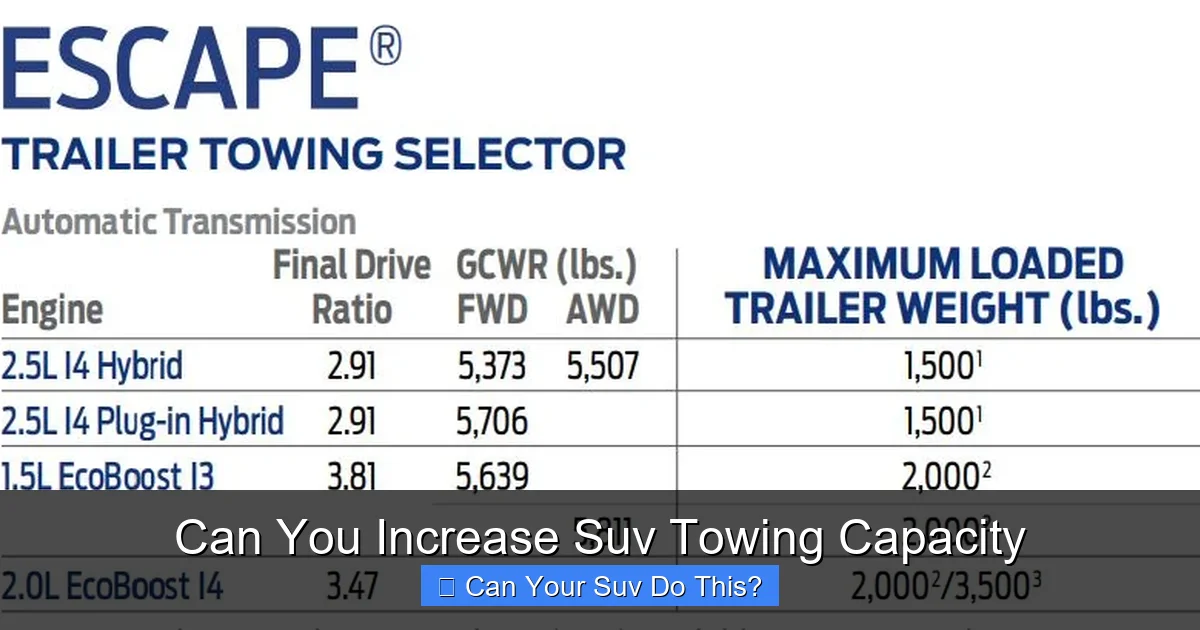
Pro tip: Use online towing calculators (like those from Reese or Curt) to input your exact SUV model, year, engine, drivetrain, and equipment package. These tools give you a precise towing capacity—not just a generic estimate.
Legitimate Ways to Increase Towing Capacity
Visual guide about Can You Increase Suv Towing Capacity
Image source: towstats.com
Now that you know your starting point, let’s explore proven methods to safely boost your SUV’s towing performance. Remember: the goal isn’t to wildly exceed factory limits, but to optimize what your vehicle can already handle—and possibly unlock hidden potential if it wasn’t “properly equipped” from the factory.
Many SUVs come in multiple trims, and lower trims often lack towing packages. If your SUV has the same engine and frame as a higher trim that tows more, you might be able to add those missing components legally and safely.
Install a Towing Package (If Not Already Equipped)
A factory towing package typically includes:
– Heavy-duty radiator
– Upgraded alternator
– Transmission cooler
– Trailer hitch receiver
– Wiring harness
– Reinforced suspension
If your SUV didn’t come with one, check if the manufacturer offers a retrofit kit. For instance, Toyota sells genuine towing packages for many Highlander and 4Runner models. These are designed to integrate seamlessly and maintain warranty coverage.
Upgrade Your Suspension System
When you tow, your SUV’s rear end sags, shifting weight forward and reducing steering control. Heavy-duty suspension components help maintain level ride height and improve stability.
Consider these upgrades:
– **Air Helper Springs** (like Firestone Ride-Rite): Inflatable air bags that sit inside your rear coil springs. They adjust automatically based on load and can add 1,000–2,000 lbs of support.
– **Heavy-Duty Shocks**: Brands like Bilstein or KYB offer shocks designed for towing, reducing bounce and sway.
– **Sway Bars**: Upgraded rear sway bars minimize trailer-induced rocking.
Real-world example: A 2020 Subaru Ascent owner added air springs and saw a noticeable improvement in handling when towing a 6,000-lb camper—even though the Ascent’s max rating is 5,000 lbs. But note: they stayed within the GCWR and didn’t exceed the axle ratings.
Enhance Braking Performance
Stopping power is critical when towing. Your SUV’s stock brakes may struggle with extra weight, especially downhill.
Solutions include:
– **Trailer Brake Controller**: Required for trailers over 3,000 lbs in most states. It syncs your SUV’s brakes with electric brakes on the trailer.
– **High-Performance Brake Pads & Rotors**: Brands like Power Stop or EBC offer towing-specific kits that resist fade under heavy use.
– **Brake Booster Upgrade**: On older SUVs, a larger brake booster can improve pedal feel and stopping distance.
Never tow heavy loads without a brake controller—it’s not just unsafe, it’s illegal in many places.
Improve Cooling Systems
Towing puts massive strain on your engine and transmission. Overheating is a leading cause of towing-related breakdowns.
Add these coolers:
– **Transmission Cooler**: Mounts in front of the radiator and reduces trans fluid temps by 20–50°F. Essential for automatic transmissions under load.
– **Engine Oil Cooler**: Helps maintain optimal oil viscosity, especially in turbocharged engines.
– **Auxiliary Radiator**: For extreme conditions (desert towing, frequent hills), some owners add a secondary radiator.
Example: A Ford Explorer owner towing a 7,000-lb boat through Arizona added a dual-pass transmission cooler and avoided the dreaded “limp mode” on long climbs.
Use Proper Towing Accessories
Even with upgrades, your hitch and setup matter immensely.
Invest in:
– **Weight-Distribution Hitch**: Redistributes trailer tongue weight across all axles, improving ride quality and control. Can effectively increase usable towing capacity by reducing rear sag.
– **Sway Control Devices**: Friction or hydraulic bars that dampen side-to-side movement.
– **Properly Rated Hitch**: Ensure your receiver hitch matches or exceeds your trailer’s weight. Class III (6,000 lbs), Class IV (10,000 lbs), or Class V (12,000+ lbs).
Tip: Always use safety chains, breakaway brakes (for trailers over 1,500 lbs), and proper lighting connectors.
What You Should NEVER Do to Increase Towing
While the temptation to “push the limits” is real, some modifications are downright dangerous—or outright illegal.
Don’t Alter the Frame or Chassis
Cutting, welding, or reinforcing your SUV’s frame to “handle more weight” is a terrible idea. Modern SUVs use unibody construction (body and frame combined). Modifying it compromises crash safety and structural integrity. Plus, it voids your warranty and may violate DOT regulations.
Don’t Overload Axles
Each axle has a Gross Axle Weight Rating (GAWR). You can tow within your total capacity but exceed front or rear axle limits—and cause tire blowouts, suspension failure, or loss of steering.
Use a truck scale to weigh your loaded SUV and trailer at each axle. Many RV parks and truck stops offer this service for $10–$20.
Don’t Ignore Tire Ratings
Your tires must be rated for the total load. Check the sidewall for the Load Index (e.g., 110 = 1,764 lbs per tire). Upgrade to Load Range E (LT) tires if needed—they’re stiffer and handle heavier loads better than standard passenger (P) tires.
Never tow on worn, underinflated, or mismatched tires.
Don’t Assume Aftermarket “Towing Boosters” Work
Beware of gimmicks like “towing chips” or “performance tuners” that claim to increase towing by 2,000 lbs. Most only adjust shift points or fuel mapping—they don’t strengthen physical components. At best, they’re useless. At worst, they cause engine damage.
When Upgrades Aren’t Enough: Know When to Upgrade Your Vehicle
Let’s be honest: if you’re regularly towing 7,000+ lbs, your SUV might not be the right tool—even with mods.
Consider switching to:
– **Full-Size Truck-Based SUVs**: Like the Chevrolet Tahoe, GMC Yukon, or Lincoln Navigator. These share platforms with heavy-duty trucks and often have 8,000–9,000 lb capacities stock.
– **Heavy-Duty Trucks**: If you tow weekly, a Ford F-150, Ram 1500, or Toyota Tundra offers better cooling, stronger frames, and higher GCWRs.
– **Commercial-Grade Vehicles**: For 10,000+ lbs, look at Ford Super Duty or Chevrolet Silverado HD—but these aren’t daily drivers.
Ask yourself:
– How often do I tow?
– What’s the heaviest load I realistically need to pull?
– Am I comfortable with the added fuel cost, wear, and complexity?
Sometimes, the smartest “upgrade” is choosing the right vehicle from the start.
Real-World Example: Boosting a Toyota RAV4’s Towing
Let’s put this into practice. Say you own a 2022 Toyota RAV4 Hybrid (max towing: 1,750 lbs) and want to tow a small teardrop trailer weighing 1,600 lbs.
Can you increase its towing capacity? Technically, no—not meaningfully. The RAV4’s compact frame, CVT transmission, and front-wheel-drive bias aren’t built for heavy loads. Adding a transmission cooler or air springs won’t magically let you tow 5,000 lbs.
But you *can* tow safely within its limits by:
– Ensuring the trailer is properly balanced (60% weight forward of axles)
– Using a weight-distribution hitch (even for light loads)
– Avoiding mountainous terrain
– Checking tire pressure and brake function before every trip
The lesson? Know your vehicle’s design intent. Compact SUVs excel at fuel efficiency and city driving—not heavy hauling.
Final Tips for Safe Towing
Regardless of your SUV’s capacity or upgrades, follow these best practices:
– **Practice First**: Hook up your trailer in an empty parking lot. Test braking, turning, and reversing.
– **Distribute Weight Properly**: Keep 60% of trailer weight ahead of the axle. Avoid overloading the tongue (ideal: 10–15% of total trailer weight).
– **Check Local Laws**: Some states require special licenses or inspections for trailers over certain weights.
– **Inspect Regularly**: Before each trip, check hitch, lights, tires, brakes, and fluid levels.
– **Drive Defensively**: Allow extra following distance, avoid sudden moves, and use lower gears on descents.
Remember: increasing SUV towing capacity isn’t about breaking records—it’s about doing what you love safely and responsibly.
Frequently Asked Questions
Can I legally increase my SUV’s towing capacity?
You can legally enhance your SUV’s towing performance with approved upgrades like suspension kits, brake controllers, and coolers—but you cannot legally exceed the manufacturer’s Gross Combined Weight Rating (GCWR) or axle limits. Always comply with state and federal towing regulations.
Will adding a transmission cooler increase my towing capacity?
A transmission cooler won’t raise your official towing capacity, but it allows your SUV to tow closer to its rated limit without overheating. This is especially helpful in hot climates or when climbing hills with a heavy load.
Can I tow more than my SUV’s listed capacity if I upgrade the engine?
No. Engine upgrades like turbochargers or tuners may improve power, but they don’t strengthen the transmission, frame, or brakes. Towing beyond factory specs risks mechanical failure and voids your warranty.
Do I need a special license to tow heavy trailers with my SUV?
In most U.S. states, no special license is required for trailers under 10,000 lbs GVWR. However, some states mandate brake controllers or safety courses for larger trailers. Check your local DMV rules.
Are air suspension systems worth it for towing?
Yes—if you frequently tow near your SUV’s limit. Air springs maintain level ride height, improve stability, and reduce rear sag. They’re a cost-effective way to enhance control and safety without major modifications.
What’s the safest way to test if my modified SUV can handle a heavier load?
Never test by guessing. Use a certified truck scale to weigh your fully loaded SUV and trailer at each axle. Compare these weights to your vehicle’s GAWR and GCWR. If all numbers are within limits, you’re safe to proceed.