
Jump starting a Freightliner M2 with an SUV is possible, but it’s not as simple as hooking up cables and turning the key. Due to the M2’s heavy-duty electrical system and higher voltage demands, you’ll need heavy-duty jumper cables, a compatible SUV with a strong battery, and careful attention to safety. Done incorrectly, you risk damaging both vehicles or causing injury—so preparation and caution are essential.
So, your Freightliner M2 won’t start—again. You’re parked at a rest stop, the engine’s silent, and the dashboard lights are dim. You’ve got a fully charged SUV nearby, maybe a Ford Explorer or a Toyota 4Runner, and you’re wondering: *Can I use this to jump start my truck?*
The short answer? Yes—but with major caveats. Jump starting a commercial-grade vehicle like the Freightliner M2 isn’t the same as giving your Honda Civic a quick boost. The M2 is built for heavy-duty work, with a robust electrical system, larger batteries, and higher cranking demands. While an SUV *can* provide enough power in a pinch, doing it safely requires the right tools, knowledge, and respect for the risks involved.
This guide will walk you through everything you need to know about jump starting a Freightliner M2 using an SUV truck—from understanding the electrical systems to step-by-step procedures, safety tips, and when it’s better to call for professional help. Whether you’re a fleet manager, owner-operator, or just someone who occasionally drives a medium-duty truck, this information could save you time, money, and a potential disaster.
Key Takeaways
- Yes, it’s possible: An SUV can jump start a Freightliner M2, but only if the SUV has a robust 12-volt system and the right equipment.
- Use heavy-duty jumper cables: Standard cables won’t handle the current needed—opt for 2/0 or 4-gauge cables with strong clamps.
- Match voltage systems: Both the Freightliner M2 and your SUV must be 12-volt systems; never attempt to jump a 24-volt system with a 12-volt vehicle.
- Follow proper connection order: Connect positive to positive, negative to ground (not the dead battery’s terminal) to avoid sparks near flammable gases.
- Let the donor vehicle run: Keep the SUV engine running at moderate RPM to provide consistent power during the jump.
- Know when not to try: If the M2’s battery is swollen, leaking, or frozen, do not attempt a jump—call a professional.
- Consider alternatives: A portable jump starter designed for commercial trucks is often safer and more reliable than relying on an SUV.
📑 Table of Contents
Understanding the Freightliner M2’s Electrical System
Before you even think about connecting cables, it’s crucial to understand what you’re working with. The Freightliner M2 is a medium-duty commercial truck commonly used for delivery, construction, and utility work. Unlike passenger vehicles, it’s designed to handle heavy loads, frequent starts, and long idle times—all of which put extra strain on the electrical system.
Battery Configuration and Voltage
Most Freightliner M2 models run on a 12-volt electrical system, just like your SUV. However, they often use two 12-volt batteries connected in parallel to provide extra cranking amps (CCA). This setup increases the total available current without changing the voltage—so you’re still dealing with 12 volts, but with more power on tap.
Some older or specialized M2 models may use a 24-volt system, especially if they’re equipped with dual alternators or high-draw accessories. If you’re unsure, check the battery labels or consult the owner’s manual. **Never attempt to jump a 24-volt system with a 12-volt SUV—it won’t work and could damage both vehicles.**
Starter Motor and Cranking Demands
The M2’s diesel engine (commonly a Cummins ISB or Detroit DD5) requires significantly more current to turn over than a typical gasoline SUV engine. Cold weather, worn glow plugs, or a weak battery can make starting even harder. This means the jump-starting vehicle must be able to deliver a strong, steady flow of electricity—something not all SUVs can manage reliably.
For example, a Toyota RAV4 with a small 1.8L engine might struggle to provide enough current, while a Ford F-150 with a 5.0L V8 and a healthy battery stands a much better chance. The key is not just battery size, but the overall health and output capacity of the donor vehicle’s electrical system.
Alternator and Charging System
Once the M2 starts, its alternator takes over to recharge the batteries and power the electrical systems. However, during a jump start, the alternator isn’t yet active—so all the power must come from the SUV’s battery and charging system. If the SUV’s alternator is weak or the battery is low, it may not sustain the current needed to get the M2 running.
Can Your SUV Actually Handle the Job?
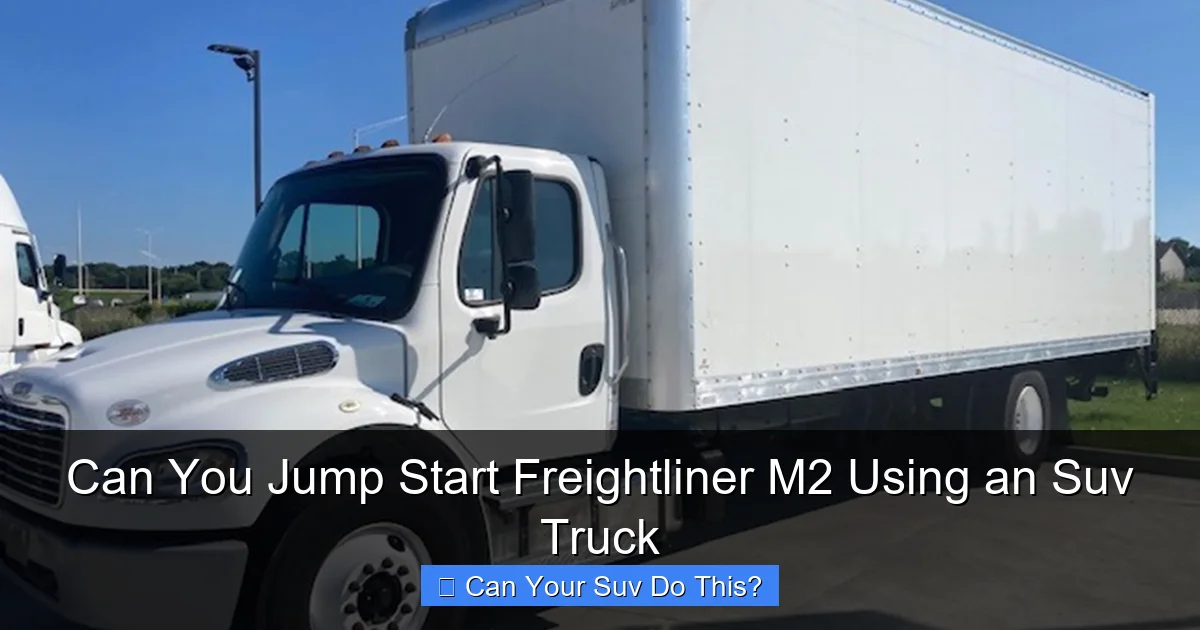
Visual guide about Can You Jump Start Freightliner M2 Using an Suv Truck
Image source: truckcountry.com
Not all SUVs are created equal when it comes to jump starting heavy-duty trucks. While many modern SUVs have powerful engines and robust electrical systems, there are limits to what they can safely deliver.
SUV Battery and Electrical Capacity
To successfully jump start a Freightliner M2, your SUV should have:
– A healthy, fully charged 12-volt battery
– A high-output alternator (typically 120+ amps)
– A gasoline or diesel engine with at least 3.5L displacement (larger is better)
SUVs like the Chevrolet Tahoe, GMC Yukon, or Nissan Armada are strong candidates. Compact SUVs like the Honda CR-V or Mazda CX-5 may lack the electrical muscle needed, especially in cold weather or if their own battery is aging.
Real-World Example: Jump Starting with a Ford Explorer
Let’s say you’re driving a 2020 Ford Explorer with a 3.3L V6 and a 12-volt, 70Ah battery. You come across a stranded Freightliner M2 with a dead battery. The Explorer’s battery is strong, and the alternator is rated at 150 amps—more than enough in theory.
But here’s the catch: the M2’s starter may demand 800–1000 amps to crank, especially if the engine is cold. The Explorer’s system can’t deliver that directly—but it doesn’t need to. The goal isn’t to power the starter directly, but to give the M2’s batteries enough charge to allow the starter to engage.
In practice, if the M2’s batteries aren’t completely dead (just low), the Explorer can often provide enough “boost” to get the truck started—especially if the SUV engine is revved to 1,500–2,000 RPM during the attempt.
When an SUV Isn’t Enough
There are situations where even a strong SUV won’t cut it:
– The M2’s batteries are completely dead or internally damaged
– The starter motor is seized or faulty
– The M2 has a 24-volt system
– The SUV’s battery is weak or the alternator is failing
In these cases, forcing a jump start can drain the SUV’s battery, damage its electrical system, or even cause a battery explosion. Always assess both vehicles before attempting a jump.
Essential Tools and Equipment
You can’t just grab any old set of jumper cables and hope for the best. Jump starting a Freightliner M2 requires heavy-duty equipment designed for high-current applications.
Heavy-Duty Jumper Cables
Standard 8-gauge or 6-gauge jumper cables are fine for cars, but they’re inadequate for trucks. For a Freightliner M2, you need:
– **2/0 or 4-gauge cables** (thicker = lower resistance = more current flow)
– **Copper-clad aluminum or pure copper conductors** (copper is better for conductivity)
– **Heavy-duty clamps with strong springs** (to maintain contact under vibration)
– **Insulated handles and color-coded cables** (red for positive, black for negative)
Look for cables rated for 1,000+ amps. Brands like Cartman, NOCO, and Stanley offer commercial-grade options. A 12- to 15-foot length gives you flexibility without excessive voltage drop.
Portable Jump Starter (Recommended Alternative)
While using an SUV is possible, a portable jump starter designed for commercial trucks is often a better choice. These devices have lithium-ion or AGM batteries capable of delivering 2,000–4,000 peak amps—more than enough for an M2.
Top models like the NOCO Boost Pro GB150 or the Hulkman Alpha85 can jump start diesel trucks up to 10.0L, making them ideal for Freightliner M2s. They’re compact, safe, and eliminate the need for a second vehicle. Plus, they often include USB ports, flashlights, and air compressors—making them great for roadside emergencies.
Safety Gear
Always wear:
– **Safety glasses** (to protect against sparks or battery acid)
– **Gloves** (insulated, non-conductive)
– **Closed-toe shoes**
Keep a fire extinguisher (Class ABC) nearby, and ensure both vehicles are in park (or neutral with the parking brake on) and turned off before connecting cables.
Step-by-Step Jump Start Procedure
Now that you’ve assessed the situation and gathered your tools, it’s time to proceed—safely and correctly.
Step 1: Position the Vehicles
Park the SUV as close as possible to the Freightliner M2, but ensure the vehicles do not touch. Turn off both engines, engage the parking brakes, and remove the keys. Open the hoods and locate the batteries.
Step 2: Identify Battery Terminals
On the M2, you’ll typically find two batteries side by side. Identify the positive (+) and negative (-) terminals. The positive terminals are usually marked with a red cover or “+” symbol. The negative terminals are grounded to the chassis.
On the SUV, locate the single 12-volt battery and its terminals.
Step 3: Connect the Jumper Cables
Follow this exact order to minimize sparking and reduce risk:
1. **Connect the red (positive) clamp to the positive terminal of the M2’s dead battery.**
2. **Connect the other red clamp to the positive terminal of the SUV’s battery.**
3. **Connect the black (negative) clamp to the negative terminal of the SUV’s battery.**
4. **Connect the other black clamp to an unpainted metal surface on the M2’s engine block or chassis—not the dead battery’s negative terminal.**
*Why ground to the engine block?* This reduces the chance of sparks near the battery, where hydrogen gas may be present. Hydrogen is flammable and can ignite with a single spark.
Step 4: Start the Donor Vehicle
Start the SUV and let it run for 3–5 minutes. Rev the engine gently to 1,500–2,000 RPM to boost alternator output. This helps charge the M2’s batteries more effectively.
Step 5: Attempt to Start the Freightliner M2
Have someone in the M2 turn the ignition. If the engine doesn’t start immediately, wait 30–60 seconds and try again. Do not crank for more than 10–15 seconds at a time—overheating the starter can cause damage.
Step 6: Disconnect the Cables (in Reverse Order)
Once the M2 is running:
1. **Disconnect the black clamp from the M2’s engine block.**
2. **Disconnect the black clamp from the SUV’s negative terminal.**
3. **Disconnect the red clamp from the SUV’s positive terminal.**
4. **Disconnect the red clamp from the M2’s positive terminal.**
Close the hoods and let the M2 run for at least 20–30 minutes to allow the alternator to recharge the batteries.
Safety Risks and How to Avoid Them
Jump starting any vehicle carries risks, but the stakes are higher with a commercial truck.
Battery Explosion
Lead-acid batteries produce hydrogen gas, especially when charging. A spark near the battery can cause an explosion. Always connect the final negative clamp to the engine block—not the battery terminal—and avoid smoking or using open flames nearby.
Electrical Damage
Reversing the polarity (connecting positive to negative) can fry ECUs, alternators, and other sensitive electronics. Double-check cable connections before starting the donor vehicle.
Overloading the SUV’s System
If the SUV’s alternator or battery is weak, attempting a jump can drain it completely. This leaves you stranded with two dead vehicles. Always ensure the donor vehicle is in good condition.
Frozen or Damaged Batteries
Never jump a battery that is cracked, leaking, or frozen. A frozen battery can explode when current is applied. If the battery case is bulging or cold to the touch, call a tow truck instead.
When to Call a Professional
Sometimes, a jump start just isn’t the answer. Here’s when you should skip the DIY approach:
– The M2 has a 24-volt system
– The batteries are more than 4 years old and haven’t been maintained
– The starter motor makes a clicking sound but won’t turn
– There’s a burning smell or visible damage under the hood
– You’re in a high-traffic area or unsafe location
Professional roadside assistance services have the tools and training to handle heavy-duty jumps safely. Many also offer battery replacement on-site.
Prevention: How to Avoid Future Jump Starts
The best jump start is the one you never need. Here’s how to keep your Freightliner M2 starting reliably:
– **Test batteries regularly**—use a load tester every 6 months
– **Keep terminals clean and tight**—corrosion increases resistance
– **Use a battery maintainer**—especially if the truck sits for long periods
– **Check the alternator output**—should be 13.8–14.4 volts when running
– **Replace batteries every 3–5 years**—even if they seem to work
For fleet operators, consider installing dual battery isolators or auxiliary power systems to reduce strain on the primary batteries.
Conclusion
So, can you jump start a Freightliner M2 using an SUV truck? Yes—but only if you have the right equipment, a compatible SUV, and a solid understanding of the risks involved. While it’s possible in many situations, it’s not always the safest or most reliable option.
Heavy-duty jumper cables, proper connection techniques, and a healthy donor vehicle are essential. But for peace of mind and consistent performance, investing in a commercial-grade portable jump starter is often the smarter choice.
Remember: when it comes to jump starting a truck, preparation beats panic every time. Keep your tools ready, your knowledge sharp, and never take shortcuts with safety. Your Freightliner M2—and your SUV—will thank you.
Frequently Asked Questions
Can I jump start a Freightliner M2 with a small SUV like a Honda CR-V?
It’s possible, but not ideal. Small SUVs often lack the electrical output needed for a reliable jump. If the CR-V’s battery is strong and the M2’s batteries aren’t completely dead, it might work—but a larger SUV or portable jump starter is safer.
What if my Freightliner M2 has two batteries?
Connect the jumper cables to one of the batteries—usually the one closest to the starter. Both batteries are connected in parallel, so charging one will help the other. Just ensure you connect to the correct terminals.
How long should I let the SUV run before attempting to start the M2?
Let the SUV run for 3–5 minutes with the engine at 1,500–2,000 RPM. This gives the M2’s batteries time to accept a charge. If it doesn’t start after two attempts, wait a few minutes before trying again.
Can I use a portable jump starter instead of an SUV?
Yes—and it’s often better. Commercial jump starters like the NOCO GB150 are designed for trucks and can deliver the high current needed without risking another vehicle.
Is it safe to jump start a diesel Freightliner M2?
Yes, as long as you follow proper procedures. Diesel engines require more cranking power, so use heavy-duty cables and ensure the donor vehicle is strong. Never attempt if the batteries are damaged.
What should I do if the M2 still won’t start after a jump?
Check for faulty glow plugs, a bad starter, or a failing alternator. If the engine cranks but won’t fire, it could be a fuel or air issue. When in doubt, call a mechanic or roadside service.