
Converting a 2WD SUV to 4WD is technically possible but rarely practical. The process involves major mechanical overhauls, high costs, and potential reliability issues. Most experts recommend buying a factory 4WD model instead for better performance and value.
So, you’ve got a trusty 2WD SUV—maybe it’s a Honda CR-V, a Toyota RAV4, or a Ford Escape—and you’re dreaming of tackling muddy trails, snowy mountain passes, or rocky backroads. You’ve seen those rugged 4WD SUVs crawling over obstacles with ease and thought, “Can I just add four-wheel drive to mine?” It’s a tempting idea. After all, your SUV already looks the part. But here’s the real question: **Can you make a 2WD SUV a 4WD?**
The short answer? Technically, yes—but practically, it’s rarely worth it. Converting a two-wheel-drive SUV to four-wheel drive isn’t like swapping out tires or adding a roof rack. It’s a massive mechanical overhaul that involves rewiring, reengineering, and replacing critical components. And while some enthusiasts have pulled it off, most end up wishing they’d just bought a 4WD model from the start.
In this guide, we’ll break down everything you need to know about converting a 2WD SUV to 4WD—what it takes, how much it costs, why it’s so hard, and whether there are smarter alternatives. Whether you’re a weekend warrior, a DIY tinkerer, or just curious about what’s possible, this article will help you make an informed decision.
Key Takeaways
- Conversion is complex and expensive: Turning a 2WD SUV into a 4WD requires swapping in a transfer case, front differential, driveshafts, and more—costing $8,000–$15,000 or more.
- Not all SUVs can be converted: Only certain platforms with shared 4WD variants (like the Toyota 4Runner or Ford Explorer) may support a feasible conversion.
- Factory 4WD is more reliable: OEM systems are engineered for durability, safety, and seamless integration—something aftermarket conversions often lack.
- Legal and warranty concerns: Modifications may void your warranty and fail state inspections or insurance requirements.
- Alternatives exist: Consider adding traction aids like limited-slip differentials, all-terrain tires, or electronic aids instead of full conversion.
- Used 4WD SUVs offer better value: For the cost of a conversion, you can often buy a used 4WD SUV with similar features and better capability.
- DIY attempts carry high risk: Without expert mechanical knowledge, DIY conversions can lead to unsafe vehicles and costly repairs.
📑 Table of Contents
What Does “4WD” Actually Mean?
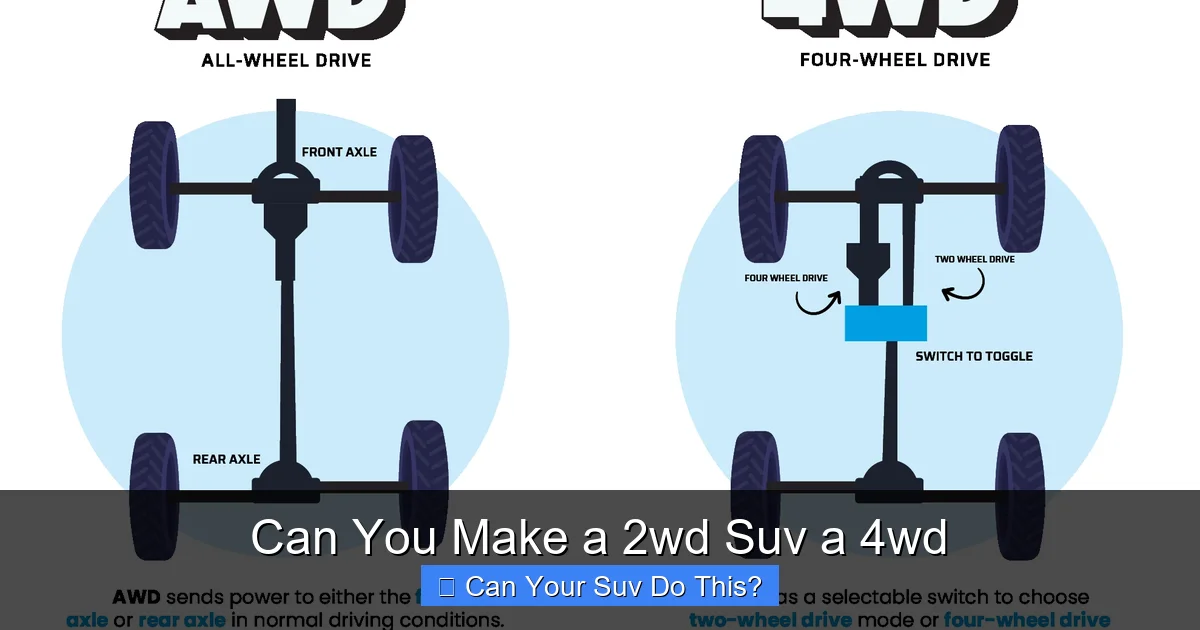
Before diving into conversions, it’s important to understand what 4WD really is—and how it differs from 2WD and AWD.
In a 2WD SUV, power only goes to either the front wheels (FWD) or the rear wheels (RWD). Most modern SUVs are front-wheel drive, which helps with fuel efficiency and interior space. But when traction is low—like on snow, mud, or loose gravel—those two wheels can easily lose grip, leaving you stuck.
4WD, or four-wheel drive, sends power to all four wheels simultaneously. This gives you much better traction in off-road or slippery conditions. True 4WD systems often include a transfer case that lets you switch between 2WD and 4WD modes, and sometimes even a low-range gear for extreme terrain.
All-wheel drive (AWD), on the other hand, is typically automatic and always active. It’s great for light off-roading and bad weather, but not built for serious rock crawling or deep mud.
So when people ask, “Can you make a 2WD SUV a 4WD?” they’re usually asking if they can add that robust, selectable four-wheel-drive capability—not just AWD.
Why Converting 2WD to 4WD Is So Difficult
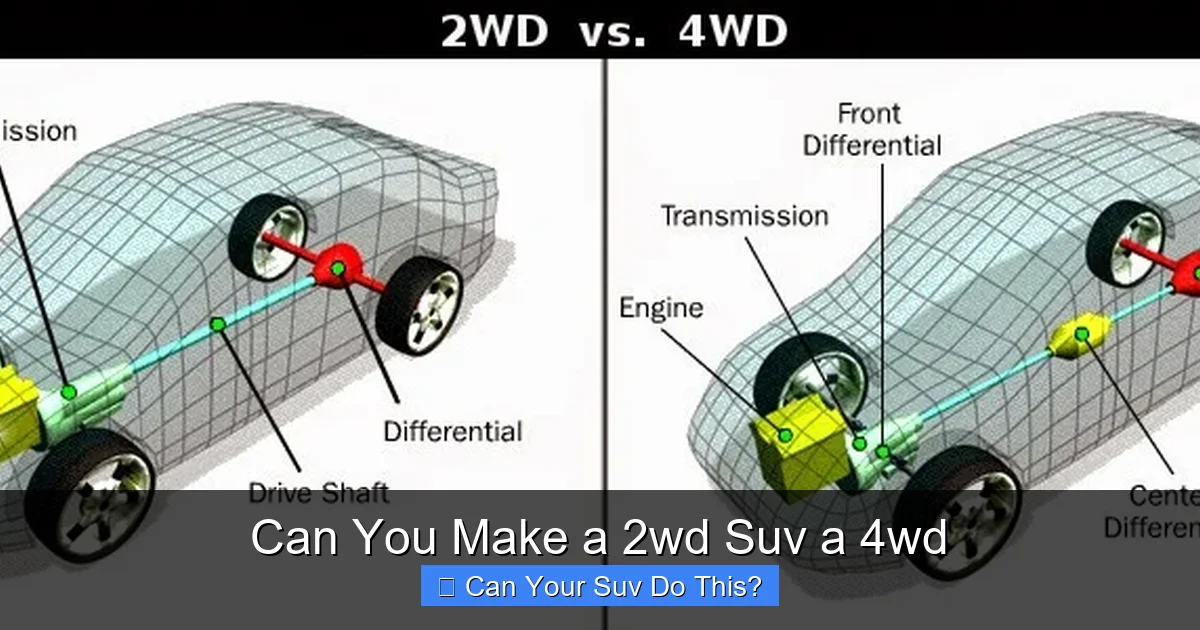
Visual guide about Can You Make a 2wd Suv a 4wd
Image source: 2.bp.blogspot.com
Now, let’s get into the nitty-gritty: why this conversion is such a beast.
Mechanical Overhaul Required
To go from 2WD to 4WD, you’re not just adding a few parts. You’re essentially rebuilding the drivetrain. Here’s what’s typically involved:
– **Transfer case:** This is the heart of a 4WD system. It splits power between the front and rear axles. A 2WD SUV doesn’t have one, so you’d need to install one—along with the mounting brackets, wiring, and control system.
– **Front differential:** In a 2WD SUV, the front wheels don’t receive power. So you’d need to add a front differential, which routes power to the front wheels.
– **Front driveshaft:** This connects the transfer case to the front differential. Again, not present in 2WD models.
– **Rear differential modifications:** Even if your SUV is RWD, the rear diff may need upgrades to handle 4WD torque.
– **Steering and suspension changes:** Adding a front differential can interfere with steering components. You may need to modify or replace control arms, steering knuckles, or even the subframe.
– **Transmission compatibility:** Not all transmissions can connect to a transfer case. You might need to swap in a different transmission or adapter.
That’s a lot of parts—and a lot of labor.
Electrical and Computer Challenges
Modern SUVs are packed with computers. The engine control unit (ECU), transmission control module (TCM), and body control module (BCM) all communicate to manage power delivery, traction control, and safety systems.
Adding 4WD means these systems need to recognize and control the new components. You’ll need to integrate sensors, switches, and wiring for the transfer case, front differential, and 4WD selector. In many cases, the factory ECU won’t support 4WD functions, so you might need a standalone controller or a complete ECU swap.
And don’t forget the dashboard—your SUV won’t have a 4WD indicator light or switch, so you’d need to add those too.
Structural and Space Limitations
SUVs are designed with specific drivetrains in mind. The frame, floor pan, and engine bay are built to accommodate either 2WD or 4WD—not both. Installing a transfer case and front differential often requires cutting and welding the frame or floor, which can compromise structural integrity if not done perfectly.
There’s also the issue of space. Where do you mount the transfer case? Does it fit between the engine and transmission? Will it clear the exhaust or fuel tank? These aren’t trivial questions—they require precise measurements and custom fabrication.
Real-World Conversion Examples
So, has anyone actually done this? Yes—but it’s rare and usually limited to specific models.
Toyota 4Runner and Tacoma Conversions
One of the most documented conversions involves the Toyota 4Runner. Some owners of 2WD 4Runners have swapped in 4WD drivetrains from donor vehicles like the Tacoma or 4WD 4Runner. Because these trucks share platforms and components, the swap is more feasible.
The process typically involves:
– Using a complete 4WD front axle assembly from a donor vehicle.
– Swapping in a 4WD transmission and transfer case.
– Modifying the frame to accept the front differential.
– Rewiring the ECU and adding 4WD controls.
Even then, it’s a months-long project costing $10,000 or more—and requires expert mechanical skills.
Ford Explorer and Ranger Swaps
Similarly, some Ford Explorer owners have attempted 4WD conversions using parts from the Ford Ranger or 4WD Explorer models. Again, the shared platform helps, but the complexity remains high.
These conversions often result in a functional 4WD vehicle—but not one that matches factory performance. Issues like poor alignment, vibration, or unreliable engagement are common.
DIY Enthusiasts vs. Professional Shops
Most successful conversions are done by experienced mechanics or fabrication shops. DIYers who attempt this often underestimate the scope and end up with a non-drivable vehicle.
One forum user shared his experience converting a 2WD Jeep Cherokee to 4WD. After two years and $12,000, he got it running—but admitted it was “more of a science project than a reliable off-roader.”
Cost Breakdown: Is It Worth the Money?
Let’s talk dollars and cents. How much does it really cost to convert a 2WD SUV to 4WD?
Parts Costs
Here’s a rough estimate of what you’d need to buy:
– Transfer case: $1,500–$3,000 (used or rebuilt)
– Front differential and axle: $2,000–$4,000
– Front driveshaft: $300–$600
– 4WD transmission (if needed): $2,000–$4,000
– Wiring harness and controls: $500–$1,000
– Suspension and steering mods: $1,000–$2,000
– Custom fabrication (brackets, mounts): $1,000–$2,000
Total parts: $8,300–$16,600
Labor Costs
If you’re not doing it yourself, labor can easily add $3,000–$6,000 or more. This includes disassembly, welding, alignment, and tuning.
Hidden Costs
Don’t forget:
– Alignment and calibration after installation
– Potential repairs if something goes wrong
– Insurance and registration updates
– Possible failure during state inspections
Comparison: Conversion vs. Buying 4WD
Now, consider this: for $12,000–$20,000, you could buy a used 4WD SUV like a Toyota 4Runner, Jeep Grand Cherokee, or Subaru Outback. These come with factory 4WD, warranties (if certified pre-owned), and proven reliability.
Even a new base-model 4WD SUV like the Subaru Forester or Ford Bronco Sport starts around $28,000—only slightly more than a full conversion.
In short: **the cost of conversion often exceeds the value it adds.**
Legal, Safety, and Warranty Concerns
Beyond mechanics and money, there are serious legal and safety issues to consider.
Warranty Voidance
If your SUV is still under warranty, any major modification—especially to the drivetrain—will almost certainly void it. That means if your engine or transmission fails, you’re on your own.
Insurance Complications
Insurance companies may not cover a heavily modified vehicle, or they may charge higher premiums. Some won’t insure it at all if it’s deemed unsafe or improperly converted.
State Inspections and Registration
In many states, modified vehicles must pass enhanced inspections. If your conversion isn’t up to code—or if it alters the vehicle’s original design too much—you could fail inspection and be unable to register the vehicle.
Safety Risks
A poorly executed conversion can lead to:
– Drivetrain failure at high speed
– Loss of control due to misaligned axles
– Electrical fires from improper wiring
– Reduced crash protection if the frame is weakened
Remember: factory 4WD systems are crash-tested and engineered for safety. Your DIY conversion isn’t.
Smarter Alternatives to Full Conversion
If you’re set on better traction but don’t want to go full 4WD, consider these alternatives:
Upgrade Your Tires
The easiest and cheapest upgrade? All-terrain or mud-terrain tires. They provide significantly better grip in snow, mud, and off-road conditions—without any mechanical changes.
Add a Limited-Slip Differential (LSD)
If your SUV has an open differential, one wheel can spin freely when traction is lost. An LSD sends power to the wheel with more grip. It’s a $1,000–$2,000 upgrade that makes a big difference.
Install Electronic Traction Aids
Some aftermarket systems use sensors and brakes to simulate limited-slip behavior. While not as strong as true 4WD, they help in slippery conditions.
Use Traction Mats or Chains
For occasional off-roading or snow driving, traction mats (like Maxtrax) or tire chains can get you unstuck without permanent modifications.
Buy a 4WD SUV
This might sound obvious, but it’s the most practical solution. Look for used 4WD models in your budget. You’ll get better performance, reliability, and resale value.
When Conversion Might Make Sense
Despite the challenges, there are rare cases where conversion could be justified:
– You have a rare or classic SUV with high sentimental value.
– You’re a professional fabricator or mechanic with access to tools and donor parts.
– You’re building a custom off-road rig for competition or display (not daily driving).
– You already have most of the 4WD components from a wrecked vehicle.
Even then, it’s a project—not a practical upgrade.
Final Verdict: Should You Do It?
So, can you make a 2WD SUV a 4WD? Yes—but should you?
For 99% of drivers, the answer is no. The cost, complexity, and risk far outweigh the benefits. You’ll spend more than a used 4WD SUV costs, end up with a less reliable vehicle, and potentially face legal and safety issues.
But if you’re a skilled mechanic with a passion for fabrication, and you’re doing it for the challenge—not daily use—then go for it. Just know what you’re getting into.
For everyone else? Save your money, upgrade your tires, and consider trading up to a factory 4WD SUV. Your wallet—and your peace of mind—will thank you.
Frequently Asked Questions
Can any 2WD SUV be converted to 4WD?
Not all 2WD SUVs can be converted. Only models that share a platform with a 4WD variant (like the Toyota 4Runner or Ford Explorer) have a realistic chance. Even then, it’s a major undertaking.
How much does it cost to convert a 2WD SUV to 4WD?
Expect to spend $8,000 to $20,000 or more, including parts, labor, and potential repairs. In many cases, this exceeds the value of the vehicle.
Will converting to 4WD void my warranty?
Yes. Most manufacturers void warranties if you modify the drivetrain. This includes engine, transmission, and suspension changes.
Is a 2WD to 4WD conversion legal?
It can be, but only if it passes state inspections and meets safety standards. Improper modifications may fail inspection or be deemed unsafe.
Can I do the conversion myself?
Only if you’re an experienced mechanic with fabrication skills. Most DIY attempts result in unsafe or non-functional vehicles.
What’s a better alternative to converting my 2WD SUV?
Buy a used 4WD SUV, upgrade to all-terrain tires, or add a limited-slip differential. These options are safer, cheaper, and more reliable.