
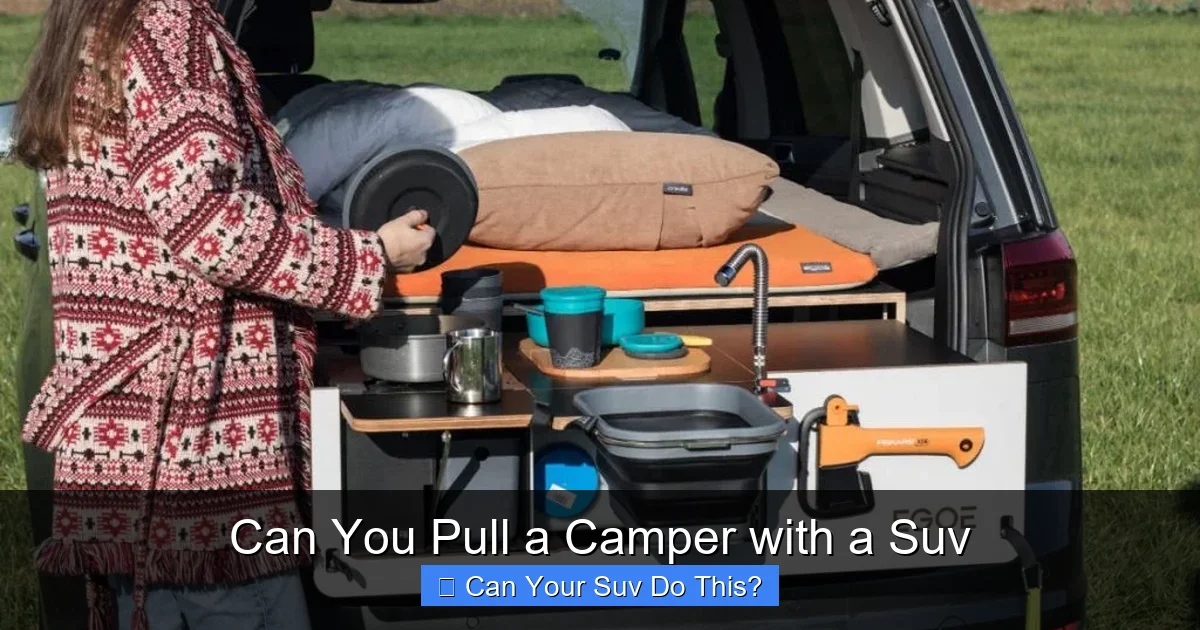
Yes, you can pull a camper with an SUV—but only if your vehicle has the right towing capacity, proper equipment, and you follow safety guidelines. Not all SUVs are created equal when it comes to towing, so it’s essential to match your SUV’s capabilities with the weight and type of camper you plan to haul.
Key Takeaways
- Check your SUV’s towing capacity: This is the maximum weight your vehicle can safely tow, found in the owner’s manual or manufacturer’s website.
- Match camper weight to your SUV: The camper’s gross vehicle weight rating (GVWR) should be well below your SUV’s towing limit.
- Use the right towing equipment: A weight-distributing hitch, brake controller, and proper wiring are often necessary for safe towing.
- Consider drivetrain and engine power: All-wheel drive (AWD) or four-wheel drive (4WD) SUVs generally handle towing better than front-wheel drive models.
- Know the difference between camper types: Travel trailers, pop-ups, and teardrop campers vary in weight and towing demands.
- Practice safe driving habits: Allow extra stopping distance, avoid sudden maneuvers, and check tire pressure regularly.
- Get professional help if unsure: Consult a mechanic or towing specialist before your first trip.
📑 Table of Contents
- Can You Pull a Camper with an SUV? The Short Answer
- Understanding Towing Capacity: The Most Important Number
- Types of Campers and What SUVs Can Tow Them
- Choosing the Right Towing Equipment
- SUV Features That Help with Towing
- Driving Tips for Towing a Camper with an SUV
- Common Mistakes to Avoid
- Conclusion: Is Your SUV Ready to Pull a Camper?
Can You Pull a Camper with an SUV? The Short Answer
So, you’ve got an SUV and a dream of hitting the open road with a cozy camper in tow. Maybe you’re picturing weekend getaways to the mountains, lakeside campsites, or cross-country adventures. But before you hitch up and hit the highway, you’re probably wondering: Can you pull a camper with an SUV?
The quick answer is: Yes—many SUVs can pull a camper, but it all depends on the specific model of your SUV, its towing capacity, and the type of camper you want to tow. Not every SUV is built for heavy-duty towing, and trying to pull a camper that’s too heavy can lead to dangerous situations, mechanical failures, or even accidents. That’s why it’s crucial to do your homework before you start shopping for that perfect little travel trailer.
In this guide, we’ll walk you through everything you need to know about towing a camper with an SUV. From understanding towing capacity and choosing the right camper to selecting the proper equipment and driving safely, we’ve got you covered. Whether you drive a compact crossover or a full-size SUV, this article will help you determine if your vehicle is up to the task—and how to do it the right way.
Understanding Towing Capacity: The Most Important Number
When it comes to towing a camper with an SUV, the first thing you need to know is your vehicle’s towing capacity. This is the maximum weight your SUV can safely pull, including the camper, cargo, water, propane, and any gear inside. Exceeding this limit is not just risky—it can void your warranty, damage your vehicle, and put you and others in danger.
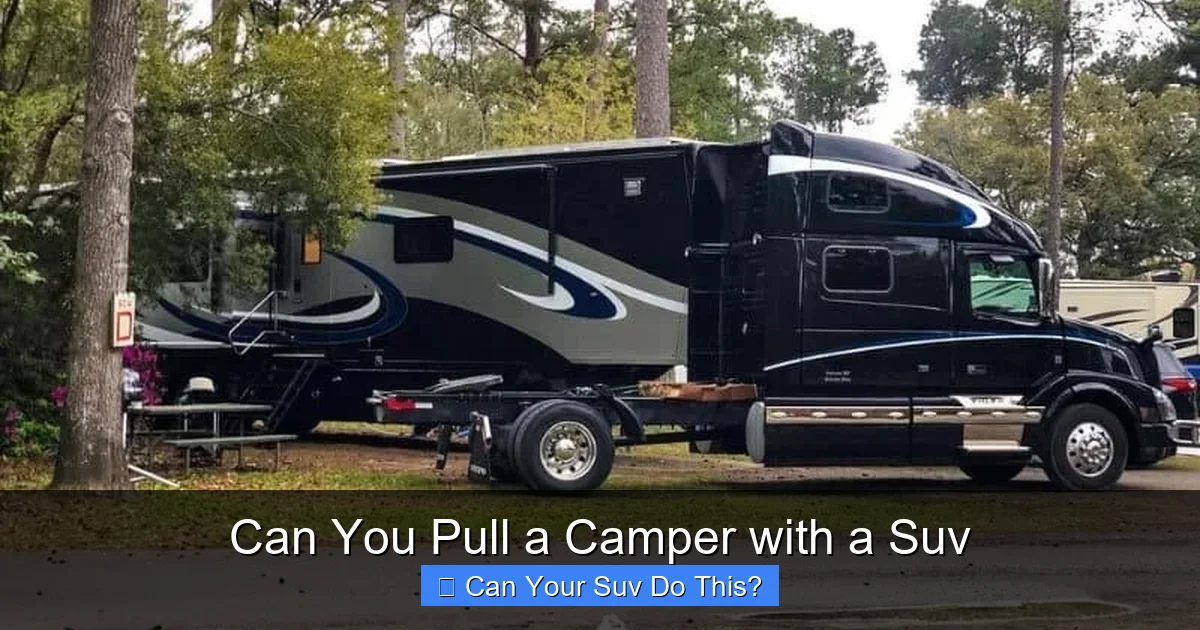
Visual guide about Can You Pull a Camper with a Suv
Image source: rvingknowhow.com
Where to Find Your SUV’s Towing Capacity
Your SUV’s towing capacity isn’t a guess—it’s a precise number determined by the manufacturer. You can find it in a few places:
- The owner’s manual
- The vehicle’s door jamb sticker (usually on the driver’s side)
- The manufacturer’s official website (search by year, make, and model)
- A trusted towing guide or app (like the one from the RV Industry Association)
For example, a 2023 Toyota RAV4 has a towing capacity of around 1,500 to 3,500 pounds, depending on the engine and drivetrain. Meanwhile, a 2023 Ford Expedition can tow up to 9,300 pounds. That’s a huge difference—and it shows why knowing your specific model matters.
Why Towing Capacity Isn’t the Whole Story
While towing capacity is critical, it’s not the only factor. You also need to consider:
- Payload capacity: This is how much weight your SUV can carry inside the vehicle (passengers, gear, etc.). If you’re loaded up with people and supplies, you may have less room for tongue weight from the camper.
- GCWR (Gross Combined Weight Rating): This is the total weight of your SUV, passengers, cargo, and the fully loaded camper. Never exceed this number.
- Tongue weight: Typically 10–15% of the camper’s total weight, this is the downward force on the hitch. Too much can cause your SUV to sag in the back and lose control.
Let’s say your SUV has a 5,000-pound towing capacity, but your camper weighs 4,800 pounds fully loaded. That might seem okay—but if the tongue weight is 700 pounds and your payload capacity is only 1,200 pounds, you could be overloading your vehicle once you add passengers and gear.
Types of Campers and What SUVs Can Tow Them
Not all campers are the same. Some are lightweight and perfect for smaller SUVs, while others require heavy-duty trucks. Understanding the different types of campers will help you match the right one to your SUV.
Pop-Up Campers (Folding Trailers)
Pop-up campers are among the lightest options, typically weighing between 1,500 and 3,500 pounds when fully loaded. They fold down for easy towing and pop up at the campsite to reveal beds, a small kitchen, and sometimes a dinette. Because of their low weight, they’re ideal for compact and midsize SUVs like the Honda CR-V, Subaru Outback, or Jeep Cherokee.
Example: A 2022 Subaru Outback with a 2.4L turbo engine can tow up to 3,500 pounds—perfect for a pop-up camper that weighs 2,800 pounds with gear.
Teardrop Campers
Teardrop campers are small, aerodynamic, and usually under 1,500 pounds. They’re great for minimalist travelers and are easily towed by almost any SUV with a hitch. Models like the Little Guy Mini Max or the Happier Camper HC1 are popular choices.
Pro Tip: Even if your SUV can technically tow a teardrop, make sure it has a hitch receiver and wiring for lights. Many small SUVs come without these, so you may need to install them.
Travel Trailers
Travel trailers are the most common type of camper and come in a wide range of sizes and weights. Smaller models (like the Jayco Jay Feather or Forest River R-Pod) can weigh 3,000 to 5,000 pounds, making them suitable for larger SUVs like the Toyota Highlander, Ford Explorer, or Chevrolet Traverse.
Larger travel trailers, however, can exceed 7,000 pounds and are better suited for full-size SUVs like the Chevrolet Tahoe, GMC Yukon, or Ford Expedition.
Example: A 2023 Ford Explorer with the Class III towing package can tow up to 5,600 pounds—enough for a mid-sized travel trailer, but not a large one.
Fifth-Wheel and Class A Campers
These are the big boys of the camping world. Fifth-wheel campers require a special hitch in the bed of a pickup truck, and Class A motorhomes are self-contained RVs that you drive, not tow. Neither can be pulled by an SUV—so if you’re dreaming of a luxury fifth-wheel, you’ll need a truck.
Choosing the Right Towing Equipment
Even if your SUV has the towing capacity, you can’t just hook up a camper and go. You need the right equipment to tow safely and legally.
Hitch and Receiver
Most SUVs need a Class III or Class IV hitch receiver to tow a camper. This is the metal frame that attaches to your vehicle and accepts the hitch ball. Make sure the hitch is rated for your camper’s weight.
Tip: Don’t buy a hitch based on price alone. Look for one with a weight rating that exceeds your camper’s GVWR. A 5,000-pound hitch is better than a 3,500-pound one if you’re towing near your limit.
Weight-Distributing Hitch
If your camper is heavy (usually over 3,500 pounds), a weight-distributing hitch helps balance the load. It uses spring bars to shift some of the tongue weight from the rear axle to the front axle and trailer axles, improving stability and control.
This is especially important for longer travel trailers that can sway in wind or when passing trucks.
Brake Controller
Most campers over 1,500 pounds require electric brakes. Since your SUV’s brakes alone can’t handle the extra weight, you need a brake controller inside the cabin. This device lets you manually activate the trailer’s brakes and adjust their sensitivity.
Many modern SUVs come with a built-in brake controller, but if yours doesn’t, you can install an aftermarket one like the Tekonsha P3 or Redarc Tow-Pro.
Wiring Harness and Lights
Your camper needs working brake lights, turn signals, and running lights. A 4-pin or 7-pin wiring harness connects the camper to your SUV’s electrical system. Make sure the harness is compatible and properly installed to avoid electrical issues on the road.
Sway Control Devices
Trailer sway is one of the biggest dangers when towing. A sway control device—either built into your hitch or added as an accessory—helps keep the camper aligned with your SUV, especially in crosswinds or when changing lanes.
Some hitches, like the Equal-i-zer, combine weight distribution and sway control in one system.
SUV Features That Help with Towing
Not all SUVs are created equal when it comes to towing. Certain features make some models better suited for pulling a camper than others.
Engine Power and Torque
A strong engine with high torque is essential for towing. Diesel engines and turbocharged gasoline engines typically offer better towing performance than naturally aspirated four-cylinders.
For example, the 2023 Chevrolet Tahoe with the 6.2L V8 can tow up to 8,400 pounds, while the 2023 Honda Pilot with a 3.5L V6 maxes out at 5,000 pounds. The difference? Torque—the Tahoe produces 460 lb-ft, while the Pilot makes 262 lb-ft.
Drivetrain: AWD vs. 4WD
All-wheel drive (AWD) and four-wheel drive (4WD) improve traction, which is helpful when towing on wet or uneven roads. However, 4WD is generally better for off-road towing, while AWD is sufficient for most highway and campsite conditions.
Note: Some SUVs require you to switch to 2WD when towing to avoid drivetrain damage—check your manual.
Towing Packages
Many SUVs offer optional towing packages that include:
- Upgraded cooling systems (for the engine and transmission)
- Heavy-duty suspension
- Integrated brake controller
- Trailer hitch pre-wiring
- Enhanced alternator
These packages can increase your SUV’s towing capacity and make towing safer and easier. For example, the 2023 Toyota Highlander’s towing capacity jumps from 3,500 to 5,000 pounds with the towing package.
Transmission and Cooling
Towing puts extra strain on your transmission. SUVs with heavy-duty transmissions and auxiliary coolers are better equipped to handle long trips with a camper. Overheating can lead to transmission failure, so make sure your SUV has adequate cooling—especially if you’re driving in hot climates or mountainous terrain.
Driving Tips for Towing a Camper with an SUV
Towing changes how your SUV handles. It’s slower to accelerate, takes longer to stop, and is more affected by wind and road conditions. Here’s how to drive safely.
Allow Extra Space
When towing, increase your following distance to at least 4–6 seconds behind the vehicle in front of you. This gives you more time to react and stop safely.
Use Lower Gears on Hills
When climbing steep grades, shift into a lower gear (like “L” or “2”) to maintain speed without overworking the engine. On descents, use engine braking to avoid overheating the brakes.
Avoid Sudden Maneuvers
Sharp turns, quick lane changes, or sudden braking can cause trailer sway or jackknifing. Make smooth, gradual movements and give yourself plenty of room to merge or turn.
Check Tire Pressure Regularly
Underinflated tires on your SUV or camper can overheat and blow out. Check tire pressure before every trip and adjust for load. Use a quality tire pressure monitoring system (TPMS) if possible.
Practice Before You Go
If you’ve never towed a camper before, practice in an empty parking lot. Try backing up, turning, and stopping to get a feel for how the camper affects your SUV’s handling.
Secure Your Load
Make sure everything inside the camper is tied down. Loose items can shift during travel and affect balance. Use bungee cords, cargo nets, or storage bins to keep things in place.
Common Mistakes to Avoid
Even experienced drivers make towing mistakes. Here are some to watch out for:
- Overloading the camper: Just because your SUV can tow 5,000 pounds doesn’t mean you should load the camper to 5,000 pounds. Leave room for safety and comfort.
- Ignoring maintenance: Towing stresses your SUV’s engine, transmission, and brakes. Get regular oil changes, brake inspections, and coolant checks.
- Using the wrong hitch ball size: Most campers use a 2-inch ball, but some require 2-5/16 inches. Using the wrong size can cause the trailer to detach.
- Not checking local laws: Some states require trailer brakes above a certain weight or have speed limits for towing. Know the rules before you travel.
- Skipping the pre-trip inspection: Always check lights, tires, hitch connections, and brake controller before hitting the road.
Conclusion: Is Your SUV Ready to Pull a Camper?
So, can you pull a camper with an SUV? The answer is a resounding yes—if you do it right. With the right vehicle, proper equipment, and safe driving habits, your SUV can be a reliable partner for countless camping adventures.
Start by checking your SUV’s towing capacity and matching it to a camper that fits within safe limits. Invest in quality towing gear like a weight-distributing hitch and brake controller. And never underestimate the importance of practice and preparation.
Whether you’re towing a lightweight teardrop or a full-sized travel trailer, the key is respect—for your vehicle’s limits, the rules of the road, and the joy of the journey. With the right setup, your SUV can open the door to a world of outdoor exploration, one campsite at a time.
Frequently Asked Questions
Can a small SUV like a Honda CR-V tow a camper?
Yes, but only lightweight campers. The Honda CR-V can typically tow 1,500 to 3,500 pounds, making it suitable for pop-up campers or teardrops—but not heavier travel trailers.
Do I need a special license to tow a camper with an SUV?
In most states, no. A standard driver’s license is sufficient for towing a camper as long as it’s within your SUV’s towing capacity and properly equipped. However, check your local DMV for specific regulations.
What happens if I exceed my SUV’s towing capacity?
Exceeding towing capacity can cause transmission failure, brake overheating, loss of control, and increased risk of accidents. It may also void your warranty and insurance coverage.
Can I tow a camper without a brake controller?
Only if the camper weighs less than 1,500 pounds and doesn’t have electric brakes. Most campers over this weight require a brake controller for safe stopping.
Is it safe to tow a camper in the rain or snow?
Yes, but extra caution is needed. Wet or icy roads reduce traction, so drive slower, increase following distance, and avoid sudden moves. Make sure your tires and brakes are in good condition.
Can I install a hitch myself?
Some people do, but it’s safer to have a professional install it. Improper installation can lead to hitch failure, especially when towing heavy loads. Many auto shops offer hitch installation services.