
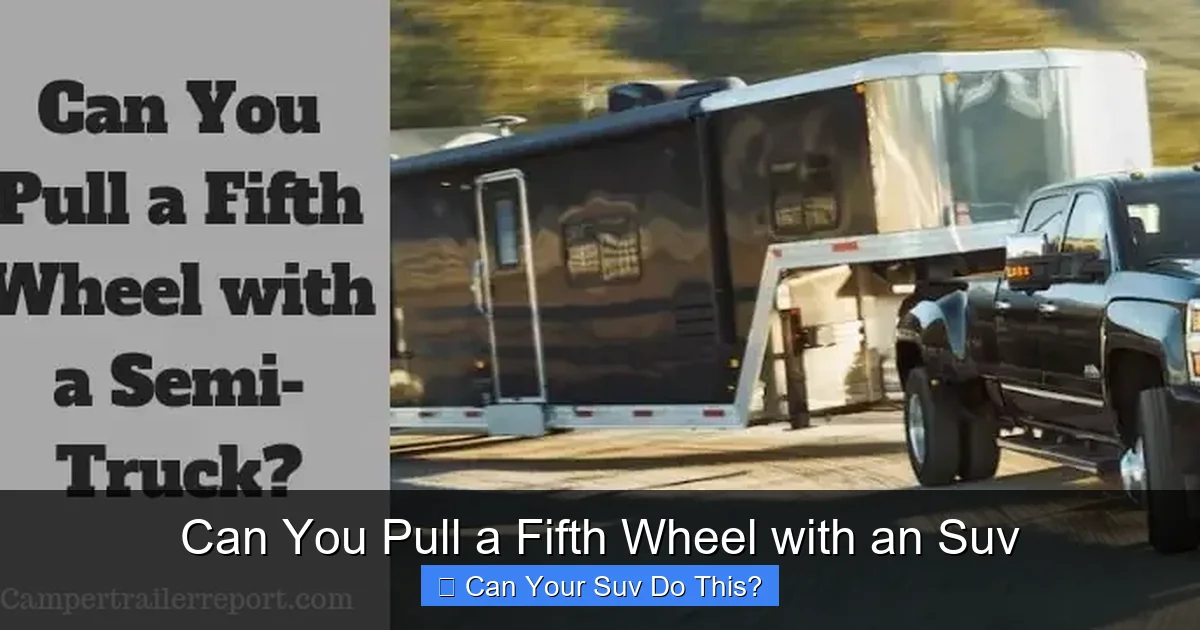
Pulling a fifth wheel with an SUV is possible—but only if your vehicle has the right towing capacity, proper hitch setup, and sufficient wheelbase. While most standard SUVs aren’t built for this heavy-duty task, certain full-size and heavy-duty models can handle it safely with the correct equipment and planning.
So, you’ve got an SUV—maybe a rugged Ford Expedition, a beefy Chevrolet Tahoe, or even a lifted Toyota Sequoia—and you’re dreaming of hitting the open road with a cozy fifth-wheel trailer in tow. You’ve seen those massive RVs gliding down the highway, and you’re wondering: *Can you pull a fifth wheel with an SUV?* It’s a great question, and one that sparks a lot of debate among RV enthusiasts, mechanics, and weekend adventurers alike.
At first glance, it might seem like a no-brainer. After all, modern SUVs are bigger, stronger, and more capable than ever. Many come equipped with turbocharged engines, advanced towing packages, and all-wheel drive. But here’s the catch: fifth-wheel trailers aren’t your average travel trailers. They’re heavier, taller, and designed to be hitched directly over the bed of a pickup truck using a special kingpin connection. This unique setup means that not just any vehicle can handle the job—even if it looks tough enough.
In this guide, we’ll break down everything you need to know about pulling a fifth wheel with an SUV. We’ll explore the technical requirements, examine which SUVs (if any) are up to the task, discuss the challenges involved, and offer practical alternatives if your ride isn’t quite fifth-wheel ready. Whether you’re a seasoned RVer or just starting to explore the world of recreational vehicles, this article will help you make an informed decision—so you can hit the road safely and confidently.
Key Takeaways
- Not all SUVs can tow a fifth wheel: Only large, heavy-duty SUVs with high towing ratings (typically 10,000+ lbs) are suitable candidates.
- Towing capacity matters most: Always check your SUV’s manufacturer-rated towing capacity before considering a fifth-wheel trailer.
- Fifth-wheel hitches require a truck bed: Unlike travel trailers, fifth wheels need a special hitch mounted in the bed of a pickup truck—most SUVs don’t have this feature.
- Weight distribution is critical: Fifth wheels place significant weight on the tow vehicle’s rear axle, requiring careful load management and suspension upgrades.
- Specialized conversions exist: Some companies modify SUVs or offer SUV-to-truck conversions to enable fifth-wheel towing, but these are rare and costly.
- Safety and legality come first: Ensure your setup meets state regulations and includes brake controllers, sway control, and proper lighting.
- Consider alternatives: For most SUV owners, a lightweight travel trailer or toy hauler may be a safer, more practical option.
📑 Table of Contents
Understanding Fifth-Wheel Trailers and How They Work
Before we dive into whether your SUV can handle a fifth wheel, let’s take a moment to understand what exactly a fifth-wheel trailer is—and why it’s different from other types of RVs.
A fifth-wheel trailer is a type of recreational vehicle that’s designed to be towed by a pickup truck. It gets its name from the distinctive hitch system: instead of connecting to a standard bumper or receiver hitch like a travel trailer, a fifth wheel uses a kingpin that locks into a specialized hitch mounted in the bed of a truck. This hitch, often called a “fifth-wheel hitch” or “gooseneck hitch,” sits directly over the rear axle of the tow vehicle and allows the trailer to pivot smoothly during turns.
Because of this setup, fifth-wheel trailers offer several advantages over traditional travel trailers. They tend to be more stable on the road, provide better weight distribution, and allow for larger living spaces—many even have multiple levels, full kitchens, and master bedrooms. They’re popular among full-time RVers and those who want a more home-like experience while traveling.
But here’s the kicker: that hitch needs to be installed in a truck bed. Most SUVs don’t have an open bed like a pickup truck. Instead, they have enclosed cargo areas or tailgates that aren’t designed to accommodate a fifth-wheel hitch. This fundamental design difference is the biggest hurdle when it comes to pulling a fifth wheel with an SUV.
Why the Hitch Location Matters
The placement of the hitch is crucial for both safety and functionality. When a fifth wheel is connected, a significant portion of its weight—typically 15% to 25% of the total trailer weight—is transferred directly onto the tow vehicle’s rear axle. This is known as “tongue weight” in travel trailers, but for fifth wheels, it’s often referred to as “pin weight.”
This concentrated load helps stabilize the trailer and reduces sway, but it also puts immense stress on the tow vehicle’s frame, suspension, and rear axle. That’s why fifth-wheel hitches are engineered to be mounted low and centered over the rear axle—ideally within the bed of a pickup truck, where the structure is reinforced to handle the load.
SUVs, on the other hand, are built differently. Their rear ends are designed for passenger comfort and cargo space, not for bearing heavy vertical loads. Even if you could somehow install a fifth-wheel hitch in an SUV’s cargo area, the frame and suspension likely wouldn’t be rated to handle the stress. This makes traditional fifth-wheel towing with an SUV not just difficult—but potentially dangerous.
The Role of Towing Capacity
Another key factor is towing capacity. Every vehicle comes with a manufacturer-rated maximum towing capacity, which is determined by the engine, transmission, cooling system, frame strength, and braking system. For fifth-wheel trailers, which often weigh between 10,000 and 20,000 pounds or more, you need a tow vehicle with a high towing rating.
Most mid-size and full-size SUVs have towing capacities ranging from 5,000 to 8,000 pounds. While that’s plenty for a small travel trailer or boat, it’s nowhere near enough for a typical fifth wheel. Even some of the largest SUVs on the market—like the Ford Expedition Max or the Chevrolet Suburban—top out around 9,000 to 10,000 pounds when properly equipped.
And remember: that’s the *total* towing capacity. When you factor in the pin weight of a fifth wheel (which can be 2,000 to 4,000 pounds or more), you quickly eat into your vehicle’s payload capacity. Payload includes passengers, cargo, fuel, and any added equipment—so if your SUV is already loaded with gear and people, you may not have enough capacity left to safely tow a fifth wheel.
Can Any SUV Actually Pull a Fifth Wheel?
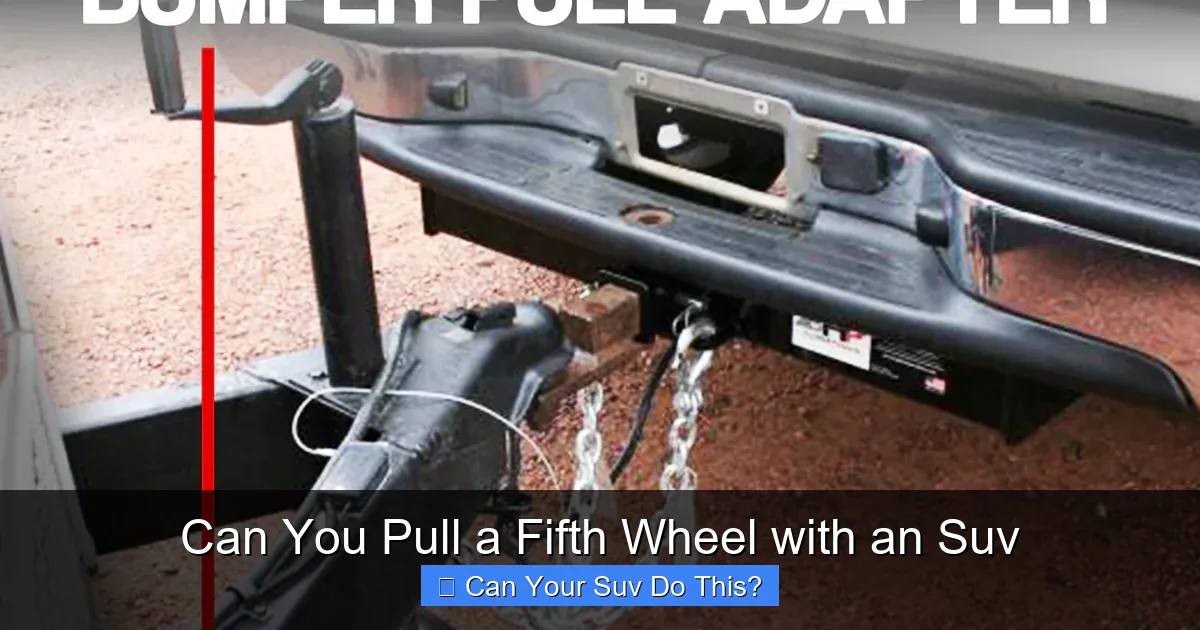
Visual guide about Can You Pull a Fifth Wheel with an Suv
Image source: cdn.shopify.com
Now for the million-dollar question: is there *any* SUV that can realistically pull a fifth wheel? The short answer is: technically, yes—but with major caveats.
There are a few heavy-duty, full-size SUVs that come close to meeting the requirements. These vehicles are built on truck platforms and share many components with their pickup truck siblings. Examples include:
– **Ford Expedition (with Heavy-Duty Trailer Tow Package):** Up to 9,300 lbs towing capacity.
– **Chevrolet Tahoe/Suburban (with Max Trailering Package):** Up to 8,400 lbs (Tahoe) and 8,300 lbs (Suburban).
– **GMC Yukon XL (with Max Trailering Package):** Up to 8,400 lbs.
– **Toyota Sequoia (with Tow Package):** Up to 9,500 lbs.
– **Nissan Armada:** Up to 8,500 lbs.
While these numbers look impressive, they still fall short of what most fifth-wheel trailers require. Even the heaviest-duty SUVs rarely exceed 10,000 pounds in towing capacity—and that’s under ideal conditions, with minimal cargo and passengers.
But let’s say you find a lightweight fifth-wheel model that weighs under 8,000 pounds. Could you make it work? Possibly—but you’d still face the hitch problem. Since SUVs don’t have truck beds, you can’t install a standard fifth-wheel hitch.
Workarounds and Modifications
Some companies and DIY enthusiasts have attempted to solve this problem by modifying SUVs to accept fifth-wheel hitches. One approach involves cutting into the SUV’s rear cargo area and installing a reinforced hitch plate that mimics a truck bed. This requires extensive welding, structural reinforcement, and custom fabrication.
Another option is using a gooseneck adapter. Some fifth-wheel trailers can be converted to use a gooseneck hitch, which connects to a ball mounted in the bed of a truck. In theory, you could install a gooseneck ball in an SUV’s cargo floor—but again, this would require major modifications and may void your warranty or compromise safety.
There are also specialized conversion kits available from companies like **RV Innovations** or **TrailerMate**, which offer SUV-specific fifth-wheel solutions. These systems often involve mounting a hitch platform in the rear of the vehicle and reinforcing the frame. However, they’re expensive—often costing $5,000 to $15,000 or more—and may not be legal in all states.
Even if you manage to install a hitch, you’ll still need to address other challenges: brake controllers, electrical connections, sway control, and ensuring the SUV’s suspension can handle the added weight. Many of these modifications require professional installation and certification.
Real-World Examples
There are a handful of documented cases where SUV owners have successfully towed fifth wheels. For example, some Ford Excursion owners (a now-discontinued full-size SUV) have modified their vehicles to tow lightweight fifth wheels using custom hitch systems. Similarly, a few Ramcharger owners (a rare SUV based on the Dodge Ram pickup) have used their truck-like beds to install fifth-wheel hitches.
But these are exceptions, not the rule. The Ramcharger, for instance, was essentially a pickup truck with an enclosed bed—so it was uniquely suited for this purpose. Most modern SUVs don’t share that design.
In short, while it’s *possible* to pull a fifth wheel with an SUV in rare cases, it’s not practical, safe, or recommended for the average driver.
The Risks and Challenges of Towing a Fifth Wheel with an SUV
Even if you manage to overcome the mechanical hurdles, towing a fifth wheel with an SUV comes with significant risks. Let’s break down the main challenges you’ll face.
Structural Integrity and Frame Stress
SUVs are not built to handle the concentrated load of a fifth-wheel hitch. The rear frame, suspension, and axle are designed for passenger comfort and cargo hauling—not for bearing thousands of pounds of vertical force directly over the rear wheels.
When you connect a fifth wheel, that pin weight presses down on the hitch, which transfers stress to the SUV’s frame. Over time, this can lead to frame flex, cracking, or even failure—especially if the vehicle isn’t reinforced. Unlike pickup trucks, which have reinforced frames and suspension systems designed for heavy towing, most SUVs simply aren’t up to the task.
Suspension and Handling Issues
Adding a fifth wheel dramatically changes how your SUV handles. The added weight at the rear can cause the vehicle to “squat,” reducing ground clearance and making it harder to control. You may also experience increased sway, especially in windy conditions or when passing large trucks.
Without proper weight distribution and sway control systems, the trailer can push the SUV around, leading to dangerous fishtailing or loss of control. Even with aftermarket suspension upgrades—like airbags or heavy-duty shocks—the inherent design limitations of an SUV make it a less stable tow vehicle compared to a pickup truck.
Brake System Limitations
Fifth-wheel trailers are heavy, and stopping them requires serious braking power. Most SUVs come with adequate brakes for their own weight and moderate towing, but they may struggle when hauling 10,000+ pounds.
That’s why fifth-wheel setups almost always include an electric brake controller in the tow vehicle and electric brakes on the trailer. But even with these systems, the SUV’s braking system may not be rated for such heavy loads. Overheating brakes, longer stopping distances, and brake fade are real risks—especially on long downhill grades.
Legal and Insurance Concerns
Modifying your SUV to tow a fifth wheel may violate state laws or void your vehicle’s warranty. Many states have strict regulations about hitch types, weight limits, and required safety equipment. If your modified SUV isn’t up to code, you could face fines or be denied coverage in the event of an accident.
Insurance companies may also be hesitant to cover a non-standard towing setup. If something goes wrong—like a hitch failure or rollover—you could be on the hook for thousands of dollars in damages.
Reduced Maneuverability and Visibility
Fifth-wheel trailers are long and tall, which can make backing up, turning, and parking a challenge—even for experienced drivers. When attached to an SUV, the combination can be especially unwieldy. The SUV’s shorter wheelbase (compared to a pickup truck) means less stability during tight maneuvers.
Additionally, the trailer can block your rearview visibility, making it harder to see what’s behind you. You’ll need to rely heavily on side mirrors and possibly install a backup camera system.
Safer Alternatives for SUV Owners
If your heart is set on RVing but your SUV isn’t fifth-wheel ready, don’t despair. There are plenty of great alternatives that are better suited to your vehicle.
Lightweight Travel Trailers
Travel trailers are the most common type of towable RV and are designed to be hitched to a standard receiver hitch on the back of an SUV. They come in a wide range of sizes and weights, with many lightweight models under 5,000 pounds.
Popular options include:
– **Airstream Bambi:** Compact, stylish, and easy to tow.
– **Jayco Jay Flight SLX:** Affordable and family-friendly.
– **Winnebago Micro Minnie:** Lightweight with modern amenities.
These trailers offer many of the same comforts as fifth wheels—kitchens, bathrooms, beds—but without the need for a truck bed or heavy-duty hitch.
Toy Haulers and Hybrid Trailers
If you want to bring along ATVs, motorcycles, or other gear, consider a toy hauler. These trailers have a rear ramp door and open cargo area, making them perfect for adventure seekers. Many are designed to be towed by SUVs and offer convertible living spaces.
Hybrid trailers, which combine hard-sided walls with pop-out tent ends, are another great option. They’re lighter than full-sized RVs and provide extra sleeping space when expanded.
Teardrop Trailers and Campers
For minimalist travelers, teardrop trailers and pop-up campers are excellent choices. They’re small, lightweight, and easy to maneuver. Many can be towed by even compact SUVs.
Teardrops often include basic kitchen setups and sleeping areas, while pop-ups offer more interior space when raised. Both are affordable, fuel-efficient, and perfect for weekend getaways.
Upgrade to a Pickup Truck
If you’re serious about fifth-wheel living, consider trading your SUV for a heavy-duty pickup truck. Models like the Ford F-350, Ram 3500, or Chevrolet Silverado 3500 are built for this kind of work. They offer high towing capacities, reinforced frames, and plenty of bed space for a fifth-wheel hitch.
Many people use their truck for both daily driving and RV towing, making it a versatile investment. You can even find crew-cab models with spacious interiors for families.
Final Thoughts: Is It Worth the Effort?
So, can you pull a fifth wheel with an SUV? Technically, yes—but it’s not easy, safe, or practical for most people. The design limitations of SUVs, combined with the heavy demands of fifth-wheel towing, make this a risky endeavor.
Unless you’re working with a rare, truck-based SUV and are willing to invest in extensive modifications, it’s better to choose a towing setup that matches your vehicle’s capabilities. Lightweight travel trailers, toy haulers, and pop-up campers offer a safer, more reliable way to enjoy the RV lifestyle without pushing your SUV beyond its limits.
Remember: the goal is to have fun, stay safe, and create lasting memories—not to win a towing contest. Choose the right rig for your ride, and you’ll be hitting the open road with confidence in no time.
Frequently Asked Questions
Can any SUV tow a fifth wheel?
Very few SUVs can safely tow a fifth wheel. Only heavy-duty, full-size models with high towing capacities and modified hitch systems might be capable—but even then, it’s not recommended without professional reinforcement and legal compliance.
Why can’t most SUVs use a fifth-wheel hitch?
Fifth-wheel hitch require a truck bed for proper installation and weight distribution. Most SUVs have enclosed cargo areas instead of open beds, making it impossible to install a standard fifth-wheel hitch without major modifications.
What’s the difference between a fifth wheel and a travel trailer?
A fifth wheel connects over the bed of a pickup truck using a kingpin and special hitch, while a travel trailer attaches to a receiver hitch at the rear of the vehicle. Fifth wheels are generally larger and more stable but require a truck to tow.
Can I modify my SUV to tow a fifth wheel?
Yes, but it’s expensive, complex, and potentially unsafe. Modifications may include cutting the cargo area, reinforcing the frame, and installing a custom hitch—often costing thousands and voiding warranties.
What’s a safer alternative to towing a fifth wheel with an SUV?
Lightweight travel trailers, toy haulers, or pop-up campers are much better suited for SUVs. They’re easier to tow, require no special hitch, and are designed for vehicles with lower towing capacities.
Do I need a special license to tow a fifth wheel?
In most states, no special license is required for fifth-wheel trailers under 26,001 pounds. However, some states may require a special endorsement for larger RVs, so always check local regulations before hitting the road.