
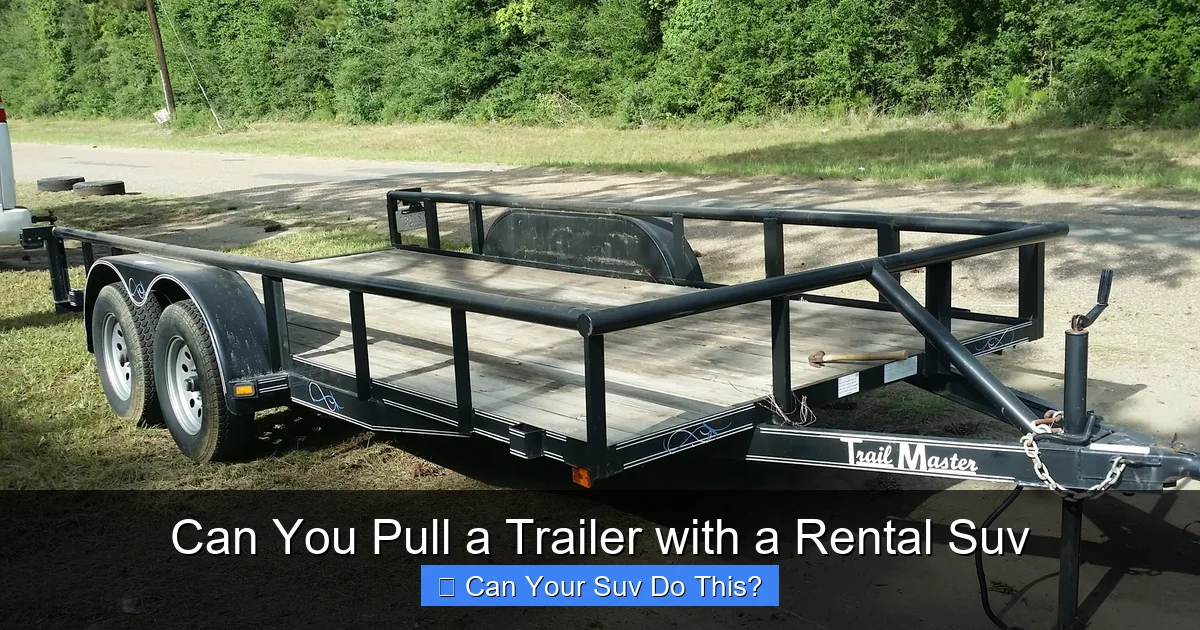
Yes, you can pull a trailer with a rental SUV—but only if the specific model is rated for towing and you follow rental company policies. Not all SUVs are created equal, and ignoring weight limits or hitch requirements can lead to fines, damage fees, or even accidents.
So, you’ve got a big move coming up, a weekend camping trip, or maybe you’re hauling a boat to the lake—and you’re wondering: *Can you pull a trailer with a rental SUV?* It’s a smart question, and the short answer is: **yes, but with major caveats**. Just because you’re driving an SUV doesn’t mean it’s built to tow. And just because you rented a large vehicle doesn’t mean the rental company will let you hitch up and hit the road.
Towing a trailer isn’t like driving a regular car. It changes how your vehicle handles, brakes, and responds to wind or hills. Add in the fact that you’re driving a vehicle you’re not familiar with—and possibly one you’ll be charged for any damage—and it’s easy to see why this requires careful planning. But don’t worry. With the right knowledge, you can safely and legally tow a trailer with a rental SUV. This guide will walk you through everything you need to know, from choosing the right vehicle to understanding weight limits, equipment needs, and rental policies.
Whether you’re renting from Enterprise, Hertz, Budget, or a local agency, the rules vary. Some companies are surprisingly flexible, while others flat-out prohibit towing. And even if they allow it, not every SUV in their fleet is up to the task. So before you book that shiny new SUV and start loading up your gear, let’s dive into the details.
Key Takeaways
- Not all rental SUVs can tow: Only certain models like the Ford Explorer, Toyota Highlander, or Chevrolet Tahoe are equipped for towing. Compact SUVs like the Honda CR-V often lack the power and hitch setup.
- Check the towing capacity: Always verify the vehicle’s maximum towing capacity in the owner’s manual or with the rental agency. Exceeding this limit is dangerous and voids insurance.
- Rental companies have strict rules: Most require prior approval, charge extra fees, and may prohibit towing altogether. Always call ahead and get written confirmation.
- You’ll need the right equipment: A proper hitch, wiring harness, brake controller (for heavy trailers), and safety chains are essential. Some rentals include these; others don’t.
- Weight distribution matters: The trailer’s tongue weight should be 10–15% of the total load. Overloading the rear or front can cause swaying or loss of control.
- Practice makes perfect: If you’ve never towed before, practice in an empty parking lot. Reversing, turning, and braking all feel different with a trailer attached.
- Insurance and liability are critical: Standard rental insurance may not cover towing-related damage. Consider supplemental coverage or your own auto policy.
📑 Table of Contents
Understanding Towing Capacity in Rental SUVs
When it comes to pulling a trailer, the most important number to know is the **towing capacity**—the maximum weight your vehicle can safely pull. This isn’t just a suggestion; it’s a hard limit set by the manufacturer based on the engine, transmission, suspension, and braking system. Exceeding it can lead to overheating, brake failure, or even a breakdown on the highway.
But here’s the catch: **not all SUVs are rated for towing**, even if they look tough. A compact SUV like the Nissan Rogue or Hyundai Tucson might have a towing capacity of just 1,500 to 3,500 pounds—enough for a small utility trailer or a lightweight popup camper, but not much else. On the other hand, full-size SUVs like the Ford Expedition, Chevrolet Suburban, or Toyota Sequoia can tow 7,000 to 9,000 pounds or more.
So how do you find out what your rental SUV can handle? Start by checking the **owner’s manual**—most rental agencies leave a copy in the glove box. Look for a section labeled “Towing” or “Trailer Towing.” You’ll see a chart with different configurations (like engine type, drivetrain, and whether a tow package is installed). If the vehicle doesn’t have a tow package—which includes a reinforced frame, transmission cooler, and proper hitch—it may not be safe to tow at all.
Another way is to ask the rental agent directly. Say something like, “I need to tow a 4,000-pound trailer. Does this SUV have a towing capacity of at least that, and is it equipped with a hitch?” A good agent will either confirm or steer you toward a more suitable vehicle. If they seem unsure or dismissive, that’s a red flag.
Let’s look at a few real-world examples. The **Ford Explorer** (a popular mid-size rental SUV) has a towing capacity of up to 5,600 pounds when properly equipped. That’s enough for a small camper, a couple of ATVs, or a medium-sized boat. The **Toyota Highlander** can tow up to 5,000 pounds, while the **Chevrolet Tahoe** can handle up to 8,400 pounds. But again, only if it has the tow package.
Why Towing Capacity Isn’t the Only Factor
Even if your rental SUV can technically tow your trailer, other factors come into play. For instance, **payload capacity**—the total weight the vehicle can carry, including passengers, cargo, and the tongue weight of the trailer—must also be considered. If you’ve got five people and a full cooler in the back, you might not have much room left for trailer weight.
Also, **driving conditions** matter. Towing uphill, in high winds, or on rough terrain puts extra strain on the vehicle. A 3,000-pound trailer might feel fine on flat highways but could overwhelm the engine and brakes in the mountains.
And don’t forget **fuel economy**. Towing can cut your MPG in half. A rental SUV that normally gets 25 MPG might drop to 12–15 MPG when towing a heavy load. That means more frequent stops and higher fuel costs—something to keep in mind on long trips.
Rental Company Policies on Towing
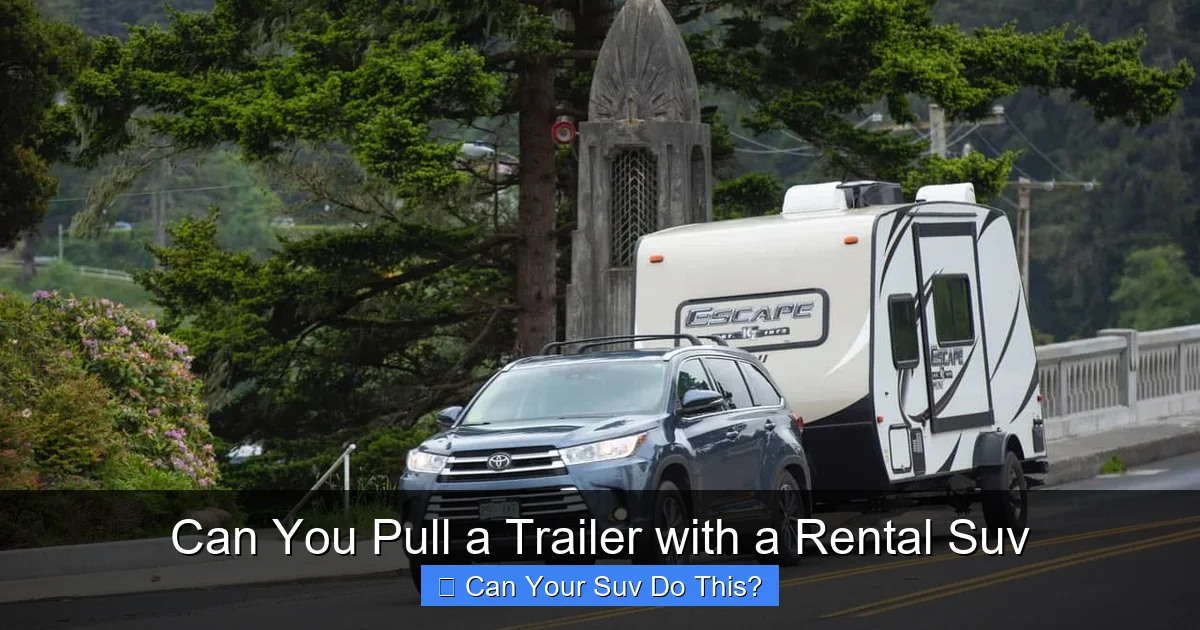
Visual guide about Can You Pull a Trailer with a Rental Suv
Image source: campersmarts.com
Now that you know what your SUV can handle, let’s talk about the rental company. This is where many people get tripped up. Just because a vehicle *can* tow doesn’t mean the rental agency *allows* it.
Most major rental companies—like Enterprise, Hertz, Avis, and Budget—have **strict policies** about towing. Some prohibit it entirely. Others allow it only with prior approval and additional fees. And nearly all require that the trailer and load comply with the vehicle’s towing capacity.
For example, **Enterprise** allows towing in certain SUVs and trucks, but only if you request it at the time of booking. They may charge a daily towing fee (often $10–$25) and require proof of insurance that covers towing. They also won’t rent you a hitch or wiring harness, so you’ll need to bring your own or rent one separately.
**Hertz** has a similar policy. They allow towing in select vehicles, but you must call ahead and get authorization. They also recommend using a weight-distribution hitch for loads over 3,500 pounds. And like Enterprise, they don’t provide towing equipment.
**Budget** and **Avis** are a bit more lenient, but still require advance notice. Budget, for instance, allows towing in full-size SUVs and trucks, but only if the trailer is properly licensed and insured. They also warn that towing may void certain damage waivers, so you’ll want to read the fine print.
The bottom line? **Never assume towing is allowed.** Always call the rental location directly, explain what you plan to tow, and ask for written confirmation. If they say no, don’t try to sneak it—rental companies often inspect vehicles upon return, and towing without permission can result in hefty fees or even being banned from future rentals.
What If the Rental Company Says No?
If your preferred rental agency doesn’t allow towing, don’t panic. You have options. One is to **rent a truck instead**. Many companies offer pickup trucks (like the Ford F-150 or Chevrolet Silverado) that are designed for towing and often come with hitches pre-installed. These are usually more towing-friendly than SUVs.
Another option is to **use a peer-to-peer rental service** like Turo or Getaround. These platforms let individuals rent out their personal vehicles, and some owners are happy to rent out their towing-capable SUVs—sometimes even with the hitch included. Just be sure to check the vehicle’s towing specs and confirm the owner allows towing.
You could also **rent the trailer separately** from a U-Haul or trailer rental company. They often have partnerships with rental car agencies and can help coordinate everything, including hitch installation and safety checks.
Essential Towing Equipment You’ll Need
Even if your rental SUV is towing-ready and the company gives the green light, you still need the right gear. Towing isn’t just about hooking up and going—it’s about doing it safely and legally.
Here’s what you’ll typically need:
- Class III or IV Hitch: This is the metal receiver that attaches to the vehicle’s frame. Most full-size SUVs come with one if they’re tow-rated, but compact SUVs often don’t. If your rental doesn’t have one, you’ll need to install it—but most rental companies won’t allow modifications, so this is a dealbreaker unless it’s already there.
- Ball Mount and Hitch Ball: The ball mount slides into the hitch, and the hitch ball (usually 2” or 2-5/16”) connects to the trailer coupler. Make sure the ball size matches your trailer.
- Wiring Harness: This connects the trailer’s lights (brake, turn, and running lights) to the vehicle’s electrical system. Without it, your trailer lights won’t work, which is illegal in most states. Some rentals include a harness; others don’t. If not, you’ll need a plug-and-play adapter that fits your SUV’s tail light connector.
- Safety Chains: These cross under the trailer tongue and attach to the vehicle’s hitch. If the trailer becomes unhitched, the chains catch it and prevent it from hitting the ground. Always use them—no exceptions.
- Brake Controller (for heavy trailers): If your trailer has electric brakes (usually on loads over 3,000 pounds), you’ll need a brake controller inside the vehicle to activate them. Most rental SUVs don’t come with one, so you’ll need to bring your own or rent one. Some newer SUVs have integrated controllers, but don’t assume.
- Weight Distribution Hitch (for heavy loads): This spreads the trailer’s weight more evenly across the vehicle and trailer axles, improving stability. It’s recommended for trailers over 5,000 pounds.
Can You Rent the Equipment?
Some rental companies offer towing equipment for rent, but it’s rare. U-Haul, for example, rents hitches, wiring kits, and brake controllers—but you’ll need to install them yourself, which may not be allowed on a rental vehicle.
A better option might be to **buy a universal wiring harness** (around $30–$50) that plugs into your SUV’s tail lights. These are easy to install and remove, and many are compatible with multiple vehicle models. Just make sure it matches your SUV’s year, make, and model.
For hitches and ball mounts, you’re usually better off bringing your own—especially if you tow regularly. But if this is a one-time thing, consider renting a truck with a pre-installed hitch instead.
How to Safely Tow with a Rental SUV
Once you’ve got the right vehicle, permission, and equipment, it’s time to hit the road. But towing changes how your SUV drives, so you’ll need to adjust your habits.
First, **practice in a safe area**. Find an empty parking lot and practice backing up, turning, and braking with the trailer attached. Reversing is especially tricky—turn the wheel in the opposite direction you want the trailer to go. It feels counterintuitive at first, but you’ll get the hang of it.
When driving, **allow extra space**. Your stopping distance increases significantly when towing. Leave at least 3–4 seconds behind the car in front of you. And remember: you can’t stop as quickly, so brake earlier and smoother.
**Watch your speed**. Most experts recommend driving 5–10 mph slower than the speed limit when towing. High speeds increase the risk of trailer sway—a dangerous wobbling that can cause a jackknife.
Dealing with Trailer Sway
Trailer sway happens when wind, uneven roads, or improper loading causes the trailer to fishtail behind the vehicle. If it starts, **don’t slam on the brakes**. Instead, ease off the accelerator and gently apply the trailer brakes (if you have a brake controller). Once the sway stops, you can resume normal driving.
To prevent sway, make sure your trailer is loaded correctly. The **tongue weight** (the downward force on the hitch) should be 10–15% of the total trailer weight. Too little, and the trailer can fishtail; too much, and it can overload the rear of the SUV.
Also, **distribute weight evenly**. Heavier items should be placed over the trailer’s axles, not at the back. And never exceed the trailer’s gross vehicle weight rating (GVWR), which is stamped on the trailer’s frame.
Parking and Turning
Parking with a trailer takes practice. Always back into spaces when possible—it’s easier to see and control. And when turning, **widen your arc**. The trailer will follow a tighter path than the SUV, so you need to swing wider to avoid curbs or obstacles.
If you’re parking on a hill, use wheel chocks (small wedges placed behind the trailer wheels) to prevent rolling. And always set the parking brake on both the SUV and the trailer (if it has one).
Insurance and Liability When Towing
This is a big one. **Standard rental insurance may not cover towing-related damage.** If you crash while towing, and the rental agreement prohibits towing, your damage waiver could be voided. That means you’re on the hook for the full cost of repairs—or even the entire vehicle.
So what can you do?
First, **check your personal auto insurance policy**. Many policies extend to rental cars, including towing, as long as you’re using the vehicle as intended. Call your insurer and ask: “Does my policy cover towing a trailer with a rental SUV?”
Second, **consider supplemental coverage**. Some rental companies offer “towing protection” or “extended liability” for an extra fee. It’s not cheap, but it could save you thousands.
Third, **use a credit card with rental car benefits**. Some premium cards (like those from Chase or American Express) offer secondary or primary rental insurance that includes towing. Just make sure to decline the rental company’s insurance and pay with the card.
And finally, **document everything**. Take photos of the SUV and trailer before you leave, note the mileage, and keep all rental agreements and receipts. If there’s a dispute later, you’ll have proof.
Real-Life Examples and Tips
Let’s say you’re planning a cross-country move and need to tow a 4,000-pound enclosed trailer. You rent a Ford Explorer from Enterprise. Here’s how to do it right:
1. **Call Enterprise ahead of time.** Ask if the Explorer can tow 4,000 pounds and if towing is allowed. Request a model with the tow package.
2. **Confirm the hitch is installed.** If not, ask if they can provide one or suggest a different vehicle.
3. **Bring your own wiring harness and brake controller.** Test them before leaving.
4. **Load the trailer correctly.** Place heavy items over the axles, keep tongue weight at 12%, and secure everything with straps.
5. **Practice in a parking lot.** Spend 20 minutes getting comfortable with reversing and turning.
6. **Drive cautiously.** Stay in the right lane, avoid highways with steep grades, and take breaks every 2 hours.
7. **Return the vehicle clean and undamaged.** Remove all towing equipment and wipe down the hitch area.
Another scenario: You’re going camping and want to tow a 2,500-pound pop-up camper. You rent a Toyota Highlander. This is more feasible, but still requires planning. The Highlander can handle it, but only if it’s the V6 model with the tow package. Compact hybrids usually can’t tow much at all.
What Not to Do
Avoid these common mistakes:
- Towing without permission: Even if you think it’s fine, get it in writing.
- Overloading the trailer: Weigh your load at a truck stop scale if unsure.
- Ignoring trailer lights: A broken brake light can get you pulled over—and cause an accident.
- Driving too fast: Speed is the enemy of stability when towing.
- Skipping the pre-trip check: Always inspect tires, lights, hitch, and chains before driving.
Conclusion
So, can you pull a trailer with a rental SUV? **Yes—but only if the vehicle is rated for towing, the rental company allows it, and you have the right equipment and knowledge.** It’s not as simple as just hitching up and going, but with careful planning, it’s absolutely doable.
Start by choosing a towing-capable SUV like a Ford Explorer, Chevrolet Tahoe, or Toyota Highlander. Confirm the towing capacity and ensure it has a hitch. Call the rental agency in advance and get written approval. Bring or rent the necessary equipment, including a wiring harness and brake controller if needed. Practice driving with the trailer, load it correctly, and drive safely.
Towing with a rental SUV can save you money and give you flexibility for moves, trips, or hauling projects. But it’s not without risks. One mistake—like exceeding the weight limit or towing without permission—can lead to serious consequences.
By following this guide, you’ll be prepared to tow confidently and legally. So go ahead—load up that trailer, hit the road, and enjoy the journey. Just remember: safety first, always.
Frequently Asked Questions
Can I tow a trailer with any rental SUV?
No, not all rental SUVs are designed for towing. Only models with sufficient towing capacity and proper equipment—like the Ford Explorer or Chevrolet Tahoe—can safely pull a trailer. Always check the vehicle’s specs and rental company policies.
Do rental companies provide hitches and towing equipment?
Most rental companies do not provide hitches, ball mounts, or wiring harnesses. You’ll typically need to bring your own or rent them separately from a trailer shop like U-Haul.
What happens if I tow without permission from the rental company?
Towing without approval can void your rental agreement and insurance coverage. You may be charged damage fees, lose your security deposit, or even be banned from future rentals.
How do I know if my rental SUV has a tow package?
Check the owner’s manual in the glove box or ask the rental agent. Look for terms like “trailer tow package,” which usually includes a hitch, transmission cooler, and reinforced frame.
Can I tow a boat with a rental SUV?
Yes, if the SUV’s towing capacity exceeds the combined weight of the boat, trailer, and gear. For example, a 3,500-pound boat requires an SUV that can tow at least 4,000 pounds to account for the trailer and safety margin.
Is it safe to tow for the first time with a rental SUV?
It can be, but only if you practice in a safe area first. Reversing, turning, and braking feel very different with a trailer. Take time to get comfortable before hitting busy roads.