
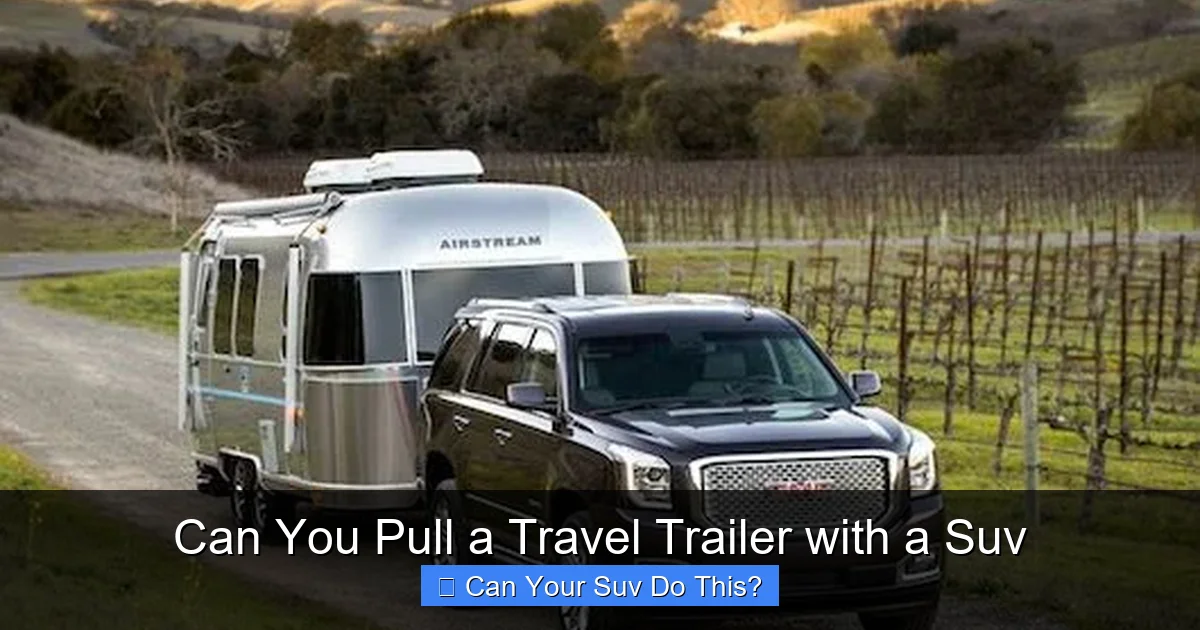
Yes, you can pull a travel trailer with an SUV—but only if your vehicle is properly equipped and rated for the job. Towing safely depends on matching your SUV’s towing capacity to the trailer’s weight, using the right gear, and driving with care.
Thinking about hitting the open road with a travel trailer in tow? You’re not alone. More and more people are embracing the freedom of RV travel, and SUVs have become a popular choice for pulling lightweight campers. But here’s the big question: *Can you pull a travel trailer with an SUV?* The short answer is yes—but it’s not as simple as just hitching up and driving off.
SUVs come in all shapes and sizes, from compact crossovers to full-size beasts with serious muscle under the hood. Some are built for city driving and weekend errands, while others are designed to haul heavy loads across rugged terrain. The key to safe and successful towing lies in understanding your SUV’s capabilities and matching them to the right travel trailer. It’s not just about power—it’s about preparation, knowledge, and respect for the physics of towing.
In this guide, we’ll walk you through everything you need to know about pulling a travel trailer with an SUV. Whether you’re a first-time RVer or a seasoned road warrior looking to upgrade your setup, we’ll cover the essentials: how to check your SUV’s towing capacity, what kind of trailers work best, the equipment you’ll need, and how to drive safely with a trailer in tow. By the end, you’ll know exactly whether your SUV is up to the task—and how to do it the right way.
Key Takeaways
- Check your SUV’s towing capacity: Every SUV has a maximum towing limit set by the manufacturer—know yours before hitching up.
- Match trailer weight to your SUV: The trailer’s gross vehicle weight rating (GVWR) must be within your SUV’s towing capacity, including cargo and passengers.
- Use proper towing equipment: A weight-distributing hitch, brake controller, and safety chains are essential for safe towing.
- Consider drivetrain and engine power: All-wheel drive (AWD) or four-wheel drive (4WD) SUVs often handle towing better than front-wheel drive models.
- Practice driving and parking: Towing changes how your SUV handles—practice in empty lots before hitting the road.
- Know the laws: Towing regulations vary by state, including speed limits, required equipment, and licensing.
- Choose the right trailer: Lightweight travel trailers under 5,000 pounds are ideal for most mid-size SUVs.
📑 Table of Contents
Understanding SUV Towing Capacity
Before you even think about buying a trailer, you need to know your SUV’s towing capacity. This is the maximum weight your vehicle can safely pull, as determined by the manufacturer. It’s not a suggestion—it’s a hard limit based on your SUV’s engine, transmission, cooling system, frame strength, and braking power.
Towing capacity varies widely across SUV models. A small crossover like the Honda CR-V might have a towing capacity of around 1,500 pounds, while a full-size SUV like the Ford Expedition can pull up to 9,300 pounds. That’s a huge difference! Even within the same brand, different trims and engine options can change the towing rating. For example, a Toyota Highlander with a V6 engine can tow up to 5,000 pounds, but the four-cylinder version is limited to just 3,500 pounds.
So how do you find your SUV’s towing capacity? Start by checking the owner’s manual—it’s the most reliable source. You can also look up your vehicle on the manufacturer’s website or use online tools like the National Highway Traffic Safety Administration (NHTSA) database. Don’t rely on dealership estimates or online forums; always go back to the official specs.
What Affects Towing Capacity?
Several factors influence how much your SUV can safely tow. The engine is a big one—larger, more powerful engines generate the torque needed to pull heavy loads. Transmission type also matters; SUVs with heavy-duty or tow-rated transmissions often have higher capacities. Cooling systems are critical too; towing puts extra strain on the engine and transmission, so vehicles with enhanced radiators and coolers are better equipped.
The drivetrain plays a role as well. SUVs with all-wheel drive (AWD) or four-wheel drive (4WD) typically have better traction and stability when towing, especially on inclines or in wet conditions. However, AWD doesn’t automatically mean higher towing capacity—some AWD models are actually rated lower than their two-wheel drive counterparts due to added weight and mechanical complexity.
Finally, the SUV’s weight and suspension matter. Heavier SUVs with reinforced frames and upgraded suspension systems can handle more weight. That’s why full-size SUVs like the Chevrolet Tahoe or Nissan Armada often have higher towing ratings than smaller models.
Don’t Forget the Payload
While towing capacity gets all the attention, payload capacity is just as important. Payload is the total weight your SUV can carry, including passengers, cargo, and the tongue weight of the trailer. Tongue weight is the downward force exerted by the trailer hitch on the SUV’s rear axle—typically 10% to 15% of the trailer’s total weight.
For example, if you’re towing a 4,000-pound trailer, the tongue weight could be 400 to 600 pounds. That weight counts toward your SUV’s payload limit. If your SUV has a payload capacity of 1,500 pounds and you’ve got four people (600 pounds), gear (200 pounds), and a 500-pound tongue weight, you’re already at 1,300 pounds—leaving little room for error.
Overloading your SUV can lead to poor handling, brake failure, and even structural damage. Always check both towing and payload capacities before hitting the road.
Choosing the Right Travel Trailer for Your SUV

Visual guide about Can You Pull a Travel Trailer with a Suv
Image source: rvownerhq.com
Not all travel trailers are created equal—and not all are suitable for SUV towing. The key is finding a trailer that matches your SUV’s capabilities. Most mid-size and full-size SUVs can handle lightweight travel trailers, but compact SUVs are usually limited to smaller campers or teardrop trailers.
Lightweight travel trailers typically weigh between 2,000 and 5,000 pounds when fully loaded. These include models like the Airstream Basecamp, Winnebago Micro Minnie, and Jayco Jay Feather. They’re designed with aerodynamic shapes, lightweight materials, and compact floor plans to reduce drag and weight.
Teardrop trailers are even lighter, often under 2,000 pounds. They’re perfect for small SUVs and offer basic amenities like a small kitchenette and sleeping area. Pop-up campers are another option—they collapse for easy towing and expand at the campsite. While they’re not technically travel trailers, they serve a similar purpose and are ideal for SUVs with lower towing capacities.
What to Look for in a Trailer
When shopping for a travel trailer, focus on weight first. Check the trailer’s dry weight (unloaded) and gross vehicle weight rating (GVWR)—the maximum weight it can safely carry when fully loaded. Always plan for the GVWR, not the dry weight, since you’ll be carrying water, gear, and supplies.
Look for trailers with a low center of gravity and balanced weight distribution. Trailers that are too front-heavy or back-heavy can cause swaying or fishtailing, making them dangerous to tow. Features like electric brakes, breakaway switches, and sway control systems can improve safety.
Also consider the trailer’s length and width. Longer trailers are harder to maneuver and park, especially in tight campsites or on narrow roads. Wider trailers may not be legal on certain highways or bridges. Stick to trailers under 25 feet if you’re towing with a mid-size SUV.
Popular SUV and Trailer Combinations
Here are a few real-world examples of SUVs and trailers that work well together:
– **Toyota 4Runner (5,000 lbs towing capacity)** + **Airstream Basecamp (3,500 lbs GVWR)**: A rugged SUV paired with a compact, off-road-ready trailer.
– **Ford Explorer (5,600 lbs towing capacity)** + **Jayco Jay Feather (4,800 lbs GVWR)**: A family-friendly SUV with plenty of power for a mid-size trailer.
– **Subaru Outback (3,500 lbs towing capacity)** + **Aliner Classic (2,600 lbs GVWR)**: A smaller SUV handling a lightweight pop-up camper with ease.
These combinations show that with the right match, even modest SUVs can enjoy the RV lifestyle.
Essential Towing Equipment
You can’t just hitch up a trailer and go—towing requires the right equipment. Without it, you risk damaging your SUV, losing control of the trailer, or breaking the law.
Hitch and Ball Mount
The hitch is the connection point between your SUV and the trailer. Most SUVs come with a factory-installed hitch receiver, but you may need to install one if it’s not already there. Hitches are rated by class (I through V), with higher classes supporting more weight. A Class III hitch, for example, can handle up to 6,000 pounds.
The ball mount holds the hitch ball, which connects to the trailer coupler. Make sure the ball size matches your trailer—common sizes are 2 inches and 2-5/16 inches. The height of the ball mount is also important; it should position the trailer level when hitched.
Weight Distribution Hitch
For heavier trailers, a weight distribution hitch is essential. It redistributes the tongue weight across all four wheels of your SUV and the trailer axles, improving stability and handling. Without it, the rear of your SUV can sag, causing poor steering and brake performance.
Weight distribution hitches use spring bars to level the load. They’re especially helpful when towing trailers over 5,000 pounds, but even lighter trailers benefit from the added control.
Brake Controller
If your trailer has electric brakes (most do), you’ll need a brake controller inside your SUV. This device allows you to activate the trailer’s brakes independently or in sync with your SUV’s brakes. It’s a critical safety feature—without it, the trailer can push your SUV during sudden stops.
Brake controllers come in two types: time-delayed and proportional. Proportional controllers (also called inertia-based) apply the trailer brakes in proportion to how hard you’re braking, offering smoother, more responsive stopping power.
Safety Chains and Breakaway Switch
Safety chains are a backup in case the hitch fails. They should be crossed under the coupler to create a cradle that catches the trailer if it detaches. Always check that the chains are long enough to allow turning but short enough to prevent the trailer from hitting the ground.
A breakaway switch is another safety must-have. It’s a battery-powered device that activates the trailer’s brakes if it becomes unhitched. It’s required by law in most states.
Tow Mirrors and Lights
Extended tow mirrors give you a better view of the trailer and blind spots. Most SUVs have standard mirrors, but you may need to upgrade for wider trailers.
Trailer lights (brake, turn, and running lights) must be connected to your SUV’s electrical system. Use a wiring harness to ensure compatibility and avoid electrical issues.
Driving and Safety Tips
Towing a travel trailer changes how your SUV behaves. It’s heavier, longer, and less responsive. But with practice and caution, you can drive safely and confidently.
Pre-Trip Inspection
Before every trip, do a thorough check. Inspect the tires (on both SUV and trailer), lights, hitch, safety chains, and brake controller. Make sure the trailer is level and the load is balanced. Check fluid levels in your SUV—towing increases engine and transmission stress.
Adjust Your Driving
With a trailer in tow, you’ll need more time and space to accelerate, brake, and turn. Increase your following distance—aim for at least six seconds behind the vehicle in front of you. Brake earlier and more gently to avoid locking up the trailer brakes.
Take turns wider to prevent the trailer from cutting corners. On highways, use the right lane and avoid sudden lane changes. Be extra cautious in windy conditions—crosswinds can cause trailer sway.
Dealing with Sway
Trailer sway (fishtailing) is scary but manageable. If it happens, don’t slam on the brakes—gently ease off the accelerator and let the trailer settle. Use your brake controller to apply the trailer brakes slightly, which can help stabilize it.
To prevent sway, ensure the trailer is loaded correctly (heavier items low and forward), use a sway control device, and avoid overloading.
Parking and Backing Up
Parking with a trailer takes practice. Always back up slowly and use your mirrors. Remember: turn the steering wheel in the opposite direction you want the trailer to go. Practice in an empty parking lot before trying it at a busy campground.
Use leveling blocks or ramps if the campsite is uneven. Never unhitch on a slope—it’s unsafe and can damage the trailer.
Legal and Insurance Considerations
Towing laws vary by state, so it’s important to know the rules where you’ll be driving. Most states require trailers over a certain weight (usually 1,500 to 3,000 pounds) to have brakes and a brake controller. Some require additional lighting or reflectors.
Speed limits for towing are often lower than regular limits—check local regulations. In some states, you may need a special license or endorsement to tow heavy trailers.
Insurance is another consideration. Your auto insurance may cover towing, but it’s best to confirm with your provider. You may need to add coverage for the trailer itself, especially if it’s expensive or has custom features.
Conclusion
So, can you pull a travel trailer with an SUV? Absolutely—if you do it right. The key is matching your SUV’s towing capacity to a trailer that fits within those limits, using the proper equipment, and driving with care. With the right setup, your SUV can be the perfect partner for weekend getaways, cross-country adventures, or full-time RV living.
Don’t rush the process. Take time to research your SUV’s specs, choose a trailer wisely, and invest in quality towing gear. Practice driving and parking before your first big trip. And always prioritize safety—yours, your passengers’, and other drivers on the road.
The freedom of the open road is calling. With the right preparation, your SUV can answer that call—and take you wherever your heart desires.
Frequently Asked Questions
Can a small SUV pull a travel trailer?
Yes, but only lightweight models. Small SUVs like the Honda CR-V or Subaru Forester can typically tow 1,500 to 3,500 pounds, which is enough for teardrop trailers or small pop-ups. Always check your specific model’s towing capacity.
Do I need a special license to tow a travel trailer?
In most states, no—standard driver’s licenses cover towing trailers under 10,000 pounds. However, some states require a special endorsement for larger trailers, so check local laws.
What’s the difference between towing capacity and payload?
Towing capacity is the maximum weight your SUV can pull. Payload is the total weight it can carry, including passengers, cargo, and the trailer’s tongue weight. Both matter for safe towing.
Can I tow a travel trailer in the rain or snow?
Yes, but with extra caution. Wet or icy roads reduce traction and increase stopping distance. Use lower speeds, avoid sudden moves, and ensure your tires and brakes are in good condition.
How do I prevent trailer sway?
Load the trailer properly (heavier items low and forward), use a sway control device, and avoid overloading. If sway occurs, ease off the gas and gently apply the trailer brakes.
Can I install a hitch myself?
It’s possible, but not recommended unless you’re experienced. Improper installation can lead to failure. Have a professional install your hitch and wiring for safety and reliability.