
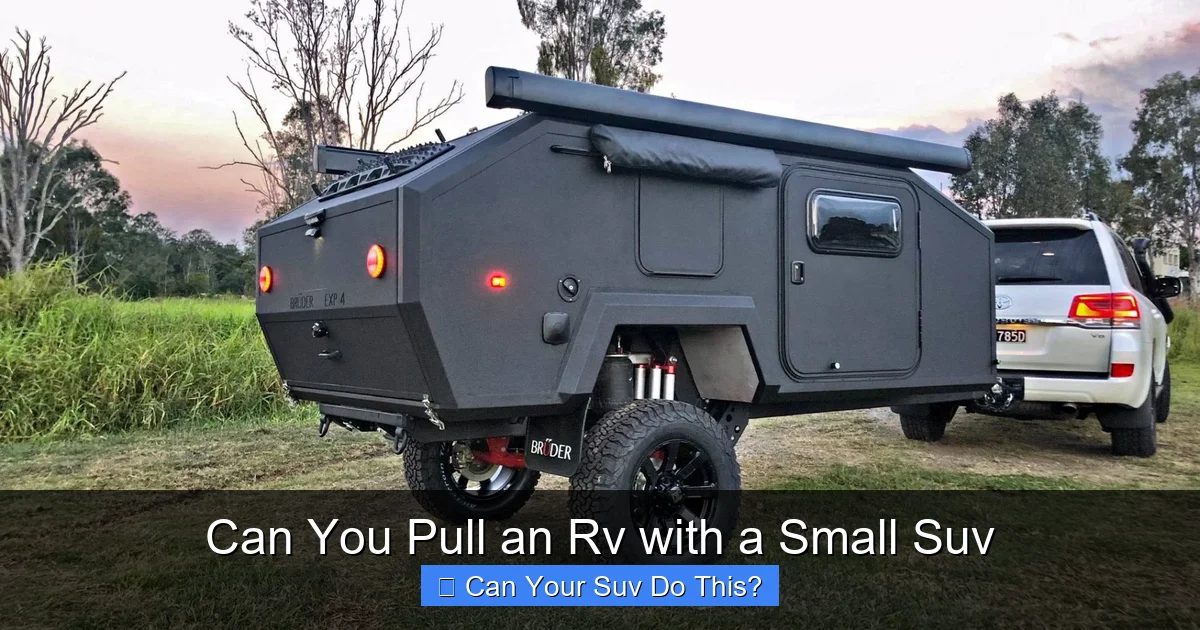
Yes, you can pull an RV with a small SUV—but only if it’s within your vehicle’s towing capacity and you use the right equipment. Many modern small SUVs are surprisingly capable, but overloading or improper setup can lead to dangerous situations. Always check your owner’s manual, match your trailer weight, and prioritize safety.
Key Takeaways
- Check your SUV’s towing capacity: This is the maximum weight your vehicle can safely tow, listed in the owner’s manual or manufacturer specs.
- Match the RV weight to your SUV: The RV’s gross vehicle weight rating (GVWR) must be below your SUV’s towing limit.
- Use proper towing equipment: A quality hitch, brake controller, and weight distribution system are essential for safe towing.
- Consider the type of RV: Small travel trailers, teardrop campers, and pop-ups are more suitable for small SUVs than large fifth wheels or motorhomes.
- Practice driving and braking: Towing changes handling—practice in empty parking lots before hitting the road.
- Know your limits: Even if technically possible, towing near max capacity increases wear on your SUV and reduces fuel efficiency.
- Safety first: Always inspect tires, lights, and connections before every trip.
📑 Table of Contents
- Can You Pull an RV with a Small SUV? The Real Answer
- Understanding Towing Capacity: The Most Important Number
- What Types of RVs Can Small SUVs Tow?
- Essential Towing Equipment for Small SUVs
- Driving and Safety Tips for Towing with a Small SUV
- Real-World Examples: Small SUVs Towing RVs
- When to Say No: Knowing Your Limits
- Conclusion: Yes, But Do It Right
Can You Pull an RV with a Small SUV? The Real Answer
So, you’ve got a small SUV—maybe a Honda CR-V, Toyota RAV4, or Subaru Forester—and you’re dreaming of weekend getaways in a cozy little travel trailer. You’ve seen others doing it, and now you’re wondering: *Can I really pull an RV with my small SUV?*
The short answer? **Yes—but with major caveats.**
Small SUVs have come a long way in the last decade. Thanks to improved engineering, turbocharged engines, and better transmissions, many compact crossovers now offer towing capacities that rival older midsize trucks. That means you might actually be able to tow a lightweight travel trailer or pop-up camper without needing to upgrade your vehicle.
But here’s the catch: not all small SUVs are created equal, and not all RVs are light enough to be safely towed. Towing isn’t just about horsepower—it’s about balance, safety, and knowing your vehicle’s limits. If you ignore those limits, you could end up with a dangerous swaying trailer, overheated brakes, or even a broken transmission.
In this guide, we’ll walk you through everything you need to know about pulling an RV with a small SUV. We’ll cover towing capacities, the best types of RVs for compact vehicles, essential equipment, driving tips, and safety precautions. By the end, you’ll know whether your small SUV is up to the task—and how to do it safely if it is.
Understanding Towing Capacity: The Most Important Number
Visual guide about Can You Pull an Rv with a Small Suv
Image source: i.ytimg.com
Before you even think about hitching up an RV, you need to know one critical number: your SUV’s **towing capacity**.
This isn’t a guess. It’s not what your friend’s SUV can tow. It’s the maximum weight your specific vehicle is designed to pull safely, as determined by the manufacturer. You’ll find this number in your owner’s manual, on the manufacturer’s website, or sometimes on a sticker inside the driver’s door jamb.
For example:
– A 2023 Honda CR-V has a towing capacity of **1,500 to 2,000 pounds**, depending on the engine and drivetrain.
– A 2023 Toyota RAV4 can tow up to **3,500 pounds** with the proper towing package.
– A 2023 Subaru Forester maxes out at **2,700 pounds** when equipped with the optional towing package.
Notice the variation? Even within the same vehicle class, towing capacities can differ significantly based on engine size, transmission, cooling systems, and factory-installed towing packages.
Why Towing Capacity Matters
Towing capacity isn’t just a suggestion—it’s a safety threshold. Exceeding it can lead to:
– **Transmission overheating:** Small SUVs often use continuously variable transmissions (CVTs) or smaller automatic transmissions that aren’t built for heavy, sustained loads.
– **Brake failure:** Your SUV’s brakes are designed to stop the vehicle itself, not a heavy trailer. Overloading increases stopping distance and can cause brake fade.
– **Suspension damage:** Constant stress from towing too much weight can warp frames, break springs, or damage shocks.
– **Loss of control:** An overloaded or improperly balanced trailer can cause dangerous sway, especially in windy conditions or when passing trucks.
So, always stay **at or below** your SUV’s rated towing capacity. And remember: that number includes the weight of the trailer, cargo, water, propane, and any accessories—not just the empty trailer.
How to Find Your SUV’s Towing Capacity
Don’t rely on memory or hearsay. Here’s how to find the real number:
1. **Check the owner’s manual:** Look for a section titled “Towing” or “Trailer Towing.”
2. **Visit the manufacturer’s website:** Most automakers have a “Towing Guide” or “Specs” page where you can enter your VIN or model/year.
3. **Look for a towing capacity sticker:** Some vehicles have this near the radiator or on the driver’s side door frame.
4. **Contact a dealership:** If you’re unsure, a service advisor can look up your vehicle’s specs.
Pro tip: If your SUV didn’t come with a factory towing package, its capacity may be lower. Adding a towing package (which often includes a hitch, wiring harness, and upgraded cooling) can increase capacity—but only if the vehicle was designed to support it.
What Types of RVs Can Small SUVs Tow?
Now that you know your SUV’s towing limit, the next question is: *What kind of RV can I actually pull?*
The good news? There are plenty of lightweight RVs designed specifically for smaller tow vehicles. The key is choosing the right type and size.
Best RVs for Small SUVs
Here are the most compatible options:
**1. Teardrop Trailers (300–1,500 lbs)**
These compact, aerodynamic campers are perfect for small SUVs. They usually sleep two, have a small kitchenette in the rear hatch, and are easy to maneuver. Popular models include the Little Guy Mini Max and the Happier Camper HC1.
**2. Pop-Up Campers (1,000–3,000 lbs)**
Also known as tent trailers, these fold down for easy towing and expand when parked. They’re lightweight, affordable, and great for families. Examples: Jayco Jay Series, Forest River R-Pod (some models).
**3. Small Travel Trailers (1,500–4,000 lbs)**
Modern travel trailers come in lightweight versions made with aluminum frames and composite walls. Look for models under 3,500 lbs GVWR. Examples: Airstream Basecamp, Winnebago Micro Minnie, and the Casita Spirit.
**4. Off-Road Trailers (1,500–3,500 lbs)**
Built for adventure, these rugged campers are designed to be towed by smaller vehicles. They often have high ground clearance and durable suspensions. Examples: Taxa Outdoors TigerMoth, SylvanSport GO.
**5. Cargo Trailers Converted to Campers (1,000–3,000 lbs)**
Some DIYers convert small cargo trailers into minimalist campers. These are ultra-light and customizable, but require some building skills.
RVs to Avoid with Small SUVs
Steer clear of:
– **Fifth-wheel trailers:** These require a pickup truck with a bed-mounted hitch.
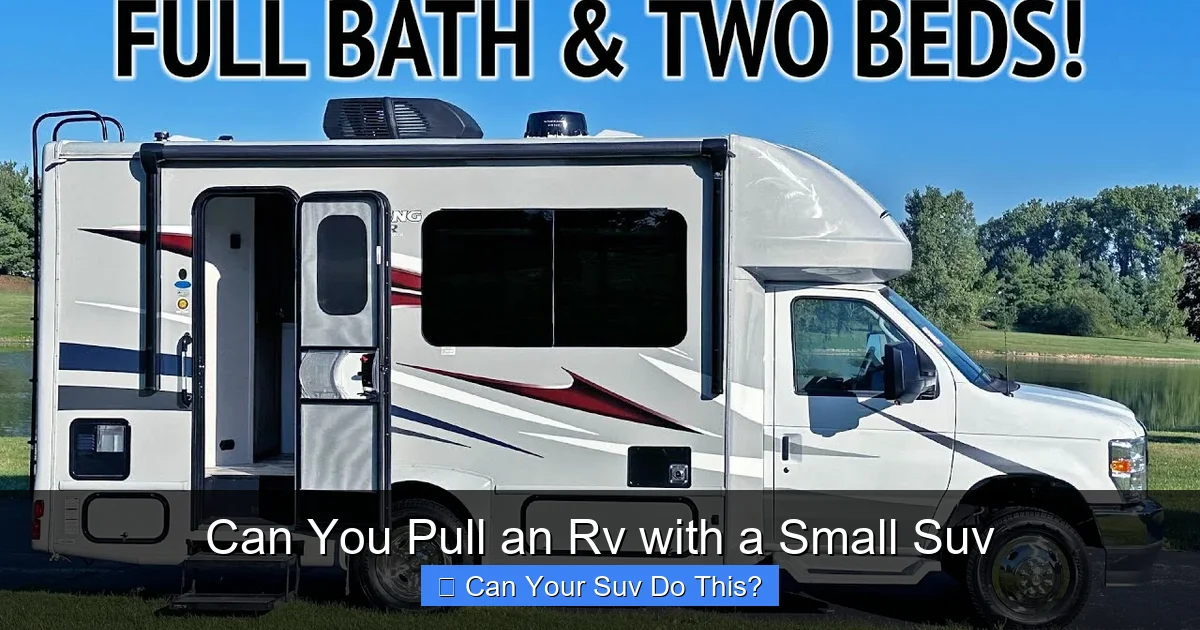
– **Large motorhomes (Class A, B+, C):** These are self-contained and too heavy.
– **Full-size travel trailers over 4,000 lbs:** Even if your SUV can technically tow it, the handling and braking will be compromised.
– **Toy haulers or multi-axle trailers:** These are heavy and create more sway.
Remember: just because you *can* tow something doesn’t mean you *should*. Always leave a safety margin—aim to tow no more than 80–90% of your SUV’s max capacity.
Essential Towing Equipment for Small SUVs
You can’t just hook up a trailer and go. Safe towing requires the right gear. Here’s what you’ll need:
1. Class III or IV Hitch
Your SUV needs a receiver hitch rated for the weight you’re towing. Most small SUVs use a **Class III hitch** (up to 5,000 lbs), but some may require a **Class II** (up to 3,500 lbs). Never use a hitch rated below your trailer’s weight.
Install it professionally—DIY installations can fail under stress.
2. Weight Distribution Hitch (for heavier trailers)
If your trailer is over 3,000 lbs or more than 50% of your SUV’s weight, use a **weight distribution hitch**. It spreads the load across all four tires, improving stability and reducing sway.
3. Sway Control System
Even lightweight trailers can sway in wind or when passed by trucks. A sway control device—either built into the weight distribution hitch or added separately—helps keep the trailer tracking straight.
4. Brake Controller (if required)
If your trailer has electric brakes (common on trailers over 1,500 lbs), you’ll need a **brake controller** inside your SUV. It lets you manually activate the trailer brakes and adjust their sensitivity.
Most small SUVs don’t come with one factory-installed, so you’ll need to add it.
5. Wiring Harness and Lights
Your trailer’s brake lights, turn signals, and running lights must sync with your SUV. Use a **4-pin or 7-pin wiring harness** (depending on the trailer) and test all lights before every trip.
6. Towing Mirrors
Standard side mirrors won’t give you a clear view of the trailer’s edges. Clip-on or extended towing mirrors improve visibility and reduce blind spots.
7. Tire Pressure Monitoring System (TPMS)
Towing increases tire stress. A TPMS alerts you to underinflation or overheating—critical for preventing blowouts.
8. Trailer Brake Check and Breakaway System
Every trailer with brakes must have a **breakaway system**—a battery-powered brake activator that engages if the trailer detaches. Test it monthly.
Driving and Safety Tips for Towing with a Small SUV
Towing changes how your SUV handles. It’s heavier, slower to accelerate, and harder to stop. Here’s how to drive safely:
Pre-Trip Checklist
Before hitting the road:
– ✔️ Confirm trailer weight (use a scale if possible).
– ✔️ Check tire pressure on both SUV and trailer.
– ✔️ Inspect hitch, safety chains, and lights.
– ✔️ Secure all cargo inside the trailer (shift weight forward, but not over 60% on the tongue).
– ✔️ Test brake controller and breakaway system.
Driving Tips
– **Accelerate slowly:** Small SUVs have less power. Give yourself extra time to merge and climb hills.
– **Brake early and gently:** Increase following distance to 5–6 seconds. Use engine braking on downhill grades.
– **Avoid sudden moves:** Steering inputs should be smooth. Jerky turns can cause sway.
– **Watch for crosswinds:** Lightweight trailers are more affected by wind. Reduce speed in gusty conditions.
– **Use lower gears on hills:** This reduces strain on the transmission and improves control.
Parking and Maneuvering
– **Practice backing up:** Start in an empty parking lot. Remember: turn the wheel *opposite* the direction you want the trailer to go.
– **Use a spotter:** Have someone guide you when parking or reversing.
– **Allow extra space:** You’ll need more room to turn, park, and exit driveways.
Fuel Efficiency and Wear
Towing cuts fuel economy by 20–40%. Expect to spend more on gas, especially on long trips or mountainous terrain. Also, frequent towing near max capacity can shorten the life of your transmission, brakes, and suspension.
Real-World Examples: Small SUVs Towing RVs
Let’s look at a few real scenarios to see how this works in practice.
Example 1: Honda CR-V Towing a Teardrop Trailer
– **SUV:** 2022 Honda CR-V EX (2,000 lbs towing capacity)
– **RV:** Little Guy Mini Max (1,400 lbs GVWR)
– **Result:** Perfect match. The CR-V handles the trailer with ease on highways and mountain roads. Owner reports only a 15% drop in fuel economy.
Example 2: Toyota RAV4 Towing a Pop-Up Camper
– **SUV:** 2023 Toyota RAV4 Hybrid (3,500 lbs towing capacity)
– **RV:** Jayco Jay Series Pop-Up (2,800 lbs loaded)
– **Result:** Smooth towing with no sway. The hybrid system provides extra torque for hills. Owner uses a weight distribution hitch for added stability.
Example 3: Subaru Forester Attempting a Heavy Travel Trailer
– **SUV:** 2021 Subaru Forester (2,700 lbs towing capacity)
– **RV:** Used travel trailer (3,200 lbs GVWR)
– **Result:** Overloaded. The Forester struggled on inclines, brakes overheated, and the owner experienced dangerous sway. Lesson: don’t exceed capacity, even slightly.
These examples show that success depends on matching the right SUV to the right RV—and respecting the limits.
When to Say No: Knowing Your Limits
Despite the advances in small SUV towing, there are times when it’s just not worth the risk.
Say no if:
– Your trailer’s GVWR exceeds your SUV’s towing capacity.
– You’re planning frequent long-distance or mountainous trips.
– Your SUV lacks a factory towing package and can’t be upgraded.
– You’re uncomfortable with the added driving complexity.
– You’re towing near max capacity regularly—this accelerates wear.
In these cases, consider alternatives:
– **Rent a larger tow vehicle** for big trips.
– **Choose a smaller or lighter RV.**
– **Upgrade to a midsize SUV or truck** if RVing becomes a lifestyle.
Remember: convenience isn’t worth compromising safety.
Conclusion: Yes, But Do It Right
So, can you pull an RV with a small SUV? **Absolutely—if you do your homework.**
Modern small SUVs are more capable than ever, and with the right trailer and equipment, they can make excellent tow vehicles for weekend adventures and light travel. But success hinges on three things: knowing your SUV’s towing capacity, choosing a compatible RV, and using proper safety gear.
Don’t let the dream of RV life push you into unsafe choices. Take the time to research, prepare, and practice. When you tow within your limits and prioritize safety, your small SUV can open the door to incredible outdoor experiences—without breaking the bank or your vehicle.
So go ahead, hit the road. Just make sure you’re doing it the smart way.
Frequently Asked Questions
Can a small SUV really tow a travel trailer?
Yes, many small SUVs can tow lightweight travel trailers under 3,500 lbs, especially if they have a factory towing package. Always check your vehicle’s towing capacity first.
What’s the lightest RV you can tow with a small SUV?
Teardrop trailers and pop-up campers are the lightest options, often weighing between 300 and 2,500 lbs. These are ideal for small SUVs with lower towing limits.
Do I need a special hitch to tow an RV with my SUV?
Yes, you’ll need a receiver hitch rated for your trailer’s weight. For heavier trailers, a weight distribution hitch and sway control are also recommended.
Will towing an RV damage my small SUV?
Towing within your vehicle’s capacity won’t damage it, but frequent max-capacity towing can increase wear on the transmission, brakes, and suspension. Regular maintenance helps.
Can I tow an RV with a hybrid small SUV?
Yes, many hybrid SUVs like the Toyota RAV4 Hybrid have strong towing capacities (up to 3,500 lbs) and benefit from extra torque for climbing hills.
What should I do if my trailer starts to sway?
Ease off the accelerator, avoid braking hard, and gently steer straight. If sway continues, use your brake controller to apply trailer brakes slowly. Pull over safely to check load balance and hitch setup.