
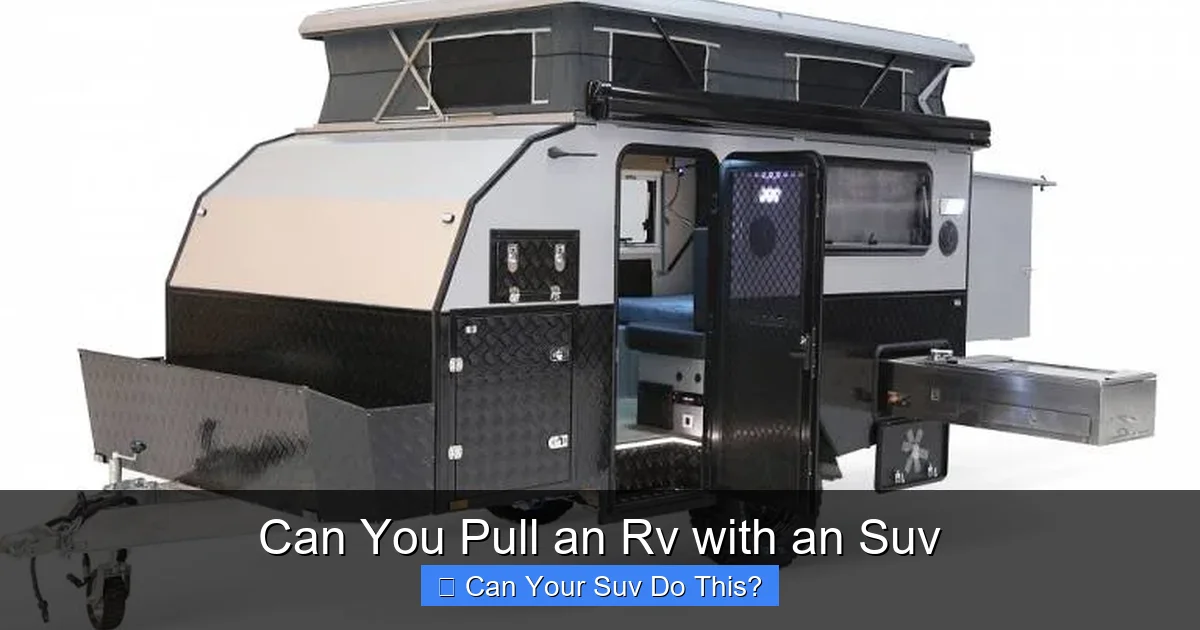
Yes, you can pull an RV with an SUV—but only if your vehicle has the right towing capacity, proper equipment, and you follow safety guidelines. Not all SUVs are created equal, so understanding your SUV’s limits and matching them to your RV’s weight is crucial for a safe and successful trip.
Key Takeaways
- Check your SUV’s towing capacity: This is the maximum weight your SUV can safely tow, found in the owner’s manual or manufacturer’s website.
- Know your RV’s weight: Always consider the fully loaded weight (including water, gear, and passengers), not just the dry weight.
- Use the right towing equipment: A weight-distributing hitch, brake controller, and proper wiring are essential for safe towing.
- Choose the right SUV: Larger SUVs like the Ford Expedition or Toyota Sequoia are better suited for towing RVs than compact models.
- Practice safe driving habits: Allow extra stopping distance, avoid sudden maneuvers, and check your setup before hitting the road.
- Consider a smaller RV: Travel trailers, pop-ups, and teardrop campers are often ideal for SUV towing.
- Get professional help if needed: Consult a mechanic or towing specialist if you’re unsure about your setup.
📑 Table of Contents
- Can You Pull an RV with an SUV? The Short Answer
- Understanding Towing Capacity: The Most Important Number
- Types of RVs You Can Tow with an SUV
- Essential Towing Equipment for SUVs
- Best SUVs for Towing an RV
- Safety Tips for Towing an RV with an SUV
- Common Mistakes to Avoid
- Conclusion: Yes, You Can—If You Do It Right
Can You Pull an RV with an SUV? The Short Answer
So, you’ve got an SUV and you’re dreaming of hitting the open road with an RV in tow. Maybe you’re planning a cross-country adventure, a weekend getaway to the mountains, or a summer trip to the lake. But before you hook up that camper, you’re probably wondering: *Can you pull an RV with an SUV?*
The short answer is: **Yes, you can—but it depends.** Not every SUV is built to tow a full-sized RV, and not every RV is light enough for your vehicle. Towing isn’t just about power; it’s about balance, safety, and preparation. If you get it right, your SUV can be the perfect companion for your RV adventures. But if you ignore the basics, you could end up with a dangerous situation on the highway.
In this guide, we’ll walk you through everything you need to know about pulling an RV with an SUV. We’ll cover towing capacity, the types of RVs that work best, the equipment you’ll need, and how to stay safe on the road. Whether you drive a compact crossover or a full-size SUV, this guide will help you make smart, informed decisions.
Understanding Towing Capacity: The Most Important Number
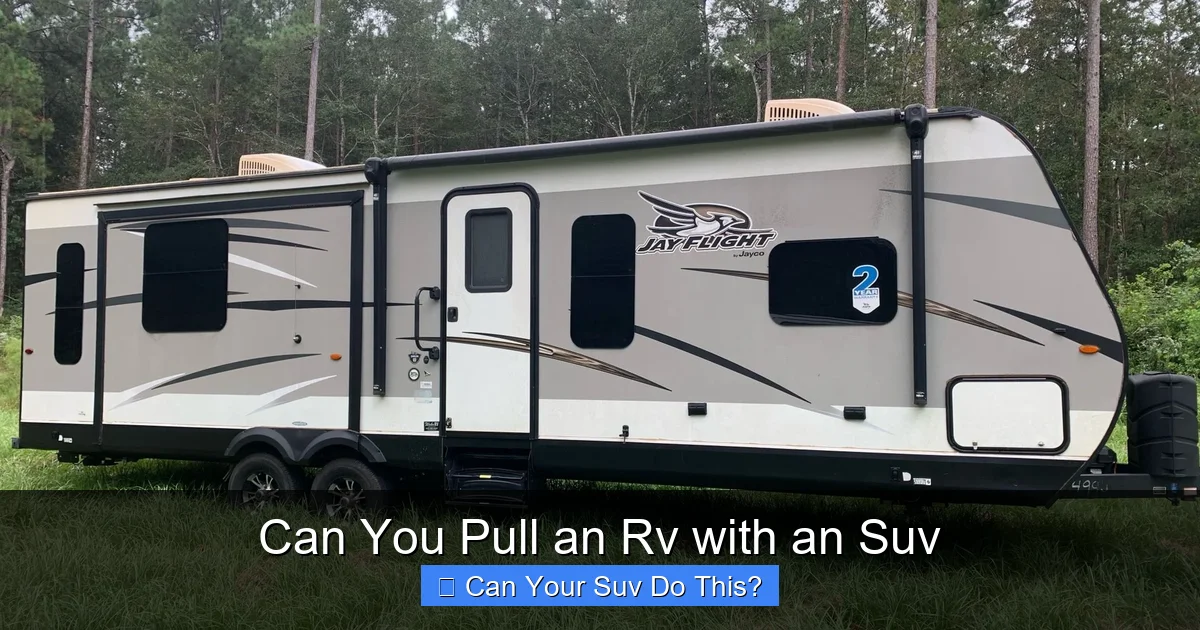
Visual guide about Can You Pull an Rv with an Suv
Image source: images.offerup.com
When it comes to towing an RV with an SUV, the most critical factor is **towing capacity**. This is the maximum weight your SUV can safely pull, as determined by the manufacturer. It’s not a suggestion—it’s a hard limit. Exceeding it can damage your vehicle, void your warranty, and put you and others at risk.
How to Find Your SUV’s Towing Capacity
Your SUV’s towing capacity isn’t always obvious. It’s not usually listed on the window sticker or in bold letters on the dealership floor. Instead, you’ll need to dig a little deeper. Here’s where to look:
– **Owner’s Manual:** This is the most reliable source. Look for a section titled “Towing” or “Trailer Towing.”
– **Manufacturer’s Website:** Most automakers have online tools where you can enter your vehicle’s year, make, model, and engine type to find its towing specs.
– **Door Jamb Sticker:** Some SUVs have a label on the driver’s side door jamb that includes towing information.
– **Dealer or Service Center:** If you’re still unsure, your local dealership can help.
Keep in mind that towing capacity can vary widely—even within the same SUV model. For example, a Ford Explorer with a V6 engine might tow up to 5,000 pounds, while a base model with a four-cylinder engine may only handle 2,500 pounds. Engine type, transmission, drivetrain (AWD vs. 4WD), and optional towing packages all play a role.
Why Towing Capacity Matters
Let’s say your SUV has a towing capacity of 6,000 pounds. That doesn’t mean you can tow any 6,000-pound trailer. You also need to consider:
– **Tongue Weight:** This is the downward force the trailer exerts on the hitch. It should be 10–15% of the trailer’s total weight.
– **Payload Capacity:** This is how much weight your SUV can carry, including passengers, cargo, and the tongue weight of the trailer.
– **GCWR (Gross Combined Weight Rating):** This is the maximum allowable weight of your fully loaded SUV plus the fully loaded trailer.
If your SUV weighs 5,000 pounds and your trailer weighs 6,000 pounds, your combined weight is 11,000 pounds. If your GCWR is 12,000 pounds, you’re within limits. But if it’s 10,500 pounds, you’re over—and that’s dangerous.
Types of RVs You Can Tow with an SUV
Not all RVs are created equal—and not all are suitable for SUV towing. The type of RV you choose will depend on your SUV’s capabilities and your camping style. Here are the most common types of RVs that work well with SUVs:
Travel Trailers
Travel trailers are the most popular type of towable RV. They come in all sizes, from compact 15-foot models to large 35-foot bunkhouses. For SUV towing, **smaller travel trailers** (under 6,000 pounds) are your best bet.
Examples include:
– **Airstream Bambi:** Around 4,000 pounds, stylish and well-built.
– **Jayco Jay Feather:** Lightweight and family-friendly, often under 5,000 pounds.
– **Winnebago Micro Minnie:** Compact and efficient, great for couples or small families.
These trailers typically sleep 2–6 people and include basic amenities like a kitchen, bathroom, and sleeping areas. They’re ideal for weekend trips or extended travel.
Pop-Up Campers
If you’re driving a smaller SUV with limited towing capacity, a pop-up camper might be your perfect match. These lightweight trailers fold down for easy towing and expand when you arrive at your campsite.
– **Weight:** Usually between 1,500 and 3,500 pounds.
– **Pros:** Affordable, fuel-efficient to tow, and easy to store.
– **Cons:** Less insulation and fewer amenities than hard-sided trailers.
Popular models include the Coleman Sundome and the Forest River Rockwood. Pop-ups are great for campers who want simplicity and flexibility.
Teardrop Trailers
Teardrop trailers are the smallest and lightest option—perfect for SUVs with lower towing limits. They’re named for their distinctive shape: a small, rounded cabin with a rear kitchen.
– **Weight:** Typically 1,000 to 2,500 pounds.
– **Pros:** Super easy to tow, fuel-efficient, and stylish.
– **Cons:** Limited space—usually just a bed and small kitchen.
Models like the Little Guy Mini Max or the Retro by Happier Camper are popular choices. They’re ideal for solo travelers or couples who don’t need a lot of space.
Fifth Wheels and Toy Haulers: Proceed with Caution
Fifth wheels and large toy haulers are generally **not suitable for most SUVs**. These heavy trailers require a pickup truck with a fifth-wheel hitch and strong towing capacity (often 10,000+ pounds). While some large SUVs like the Chevrolet Tahoe or Ford Expedition *might* handle a lightweight fifth wheel, it’s risky and not recommended unless you’re certain your vehicle can handle it.
Essential Towing Equipment for SUVs
Even if your SUV has the right towing capacity, you can’t just hook up a trailer and go. You need the right equipment to tow safely and legally. Here’s what you’ll need:
Weight-Distributing Hitch
A weight-distributing hitch (WDH) is a must for towing heavier trailers. It helps balance the load by distributing the tongue weight across all four tires of your SUV. Without it, your vehicle’s rear end can sag, making steering and braking difficult.
– **Best for:** Trailers over 3,500 pounds.
– **Tip:** Look for a hitch with built-in sway control for added stability.
Brake Controller
If your trailer has electric brakes (most do), you’ll need a brake controller inside your SUV. This device lets you activate the trailer’s brakes independently or in sync with your vehicle’s brakes.
– **Types:** Proportional (activates based on how hard you brake) and time-delayed (activates after a set delay).
– **Installation:** Most controllers plug into a wiring harness under the dashboard. Professional installation is recommended.
Wiring Harness and Lights
Your trailer’s brake lights, turn signals, and running lights must work in sync with your SUV. A 4-pin or 7-pin wiring harness connects your vehicle to the trailer.
– **4-pin:** Basic lights (brake, turn, tail).
– **7-pin:** Includes brake controller connection and auxiliary power.
Make sure the harness is compatible with your SUV and trailer. Test all lights before every trip.
Sway Control Devices
Trailer sway—when the trailer fishtails behind your SUV—is dangerous and can lead to loss of control. Sway control devices help prevent this by adding resistance to side-to-side movement.
– **Options:** Friction bars, dual-cam systems, or integrated WDH systems.
– **Tip:** Avoid sudden steering corrections if sway occurs. Gradually slow down and let the trailer settle.
Tow Mirrors
Standard side mirrors often don’t provide enough visibility when towing a wide trailer. Extended tow mirrors give you a better view of blind spots.
– **Types:** Clip-on, bolt-on, or replacement mirrors.
– **Tip:** Adjust mirrors before hitting the road—don’t wait until you’re driving.
Best SUVs for Towing an RV
Not all SUVs are equal when it comes to towing. If you’re shopping for a new SUV or wondering if your current one can handle an RV, here are some of the best options:
Full-Size SUVs
These heavy-duty vehicles are built for towing and can handle larger RVs with ease.
– **Ford Expedition:** Up to 9,300 pounds with the Max Trailer Tow Package.
– **Chevrolet Tahoe/Suburban:** Up to 8,400 pounds (Tahoe) and 8,300 pounds (Suburban).
– **Toyota Sequoia:** Up to 9,500 pounds with the right setup.
– **Nissan Armada:** Up to 8,500 pounds.
These SUVs have powerful V8 engines, robust frames, and available towing packages that include coolers, hitches, and brake controllers.
Mid-Size SUVs
Great for smaller trailers and pop-ups, mid-size SUVs offer a balance of power and fuel efficiency.
– **Jeep Grand Cherokee:** Up to 7,200 pounds (with the 5.7L V8 and tow package).
– **Toyota 4Runner:** Up to 5,000 pounds.
– **Ford Explorer:** Up to 5,600 pounds (with the Class III/IV tow package).
– **Hyundai Palisade:** Up to 5,000 pounds.
These are ideal for families who want to tow a travel trailer or pop-up without upgrading to a full-size SUV.
Compact and Crossover SUVs
These are best for very light trailers like teardrops or small pop-ups.
– **Subaru Outback:** Up to 3,500 pounds (with the optional towing package).
– **Honda CR-V:** Up to 1,500 pounds (not recommended for RVs).
– **Toyota RAV4:** Up to 3,500 pounds (with the tow package).
While these SUVs can technically tow small campers, they’re not ideal for frequent or long-distance RV trips. Use caution and stay well below the towing limit.
Safety Tips for Towing an RV with an SUV
Towing an RV isn’t just about power—it’s about safety. A loaded trailer changes how your SUV handles, brakes, and accelerates. Follow these tips to stay safe on the road:
Do a Pre-Trip Inspection
Before every trip, check:
– Tire pressure (SUV and trailer)
– Hitch and safety chains
– Brake controller settings
– Lights and signals
– Fluid levels (engine oil, coolant, transmission)
A quick 10-minute check can prevent major problems down the road.
Practice Driving and Parking
Towing a trailer takes practice. Find an empty parking lot and practice:
– Backing up (go slow and use small steering corrections)
– Turning (wider turns are needed)
– Braking (allow extra distance)
The more comfortable you are, the safer you’ll be.
Watch Your Speed
Drive slower than you normally would—especially on highways and downhill grades. Most experts recommend driving 5–10 mph below the speed limit when towing.
Use Lower Gears on Hills
When climbing or descending steep grades, shift into a lower gear (like “L” or “2”) to reduce strain on your engine and brakes. This is called “engine braking” and helps prevent overheating.
Distribute Weight Properly
Pack your trailer so that 60% of the weight is in the front half. This helps maintain proper tongue weight and prevents sway.
Never Exceed Your Limits
Even if your SUV *feels* like it can handle more, don’t push it. Overloading is one of the leading causes of towing accidents.
Common Mistakes to Avoid
Even experienced drivers make mistakes when towing. Here are some common pitfalls to watch out for:
– **Ignoring the Owner’s Manual:** Your SUV’s towing specs are there for a reason. Don’t guess.
– **Towing by Dry Weight Only:** Always use the fully loaded weight (also called “gross trailer weight” or GTW).
– **Skipping the Brake Controller:** If your trailer has brakes, you need a controller.
– **Using the Wrong Hitch:** A standard ball hitch isn’t enough for heavy trailers.
– **Forgetting to Check Tires:** Underinflated tires can overheat and blow out.
– **Driving Too Fast:** Speed increases sway and reduces control.
Conclusion: Yes, You Can—If You Do It Right
So, can you pull an RV with an SUV? Absolutely—but it’s not as simple as hitching up and hitting the road. Success comes down to knowing your SUV’s limits, choosing the right RV, using proper equipment, and driving safely.
Start by checking your towing capacity and comparing it to the weight of your fully loaded RV. If they match up, invest in a quality hitch, brake controller, and sway control. Practice your driving skills, and always do a pre-trip inspection.
With the right preparation, your SUV can be a reliable and capable towing machine. Whether you’re exploring national parks, visiting family, or just escaping the city, the freedom of the open road is within reach.
Just remember: **Towing is a responsibility, not a right.** Respect your vehicle’s limits, prioritize safety, and enjoy the journey.
Frequently Asked Questions
Can a small SUV like a Honda CR-V tow an RV?
Most small SUVs like the Honda CR-V have very low towing capacities—often under 2,000 pounds. While they can technically tow a tiny teardrop trailer, it’s not recommended for regular RV use. Stick to lightweight pop-ups or consider upgrading your vehicle.
Do I need a special license to tow an RV with an SUV?
In most U.S. states, you don’t need a special license to tow an RV with an SUV, as long as the combined weight is under 26,000 pounds. However, some states require a trailer endorsement for larger setups. Check your local DMV rules.
Can I tow a fifth wheel with an SUV?
Generally, no. Fifth wheels require a pickup truck with a fifth-wheel hitch mounted in the bed. Most SUVs don’t have the structure or towing capacity to handle them safely.
How do I know if my SUV has a tow package?
Look for features like a heavy-duty radiator, transmission cooler, upgraded suspension, and a factory-installed hitch. You can also check your owner’s manual or contact the dealership with your VIN.
What happens if I exceed my SUV’s towing capacity?
Exceeding towing capacity can cause engine overheating, transmission failure, brake problems, and loss of control. It may also void your warranty and increase your insurance risk.
Can I tow an RV in the rain or snow?
Yes, but extra caution is needed. Wet or icy roads reduce traction, making it harder to stop and control a trailer. Reduce speed, increase following distance, and avoid sudden maneuvers.