
The Toyota RAV4 does not use a traditional CVT transmission. Instead, most recent models feature a Direct Shift-CVT, which combines the smoothness of a CVT with the responsiveness of a conventional automatic. This advanced system enhances fuel efficiency, performance, and driving comfort across all RAV4 trims.
If you’re in the market for a compact SUV that blends practicality, efficiency, and reliability, the Toyota RAV4 is likely high on your list. It’s one of the best-selling vehicles in the U.S., praised for its rugged design, spacious interior, and strong resale value. But as you dig deeper into the specs, one question often pops up: *Does the Toyota RAV4 have a CVT transmission?* It’s a fair question—CVTs have become increasingly common in modern vehicles, especially in fuel-efficient models. But the answer isn’t as straightforward as a simple “yes” or “no.”
The truth is, the RAV4 doesn’t use a traditional continuously variable transmission (CVT) like some of its competitors. Instead, Toyota has implemented a more advanced system called the Direct Shift-CVT. This technology blends the best of both worlds: the fuel-saving benefits of a CVT with the responsiveness and familiarity of a conventional automatic transmission. Whether you’re navigating city streets, cruising on the highway, or tackling light off-road trails, understanding how this transmission works can help you make a smarter buying decision.
In this article, we’ll break down everything you need to know about the RAV4’s transmission system. We’ll explore what a CVT is, how Toyota’s Direct Shift-CVT differs, and why it matters for your driving experience. We’ll also compare it to other transmission types, look at real-world performance, and answer common questions about reliability and maintenance. By the end, you’ll have a clear picture of how the RAV4 delivers its smooth, efficient, and confident ride—no matter which model year or trim you’re considering.
Key Takeaways
- No Traditional CVT: The Toyota RAV4 does not use a conventional continuously variable transmission (CVT) in its current lineup.
- Direct Shift-CVT Technology: Most RAV4 models since 2019 use a Direct Shift-CVT, which includes a physical first gear for better launch performance.
- Improved Fuel Efficiency: The Direct Shift-CVT helps the RAV4 achieve excellent fuel economy, especially in hybrid versions.
- Smoother and Quieter Ride: This transmission delivers seamless acceleration and reduced engine noise compared to older automatics.
- Hybrid Models Use eCVT: RAV4 Hybrid variants use an electronically controlled CVT (eCVT), which operates differently from mechanical CVTs.
- Performance and Towing: The transmission supports strong towing capacity and responsive driving dynamics, especially in the TRD Off-Road and Adventure trims.
- Reliability and Maintenance: Toyota’s CVT-based systems are designed for long-term durability with minimal maintenance when properly cared for.
📑 Table of Contents
What Is a CVT Transmission?
Before we dive into the RAV4’s specific setup, let’s clarify what a CVT actually is. A continuously variable transmission, or CVT, is a type of automatic transmission that doesn’t use fixed gears like a traditional automatic. Instead, it uses a belt and pulley system to provide an infinite number of gear ratios. This allows the engine to operate at its most efficient RPM for any given speed, which can improve fuel economy and reduce emissions.
One of the main advantages of a CVT is smoothness. Because there are no gear shifts, acceleration feels seamless—no jerking or hesitation when the transmission “changes gears.” This can make for a more comfortable ride, especially in stop-and-go traffic. CVTs are also typically lighter and more compact than conventional automatics, which can contribute to better overall vehicle efficiency.
However, CVTs aren’t without their drawbacks. Some drivers dislike the “rubber band” feeling—where the engine revs high while the car accelerates slowly—because it can feel unnatural compared to traditional gear shifts. Early CVTs also had reliability concerns, though modern versions have improved significantly. Brands like Nissan, Honda, and Subaru have used CVTs extensively in their vehicles, but Toyota has taken a slightly different approach—especially with the RAV4.
Toyota’s Direct Shift-CVT: A Smarter Evolution
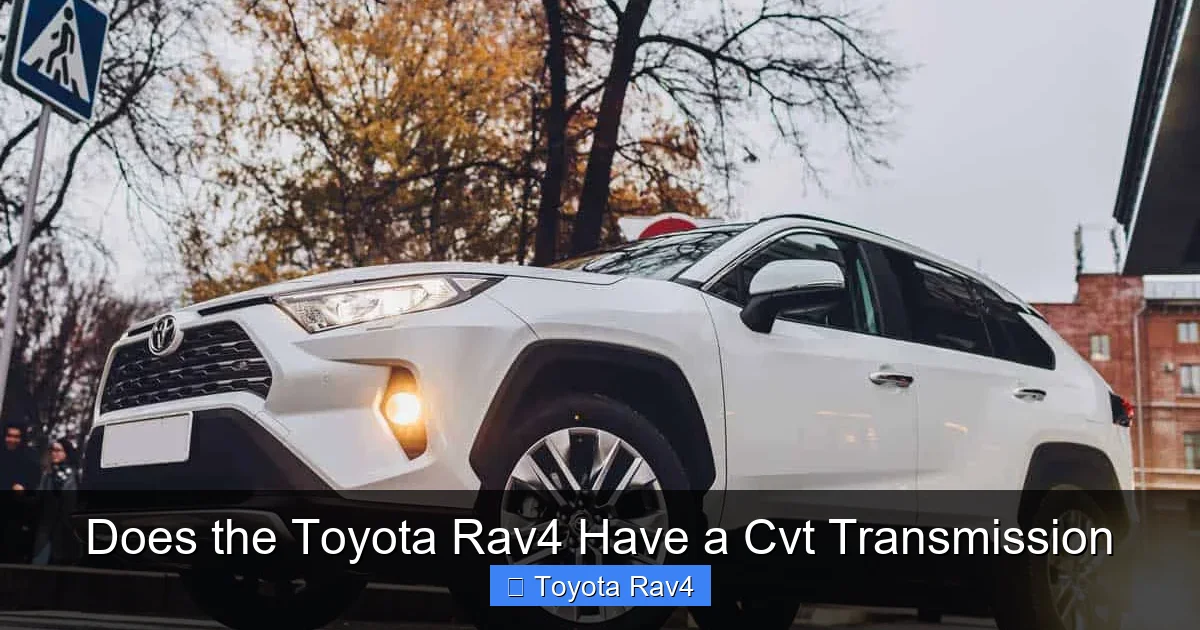
Visual guide about Does the Toyota Rav4 Have a Cvt Transmission
Image source: vehq.com
So, if the RAV4 doesn’t have a traditional CVT, what does it have? Since the 2019 model year, most gasoline-powered RAV4 models have been equipped with Toyota’s Direct Shift-CVT. This isn’t just a rebranded CVT—it’s a significant upgrade that addresses many of the common complaints about older CVT designs.
The key innovation in the Direct Shift-CVT is the addition of a physical first gear. In a traditional CVT, the belt and pulley system handles all gear ratios from the start, which can lead to sluggish acceleration from a standstill. But the Direct Shift-CVT uses a real, fixed first gear for initial launch, giving you that immediate torque and responsiveness you’d expect from a conventional automatic. Once you’re moving, the system seamlessly transitions to the CVT-style belt and pulley setup for smooth, efficient cruising.
This hybrid approach delivers the best of both worlds. You get the quick, confident takeoff that makes merging onto highways or climbing hills feel effortless, combined with the fuel-saving benefits of a CVT at higher speeds. Toyota claims this system improves both performance and efficiency, and real-world testing backs that up. Drivers report smoother acceleration, better throttle response, and improved fuel economy compared to older RAV4 models with traditional automatics.
How It Works in Practice
Let’s say you’re pulling out of a parking spot and need to accelerate quickly to merge into traffic. With the Direct Shift-CVT, the transmission uses that physical first gear to deliver strong initial power. You don’t feel the engine “hunting” for the right ratio—it just goes. Once you’re up to speed, the system shifts into CVT mode, keeping the engine in its sweet spot for optimal efficiency.
This is especially noticeable in city driving, where frequent stops and starts can expose the weaknesses of older CVTs. The Direct Shift-CVT handles these transitions smoothly, reducing the droning engine noise and lag that some drivers find annoying. On the highway, the system maintains a steady engine speed, which not only saves fuel but also reduces cabin noise for a more relaxed ride.
Benefits Over Traditional CVTs
The Direct Shift-CVT offers several clear advantages over conventional CVTs:
– **Better Launch Performance:** The physical first gear eliminates the sluggish feel often associated with CVTs.
– **Improved Fuel Economy:** By optimizing engine RPM across all driving conditions, the system maximizes efficiency.
– **Enhanced Driving Feel:** Drivers report a more connected, responsive experience that mimics a traditional automatic.
– **Reduced Wear and Tear:** The fixed gear reduces stress on the belt and pulley system, potentially improving long-term reliability.
Toyota has also integrated this transmission with its suite of driver-assist technologies, including adaptive cruise control and lane-keeping assist. The transmission works seamlessly with these systems, adjusting shift patterns to match driving conditions and driver behavior.
RAV4 Hybrid: The eCVT Difference
Now, here’s where things get interesting. While the gasoline-powered RAV4 uses the Direct Shift-CVT, the RAV4 Hybrid employs a different system altogether: an electronically controlled CVT, or eCVT.
Don’t let the name fool you—this isn’t the same as a mechanical CVT. The eCVT in the RAV4 Hybrid doesn’t use a belt and pulley system at all. Instead, it relies on a complex arrangement of electric motors, planetary gears, and power-split devices to manage power delivery between the engine, electric motors, and wheels.
In simple terms, the eCVT acts as a continuously variable transmission by blending power from the gasoline engine and electric motors. It can send power to the wheels through multiple paths, optimizing efficiency and performance in real time. For example, during light acceleration, the car might run entirely on electric power. At higher speeds or under heavy load, the engine kicks in, and the eCVT seamlessly blends the two power sources.
This system is incredibly efficient—so much so that the RAV4 Hybrid achieves up to 40 mpg in combined city and highway driving, making it one of the most fuel-efficient SUVs in its class. It’s also remarkably smooth and quiet, with virtually no shift shocks or engine noise.
Why Toyota Uses eCVT in Hybrids
Toyota has been using eCVT technology in its hybrids for decades, starting with the original Prius. It’s a proven, reliable system that excels in stop-and-go driving and maximizes fuel economy. In the RAV4 Hybrid, the eCVT works in tandem with Toyota’s Hybrid Synergy Drive, which intelligently manages when to use the engine, when to use the electric motors, and when to recharge the battery through regenerative braking.
The result is a driving experience that feels effortless and responsive. Whether you’re crawling through traffic or cruising on the freeway, the RAV4 Hybrid delivers smooth, quiet acceleration with minimal engine noise. And because there are no traditional gears to shift, you never feel any jerking or hesitation.
Performance and Towing with eCVT
You might think that a hybrid SUV with an eCVT would sacrifice performance, but the RAV4 Hybrid proves otherwise. With a combined output of up to 219 horsepower (depending on the model year), it accelerates confidently and handles highway merges with ease. The electric motors provide instant torque, giving the RAV4 Hybrid a peppy feel around town.
Even better, the RAV4 Hybrid can tow up to 1,500 pounds when properly equipped—enough for a small trailer, boat, or camper. The eCVT manages power delivery efficiently, ensuring the engine and motors work together to handle the extra load without straining.
Comparing Transmission Types in the RAV4 Lineup
To fully understand the RAV4’s transmission story, it helps to compare the different systems across the lineup. Here’s a quick breakdown:
– **Gasoline RAV4 (2019–Present):** Direct Shift-CVT with physical first gear.
– **RAV4 Hybrid (All Model Years):** eCVT (electronically controlled, no belt or pulley).
– **RAV4 Prime (Plug-in Hybrid):** Also uses an eCVT, but with a more powerful electric motor and larger battery for extended electric-only driving.
– **Older RAV4 Models (Pre-2019):** Some used a traditional 6-speed automatic, while others had an earlier version of the CVT without the Direct Shift feature.
This evolution shows Toyota’s commitment to improving efficiency and driving dynamics. The shift from older automatics to the Direct Shift-CVT and eCVT reflects broader industry trends toward smoother, more efficient transmissions.
Real-World Driving Experience
So, how does all this translate to your daily drive? Let’s look at a few scenarios:
– **City Driving:** The Direct Shift-CVT shines in stop-and-go traffic. The physical first gear gives you quick response when the light turns green, while the CVT mode keeps engine noise low during cruising. The RAV4 Hybrid is even smoother, with near-silent electric operation at low speeds.
– **Highway Cruising:** At steady speeds, both the Direct Shift-CVT and eCVT keep the engine in its most efficient range. You’ll notice better fuel economy and a quieter cabin compared to older RAV4 models.
– **Hills and Mountains:** The transmission adapts well to elevation changes. The Direct Shift-CVT holds lower ratios when climbing, while the eCVT uses electric assist to maintain power without overworking the engine.
– **Off-Roading:** The RAV4 TRD Off-Road and Adventure trims use the Direct Shift-CVT with enhanced traction control and multi-terrain select. The transmission works with these systems to deliver power smoothly over rough terrain.
Towing and Heavy Loads
If you plan to tow with your RAV4, the transmission plays a key role. The gasoline RAV4 can tow up to 3,500 pounds when properly equipped, thanks in part to the Direct Shift-CVT’s ability to manage power delivery under load. The system avoids “gear hunting” and maintains consistent engine speed, which reduces strain on the drivetrain.
The RAV4 Hybrid, while capable of towing 1,500 pounds, is better suited for lighter loads. Its eCVT is optimized for efficiency, not heavy-duty performance. For most drivers, this is more than enough—but if you need serious towing power, the gasoline model is the better choice.
Reliability and Maintenance of the RAV4 Transmission
One of the biggest concerns with CVTs—especially older models—has been reliability. Early CVTs were prone to overheating, belt slippage, and premature wear, leading to costly repairs. But Toyota has addressed many of these issues with the Direct Shift-CVT and eCVT.
Built for Durability
Toyota designs its transmissions to last. The Direct Shift-CVT uses high-strength materials and advanced cooling systems to prevent overheating. The physical first gear reduces stress on the belt and pulley system, which can extend the life of the transmission. Regular maintenance—like changing the transmission fluid at recommended intervals—can further enhance longevity.
The eCVT in the RAV4 Hybrid is even more robust. With fewer moving parts and no belt to wear out, it’s inherently more reliable. Toyota’s hybrid systems have a proven track record, with many Prius and Camry Hybrid owners reporting trouble-free operation well beyond 200,000 miles.
Maintenance Tips
To keep your RAV4’s transmission in top shape, follow these tips:
– **Follow the Maintenance Schedule:** Check your owner’s manual for recommended service intervals. Most RAV4 models require transmission fluid changes every 60,000 to 100,000 miles.
– **Use the Right Fluid:** Always use Toyota-approved transmission fluid. Using the wrong type can damage the system.
– **Avoid Overloading:** Don’t exceed the vehicle’s towing or payload capacity, as this can strain the transmission.
– **Warm Up in Cold Weather:** In freezing temperatures, let the engine idle for a minute before driving to allow the transmission fluid to circulate.
– **Listen for Warning Signs:** Unusual noises, slipping, or delayed engagement could indicate a problem. Address issues early to avoid costly repairs.
Warranty Coverage
Toyota backs its transmissions with a strong warranty. Most new RAV4 models come with a 6-year/70,000-mile powertrain warranty, which covers the transmission. Hybrid components, including the eCVT, are covered for 8 years/100,000 miles. This gives you peace of mind knowing that major repairs are covered during the critical early years of ownership.
Why the Transmission Choice Matters for Buyers
When shopping for a RAV4, the transmission might not be the first thing you think about—but it should be. It affects everything from fuel economy and performance to long-term reliability and driving enjoyment.
The Direct Shift-CVT and eCVT represent Toyota’s commitment to innovation and efficiency. They deliver a smoother, quieter, and more responsive driving experience than older automatics, while also improving fuel economy. Whether you choose the gasoline or hybrid model, you’re getting a transmission that’s designed to last and perform under real-world conditions.
For eco-conscious buyers, the RAV4 Hybrid’s eCVT offers the best of both worlds: excellent fuel economy and low emissions, without sacrificing performance. For those who need more towing power or prefer a traditional engine, the gasoline RAV4 with Direct Shift-CVT provides a balanced mix of efficiency and capability.
Resale Value and Long-Term Ownership
Toyota’s reputation for reliability extends to its transmissions. RAV4s with the Direct Shift-CVT and eCVT tend to hold their value well, thanks in part to their durability and low maintenance costs. When it’s time to sell or trade in, you’ll likely get a strong return on your investment.
Additionally, Toyota’s widespread service network means you’ll have no trouble finding qualified technicians to maintain or repair your transmission, no matter where you live.
Final Thoughts on the RAV4 Transmission
So, does the Toyota RAV4 have a CVT transmission? The short answer is no—not in the traditional sense. But it does use advanced CVT-based technology that’s smarter, smoother, and more reliable than ever before. Whether you’re driving a gasoline model with the Direct Shift-CVT or a hybrid with the eCVT, you’re getting a transmission that’s engineered for efficiency, performance, and long-term durability.
The RAV4 continues to set the standard for compact SUVs, and its transmission system is a big part of that success. It’s a testament to Toyota’s ability to innovate while staying true to its core values of quality and reliability.
Conclusion
The Toyota RAV4 doesn’t use a conventional CVT transmission, but it doesn’t need to. With the Direct Shift-CVT in gasoline models and the eCVT in hybrids, Toyota has created transmission systems that deliver the smoothness and efficiency of a CVT without the traditional drawbacks. These advanced technologies enhance fuel economy, improve driving dynamics, and support the RAV4’s reputation for reliability.
Whether you’re navigating city streets, cruising on the highway, or exploring off the beaten path, the RAV4’s transmission is designed to keep up with your lifestyle. It’s a key reason why the RAV4 remains one of the most popular and trusted SUVs on the road today.
If you’re considering a RAV4, rest assured that you’re getting a vehicle with a smart, efficient, and durable transmission system. And with Toyota’s strong warranty and service network, you can drive with confidence for years to come.
Frequently Asked Questions
Does the Toyota RAV4 have a CVT transmission?
No, the Toyota RAV4 does not use a traditional CVT. Most gasoline models feature a Direct Shift-CVT, which includes a physical first gear for better launch performance. Hybrid models use an eCVT, which operates differently from mechanical CVTs.
What is a Direct Shift-CVT?
The Direct Shift-CVT is Toyota’s advanced transmission system that combines a physical first gear with a CVT-style belt and pulley setup. This improves acceleration from a stop while maintaining smooth, efficient cruising at higher speeds.
How does the RAV4 Hybrid’s eCVT work?
The eCVT in the RAV4 Hybrid uses electric motors and planetary gears—not a belt and pulley—to blend power from the engine and electric motors. It provides seamless acceleration and excellent fuel economy without traditional gear shifts.
Is the RAV4’s transmission reliable?
Yes, Toyota’s Direct Shift-CVT and eCVT are designed for long-term durability. With proper maintenance, these systems can last well over 150,000 miles and are backed by strong powertrain warranties.
Can the RAV4 tow with its CVT-based transmission?
Yes, the gasoline RAV4 can tow up to 3,500 pounds, and the hybrid can tow up to 1,500 pounds. The transmission manages power delivery efficiently under load, though the gasoline model is better suited for heavier towing.
What maintenance does the RAV4 transmission need?
Regular transmission fluid changes every 60,000 to 100,000 miles are recommended. Use only Toyota-approved fluid and follow the maintenance schedule in your owner’s manual to ensure optimal performance and longevity.