
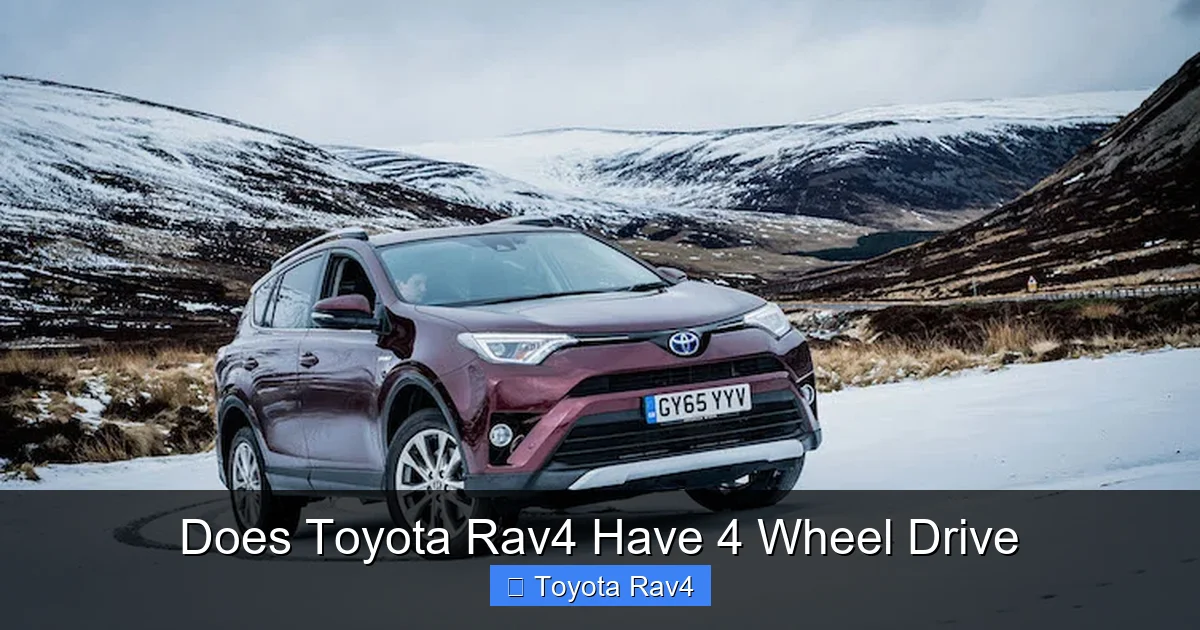
The Toyota RAV4 does offer 4-wheel drive—specifically, an advanced all-wheel drive (AWD) system, not traditional 4WD. This intelligent setup enhances grip, stability, and confidence in rain, snow, or light off-road conditions, making it ideal for drivers who want versatility without sacrificing fuel efficiency.
Key Takeaways
- RAV4 uses AWD, not 4WD: It features an electronically controlled all-wheel drive system that automatically sends power to the wheels with the most traction.
- Available on most trims: AWD is standard on certain models like the Adventure and TRD Off-Road, and optional on others like the LE, XLE, and Limited.
- Enhanced safety in bad weather: The AWD system improves handling and reduces slipping during rain, snow, or icy conditions.
- Improved off-road performance: With modes like Mud & Sand and Rock & Dirt, the RAV4 can handle light trails and rugged terrain.
- Hybrid models also have AWD: The RAV4 Hybrid comes with an electric rear motor for AWD, boosting efficiency and torque.
- Fuel economy remains strong: Despite AWD, the RAV4 maintains excellent gas mileage thanks to smart power distribution.
- No manual locking differentials: Unlike true 4WD trucks, the RAV4 is designed for on-road and light off-road use, not extreme rock crawling.
📑 Table of Contents
Does Toyota RAV4 Have 4 Wheel Drive?
If you’re shopping for a compact SUV and wondering, “Does the Toyota RAV4 have 4 wheel drive?”—you’re not alone. It’s one of the most common questions buyers ask, especially if they live in areas with snow, rain, or rough terrain. The short answer? Yes, but with a twist. The RAV4 doesn’t come with traditional 4-wheel drive (4WD) like a truck or Jeep Wrangler. Instead, it uses a sophisticated all-wheel drive (AWD) system that’s designed to give you better control, safety, and confidence on the road—without the complexity or fuel penalty of old-school 4WD.
So, what’s the difference? Think of 4WD as a mechanical system built for serious off-roading, often with low-range gearing and locking differentials. AWD, on the other hand, is smarter and more seamless—it automatically sends power to the wheels that need it most, whether you’re accelerating on a wet highway or climbing a gravel hill. The RAV4’s AWD system is engineered to be always on, always watching, and always ready. It’s not meant for rock crawling, but it’s perfect for everyday driving with a little extra peace of mind.
In this article, we’ll break down everything you need to know about the RAV4’s AWD system—how it works, which models offer it, how it compares to 4WD, and whether it’s worth the upgrade. Whether you’re a daily commuter, a weekend adventurer, or a parent driving kids to school in a snowstorm, this guide will help you decide if the RAV4’s AWD is right for you.
Understanding AWD vs. 4WD: What’s the Difference?

Visual guide about Does Toyota Rav4 Have 4 Wheel Drive
Image source: blog.toyotaofmorristown.com
Before we dive deeper into the RAV4’s capabilities, it’s important to understand the difference between all-wheel drive (AWD) and four-wheel drive (4WD). These terms are often used interchangeably, but they’re not the same—and knowing the distinction will help you make a smarter buying decision.
What Is 4WD?
Four-wheel drive, or 4WD, is a system typically found in trucks, SUVs, and off-road vehicles like the Toyota 4Runner or Ford Bronco. It’s built for serious terrain—mud, rocks, steep inclines, and deep snow. 4WD systems often include a transfer case that lets drivers manually switch between 2WD (for normal driving) and 4WD (for tough conditions). Many also offer a “low range” setting that increases torque for crawling over obstacles.
The downside? 4WD systems are heavier, less fuel-efficient, and usually require driver input to engage. They’re overkill for most city and highway driving.
What Is AWD?
All-wheel drive, or AWD, is more common in modern SUVs and crossovers—like the RAV4. It’s an automatic system that continuously monitors wheel slip and sends power to the wheels with the most grip. There’s no need to flip a switch or pull a lever. It works seamlessly in the background, whether you’re accelerating from a stoplight or driving through a downpour.
AWD is ideal for improving traction in everyday conditions—rain, light snow, gravel roads, or winding mountain passes. It’s not designed for extreme off-roading, but it’s perfect for drivers who want added safety and confidence without sacrificing comfort or fuel economy.
Why the RAV4 Uses AWD
Toyota chose AWD for the RAV4 because it aligns with the vehicle’s purpose: a versatile, fuel-efficient, family-friendly SUV that can handle a variety of road conditions. The RAV4 isn’t built to be a rock crawler—it’s built to be a reliable daily driver that can also handle weekend adventures.
With AWD, the RAV4 gets better grip without the added weight and complexity of a 4WD system. It’s also more efficient, which helps maintain the RAV4’s excellent fuel economy ratings. And because it’s always active, you don’t have to think about it—it just works.
Which RAV4 Models Come with AWD?
Now that you know the RAV4 uses AWD instead of 4WD, let’s talk about availability. Not every RAV4 comes with all-wheel drive standard, so it’s important to know which trims offer it and whether it’s worth the extra cost.
AWD Availability by Trim
Here’s a quick breakdown of which RAV4 trims come with AWD:
- LE: AWD is optional. You can choose front-wheel drive (FWD) to save money and boost fuel economy, or add AWD for better traction.
- XLE: AWD is optional. Most buyers opt for it, especially in colder climates.
- XLE Premium: AWD is optional. This trim adds comfort features like heated seats and a power liftgate, and AWD pairs well with them.
- Limited: AWD is optional. This top-tier trim includes luxury features, and many buyers choose AWD for the added confidence.
- Adventure: AWD is standard. This trim is designed for outdoor enthusiasts, with rugged styling and off-road-ready features.
- TRD Off-Road: AWD is standard. Built for light off-roading, this model includes enhanced suspension, all-terrain tires, and off-road drive modes.
- Hybrid: AWD is standard on all hybrid models. The RAV4 Hybrid uses a unique electric AWD system (called “E-Four”) that’s both powerful and efficient.
- Prime (Plug-in Hybrid): AWD is standard. The RAV4 Prime combines electric power with AWD for impressive performance and efficiency.
Is AWD Worth the Extra Cost?
Adding AWD to a RAV4 typically increases the price by $1,400 to $1,600, depending on the trim. Is it worth it? That depends on your driving needs.
If you live in a region with frequent rain, snow, or icy roads, AWD is a smart investment. It can help prevent skidding, improve acceleration, and give you more control in slippery conditions. For example, if you’re driving up a snowy driveway or navigating a wet highway during rush hour, AWD can make a noticeable difference.
On the other hand, if you live in a warm, dry climate and mostly drive on paved roads, front-wheel drive might be sufficient. You’ll save money upfront and get slightly better fuel economy.
But here’s a tip: even if you don’t think you need AWD, consider it if you plan to keep the vehicle long-term. Weather patterns are changing, and having AWD could be valuable in unexpected conditions. Plus, it can improve resale value—buyers often prefer AWD models.
How Does the RAV4’s AWD System Work?
The Toyota RAV4’s AWD system is one of the most advanced in its class. It’s not just a mechanical setup—it’s a smart, responsive system that adapts to driving conditions in real time. Let’s take a closer look at how it works.
Dynamic Torque Control AWD
Most non-hybrid RAV4 models use Toyota’s Dynamic Torque Control AWD system. Here’s how it operates:
Under normal driving conditions, the RAV4 runs primarily in front-wheel drive to save fuel. The system constantly monitors wheel speed, steering angle, and throttle input. If it detects slippage—like when you accelerate hard on a wet road or turn sharply on gravel—it automatically sends power to the rear wheels.
The transfer of power is smooth and nearly instantaneous. Up to 50% of the engine’s torque can be sent to the rear axle when needed. This helps maintain traction and stability without the driver feeling any jerking or hesitation.
Drive Modes for Different Conditions
The RAV4 also includes selectable drive modes that optimize the AWD system for specific conditions:
- Normal: Balanced performance for everyday driving.
- Eco: Prioritizes fuel efficiency by reducing engine output and AWD engagement.
- Sport: Increases throttle response and steering feel for a more dynamic drive.
- Mud & Sand: Adjusts throttle and AWD response for loose surfaces. Ideal for beach driving or muddy trails.
- Rock & Dirt: Enhances traction on uneven, rocky terrain. Best for light off-roading.
These modes don’t just change the engine’s behavior—they also influence how the AWD system distributes power. For example, in Mud & Sand mode, the system allows a bit more wheel slip to prevent digging in, while in Rock & Dirt mode, it locks torque distribution more aggressively to maintain grip.
RAV4 Hybrid: E-Four AWD
The RAV4 Hybrid takes AWD to the next level with its E-Four system. Instead of using a mechanical driveshaft to power the rear wheels, it uses a separate electric motor mounted on the rear axle.
This setup has several advantages:
- Instant torque: Electric motors deliver power immediately, improving acceleration and responsiveness.
- Better efficiency: The rear motor only activates when needed, reducing energy waste.
- Smoother operation: No mechanical connection means quieter, smoother power delivery.
- Enhanced control: The system can precisely control how much power goes to each rear wheel, improving cornering and stability.
The E-Four system is especially effective in low-traction situations. For example, if you’re starting from a stop on a snowy road, the rear motor can provide instant traction without waiting for the engine to respond.
Real-World Performance: How Does AWD Help?
So, how does all this technology translate to real-world driving? Let’s look at a few practical scenarios where the RAV4’s AWD system makes a difference.
Driving in Snow and Ice
If you live in a snowy area, AWD can be a game-changer. On a snowy morning, a front-wheel-drive RAV4 might struggle to get moving from a stop, especially if the snow is packed or icy. But with AWD, power is sent to all four wheels, reducing the chance of spinning out.
For example, imagine you’re pulling out of your driveway after a snowstorm. With FWD, one or both front wheels might slip, causing the vehicle to lurch or stall. With AWD, the system detects the slip and sends power to the rear wheels, helping you move forward smoothly.
That said, AWD doesn’t replace winter tires. Even with AWD, you should always use proper snow tires in severe winter conditions. AWD helps with acceleration and traction, but it doesn’t improve braking or cornering as much.
Rainy and Wet Roads
Rain is one of the most common causes of accidents, especially during sudden downpours. Water on the road can create a thin layer that reduces tire grip—a phenomenon known as hydroplaning.
The RAV4’s AWD system helps by maintaining better contact with the road. If one wheel starts to lose grip, power is redirected to the others. This is especially helpful when accelerating out of a turn or merging onto a highway in the rain.
Gravel and Dirt Roads
If you enjoy weekend camping trips or live in a rural area, you might frequently drive on gravel or dirt roads. These surfaces can be loose and unpredictable, especially after rain.
The RAV4’s AWD system, combined with its off-road drive modes, helps maintain control. In Rock & Dirt mode, the system adjusts throttle response and torque distribution to prevent wheel spin. You’ll feel more confident navigating ruts, potholes, or steep inclines.
Highway Driving and Merging
Even on dry highways, AWD can improve safety. When merging onto a busy freeway, you need quick acceleration. If one front wheel loses grip—say, due to oil or debris on the road—AWD ensures the other wheels can still pull you forward.
It also helps during sudden maneuvers, like swerving to avoid an obstacle. The system stabilizes the vehicle by sending power where it’s needed most.
Fuel Economy and AWD: Is There a Trade-Off?
One common concern about AWD is fuel economy. After all, powering four wheels instead of two requires more energy, right? In the past, AWD vehicles did suffer a noticeable drop in gas mileage. But modern systems like the one in the RAV4 are much more efficient.
Fuel Economy Comparison
Here’s how the RAV4’s fuel economy compares between FWD and AWD models (based on EPA estimates for the 2024 model year):
- FWD RAV4: 27 mpg city / 35 mpg highway
- AWD RAV4: 27 mpg city / 33 mpg highway
- RAV4 Hybrid AWD: 41 mpg city / 38 mpg highway
As you can see, the difference between FWD and AWD is minimal—just 2 mpg on the highway. That’s because the AWD system is designed to be as efficient as possible. It only sends power to the rear wheels when needed, and it disengages when not in use.
Hybrid Efficiency
The RAV4 Hybrid is even more impressive. Thanks to its electric motor and regenerative braking, it achieves excellent fuel economy—even with AWD standard. In fact, the hybrid model often gets better mileage than the gas-only FWD version.
This makes the RAV4 Hybrid a great choice if you want AWD, efficiency, and low emissions all in one package.
Is the RAV4’s AWD Right for You?
So, does the Toyota RAV4 have 4 wheel drive? Technically, no—but it does have a highly capable AWD system that delivers many of the same benefits. Whether it’s right for you depends on your lifestyle, driving habits, and environment.
Who Should Choose AWD?
Consider AWD if:
- You live in a region with frequent rain, snow, or ice.
- You drive on gravel, dirt, or uneven roads.
- You want added safety and confidence in bad weather.
- You enjoy outdoor activities like camping or hiking.
- You plan to keep the vehicle for many years.
Who Might Skip AWD?
You might be fine with FWD if:
- You live in a warm, dry climate with minimal weather challenges.
- You mostly drive in the city or on highways.
- You’re on a tight budget and want to save on upfront cost and fuel.
- You prioritize maximum fuel economy over traction.
Final Tip: Test Drive Both
The best way to decide is to test drive both FWD and AWD models. Pay attention to how they feel during acceleration, turning, and braking. If you notice a difference—and feel more confident with AWD—it’s probably worth the investment.
Conclusion
The Toyota RAV4 may not have traditional 4-wheel drive, but its advanced all-wheel drive system is more than capable of handling everyday challenges and light off-road adventures. Whether you’re driving through a snowstorm, navigating a rainy highway, or exploring a dirt trail, AWD gives you the traction and control you need.
With options across most trims, including standard AWD on the Adventure, TRD Off-Road, and all hybrid models, there’s a RAV4 AWD configuration for nearly every driver. And thanks to smart engineering, you don’t have to sacrifice fuel economy for peace of mind.
So, does the Toyota RAV4 have 4 wheel drive? Not exactly—but it has something better: a modern, intelligent AWD system that’s always ready when you need it. If you value safety, versatility, and confidence behind the wheel, the RAV4 with AWD is a smart, practical choice.
Frequently Asked Questions
Does the Toyota RAV4 have 4 wheel drive or all-wheel drive?
The Toyota RAV4 does not have traditional 4 wheel drive. Instead, it uses an advanced all-wheel drive (AWD) system that automatically sends power to the wheels with the most traction for better control and safety.
Is AWD standard on all RAV4 models?
No, AWD is not standard on all RAV4 trims. It’s optional on the LE, XLE, XLE Premium, and Limited trims, but standard on the Adventure, TRD Off-Road, and all hybrid models.
Can the RAV4 handle off-road driving with AWD?
Yes, the RAV4 with AWD can handle light off-road conditions like gravel roads, dirt trails, and muddy paths—especially in Adventure or TRD Off-Road trims with off-road drive modes.
Does AWD reduce fuel economy in the RAV4?
AWD has a minimal impact on fuel economy. The difference between FWD and AWD is only about 2 mpg on the highway, thanks to the system’s efficient design.
Is the RAV4 Hybrid AWD better than gas AWD?
The RAV4 Hybrid AWD offers better fuel economy and instant torque from its electric rear motor, making it more efficient and responsive than the gas-only AWD model.
Do I need AWD if I don’t live in a snowy area?
Not necessarily. If you live in a warm, dry climate and mostly drive on paved roads, front-wheel drive may be sufficient. But AWD can still add value in rainy conditions or for resale.