
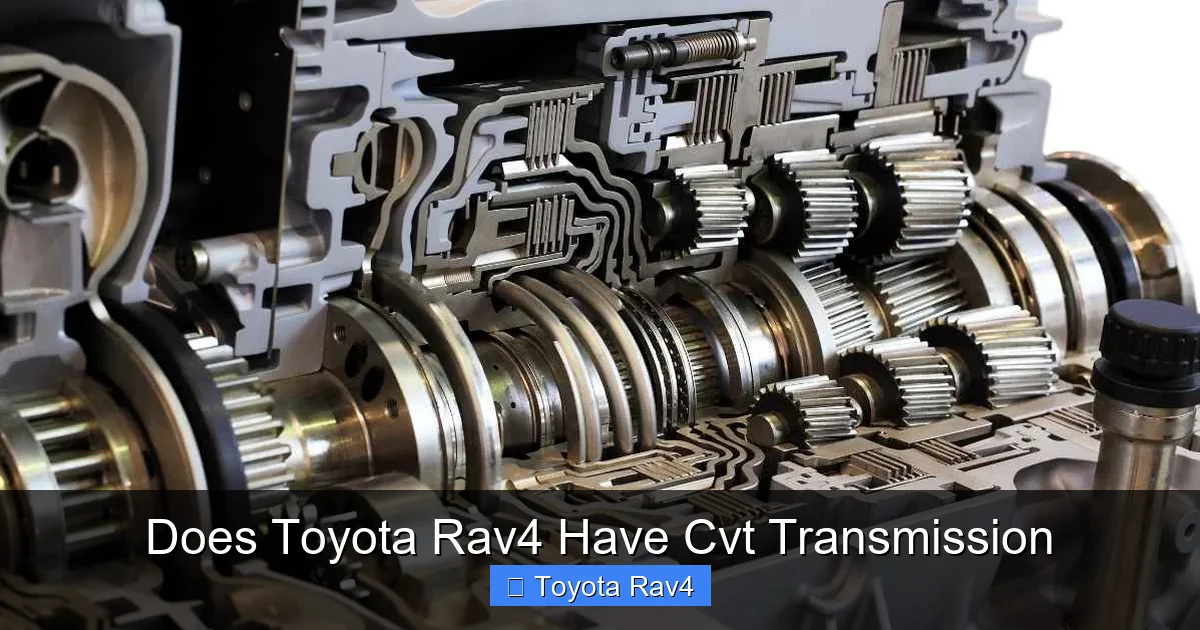
The Toyota RAV4 uses a CVT (Continuously Variable Transmission) in most of its models, especially the hybrid versions, to deliver smooth acceleration and improved fuel efficiency. Gas-only trims may use an 8-speed automatic, but the CVT remains a core part of Toyota’s strategy for optimizing performance and economy in the popular compact SUV.
If you’re in the market for a reliable, fuel-efficient compact SUV, chances are the Toyota RAV4 has already caught your eye. Known for its rugged design, impressive safety ratings, and strong resale value, the RAV4 has become one of the best-selling vehicles in the U.S. But if you’re digging deeper into the specs, one question keeps popping up: *Does the Toyota RAV4 have a CVT transmission?*
The short answer is yes—but with some important nuances. While many RAV4 models, especially the hybrid versions, come equipped with a Continuously Variable Transmission (CVT), not every trim uses this type of gearbox. Toyota has strategically implemented CVT technology across most of the RAV4 lineup to enhance fuel economy and deliver a smoother driving experience. However, certain gas-only models, particularly in earlier years, still use traditional automatic transmissions.
In this article, we’ll break down everything you need to know about the RAV4’s transmission options, how CVTs work, why Toyota chose this technology, and what it means for your daily drive. Whether you’re a first-time car buyer or a longtime Toyota fan, understanding the transmission can help you make a smarter, more informed decision.
So, let’s shift into gear and explore the ins and outs of the Toyota RAV4’s transmission system—no jargon, no fluff, just clear, practical info.
Key Takeaways
- Most RAV4 models use a CVT: The majority of Toyota RAV4 trims, especially hybrid versions, are equipped with a Continuously Variable Transmission for seamless power delivery.
- Gas-only models may use an 8-speed automatic: Some non-hybrid RAV4 trims, particularly in earlier model years, come with a traditional 6-speed or newer 8-speed automatic transmission instead of a CVT.
- CVT improves fuel efficiency: The CVT helps the RAV4 achieve better gas mileage by keeping the engine in its most efficient RPM range during acceleration and cruising.
- Smooth and quiet driving experience: Drivers often notice the absence of gear shifts with a CVT, resulting in a smoother, more comfortable ride.
- Designed for reliability and longevity: Toyota’s CVT technology is engineered for durability, with regular maintenance helping ensure long-term performance.
- Not all CVTs are the same: Toyota’s Direct Shift-CVT includes a physical first gear for better low-speed responsiveness, setting it apart from older CVT designs.
- Hybrid models rely heavily on CVT: The RAV4 Hybrid uses an electronically controlled CVT (e-CVT) that works in tandem with electric motors for optimal efficiency.
📑 Table of Contents
What Is a CVT Transmission?
Before we dive into whether the RAV4 uses a CVT, it helps to understand what a CVT actually is. Unlike traditional automatic transmissions that use a set number of gears (like 6-speed or 8-speed), a Continuously Variable Transmission doesn’t have fixed gear ratios at all. Instead, it uses a system of pulleys and a belt (or chain) to provide an infinite number of gear ratios. This allows the engine to operate at its most efficient RPM for any given speed.
Think of it like a bicycle with an infinite number of gear settings—smooth, seamless, and always adjusting to match your pace. In a car, this means the engine doesn’t “shift” in the traditional sense. There’s no jerking or pause when accelerating. Instead, the car just keeps pulling forward with a steady, linear feel.
One of the biggest advantages of a CVT is fuel efficiency. Because the transmission can keep the engine in its sweet spot—where it produces the most power with the least fuel—it helps improve gas mileage. This is especially useful in city driving, where frequent stops and starts can drain fuel in a traditional automatic.
But CVTs aren’t perfect. Some drivers complain about a “rubber band” feeling—where the engine revs high but the car doesn’t seem to accelerate quickly. Early CVTs also had reliability concerns, though modern versions, especially from brands like Toyota, have come a long way in addressing these issues.
How CVTs Work in Modern Vehicles
So how does a CVT actually function under the hood? It all comes down to two variable-width pulleys connected by a metal belt or chain. One pulley is connected to the engine (the drive pulley), and the other is connected to the wheels (the driven pulley). As the pulleys change their width, the effective diameter changes, altering the gear ratio.
When you press the accelerator, the transmission adjusts the pulleys to keep the engine at an optimal RPM. For example, during hard acceleration, the CVT might simulate a lower gear by keeping the engine转速 high while gradually increasing vehicle speed. During cruising, it shifts to a “higher” ratio to keep engine转速 low and save fuel.
Toyota has refined this technology over the years. Their latest CVTs, like the one used in the RAV4, include features such as a physical first gear—called a “launch gear”—to improve responsiveness from a stop. This helps eliminate the sluggish feel some drivers associate with older CVTs.
Toyota RAV4 Transmission Options by Model Year
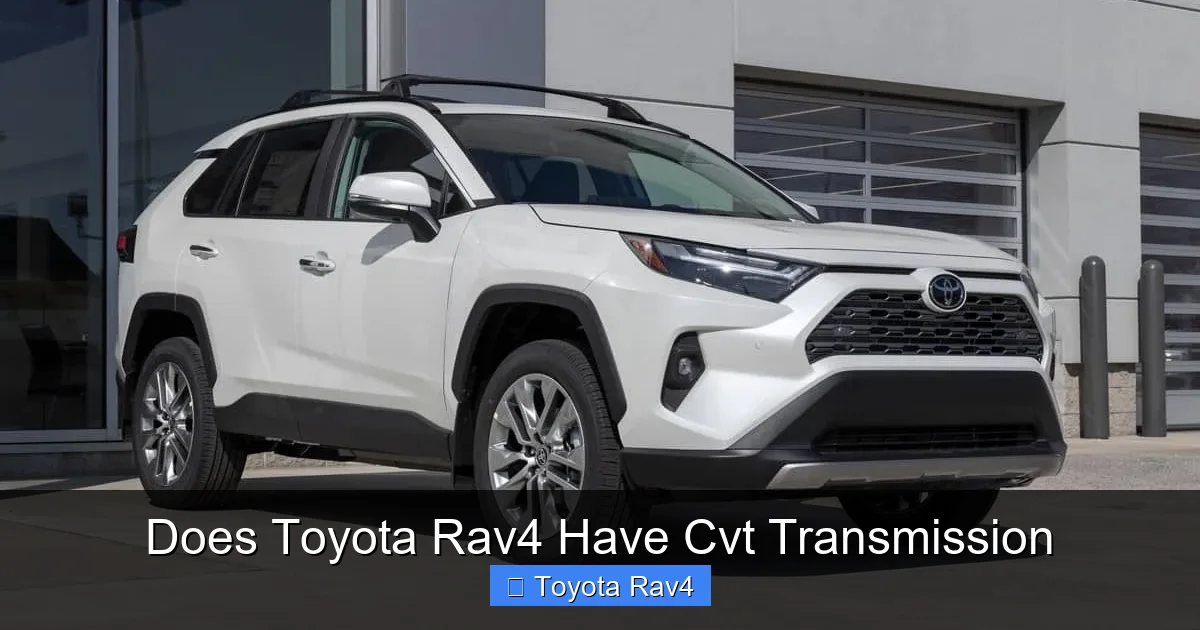
Visual guide about Does Toyota Rav4 Have Cvt Transmission
Image source: vehq.com
Now that we understand what a CVT is, let’s look at how Toyota has equipped the RAV4 over the years. The transmission setup varies depending on the model year, trim level, and whether it’s a gas-only or hybrid version.
From 2013 to 2018, most RAV4 models came with a traditional 6-speed automatic transmission. This was especially true for the gas-powered LE, XLE, and Limited trims. At the time, Toyota was still transitioning many of its vehicles to CVT technology, and the RAV4 was one of the last to make the switch.
However, starting with the 2019 model year, Toyota gave the RAV4 a complete redesign—and with it came a major transmission update. The 2019 RAV4 and newer models now feature a CVT across most trims, particularly the hybrid versions. The gas-only models (like the LE, XLE, and Adventure) also use a CVT, but with a twist: Toyota calls it the “Direct Shift-CVT,” which includes a physical first gear for better low-speed performance.
RAV4 Hybrid: e-CVT Technology
The RAV4 Hybrid is where Toyota’s CVT technology really shines. Instead of a traditional belt-and-pulley CVT, the hybrid uses an electronically controlled CVT, often referred to as an e-CVT. This system doesn’t use a physical belt at all. Instead, it relies on a planetary gearset and electric motors to manage power delivery between the engine, battery, and wheels.
In the RAV4 Hybrid, the e-CVT works in harmony with Toyota’s Hybrid Synergy Drive system. The electric motors handle low-speed driving and assist the gasoline engine during acceleration, while the CVT ensures smooth transitions between power sources. This setup not only improves fuel economy—up to 40 mpg combined—but also delivers a quiet, refined driving experience.
Because there are no traditional gears, the RAV4 Hybrid feels incredibly smooth, especially in stop-and-go traffic. You’ll notice the engine revving up during acceleration, but the car accelerates seamlessly without any jerking or hesitation.
Gas-Only RAV4: Direct Shift-CVT
For non-hybrid RAV4 models, Toyota introduced the Direct Shift-CVT in 2019. This is a newer generation of CVT that includes a physical first gear—essentially a traditional gear for launching from a stop—before switching to the variable pulley system for higher speeds.
Why does this matter? Older CVTs sometimes felt sluggish when pulling away from a stoplight because they relied entirely on the belt-and-pulley system. The Direct Shift-CVT solves this by using a real gear for initial acceleration, giving drivers a more responsive feel. Once the car reaches about 25–30 mph, it transitions to the CVT mode for smooth, efficient cruising.
This innovation shows how Toyota is working to improve the CVT experience. Drivers get the best of both worlds: the responsiveness of a traditional automatic at low speeds and the efficiency of a CVT at highway speeds.
Benefits of a CVT in the Toyota RAV4
So why did Toyota choose a CVT for the RAV4? The answer comes down to three key benefits: fuel efficiency, smooth driving, and reliability.
First and foremost, the CVT helps the RAV4 achieve excellent fuel economy. The 2023 RAV4 Hybrid, for example, gets up to 41 mpg in the city and 38 mpg on the highway—numbers that would be hard to reach with a traditional automatic. Even the gas-only RAV4 with the Direct Shift-CVT gets around 27 mpg city and 35 mpg highway, which is impressive for a compact SUV.
Second, the CVT delivers a noticeably smoother ride. Without gear shifts, there’s no jerking or hesitation when accelerating. This makes the RAV4 feel more refined, especially in city driving where frequent stops and starts are common. Passengers often comment on how quiet and comfortable the ride is—partly thanks to the seamless transmission.
Third, Toyota’s CVTs are built to last. While early CVTs had a reputation for being fragile, modern versions are designed for long-term durability. With proper maintenance—like regular transmission fluid changes—many RAV4 owners report trouble-free operation well beyond 150,000 miles.
Real-World Driving Experience
Let’s put this into perspective. Imagine you’re driving your RAV4 through downtown traffic. You stop at a red light, then accelerate when it turns green. With a traditional automatic, you might feel a slight “jerk” as the transmission shifts from first to second gear. But with the RAV4’s CVT, the acceleration is smooth and linear—no jerking, no pause.
Now picture cruising on the highway. The engine stays at a steady, low RPM, which not only saves fuel but also reduces noise inside the cabin. You’ll notice how quiet the RAV4 is at 70 mph—again, thanks in part to the CVT.
Even during uphill climbs, the CVT adjusts seamlessly to maintain power without straining the engine. This makes the RAV4 feel confident and capable, whether you’re navigating city streets or mountain roads.
Common Concerns About CVTs—And Why Toyota’s Version Is Different
Despite their benefits, CVTs have faced criticism over the years. Some drivers dislike the “rubber band” effect—where the engine revs high but the car doesn’t seem to accelerate quickly. Others worry about reliability, especially with older models from other brands.
But Toyota has addressed many of these concerns with its advanced CVT technology. The Direct Shift-CVT in the RAV4, for example, eliminates the sluggish launch feel by using a physical first gear. This gives drivers the immediate response they expect from a traditional automatic.
Toyota also uses high-strength materials and advanced software to monitor and protect the transmission. The system constantly adjusts pulley ratios and belt tension to prevent overheating or wear. Plus, the RAV4 comes with a comprehensive warranty that covers the transmission for several years.
Maintenance Tips for RAV4 CVT Owners
To keep your RAV4’s CVT running smoothly, follow these simple maintenance tips:
– **Change the transmission fluid regularly.** Toyota recommends replacing the CVT fluid every 60,000 to 100,000 miles, depending on driving conditions. Check your owner’s manual for specifics.
– **Avoid excessive towing.** While the RAV4 can tow up to 3,500 pounds (on certain trims), heavy towing can strain the CVT. Use a weight-distributing hitch and avoid overloading.
– **Warm up the engine in cold weather.** In freezing temperatures, let the engine idle for a minute or two before driving. This allows the transmission fluid to circulate and warm up.
– **Use only Toyota-approved fluid.** Using the wrong type of transmission fluid can damage the CVT. Stick with Genuine Toyota CVT Fluid FE or the recommended alternative.
By following these tips, you can help ensure your RAV4’s CVT lasts for hundreds of thousands of miles.
Comparing RAV4 CVT to Competitors
How does the RAV4’s CVT stack up against similar SUVs? Let’s compare it to a few key competitors.
The Honda CR-V, for example, also uses a CVT across its lineup. Both vehicles offer smooth acceleration and good fuel economy, but the RAV4’s Direct Shift-CVT gives it a slight edge in low-speed responsiveness. The CR-V’s CVT can feel a bit more “rubbery” during hard acceleration.
The Subaru Forester also uses a CVT, but Subaru’s version has faced more reliability complaints in the past. Toyota’s reputation for durability gives the RAV4 an advantage in long-term ownership.
Meanwhile, the Ford Escape offers both a traditional 8-speed automatic and a CVT (on hybrid models). The automatic provides a more traditional driving feel, but the CVT delivers better fuel economy. The RAV4 strikes a good balance between the two.
Why Choose the RAV4’s CVT?
Ultimately, the RAV4’s CVT offers a compelling mix of efficiency, smoothness, and reliability. Whether you’re commuting to work, taking a road trip, or driving through rough weather, the transmission helps the RAV4 perform at its best.
And with Toyota’s strong track record for quality, you can feel confident that your RAV4’s CVT will stand the test of time.
Conclusion: Yes, the Toyota RAV4 Has a CVT—And It’s a Good Thing
So, does the Toyota RAV4 have a CVT transmission? The answer is a resounding yes—for most models, especially the hybrid versions and newer gas trims. Toyota has embraced CVT technology to deliver better fuel economy, a smoother ride, and improved overall performance.
While early CVTs had their flaws, Toyota’s modern designs—like the Direct Shift-CVT and e-CVT—address many of the common concerns. The result is a transmission that feels responsive, lasts long, and helps the RAV4 remain one of the top choices in the compact SUV segment.
Whether you’re drawn to the RAV4 for its reliability, efficiency, or all-around versatility, the CVT plays a key role in making it such a great vehicle. So the next time someone asks, “Does the Toyota RAV4 have a CVT?” you can confidently say yes—and explain why it’s a feature, not a flaw.
Frequently Asked Questions
Does every Toyota RAV4 have a CVT transmission?
No, not every RAV4 has a CVT. Most models from 2019 onward, especially hybrids, use a CVT. However, earlier gas-only models (2013–2018) typically came with a 6-speed automatic transmission.
What is the difference between a CVT and an e-CVT in the RAV4?
A traditional CVT uses pulleys and a belt to vary gear ratios, while an e-CVT in the RAV4 Hybrid uses electric motors and a planetary gearset. The e-CVT doesn’t have a physical belt and is designed specifically for hybrid powertrains.
Is the RAV4’s CVT reliable?
Yes, Toyota’s CVTs are known for their reliability when properly maintained. Regular fluid changes and avoiding excessive towing can help ensure long-term performance.
Can you drive a RAV4 with a CVT aggressively?
Yes, but it’s best to avoid constant hard acceleration. The Direct Shift-CVT in newer RAV4 models handles spirited driving well, but gentle acceleration helps prolong transmission life.
Does the RAV4 CVT make noise during acceleration?
Some drivers notice the engine revving higher during acceleration, which is normal for a CVT. This doesn’t indicate a problem—it’s just how the transmission keeps the engine in its optimal power range.
Can you tow with a RAV4 that has a CVT?
Yes, certain RAV4 trims can tow up to 3,500 pounds. However, towing puts extra strain on the CVT, so it’s important to use proper equipment and avoid overloading.