

This guide walks entrepreneurs through the process of buying an SUV with a 7a business loan, from understanding eligibility to finalizing the purchase. You’ll learn how to use SBA financing wisely, avoid common pitfalls, and choose the right vehicle for your business needs.
Key Takeaways
- Understand SBA 7(a) Loan Basics: These loans are designed for small businesses and can be used to purchase vehicles like SUVs if they serve a legitimate business purpose.
- Ensure Business Use Justification: The SUV must be used primarily for business—such as client transport, equipment hauling, or mobile services—to qualify.
- Prepare Strong Documentation: Lenders require detailed financials, a solid business plan, and proof of income to approve your loan.
- Shop Smart for the Right SUV: Choose a reliable, fuel-efficient model that meets your business needs without overspending.
- Work with an SBA-Approved Lender: Not all banks offer 7(a) loans; find one experienced in SBA financing for smoother processing.
- Factor in Total Ownership Costs: Beyond the loan payment, consider insurance, maintenance, fuel, and depreciation.
- Maintain Accurate Records: Keep logs of business use to support tax deductions and compliance.
Introduction: Can You Really Buy an SUV with a 7a Business Loan?
If you’re a small business owner looking to upgrade your fleet or add a versatile vehicle to your operations, you might be wondering: *Can I buy an SUV with a 7a business loan?* The short answer is yes—but with important conditions. The U.S. Small Business Administration’s (SBA) 7(a) loan program is one of the most popular financing tools for entrepreneurs, offering low interest rates, long repayment terms, and flexible use of funds. While these loans are typically used for working capital, equipment, or real estate, they can also cover the purchase of vehicles—including SUVs—as long as the vehicle serves a clear business purpose.
In this comprehensive guide, we’ll walk you through every step of the process, from determining eligibility to driving off in your new SUV. You’ll learn how to justify the purchase to lenders, choose the right vehicle, navigate the application process, and manage ongoing costs. Whether you run a delivery service, a mobile repair business, or need a rugged vehicle for client meetings in tough terrain, this guide will help you make a smart, compliant, and financially sound decision.
By the end, you’ll have a clear roadmap to secure SBA financing for your SUV purchase—without running afoul of loan terms or tax rules. Let’s get started.
Step 1: Understand What a 7(a) Business Loan Is

Visual guide about How to Buy an Suv with a 7a Business Loan
Image source: sbaloans.blog
Before applying, it’s essential to understand how the SBA 7(a) loan works. This loan program is not directly funded by the SBA. Instead, the SBA guarantees up to 85% of loans under $150,000 and 75% for loans over $150,000, reducing the risk for lenders. This guarantee encourages banks and credit unions to lend to small businesses that might not qualify for traditional financing.
The 7(a) loan can be used for a wide range of business purposes, including:
– Purchasing equipment
– Buying real estate
– Refinancing debt
– Acquiring another business
– Covering working capital
– And yes—buying vehicles, including SUVs
However, the key requirement is that the vehicle must be used primarily for business. Personal use is allowed, but it should be minimal. The SBA and lenders want to see that the SUV supports your business operations, not just your weekend adventures.
Loan Terms and Limits
7(a) loans offer some of the most favorable terms in small business lending:
– Loan amounts up to $5 million
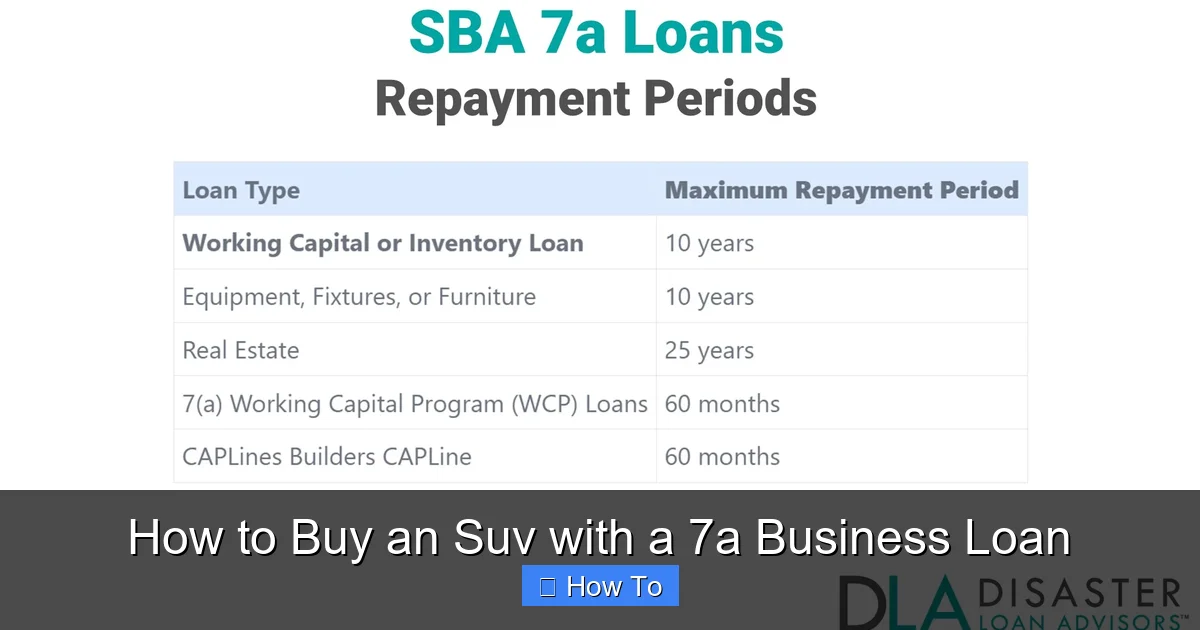
– Repayment terms up to 10 years for equipment and vehicles (25 years for real estate)
– Interest rates typically between 6% and 9%, depending on the lender and market conditions
– No prepayment penalties
These terms make the 7(a) loan an attractive option for financing a vehicle purchase, especially compared to high-interest auto loans or leasing.
Common Misconceptions
Many entrepreneurs assume that SBA loans are only for large purchases like buildings or machinery. While those are common uses, the program is flexible. As long as you can demonstrate that the SUV is necessary for your business, it’s a valid use of funds. Just remember: the SBA isn’t funding your personal lifestyle—it’s supporting your business growth.
Step 2: Determine If Your SUV Purchase Qualifies
Visual guide about How to Buy an Suv with a 7a Business Loan
Image source: disasterloanadvisors.com
Not every SUV purchase will qualify for a 7(a) loan. The SBA has strict rules about how loan funds can be used. To qualify, your SUV must meet two main criteria:
1. It must be used primarily for business purposes (typically 51% or more).
2. It must be necessary and reasonable for your business operations.
Let’s break this down.
Business Use Examples
Here are some legitimate business uses for an SUV:
– Transporting clients or employees to job sites
– Hauling tools, equipment, or inventory
– Supporting a mobile service (e.g., landscaping, plumbing, cleaning)
– Delivering goods in areas with poor road conditions
– Serving as a mobile office or command center
For example, a construction contractor might use an SUV to transport workers and tools to remote job sites. A real estate agent might use one to show properties in rural areas. A mobile pet groomer could use it to carry equipment and travel between appointments.
What Doesn’t Qualify
The following scenarios are unlikely to be approved:
– Buying an SUV primarily for personal use (e.g., family road trips, daily commuting)
– Purchasing a luxury SUV with no clear business need
– Using the loan to buy a vehicle for an employee who doesn’t directly contribute to revenue
If your business is a consulting firm and you want a luxury SUV to “look professional,” that’s a red flag. Lenders will question the necessity. But if you’re a disaster relief coordinator who needs a rugged SUV to reach flooded areas, that’s a strong justification.
Document Your Business Need
Start gathering evidence now. Keep records of:
– Current vehicle limitations (e.g., “Our van can’t handle off-road terrain”)
– Client feedback (e.g., “Clients expect a professional vehicle for site visits”)
– Operational challenges (e.g., “We lose time because we can’t transport equipment efficiently”)
This documentation will strengthen your loan application and help you stay compliant after approval.
Step 3: Check Your Eligibility and Prepare Your Application
Once you’ve confirmed your SUV purchase qualifies, it’s time to assess your eligibility and prepare your loan application. The SBA has general guidelines, but individual lenders may have additional requirements.
SBA Eligibility Requirements
To qualify for a 7(a) loan, your business must:
– Be for-profit
– Operate in the U.S. or its territories
– Have invested equity (you can’t borrow 100% of startup costs)
– Be unable to secure financing elsewhere (the “credit elsewhere” test)
– Meet size standards (typically under 500 employees, though it varies by industry)
You’ll also need to demonstrate repayment ability. Lenders will review your cash flow, credit history, and business financials.
Personal and Business Credit
Your personal credit score matters—especially if your business is new. Most lenders look for a FICO score of 680 or higher. If your score is lower, you may still qualify with strong business financials or a co-signer.
Business credit is also important. If your company has been operating for a few years, lenders will review your business credit report and payment history.
Gather Required Documents
Start collecting these key documents early:
– Personal and business tax returns (2–3 years)
– Personal and business bank statements (6–12 months)
– Profit and loss statements
– Balance sheets
– Business license and articles of incorporation
– Resume (to show management experience)
– Business plan (including how the SUV will support growth)
– Vehicle quote or invoice (from a dealer)
Having these ready will speed up the process and show lenders you’re serious and organized.
Choose the Right Lender
Not all banks offer SBA loans. Look for lenders with SBA Preferred Lender Program (PLP) status—they have delegated authority to approve loans faster. You can find a list of SBA-approved lenders on the SBA website.
Consider working with a lender who has experience financing vehicle purchases. They’ll understand the nuances and help you structure the loan properly.
Step 4: Get Pre-Approved and Shop for Your SUV
Once your application is in progress, get pre-approved for a loan amount. This gives you a clear budget and strengthens your position when negotiating with dealers.
Determine Your Budget
Use the pre-approval amount as a guide, but don’t max it out. Remember, you’ll also need to cover:
– Down payment (typically 10–20%)
– Sales tax
– Registration and title fees
– Insurance
– Maintenance and fuel
A good rule of thumb: keep your total monthly vehicle expenses (loan, insurance, fuel, maintenance) under 15% of your business’s monthly gross income.
Choose the Right SUV for Your Business
Not all SUVs are created equal. Consider these factors:
– **Reliability:** Look for models with strong safety ratings and low repair costs (e.g., Toyota Highlander, Honda Pilot, Ford Explorer).
– **Fuel Efficiency:** Diesel or hybrid options can save money long-term.
– **Cargo Space:** Ensure it can handle your equipment or inventory.
– **Off-Road Capability:** If you work in rural or rugged areas, consider all-wheel drive or 4WD.
– **Technology:** Features like GPS, Bluetooth, and rear cameras improve efficiency and safety.
Avoid overspending on luxury features unless they directly benefit your business (e.g., built-in Wi-Fi for a mobile office).
Negotiate the Purchase
With pre-approval in hand, you’re in a strong position to negotiate. Use your business status to your advantage:
– Ask for fleet or commercial pricing
– Request free maintenance packages
– Negotiate trade-in value if applicable
Get a written quote that includes all fees, and make sure the dealer understands the vehicle is for business use.
Step 5: Finalize the Loan and Complete the Purchase
Once you’ve selected your SUV and negotiated the price, it’s time to finalize the loan.
Submit Final Documentation
Your lender will require:
– Signed purchase agreement
– Vehicle title and registration info
– Proof of insurance
– Final loan application
The lender may also require a site visit or appraisal, especially for higher-value vehicles.
Close the Loan
At closing, you’ll sign the loan agreement and receive the funds. The lender will typically pay the dealer directly. Make sure the title is issued in your business’s name—not your personal name—to maintain liability protection and tax compliance.
Register and Insure the Vehicle
Register the SUV with your state’s DMV under your business name. Obtain commercial auto insurance, which may cost more than personal insurance but offers better coverage for business use.
Keep all receipts and documentation for your records.
Step 6: Manage Ongoing Costs and Compliance
Buying the SUV is just the beginning. To protect your investment and stay compliant, manage ongoing costs and usage carefully.
Track Business Use
Maintain a mileage log to document business vs. personal use. Use apps like MileIQ or QuickBooks Self-Employed to automate tracking. This is crucial for:
– Tax deductions
– Loan compliance
– Audits
The IRS allows you to deduct the business portion of vehicle expenses. If you use the SUV 70% for business, you can deduct 70% of loan interest, insurance, fuel, and maintenance.
Budget for Maintenance and Repairs
Set aside 1–2% of the vehicle’s value annually for maintenance. Regular oil changes, tire rotations, and inspections prevent costly breakdowns.
Review Loan Performance
Make payments on time to build business credit. If cash flow is tight, contact your lender early—many offer hardship programs.
Troubleshooting Common Issues
Even with careful planning, challenges can arise. Here’s how to handle them.
Loan Denial
If your application is denied, ask for specific reasons. Common issues include:
– Insufficient cash flow
– Low credit score
– Weak business plan
Address the issues and reapply. Consider a smaller loan amount or a co-signer.
High Interest Rates
If rates are higher than expected, shop around. Compare offers from multiple SBA lenders. Improve your credit score before reapplying.
Disputes Over Business Use
If the SBA or lender questions your SUV’s business use, provide documentation: mileage logs, client invoices, photos of equipment in the vehicle. Be proactive—don’t wait for an audit.
Depreciation and Resale
SUVs lose value quickly. If you plan to sell later, choose a model with strong resale value. Keep the vehicle in good condition and document all maintenance.
Conclusion: Drive Your Business Forward
Buying an SUV with a 7a business loan is a smart move when done right. It gives you access to affordable financing, supports your operations, and can even offer tax benefits. But success depends on careful planning, strong documentation, and smart financial management.
Remember: the SBA isn’t just funding a vehicle—it’s investing in your business’s growth. By choosing a vehicle that truly serves your operations, maintaining accurate records, and managing costs wisely, you’ll not only qualify for the loan but also build a stronger, more resilient business.
Take the time to prepare, work with the right lender, and drive with confidence. Your new SUV isn’t just a mode of transport—it’s a tool for success.